
#On Their Offence Against Comfort
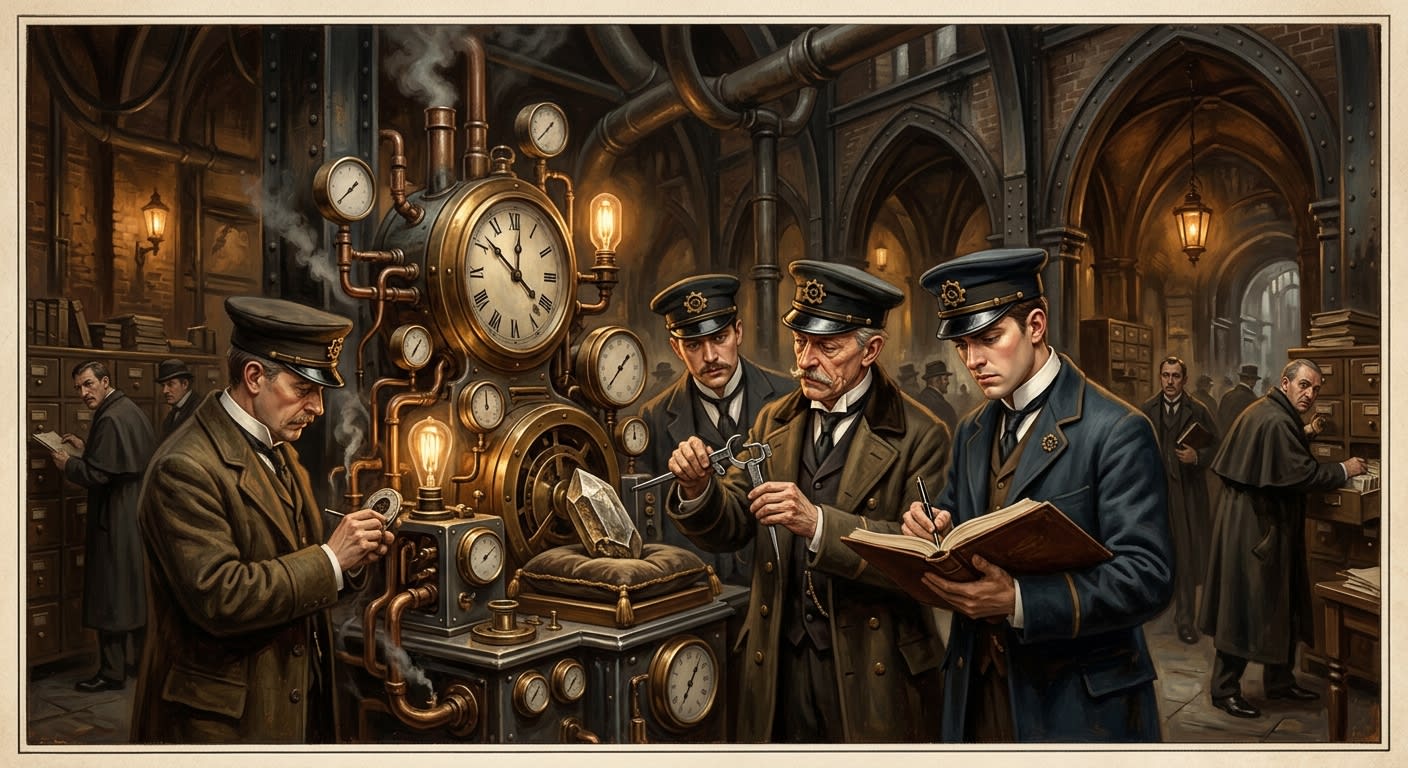
The True Measure Zealots are the faction of Commerce Clerks who treat the relic-calibrated scale as a sacred instrument and behave, to universal irritation, as if sacred instruments should be used accurately.
This alone would make them tiresome. Their greater crime is consistency. They report bribes. They re-zero scales during rush hours. They refuse candle-oil offerings whose weight in silver would feed their own children through winter. They call drift heresy, false weight contamination, and a sympathetic thumb on the pan an attempt upon the Doctrine of Measure. Their colleagues despise them. Their superiors fear paperwork from them. Vendors dream of beating them to death with sacks of legal grain.
They are often called zealots by the Mercy Weighers, frauds by smugglers, “operational obstructions” by port captains, and “useful witnesses” by the Bureau of Purity. The last title is the cruelest. It is also the most accurate.
#On the Birth of Their Piety
The faction's claimed ancestor is the Bread-Scale Uprising of A.S. 97, when a guild rigged a bastion's southern gate scales with lead, overcharged every sack, starved a city, and taught Strasbourg that private measure is just theft wearing a carpenter's apron. The Synod seized the scales. Weighing became sacrament. Reliquary calibration followed within the year. From that first seizure came the chapel, the stamp, the witnessed zero, and the clerk whose hands smelled of wheat dust and fear.
True Measure doctrine arose wherever the new system met the old market. Merchants wanted exceptions. Quartermasters wanted speed. Mothers wanted mercy. Clerks wanted to survive the day without being knifed in the queue. The True Measure answer was simple enough for a lintel: the pan decides. If the pan condemns, the clerk stamps. If the pan acquits, the clerk stamps. If the pan wavers, the clerk starts again while the queue curses his ancestry back to Adam.
The Saint Calibrus cult hardened the faction. Calibrus' closed mouth, suspended balance, and kneeling crowd gave them an icon in which inaction looked holy. They copied his level hand as a training posture. They held their arms above scale-beams until muscles failed. They recited “Measure is mercy” with the vacant serenity of men who have mistaken a slogan for a loaf.
Earlier Bureau of Tithes summaries described True Measure practice as “excessive literalism.”
Clarified by Tariff-Chapel Division memorandum A.S. 181: literal adherence to Standing Order cannot be excessive in public wording. Internal frustration may be preserved under private seal.
#On Their Practices
The Zealot begins with zero. The reliquary casket is opened before witnesses. The fragment touches the scale-arm. The calibration line is spoken in full, never abbreviated, never muttered, never swallowed to save time. A chalk mark crosses the pan. The empty scale settles. The clerk records the silence from which all weights must proceed.
Then he does it again.
This second zeroing is the first sign by which the sect may be known. Ordinary clerks zero once because the queue is alive and has teeth. True Measure clerks zero twice, sometimes thrice, and in the more diseased chapels of Essen, five times, each repetition entered in the log with ink too neat to be sane. They clean the pans between sacks. They reject cracked sealing wax. They weigh gross and net under separate prayers. They record bribe attempts by amount, form, donor, witness, smell, and probable intent.
Their private catechism contains three working maxims. False weight is heresy. Drift is confession by metal. The zero remembers. I dislike all three for being memorable; the Bureau should charge them rent.
#On Their Enemies Within the Chapel
The Mercy Weighers hate them with the heat reserved for cousins. A Mercy Weigher looks at a starving widow and sees a tariff that can be shaved, later recovered from a fat guild caravan. A True Measure clerk sees a sack, a declared weight, a rate sheet, and a soul imperiled by arithmetic compromise. Both claim Calibrus. The saint, being properly dead, has declined arbitration.
Port clerks hate them because ships rot while Zealots correct a half-ounce drift. Trench-depot clerks hate them because ammunition convoys do not wait politely for liturgical exactitude under shellfire. Relic-trusters tolerate them until a Zealot reports a calibration fragment as “devotionally suspect.” New technicians mock them until the Bureau of Relics asks who signed the assay sheet. Then mockery becomes handwriting.
The Bureau of Tithes has the most refined hatred. True Measure clerks prevent theft, which Tithes praises. They also slow throughput, anger guilds, expose tolerated irregularities, and produce reports that cannot be buried without leaving docket ash. Tithes prefers corruption it can tax. A zealot offers purity without revenue. This is vulgar.
A.S. 172 port memoranda advised removing True Measure clerks from high-volume gates.
Revised after three removals produced measurable bribe inflation, two starvation petitions, and one chapel riot. Current guidance: retain one Zealot per major gate as deterrent; isolate from schedule authority where possible.
#On Their Use to Purity
The Bureau of Purity keeps a fond little knife for the sect. Zealots report bribes with names attached. They preserve wax scraps. They can identify a clerk's thumb-pressure from ledger variance. They make excellent witnesses because they are hated, and hatred gives testimony flavour in court.
No Purity office fully trusts them. A man who loves rules may one day notice the wrong rule. A clerk who believes the scale cannot lie may begin asking why the relic assay depends upon paperwork from offices that lie professionally. Zeal is a furnace: warm when directed outward, dangerous when it discovers the chimney.
CASE FILE TM-44/VARNA: True Measure clerk assigned to harbour chapel submitted seventeen reports concerning jurisdictional delay, spoilage risk, and improper refusal to open emergency grain rates. Reports were received, docketed, transferred, duplicated, and misfiled during the dispute later known as the Ledgers of Varna.
Clerk name: █████████████ Final petition: █████████████████████████████████████ Disposition: closed before receipt
This is the hidden shame in the faction's record: accuracy does not guarantee salvation. At Varna, correct scales watched grain rot. At the Stamp War of Novi Sad, valid stamps produced famine by arithmetic fiction. True Measure clerks can certify the edge of the pit to six decimal places. The pit remains.
#On the Present Condition
As of A.S. 201, the faction persists in every major tariff corridor of the Sagittal Line, though no Bureau publishes membership rolls. They are strongest in old reliquary chapels, in inland grain gates where fraud once killed whole streets, and among younger clerks who have not yet learned the professional mercy of looking away. Their badges are informal: a double chalk line on the calibration slate, a clean left cuff, a Calibrus card tucked behind the rate wheel, the absence of laughter when a vendor says “round down.”
They train apprentices badly for survival and excellently for audit. They keep receipts that ruin friendships. They send sealed notes to Tithes, copies to Purity, and, in moments of suicidal devotion, corrections to Records. Records thanks them by losing the note in triplicate.
The Synod needs them the way a mouth needs teeth: for chewing, for display, for biting its own cheek. Too many True Measure clerks and commerce freezes into sanctified constipation. Too few and the market becomes a trough. The current policy is balance, which means no one is satisfied and everyone has filed a memorandum.