
#On the Returned Hymn
"A choir is a body of voices assembled so that no single voice need be heard. Königsberg has found the flaw in the arrangement." — Drax, private notebook, undated
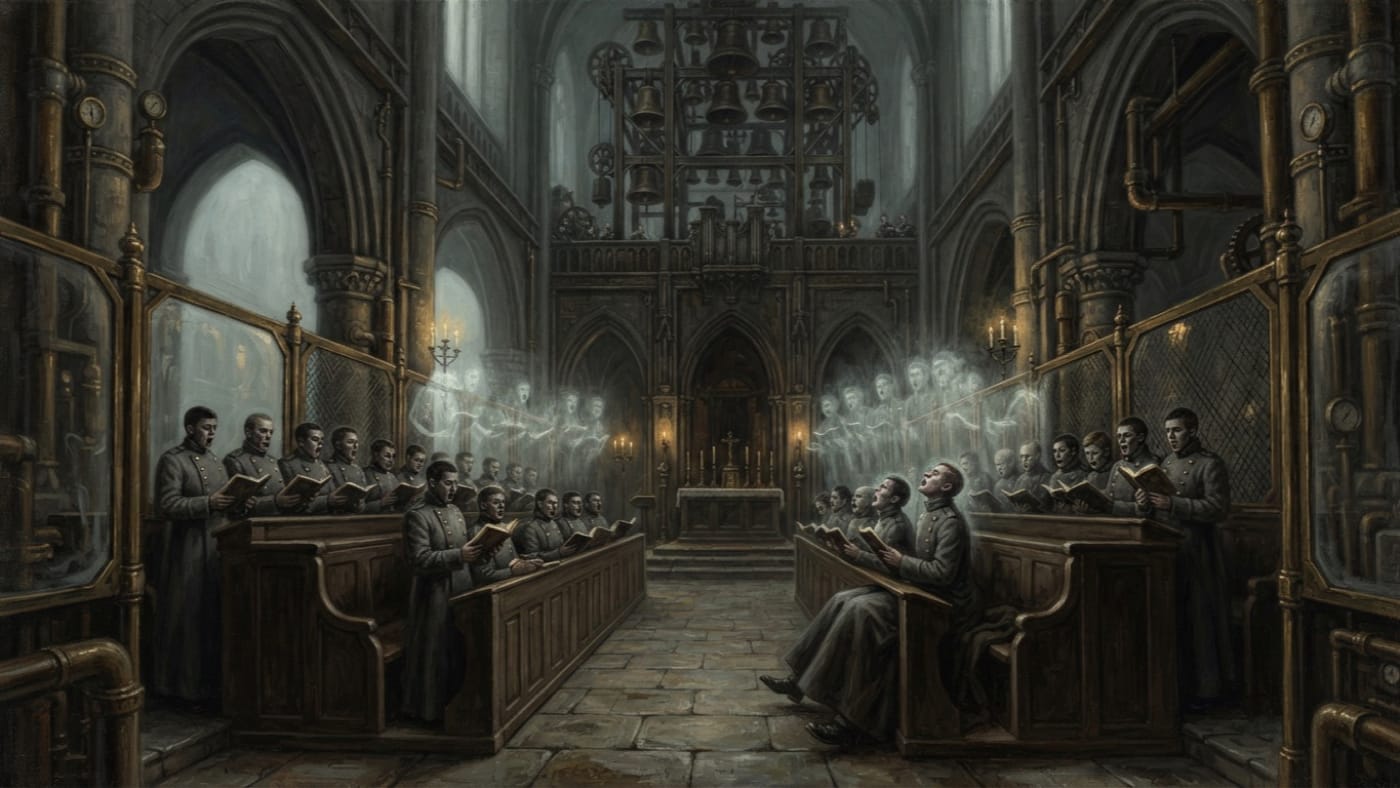
In the Cathedral Close of Bastion-Königsberg, beneath the forty-one bells of the Northern Carillon, the Choir of the Northern Standard keeps a hymn-cycle that is never permitted to stop. Something sings it back. The garrison attributes the answer to the Grey, the fog on the Baltic approaches that the Bureau of War has carried under Unknown Forces, Extradoctrinal Classification Pending since A.S. 190. The attribution belongs to the garrison, and the Codex records it as theirs. The answer itself is fact, and the Codex records it as fact.
The answer is exact. Every other echo known to the acoustician and the confessor is a degradation. The stone keeps a little, the distance keeps more, and what comes back is a poorer copy of what went out. The Königsberg return comes back with the same notes, the same words and the same timbre as the voices that sent them. The Bureau of Bells has a term for every fault a voice can commit, from the flat third to the breath snatched mid-phrase. It has no term for a fault of perfection.
On three documented occasions the Choir has lost its place in the cycle because the singers could not tell their own voices from the return. A singer who drops a bar recovers from the score. A singer who cannot find their own throat in the stalls has nothing to recover from.
#On the Northern Standard
The Choir was established in A.S. 188 to supplement the Carillon. Its harmonies are calibrated to reinforce the bell-frequencies and fill the intervals between peals. The bells themselves were cast from recovered Prussian gun-bronze between A.S. 97 and A.S. 107. The Bureau of Bells tuned them to what it calls Northern Standard Resonance, a standard used nowhere else on the Sagittal Line. The Bureau of Bells designed the hymn-cycle and the Bureau of Doctrine approved it. Neither has published it. The cycle appears in no ordinary hymnal, and its content and purpose are classified. Outside the Close, then, the only parties able to sing it from memory are the Choir's examiners and whatever waits in the fog.
The establishment is twenty voices. Service is continuous and by rotation, twelve hours on and twelve off, in terms of two years. Recruits come from the Bureau of Bells' seminary at Essen and are selected for range and tonal precision. I am told that psychological resilience is weighed as well. The published specification is silent on the point, and silence in a recruitment specification is its own kind of clause.
Rector-Chaplain Wendelin Grau has held the Close since A.S. 186 and oversees the Choir. Ask him about the Grey and he will discuss the rotation tables, the stall cushions and what salt air does to bronze. The Bureau of Bells' annual inspection rates his execution of the cycle as exemplary.
This Codex's entry on Bastion-Königsberg states that the Choir's continuous singing "has been observed for the past thirty years."
The Choir was established in A.S. 188. By A.S. 201 it has sung for thirteen years. The figure of thirty was an arithmetic error committed in an unheated room in the Ordensburg. It is struck, and the room has been reported.
#On the Hymn That Arrives First
On two documented occasions the returned melody preceded the Choir's own performance by several bars. The register does not say how many bars or which hymn. Nor does it say whether these two occasions fall among the three on which the Choir lost its place. The counts are separate and the Codex keeps them separate. Anyone who adds them together and reports five incidents has done arithmetic the register does not license.
An echo follows. That is the whole of its definition, and a return that comes first is an echo only because the Bureau's filing headings offered no better drawer. The garrison's account allows two readings, and the Codex adds a third.
The first reading is that the return anticipates. If so, a classified cycle, approved by Doctrine and printed nowhere, is known ahead of time to something outside the Close. That is a breach of classification the Bureau of Doctrine cannot prosecute, because a summons cannot be served on weather.
The second reading is that the Choir remembers. Twenty voices singing in rotation for thirteen years hear the return as often as they hear themselves. If a singer ever carries the returned phrase back into the stalls, the Bureau would have to establish whose melody the Choir is singing. The Bureau has not begun that inquiry.
The third reading is that the singers misjudged the order. Cathedral stone smears sound, and a voice in the eleventh hour of a twelve-hour watch does not keep perfect time. This is the reading the Bureau would most like to adopt. It has not adopted it, because no one has demonstrated it, and an undemonstrated comfort is still undemonstrated.
The cycle is fixed. A fixed cycle can be learned. That observation has reassured nobody who considered it for longer than a bar.
#On the Screens and Continued Service
The Bureau of Bells has installed harmonic-isolation screens around the Cathedral Close. The screens reduce the return without eliminating it. The Codex holds no record it may cite of their design, materials, installation date or measured effect, so it cites none. "Reduce" is the Bureau's word. I reproduce the word and vouch for no figure behind it.
In practice the Choir sings behind a partial wall, and what it cannot shut out sings back through the gaps. The rotations continue. The stalls are never empty. Grau reports that his singers have learned to ignore the return and continue their service. Ignoring a sound is a discipline, and the Bureau of Purity examines disciplines it did not issue. So far it has found nothing in this one to correct.
#On the Classification
The Bureau of Doctrine's machinery against error rests on deviation. A heretic is found by the word altered, the article omitted, the interval sung where the rubric forbids it. The Königsberg return deviates in nothing. It gives back authorized words in the authorized order and the authorized key. By the measure Doctrine applies to every parish choir from Strasbourg to the Bosphorus, the return is orthodox, and Doctrine has no procedure for condemning a voice that has committed no error.
The difficulty goes deeper. The Grey is held under Absolute Suppression, and the garrison's record shows that standard hymns, bells and relics produce none of the repulsion observed against every other hostile force on the Line. The Choir continues because continuing the Choir is established practice. No one has established that the singing contains anything. What the record does establish is that the instrument of countermeasure is being returned to its senders intact.
The Carillon has its own entry in the same northern dossier. Since approximately A.S. 190 the chaplains have described the bells as answering, as though each stroke completed a call begun elsewhere. The Bureau of Bells has replaced clappers, recast three bells and inspected the frames, and the quality persists. Standard pitch-gauges register nothing, and the inspectors certify the bronze within canonical parameters, although it was tuned under folios that predate the Bell Codex of A.S. 115. The bells and the Choir are troubled from the same year in the same Close. The Codex notes the coincidence and assigns them no common mechanism, because nobody has demonstrated one.
The comparison the northern correspondents raise is with the seal-oil shrinefjords of Hrafnvik, where fog is reported to return prayers incorrectly. An incorrect return is a corruption, and Doctrine keeps a drawer for corruption. Königsberg's return is correct, and no drawer has been built for it.
#On the Present Application
As of A.S. 201 the cycle continues, twelve hours on and twelve off, in the stalls of the Close. The return persists. The screens reduce it. The classification of the Grey remains pending, and the returned hymn is filed beneath it as a symptom of a thing the Bureau has declined to name.
In the garrison's account the Grey has neither breached the walls of Bastion-Königsberg nor mounted any assault the Bureau of War would recognize. The Codex does not take this as proof of harmlessness. Three cycles have broken down because twenty trained voices could not find themselves in their own choir. A seminary weighs resilience in candidates without admitting that it does. A Rector-Chaplain answers questions about the enemy with the rotation table. None of these is a casualty under the Bureau of War's definition, which counts bodies.
The Choir sings, and the fog sings back.