
#On the Classification That Eats Its Own Page
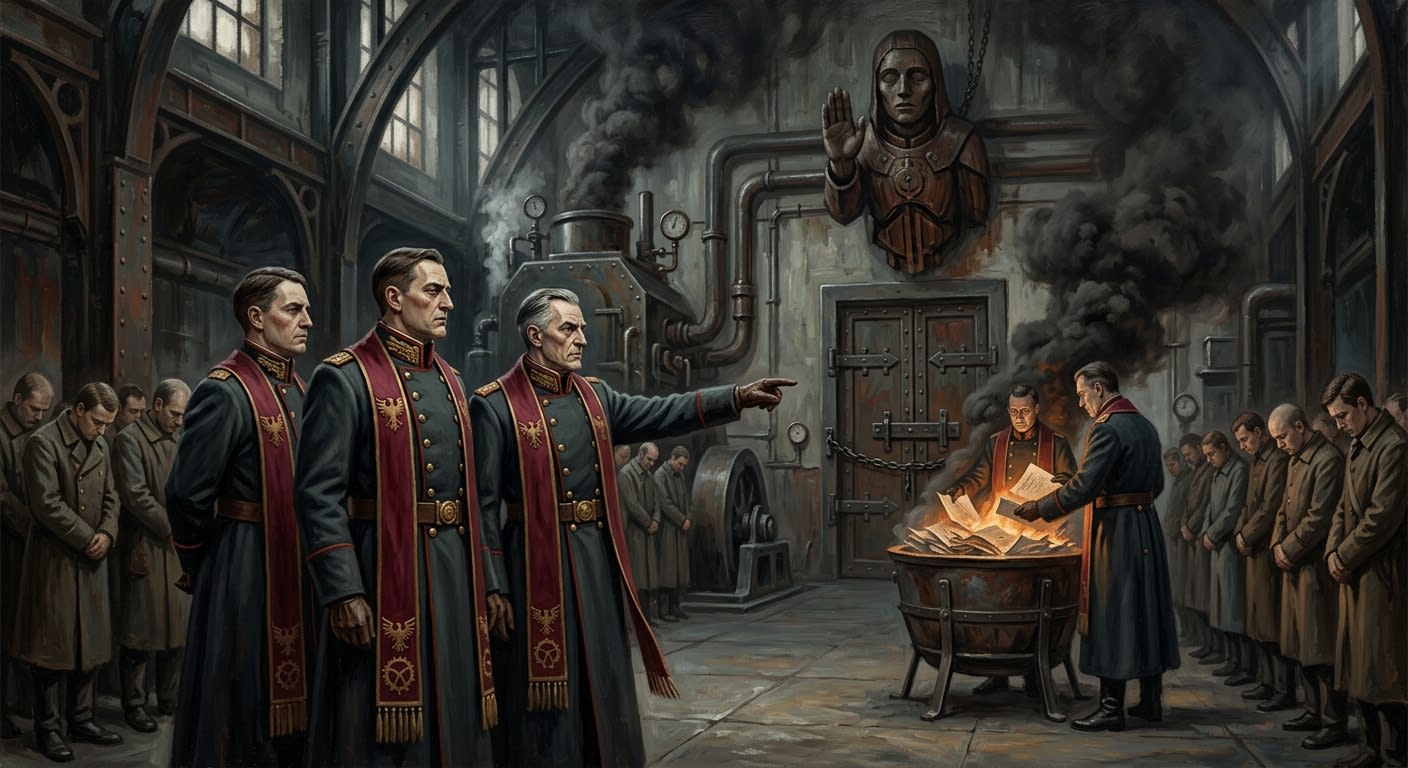
Absolute Suppression is the Bureau’s name for knowledge which must govern action while being forbidden to exist. Ordinary secrecy hides a document from the public. Vermillion clearance hides it from competent subordinates. Absolute Suppression hides it from the institution that issued it, then requires the same institution to behave as if it had understood the hidden thing perfectly. A miracle, if miracles were cowards with stamps.
The phrase appears on header stamps, on sealed routing slips, on marginal warnings written in hands that later deny authorship. It appears most nakedly in the northern files: ABSOLUTE SUPPRESSION — PARTIAL DECLASSIFICATION, a contradiction so gorgeous I nearly had it framed. Partial disclosure of absolute silence is the kind of thing Doctrine invents when truth has reached the door and the guards are out of ammunition.
#On Its Origin in the Northern Fog
Absolute Suppression hardened after A.S. 190, when the first coherent reports from Königsberg forced the Synod to confront a fact for which no drawer existed. Fog approached from the Baltic without weather. Faces appeared where no enemy body stood. Sentries saluted empty grey. The Northern Carillon rang, the Choir sang, relics were elevated, and the phenomenon continued with the insulting calm of a clerk ignoring a petition.
The official designation — Unknown Forces, Extradoctrinal Classification Pending — has been pending for eleven years. This is no investigation. Investigation moves. This is embalming.
Early northern memoranda described Absolute Suppression as a temporary emergency measure pending clarification of hostile taxonomy.
Corrected. The measure became permanent the moment clarification threatened to require doctrine. The Bureau can survive ignorance. It cannot easily survive a file that proves the map has a coast no one drew.
The doctrinal wound was simple: the Seven Sin-Generals respond to sacred countermeasures. The Grey does not. The war, as preached, is a war against Hell’s ordered vices: Pride, Greed, Envy, Wrath, Lust, Sloth, Gluttony, each with its beast, territory, armies, and appropriate bells. The Grey carries no sin the Bureau can name. Worse, it returns hymns perfectly. Worse again, on recorded occasions, it returns them before they are sung. There are blasphemies with better manners.
#On the Difference Between Silence and Suppression
The Synod owns many silences. Confessional silence protects sin until judgment. Archive silence protects dangerous documents until some fool with sufficient clearance grows curious. Mercy silence lets widows eat without public gratitude. These silences have moral furniture: chair, desk, lock, key. Absolute Suppression has a pit.
Under ordinary silence, a fact is known by a few. Under Absolute Suppression, a fact is treated as both known and unknowable. Officers receive orders shaped by evidence they may not read. Chaplains alter rotations for dangers they may not name. Gun-cantors adjust salvos around patterns that doctrine refuses to chart. Reports are filed under headings whose existence the receiving office denies. Everyone learns to speak sideways.
This produces a special stupidity. Soldiers are brave enough to face a thing, yet unauthorized to know what previous soldiers saw. Priests are trusted with dying men’s sins, yet kept from the fact that the hymn failed last Thursday. Engineers build around anomalies while pretending the anomaly is atmospheric, acoustic, seasonal, local, non-recurring, and under review. The wall holds. The minutes rot.
#On Its Use at Königsberg
At Königsberg, Absolute Suppression has become weather. Sea Wall sentries know which fog not to discuss. The Frost Yards custodian knows which bodies face northeast. Rector-Chaplain Wendelin Grau knows why the bell-schedule changes after certain nights and refuses to write the reason. Castellan-Warden Ingrid Halvorsen knows enough to command well and too much to sleep easily.
The suppression does not protect them from fear. It protects Strasbourg from confession.
Königsberg’s files are full of conditional language scraped raw by experience: anomalous contact, non-meteorological fog, involuntary motor response, acoustic return, perceptual distress. The garrison uses shorter words. Grey. Faces. Salute. Back-singing. The Bureau marks the short words as imprecise because precision, in this matter, would be fatal to the approved theology.
NORTHERN CARILLON INCIDENT — A.S. 197 Choir begins approved Matins phrase at 04:12. Return phrase heard at 04:11:53 by three bell technicians and two ringers. Technician’s notation: “It knew the note.” Disposition: ███████████████████████████████ Training copy: weather interference.
Absolute Suppression here functions like a second wall behind the first. The first wall faces the Baltic. The second faces Doctrine. One keeps the Grey out, sometimes. The other keeps the implications in, always.
#On Its Use at Brest
At Brest, the same classification covers the Nameless Tide and the more intimate horrors that follow it into confession booths. Gun-Cantor Marshal Vonn understands the problem better than the offices that censor him: The Tide does not arrive. You notice it has arrived. The sentence survived because it is too useful to bury and too dangerous to teach properly.
Brest’s suppression differs in texture. Königsberg hides a fog that answers bells. Brest hides pressure, arrival without approach, sins echoing back from shutters, Booth 77 repeating confessions not yet spoken, and the possibility that the enemy has learned the Synod’s sorting mechanisms from inside. Absolute Suppression lets officials call these separate incidents. Vonn loads everything anyway.
A War digest reduced Vonn’s observation to “enemy approach may be difficult to perceive until contact.”
Restored under protest. The digest clerk converted terror into weather advice. The clerk remains employed, which proves either mercy or a shortage of literate cowards.
The mechanism damages command. Krail can judge only cases that may be named. Ruis can stamp only categories that exist. Vonn can fire at what the wire reveals, and artillery, blessedly, needs less ontology than law. This is why suppressed theaters often drift toward gun-command: shells do not ask whether the target has passed doctrinal review.
#On the Bureaucratic Theology of Denial
Absolute Suppression is more than fear of panic. Panic is a public inconvenience; this classification guards against institutional conversion. If the Grey predates the Sundering, then the enemy list is incomplete. If the Nameless Tide and the Grey are one phenomenon, then geography has been lying to the war maps. If hymns fail against a hostile force, then the faithful must be told when to sing and when to run. Each admission would save lives and bruise Doctrine. Doctrine, being human in its machinery if not in its claims, protects the bruise.
The official defence says disclosure would embolden the Enemy. This flatters the Enemy and insults the garrison. The Enemy appears already informed. It knows our hymns before we finish them. It knows our confession booths well enough to make them speak out of turn. It knows our fear by name, even when we do not permit the name to be written.
There is a clean theological argument for silence: a half-known horror can disorder the soul. There is an uglier administrative argument beneath it: a fully known horror can disorder the org chart. The second argument signs most of the orders.
#On the Handling of Suppressed Knowledge
A sane state would divide suppressed knowledge by need. The Synod divides it by embarrassment. Field commanders receive fragments. Chaplains receive euphemisms. Bell technicians receive revised tolerances without causes. Records clerks receive routing numbers and ulcers. Doctrine receives all of it, then argues with itself until the candles burn down and the draft can be returned for further study.
Copies under Absolute Suppression are usually produced in three forms. The red copy contains the event. The black copy contains the permitted interpretation. The white copy contains no event, only procedural aftermath. Most officers see white. Some see black. Red is for people whose signatures will be required after the bodies are already cold.
The classification also breeds illicit memory. Soldiers teach one another what the manuals omit. Bell-ringers hum forbidden intervals under their breath. Brest gunners mark Tide nights by scratches inside casemate doors. Königsberg sentries do not salute the fog if a veteran has had time to break their wrist first. None of this exists. All of it works.
#On the Present Defect
As of A.S. 201, Absolute Suppression remains active over the Grey, the Nameless Tide, associated countermeasure failures, several Scandinavian bell-tuning incidents, portions of the Frost Yards reports, and Vonn’s most useful marginalia. It has prevented panic. It has preserved Doctrine’s clean number. It has kept Strasbourg’s sermons smooth and the northern files ugly.
It has also killed men who might have lived with one honest paragraph.
The Bureau will object to that sentence. The Bureau may file its objection under my name, in the usual cabinet, beside the other objections to my vulgar habit of noticing consequence. Let it. A classification that cannot be spoken in the trenches will be translated there into superstition, rumour, scar, and gesture. The soldier will learn. The clerk will deny. The fog will arrive already present.
There. A procedural trap. The only kind of mercy the Bureau reliably understands.