
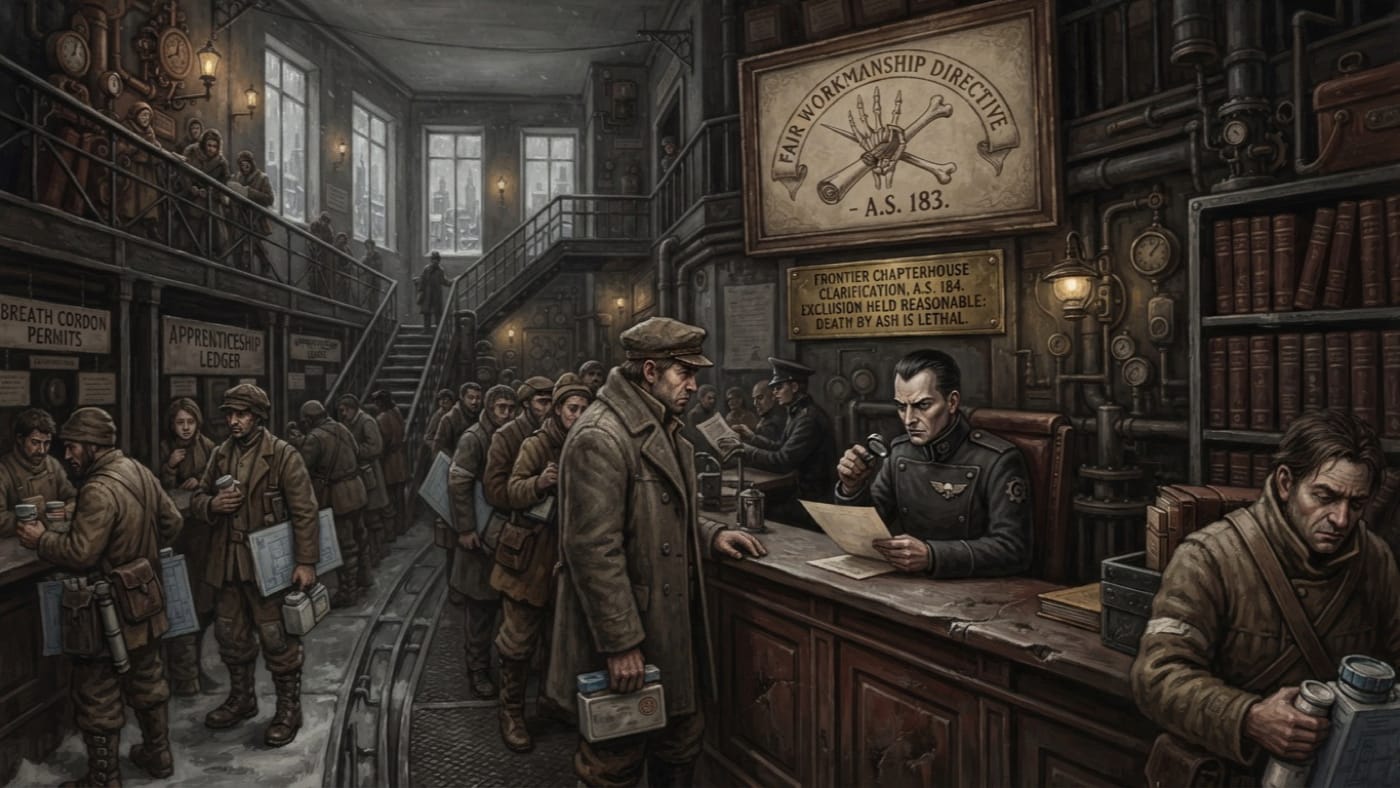
#On the Directive's Scope
The Fair Workmanship Directive belongs to A.S. 183, which is 1893 CE to those who still use the old reckoning. I do not have its full text. Nobody has sent me its issuing office, the day it was promulgated or the names of whoever sealed it, and I will not invent them. I have seen what invented clauses do to frontier towns. What survives in the correspondence of Black-Snow Lor is a single operative phrase. The directive forbids "unreasonable exclusion from frontier craft markets."
Six words, and one of them is the exemption.
A careless reader sees a prohibition. A trained reader sees a prohibition with the hinge already fitted. The directive abolished unreasonable exclusion and left exclusion itself standing. Every guild, chapter and licensed bench on the frontier excludes someone: the untrained, the unsworn, the drunk, the cousin. The directive asked one further question of each closed market, which was whether the closing could be defended. In most districts that question costs a guild some paperwork. In Lor the closed market is the seam between a sleeping child and the black snow, and the question answers itself before the clerk has finished writing it down.
#On the Chartered Work
The directive arrived in a market more than a century old. Lor began in A.S. 71 (1781 CE) as a storm-shelter node on the Carpathian edge of the Sagittal Line. Its builders learned bone-lattice from scarcity, from ash, and from the mass pits beneath the flats. The Bureau of Engineering certified bone-lime construction in A.S. 89 (1799 CE). The Second Concordat of Münster then bound the craft guilds into the Synod's tithe-structure, and in A.S. 105 (1815 CE) the Bone-Guild of Rib and Reed was recognized as a chartered craft body.
Its terms are plain. Under Lor's ordinary arrangement, no contractor outside the Guild installs bone-lattice within the Breath Cordon. The Guild holds the licensed masks and shutters. It holds the vent-screens, the storm lattices, the safehouse seals and the marrow glue that fixes reed to rib. It also holds the repair work that keeps all of these in service.
Three hands now hold the town's breath. Rib-Mother Sael holds the workmanship and the inner vent knowledge. Breath Comptroller Juno Varr holds rations and shelter permissions. Storm Warden Ilex Marr holds the closure bells. Each of the three can ruin the other two within a single storm cycle. None of them appears in any record I have seen as the directive's author or as a party to its clarification. They inherited the instrument.
For a jurist, the point is this. In Lor a craft market is also a ration schedule and a shelter register. A man who fits a shutter there has done carpentry, made a medical claim and filed a petition to go on living, all in one afternoon.
#On the Clarification of A.S. 184
In A.S. 184 (1894 CE) the Frontier Chapterhouse clarified how the directive applies in Lor. It is the only reading of the instrument in this town that matters, and it is a small masterpiece of the canonist's art.
The Chapterhouse accepted the prohibition in full. It then asked whether the Guild's exclusion of outside fitters was unreasonable. It held the exclusion reasonable, because death by ash inhalation is unreasonable. The sentence deserves a reliquary. It takes the statute's own adjective out into the weather and brings it back full of lung.
Beneath the epigram the reasoning is sound engineering. A shutter in Lor must close against grit driven at storm speed. A mask seam must hold through the closure bell and the hours after it. A vent-screen must pass enough air for the room and stop enough ash for the people in it. Its filter cloth must be washed before it clogs. When any of these fails, nobody hears a draught or a rattle. The household is found sitting upright when the bells release. The Chapterhouse weighed that arithmetic and judged that a market requiring proven competence at the bench excludes no one unreasonably.
The clarification governs how Lor reads the directive. Whether it reaches beyond Lor is a question for other dockets. The directive itself stands unrepealed.
Under the A.S. 183 Fair Workmanship Directive, the Bone-Guild's monopoly within the Breath Cordon was abolished.
Retracted. The directive forbade "unreasonable exclusion from frontier craft markets." In A.S. 184 the Frontier Chapterhouse held the Guild's exclusion reasonable. The monopoly stands. The directive stands with it.
#On the Household Consequences
A reasonable exclusion is still an exclusion, and households pay for it in specific coin.
A Guild certificate admits a household to ration discounts, safehouse eligibility, inspection priority and insurance against closure failure. A room without one is classified unsealed by the Breath Office. The walls may be dry. The shutter may close. The family may have lived through three falls behind it. In the ledger the room stays unsealed until the Guild says otherwise, and the ledger is where the rations are counted.
Independent fitters meet the exclusion at three points. The first is the permit challenge, by which the Guild contests outside work while it is underway or after it is finished. The second is material. Bone stock, filter cloth and marrow glue pass through Guild hands, and a fitter without supply is a fitter with opinions. The third is the apprenticeship ledger, which the Guild also keeps. A child refused at the bench stays outside the trade for life, and the trade's knowledge stays inside with the masters. Each of these is lawful under the 184 reading. Taken together, they leave a craftsman almost no lawful way into the trade except as a Guild apprentice.
Then there are the failures. Non-Guild shutters split and non-Guild screens develop defects at a rate that published allegations call suspicious, and those allegations connect the failures to deliberate interference. The provost patrols report insufficient direct evidence. The Guild answers that the failures prove the Chapterhouse right.
Guild work does not buy immunity either. Bone-lattice strains ash, but it does not stop every particle. A Guild shutter fitted perfectly can still fail behind a filter left too long unwashed. Competence at the bench proves only competence at the bench. It proves nothing about whose hand held the awl when an outsider's shutter split.
#On Emergency Work in A.S. 201
Two dates set up the present quarrel. After the Bureau of Purity's compliance review of A.S. 197 (1907 CE), Sael won acceptance of Guild inspection marks on every safehouse upgrade. Since A.S. 199 (1909 CE), black snow has fallen out of season and clogged filters faster than the washing rounds were built to manage. Lor has needed more sealed shelter than the Guild can certify at its own pace.
In A.S. 201 (1911 CE), Breath Comptroller Juno Varr issued shelter-upgrade permits to non-Guild contractors under emergency authority. Citing that authority is the Breath Office's business. This file does not derive it from the Fair Workmanship Directive. The A.S. 184 reading, if it points anywhere, points toward the Guild.
The risks run in both directions. Every week of certification delay is a week in which households wait outside the safehouse rolls while the falls arrive off schedule. Every uncertified upgrade is a seam no Guild master has tasted, in a room the Office may count as shelter. Both dangers kill, and they kill the same households.
The Guild has answered by threatening a stoppage. It has posted that it cannot guarantee non-Guild structures, repairs, seals, shutters, vents or masks until it gets back its cloth allotments, its inspection rights and its jurisdiction over lattice work. The Bureau of War favours requisition. The Breath Office wants its emergency contractors certified. The Frontier Chapterhouse wants quiet.
A stoppage, if it comes, would be counted in objects. Masks would go unrepaired and vent-screens unwashed. The bell frames of the Ribwatch Towers depend on Guild maintenance, so Marr's bells would hang slack. Convoy respirators bound for Bastion-Przemyśl would wait in the same queue as everything else. If the emergency shutters hold, every fitter in the Warrens will argue the A.S. 184 clarification again. If they fail, the Guild will cite it at the graveside, having been barred from inspecting the work.
#On the Present Application
In Lor the directive is in force and the monopoly is lawful. The A.S. 184 clarification is the reason both statements can sit on the same page. The dispute of A.S. 201 has left that reading untouched. What it is testing is whether an emergency can get around it. No settlement has been sealed and no stoppage outcome has been recorded. Predictions about what Sael will demand and what she will receive belong in the Guild's file, and they remain predictions there.
Unreasonable exclusion is forbidden on the frontier. In Lor the Chapterhouse found none in A.S. 184, and the fitters of the Warrens are still looking.