
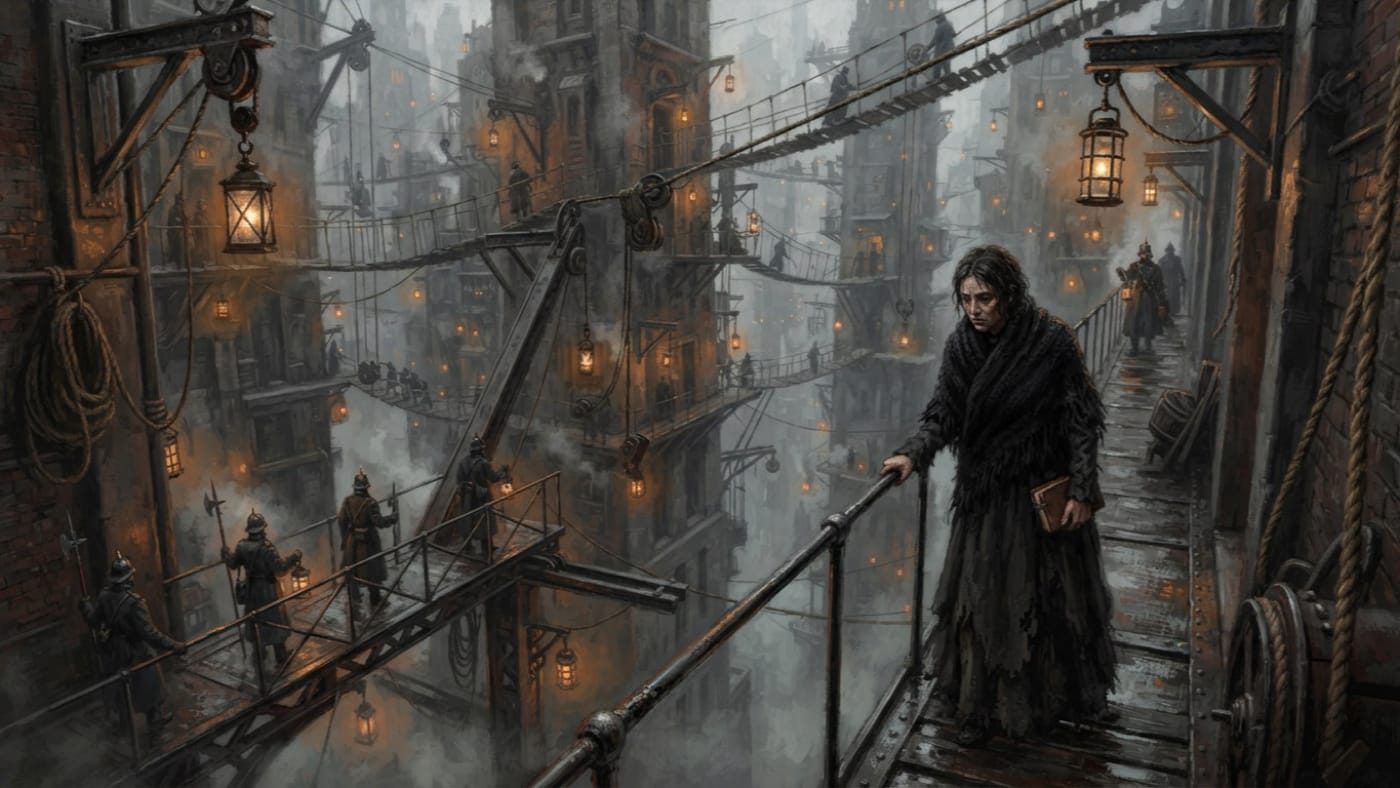
#On the Hidden Roster
The Fall List is a roster of the dead. The Circle of Rope-Road Lanterns keeps it. That Circle is the high-walk chapter of the Lantern Brotherhood, and it holds the rope-roads, pulley bridges, stacked walkways and elevated customs lanes above the bastion streets. The list names the people the Circle has "helped fall" from those heights on command. The Brotherhood's own charter puts the phrase in quotation marks. I keep them. A Hieromnemon must respect a murderer's punctuation when the punctuation is the only honest thing he has written.
Three kinds of paper describe a fall from the high walks, and a reader who confuses them deserves to meet the Wardens. The first is the public accident report. It names a span, a wind, an hour and a regrettable haste, and then it is filed. The second is the crossing record, which is the Circle's ordinary merchandise: who crossed between wards, when, with whom, carrying what. That record is a sin, but a tolerated one. Blackmail appears in the Circle's charter with no more embarrassment than rope inspection.
The third is the Fall List. It forecasts nothing and condemns no one in advance. It records what has been done, and the mere fact that it exists proves that someone asked for it. An accident report closes a matter, and a crossing record opens one. The Fall List would open the Circle itself, and several offices above it, the way an anatomist opens a hanged man on the lecture table.
#On Command and Accident
The Circle's own maxim reads: If it falls, it was always falling. That is very fine theology, but it leaves out who decided the falling was due.
Names reach the list through favours owed upward. A patron needs a quiet. The Circle supplies a fall, because it controls who crosses where and where a man is standing when the lanterns turn. The Codex entry on the Circle describes the kinds of people who have been supplied: a guild witness, a troublesome widow, a clerk who counted too carefully, and a Mercy Preacher. The preacher needs no great explanation. Licensed consolation is a respectable cover for mutual aid, for whispered arrangements and for a neighbourhood that has learned to coordinate itself. A sermon that makes three alleys quieter than doctrine permits is a nuisance to anyone whose ledger depends on those alleys staying loud. I give no individual names. The Codex holds no recovered entry, and I will not invent a corpse to improve a paragraph.
The work belongs to the midnight accident window. That is the fourth line of the Circle's daily order, placed between the interception of sling-crates and the extortion meetings, and it is described as selective drops, selective rescues. The Circle nets a courier, searches his satchel and lets him go. It drops a contraband crate where the Wardens will find it with satisfaction. Among these permitted performances, a commissioned fall sits like a forged figure in an honest column. The auditor sees only the total.
The methods are already in the record. A bridge-cord frays after inspection. A boot-iron slips despite fresh pitch. A shutter-lantern is opened into a man's eyes at the very second he reaches for the guide rope. The report then chooses from its usual remedies: wind, panic, poor maintenance, unlawful haste or divine warning, mixed in whatever proportion suits the reader's rank.
The plain word is murder. It is paid for in favours and filed as weather.
#On Chalk and Copies
Pulley Station Hark is officially a maintenance tower and bridge-inspection post. Its upper platform is locked. Behind the lock the Circle keeps its shutter-lanterns, grapnels and rope knives, its sling-cord evidence bags, and the chalked wall where crossings are written up: names, hours, companions and parcels. Elsewhere on the high walks, a chalk hook-arrow marks a span the Circle is watching from above.
The wall is built to forget. It is wiped before dawn, and by then the useful crossings have already been turned into anonymous tips for the Wardens. That daily erasure is how the Circle survives. A blackmail wall that kept its chalk would be evidence. Wiped each morning, it is only a rumour with good timing.
The Fall List is built to remember. It is a separate document. The chalk wall is not the list, and the list is not chalk. The charter gives no hiding place for it. It does not say the list is kept on the platform, in the tower, or anywhere within reach of a pulley key. The paper, the binding, the hand that keeps it, the number of entries and the first name entered are all unrecorded. I have not seen the list. I note this for the sake of my continued good health.
The Circle keeps copies. How many, where, and in whose care are not recorded, and I decline to guess. Why it keeps them is a matter of ordinary criminal prudence. A single roster is a liability: one fire or one informer is enough to lose it. Several copies are insurance against patrons. A patron who comes to feel that the Circle knows too much must consider that somewhere another sheet would outlive the Circle and name him. The paper that could hang the Lanternmen is the same paper that keeps them employed.
#On Toleration and Its Price
The charter is frank about what the Circle pays for the right to exist. It intercepts smuggled sling-crates "often enough." It catches fugitives between wards. It turns crossings into tips and tips into arrests. On the same list of services, in the same plain hand, it offers occasional "accidental" falls that remove inconvenient agitators.
So the falls are listed among the Circle's services. The Fall List is the receipt.
The Circle's toleration goes back to the A.S. 94 auxiliary clauses that the Codex entry on the Circle names as its precedent. Those clauses set out the conditions under which a Brotherhood Circle may go on existing. They do not date the list, its first entry or its first copy, and I will not let a precedent stand in for a birthday. The Wardens hold the authority that matters: they tolerate, they review, and if review requires it, they erase.
Above the Wardens, the Bureaus look at the high walks with competing appetites. The Bureau of Shadows values the Circle's surveillance, since high places collect secrets without anyone having to build them. The Bureau of Purity resents the Circle, because every crossing sold as blackmail is a sin that never reached a confessor. The Bureau of Tithes wants the revenue and deplores the leakage, in memoranda that manage to hold both views in a single sentence.
None of this shows that any Bureau commissioned any particular fall. I record motive. A motive is not an order, and the Codex has no order on file. The Circle, by its own account, has the names.
Prior Brotherhood memoranda treated every curfew-hour fall from the rope-roads as a single class of transport mishap, and the accident ledgers of the high walks were read on that understanding.
Corrected. The falls divide into two classes. One class is weather. The other has a list.
#On the Widow's Possession
The charter gives the consequence in one sentence, and it is the bluntest sentence any Brotherhood clerk has written. If even one widow obtains the Fall List, the Wardens will erase the Circle, to spare the city from admitting how it is actually governed.
The choice of a widow is deliberate. A widow has standing to ask, a grievance the courts cannot easily dismiss, and very little left to lose. She can carry a sheet of paper down to street level in her sleeve. The Circle has reason to fear her in particular. "A troublesome widow" is already one of the kinds of entry the list contains. The Lanternmen have sent one widow over the edge of a bridge, and they must now wonder about the next.
When the Wardens erase the Circle, it will be to remove the only witnesses who know who asked, rather than to punish the murders. Patrons who bought falls do not want an inquiry. They want the dead to have been weather, and they want anyone who remembers otherwise to have followed them.
No widow is known to have obtained the list. No copy has been publicly recovered. No Warden has suppressed the Circle on this account. As of the A.S. 201 survey, the Circle of Rope-Road Lanterns remains under conditional toleration, with its pulley-key custody, accident ledgers and chalk expenditure reviewed every quarter. The same review notes that reports of intentional falls remain unverified by any recoverable witness.
The witnesses in question were recovered, from courtyards, in pieces. None of them was in a condition to verify anything.