
#On the Feast Under Accord
The Feast of Saint Merrow's Tally owes its place in the archive to a single afternoon's paperwork. In A.S. 139, the first season of the Lantern Accord, its procession through the Lace District of Strasbourg showed the new arrangement working in full. Every party to the Accord stood at its station on the same streets, under the same banners, answering the same drum. The report was filed accordingly.
On the feast itself the archive is mean. It does not say who Merrow was, what Merrow counted, when the name entered the calendar, or why a tally should want a saint. It gives no month, no day, no rank among the observances, no customary dish. The Bureau of Festivals keeps the name the way a quartermaster keeps a crate label: accurately, and without curiosity about what the crate once held.
The report claims no priority among the first Accord processions. It is simply the one whose returns somebody later judged worth keeping. Festivals did not need a frontier for its demonstration. Strasbourg is the Synod's capital, deep in the safe western heartland, and Festivals wanted a capital crowd and narrow streets.
#On the Route and the Wrist
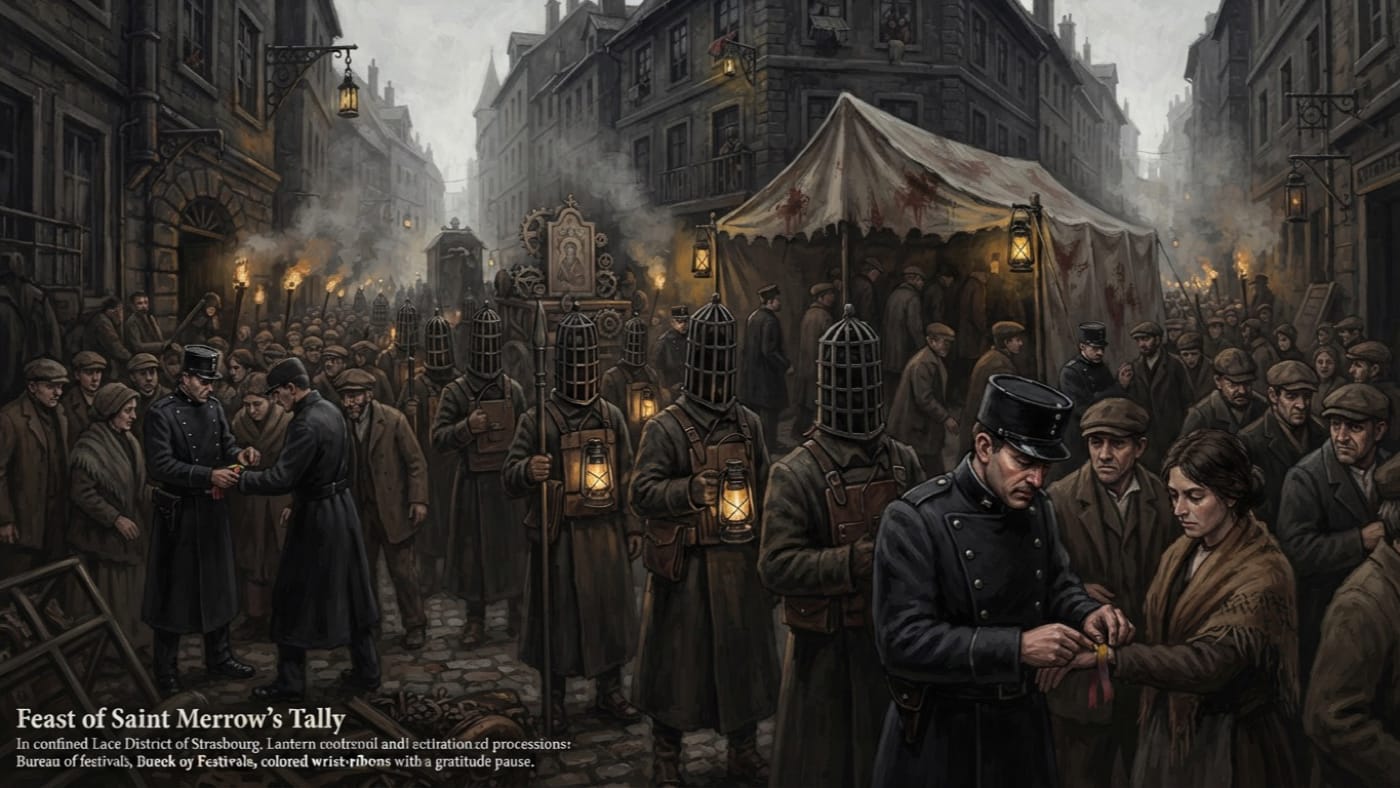
The machinery was one year old. Gray Week, publicly dated to A.S. 138, had taught the Synod that an open audit of hungry people ends in cobblestones. Records and Festivals still argue over which year that was, since one dates the famine by harvest and the other by decree. The Receipt Reform answered under Directive 88-F. Paper procession receipts were withdrawn and the wrist-ribbon replaced them: treated cloth in district dye, a punch pattern struck by dies signed out under seal, the strip set through the skin of the wrist or pressed against it hard enough to make denial foolish. An inspector reads colour, punch pattern, station mark and damage. A torn ribbon is a question with a pulse.
The Accord then appointed the questioners. Under its terms, Lantern Brotherhood escorts gained movement along the route, the right to inspect ribbons, and the right to detain anomalies for a short time. They paid with obedience to Festival drum-code, which belonged to the Pageant Captains. The Brotherhood became an official parade auxiliary. Bureau commission was withheld. Local toleration, the old licence of the Curfew Ordinance of Quiet Hours, could still be revoked without notice, as it always could.
The profession's manuals give a Pageant Captain's ordinary office as route design joined to arithmetic. The Captain places the pause points, matches faces to the parish roll, handles the exceptions and reconciles the manifest at the end. A float slows, the music swells, the crowd leans in toward the painted saint, and the Runners step forward with punch and roll. That is general practice. The Merrow report records less, and I set down only what it records.
Lanterns held the alley mouths. Ribbon Runners worked the edges of the crowd. Captains kept the floats paused long enough for wrist checks. When a ration chant rose somewhere in the press, the drummers drowned it before it could spread. Its words went unrecorded. So did the names of whoever began it, and whatever became of them once the drums had finished.
#On the Tent's Returns
Every major Festival procession carries a lost-child tent. It is a Festivals asset, staffed and stocked by Festivals, and for part of each day it does what its awning promises. Mothers find sons there. The sweetmeats are real. The rest of the day it takes in whatever the route cannot digest: a wrist without a ribbon, a ribbon that was forged, a face that disagrees with its parish roll, a name the rolls had already closed.
At the Feast of Saint Merrow's Tally, the tent reportedly received nineteen children, six deserters, three dead men under false names, and a widow whose ribbon carried the punch pattern of a feast that had not yet occurred.
That is the list as it survives. It is no census of the tent, still less of the crowd. Nobody has published how many passed under the flap without remark.
LACE DISTRICT PROCESSION REPORT — A.S. 139, FIRST ACCORD SEASON Anomalies detained: ███ Ribbons torn during inspection: ██ Children transferred to correct household: █ Children transferred to useful household: ███ Lantern injuries: █ Deaths attributable to crowd movement: none recorded after reconciliation.
The nineteen children look like the reassuring entry until the extract separates the correct household from the useful one. Both figures are blacked out. The clerk saw a difference between the two and ruled a line for each.
The six deserters went where deserters go. The report does not say where that was in A.S. 139, and I will not guess on the Bureau's behalf.
The three dead men are entered as dead men under false names, and nothing more. The phrase allows several readings. They may have been men declared dead and found walking under borrowed names. They may have reached the tent alive and left it otherwise. They may have been carried in already dead, wearing other men's ribbons. The report chooses none of these. Its grammar is precise to the point of insolence. The men are dead, the names were false, and the reader must supply the tense of each.
The widow is a matter of dies. Punch patterns changed by district and by feast. Dies were signed out under seal and returned under count. A pattern belonging to a feast not yet held should have existed only in a locked case. The report notes the anomaly and stops there. It does not name the future feast, explain how the pattern reached her wrist, or say what was done with her. A forger with early access to a die, a clerk who signed out the wrong case, a slip in the reporting clerk's own notation: any of these would serve, and the report enters none of them.
#On Serenity After Reconciliation
The official report called the procession serene. Festivals uses the word precisely. A serene procession is one in which the crowd moved as routed, the chant failed to spread and the manifest closed. Serenity measures flow.
The mortality line should be read the way a notary reads a contract: Deaths attributable to crowd movement: none recorded after reconciliation. Three qualifiers sit in that sentence like stones in famine bread. The count covers only deaths caused by crowd movement. It covers only what was recorded. And it was taken after reconciliation, the stage at which a Captain's manifest is made to agree with itself. Deaths from any other cause fall outside the line, and so do injuries among the citizens and whatever happened to the anomalies in the tent. The Lantern injuries were given a figure of their own, and that figure is blacked out.
The Feast of Saint Merrow's Tally passed serenely and without loss of life.
Corrected: the report classes the procession as serene and records no deaths attributable to crowd movement after reconciliation. Serenity is a column heading, and the column was ruled before the drums began.
Each Bureau found its own success in the same afternoon. Records praised the accuracy. Tithes praised the recoveries. Festivals praised the visible calm. The Brotherhood praised nothing in writing, and by autumn its oil allowance had doubled. No surviving decree ties that increase to this procession alone. The first Accord season had other routes, and the Lanterns walked those too.
#On Its Place in the Accord Record
In the Accord file the feast serves as an exhibit of conditional auxiliary authority working as drafted. The Lanterns had power at the alley mouth and none over the drum. The Captains commanded movement and kept their hands off the lamps. The tent held its anomalies only until a Captain, a Runner or a Warden clerk decided what each would become. Every grant came with a limit, and the drums kept time for all of them.
Saint Caldrin the Jubilant Scribe, patron of the profession, presides over such work in every Festivals chapel, with the ribbon-punch, the receipt-scroll and the gratitude pause that gives a Runner time to read a wrist. His device governed the Merrow route as it governed every Accord route since. No record sets his name to this feast, and the feast does not need him. His instruments were already in the street.
The procession gathered the bodies. The pauses bared the wrists, and the Lanterns closed the exits behind them. The tent took the exceptions. Reconciliation reduced the afternoon to a single word for the cover sheet, and the word was filed.