
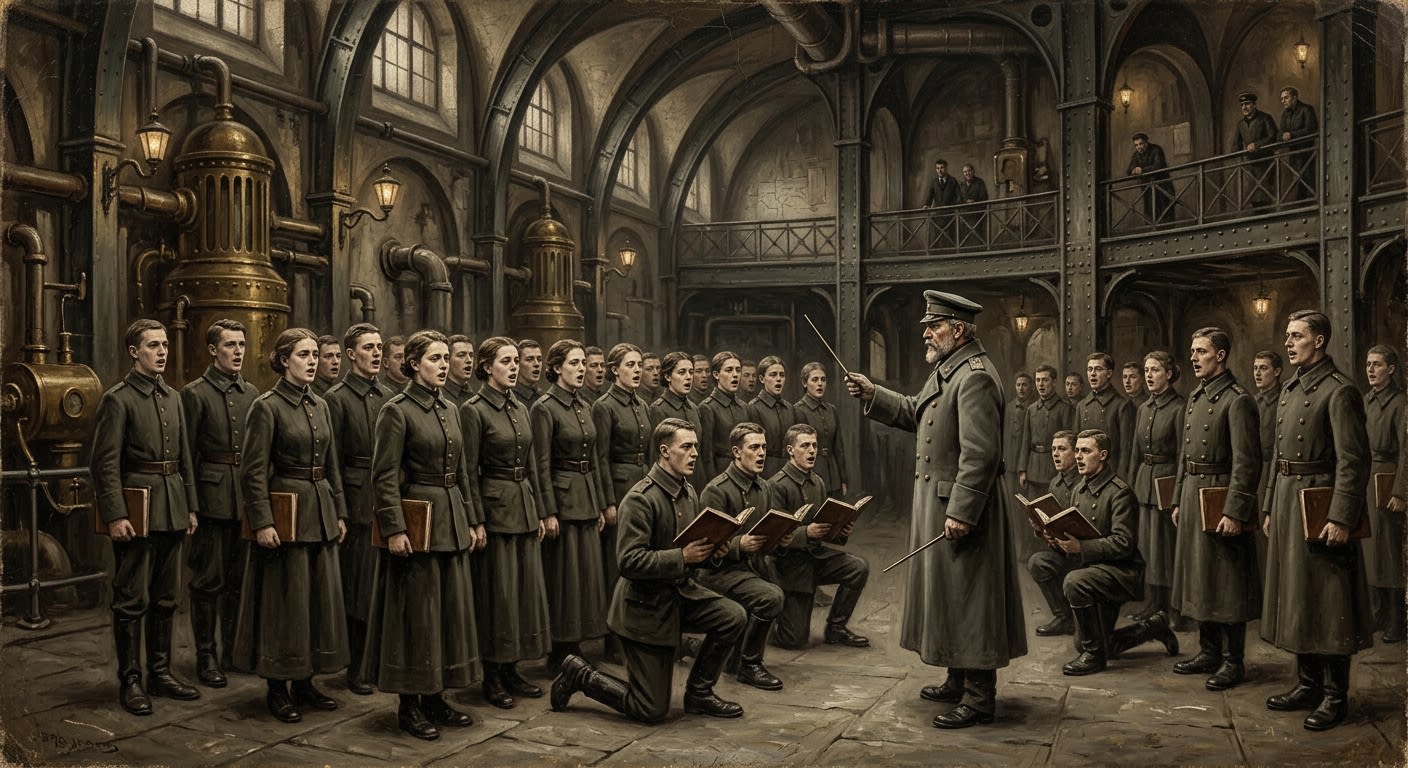
#On the House Where Joy Learns Its Chains
The Festival Conservatory of Strasbourg stands in the western quarter of Strasbourg, behind a façade of painted saints whose mouths are open in song and whose eyes have the disciplined misery of auditors. It is the training house of the Festival Chorus-Master corps, chartered under the Bureau of Festivals after the A.S. 72 ratification of licensed public celebration, and it has spent one hundred and twenty-nine years teaching clever young voices how to become instruments of Order without ever becoming music.
This is harder than it sounds. Music has instincts. Order has forms.
The Conservatory receives applicants from chapel choirs, tavern-license families, garrison bands, failed seminaries, orphanage recitation schools, and the occasional noble household whose fourth child has too much charisma to be safe at dinner. The Bureau calls them candidates. The older instructors call them throats. By graduation, the survivors have learned to conduct applause, ration laughter, bury grief inside approved antiphons, and watch a crowd with the tense affection a powder clerk shows a crate of sweating shells.
The Conservatory's purpose is simple enough for a wall motto: convert celebration into compliance. The motto over the main stair is longer, less honest, and cast in brass: GAUDIUM ADMINISTRATUM, CIVITAS SERVATA — joy administered, the city preserved. Students touch the letters before examinations, because superstition is forbidden in all cases except those that improve punctuality.
#On the Four-Year Programme
The first year breaks the voice. Candidates arrive believing they can sing. The Conservatory corrects this by teaching them that singing is the least important use of the throat. A throat may summon, soothe, command, bait, pace, indict, distract, and cut. Song is merely the pretty costume these functions wear when citizens are watching.
They study liturgical theory in the morning, crowd psychology at noon, bell-harmonic compliance under gaslight, and catechism dramaturgy until even their dreams enter on cue. They learn the safe intervals of Bells, the prohibited rhythms of the Bureau of Orison and Song, the riot profiles of market squares, pilgrim yards, trench depots, factory chapels, and ports where sailors have money, knives, and opinions. They copy the Prescribed Ovation Index until their fingers cramp. Fourteen seconds for patriotic hymn, bastion garrison. Seven seconds for approved comedic interlude, palms only, no stamping. The page is ludicrous. The punishment for laughing at it is instructive.
Second year teaches the baton. Third year teaches the ledger. Fourth year teaches fear. Fear is the senior discipline, the choir-master beneath the choir-master, the thing that keeps a hand steady when two thousand citizens decide, at once, that they would like one more chorus.
#On the Practicum of Living Inspection
The final-term practicum is the Conservatory's sacrament of controlled cruelty. Each candidate conducts a live festival performance before a real audience and a panel containing three Purity inspectors, two Doctrine auditors, one Bell representative with a tuning fork, and at least one Attendance Auditor who looks disappointed before anyone has done anything. The candidate must manage script, choir, crowd, timing, bell-space, improvised coughs, weather, vendors, crying children, overzealous pious widows, and the one old man in every square who believes all pageantry improved under a dead regime.
Survival constitutes graduation. Excellence constitutes suspicion.
PRACTICUM INCIDENT ABSTRACT — YEAR SEALED Candidate permitted audience laughter to continue beyond Index margin during comic burial scene. Purity note: “contagion possible.” Festivals note: “morale yield remarkable.” Doctrine note: █████████████████████████████ Disposition: candidate deployed to Zone 4 trench circuit; audience re-interviewed by ward
The practicum divides the future corps with beautiful efficiency. The Pure Conductors reveal themselves by cutting applause too early and receiving high marks from the sort of examiner who mistakes cold hands for clean ones. The Mercy Maestros reveal themselves by letting one true line pass under cover of doctrine, then spending the oral defence pretending the line meant less than it did. Both may graduate. The Bureau requires both, though it has the decency to be ashamed of the fact in private memoranda.
Older Conservatory prospectuses promised “formation in sacred art.”
Corrected. The institution forms licensed civic pressure officers with choral competence. Sacred art is permitted only when it can be made to carry a form number.
#On the Halls and Their Instruments
The building itself is a lesson in supervised appetite. Rehearsal chapels occupy the north wing, their altars removed and replaced with conductor platforms, their confessionals retained for post-performance admissions. The Harmonic Court sits under a copper dome tuned to expose unsafe intervals; students who sing wrong notes hear them return from the ceiling like little indictments. The Script Furnace burns rejected jokes at dusk. The Baton Gallery displays cracked rods recovered from failed festivals, each tagged with location, casualty count, and the final approved cue.
The old theatre beneath the east hall is called the Mouth. No official map labels it. Students descend there in fourth year to rehearse crowd panic under gas jets, bell interruption, false heckling, staged fainting, and Counter-Toll overwrites. The acoustics are vicious. A low word crosses the pit and returns as accusation. One class emerged from a three-hour Riot Simulation unable to speak above a murmur for six days, which Records praised as “useful retention of lesson.”
Beside it lies the Costume Lock, the Permit Sash Room, the Fork Cabinet, the Ledger Nursery where first-years practise counting heads from moving sketches, and the small infirmary for throat-bleeds, baton fractures, stage fright, and the ordinary collapse of students who discover that public happiness is a machine with teeth.
#On the A.S. 194 Graduation
I attended the A.S. 194 graduation, which is why the official account is unusually accurate. Forty candidates crossed the stage. The quota was sixty. The Bureau blamed the shortfall on inadequate enthusiasm among applicants, a diagnosis of such clean idiocy that I nearly applauded outside the prescribed interval.
The ceremony began with a hymn to measured joy, followed by the recitation of corps slogans: Rejoice by permission. Laughter is a loan; repay it in obedience. One chorus, one creed. No unscheduled encore. Parents watched from the side galleries under notice that spontaneous cheering would be classified as familial interference. Three mothers wept within parameters. One father exceeded by nine seconds and was escorted to a correction alcove, where he apologised to a clerk who had never produced anything but forms.
The graduates received permit sashes, throat-chain tokens, sealed script knives, and their first postings. Eight to bastion plazas. Twelve to pilgrim-route festival grounds. Seven to port carnivals under tight police. Nine to trench morale shows. Four to provisional office work because their examiners disliked them but lacked evidence. Twenty absences remained on the printed programme, blank lines where names should have been. The Bureau did not call them failures. It called them “unrealised placements.”
#On Present Condition
As of A.S. 201, the Conservatory remains overburdened, under-admitted, acoustically excellent, morally bruised, and administratively proud of all four conditions. Its annual target remains sixty graduates. It produces forty in a good year. The deficit is patched with provisional licensees, old Pageant Captains, exhausted choir-wranglers, and men sent back from the front with enough voice left to frighten children into rhythm.
A Bureau staffing note classed the twenty-candidate annual shortfall as “non-critical.”
Withdrawn. The shortfall is critical wherever a square has no trained hand at the moment laughter becomes cadence. The fact that Strasbourg survives the shortage does not make the shortage harmless. It makes the provinces absorbent.
The Conservatory graduates conduct celebrations for people they are not permitted to celebrate with. That is the wound at the centre of the school, and the school knows it, and the students learn to dress the wound in tempo marks. They stand before crowds and produce relief they cannot share, grief they must measure, laughter they must cut, obedience they must make beautiful enough to swallow. A few become Pure. A few become Mercy. Most become tired.