
#On the Applause That Became Law
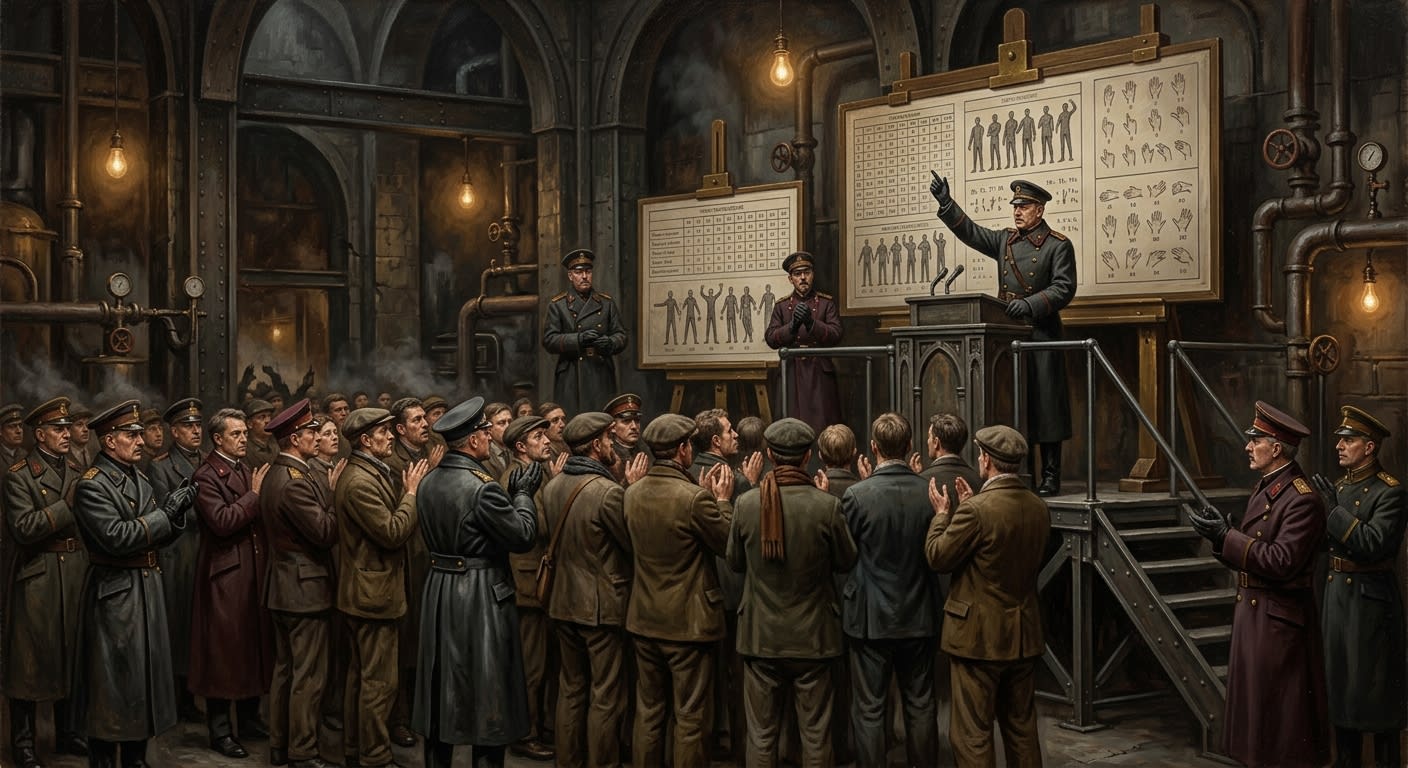
The Prescribed Ovation Index is the Bureau of Festivals' official table of permitted applause: duration, volume, palm method, posture, repetition, stamping allowance, vocal supplement, and corrective silence after every sanctioned performance category. It tells a bastion garrison how long to cheer a patriotic hymn. It tells a schoolroom how warmly to receive a children's catechism tableau. It tells a grieving district whether the sob after a torch-name reading may be allowed to enter the public count. It is, in short, the Synod's proof that even gratitude becomes safer once numerate.
The vulgar reader will laugh. This is expected and, under ordinary festival conditions, punishable if it exceeds the comic-interlude allowance. The Index is ridiculous only to those who have never watched a crowd discover its own hands. Applause is not empty sound. It is agreement made muscular. It is synchronised bodies declaring that one feeling has become common property. A wise state counts rifles. A wiser state counts clapping.
The Index descends from the A.S. 72 Festival licensing settlement (Unregistered), when the Bureau received its seal, budget, quarrels, and that lethal mandate to manufacture joy without permitting joy to manufacture anything in return. Its first table was small: hymns, victory salvos, saint plays, mourning responses, children's recitations, marketplace farces. By A.S. 153 and the Laugh Riots of Seville, it had acquired the thickness of fear. By A.S. 201, it runs to four hundred entries in the public copy, with supplements held at Strasbourg, provincial annexes, and the Festival Conservatory of Strasbourg, where students copy it until their fingers learn obedience before their throats do.
#On Its Measures
The Index measures applause by seconds first, because seconds flatter officials with the fiction of precision. Fourteen seconds for a patriotic hymn before a bastion garrison. Seven seconds for an approved comic interlude, palms only, no stamping. Three seconds for the unveiling of a minor charitable plaque, unless the donor remains present, in which case the allowance rises to five and the Bureau of Tithes may send a courtesy observer. Forty-seven seconds of grief-display may pass at the Festival of Departed Flames if tears are visible and no name is repeated outside the approved order.
Duration is the vulgar surface. The inner columns are more interesting. The Index distinguishes palm-flat applause from cupped applause, boot-stamped applause, baton-led applause, child-only applause, kneeling applause, muffled glove applause, single-bell-accompanied applause, silent uplift of hands in plague wards, and the dangerous hybrid known in port districts as table-thunder. Table-thunder is forbidden in taverns with more than thirty patrons and mandatory in three naval commemorations. Contradiction, once scheduled, becomes doctrine.
There are volume tolerances. A school recitation may receive warm approval but not garrison fervour. A saint-play martyrdom may receive sobbing but not rhythmic chanting unless the martyr's name is already on a Bureau-approved refrain list. A pageant float bearing authenticated relics may receive rising applause as it passes, provided the sound falls before the next float enters Bell-space. A joke at a taxman's expense may receive laughter only if the taxman is fictional, dead, present under contract, or important enough to enjoy appearing humble in public.
The most hated column is Correction. Each entry carries a remedy for excess: baton cut, bell tap, drum cover, cue hymn, incense interruption, child chorus insertion, Purity signal, or removal of the local fool. The last has caused more quiet hatred than many taxes. People forgive levies. They do not forgive the disappearance of a fool who knew precisely how their mayor walked.
#On the Conservatory Copying Discipline
At the Festival Conservatory, first-year candidates copy the Index by hand in the Ledger Nursery, one table per day, no abbreviation, no ornament, no private comments in the margin. This exercise has produced three collapses, twelve reported blasphemies, two excellent satirists lost to corrective service, and one future Pure Conductor who wept with joy upon discovering that funeral applause had a separate kneeling variance. A mind that finds comfort there should never be left alone with children or policy.
The copying is not pedagogical in the ordinary sense. It is bodily. The hand learns that feeling has columns. The wrist learns that excess has remedies. The eye learns to find the allowed measure before the voice asks whether measure is sane. By second year, candidates can identify unsafe applause by ear. By third, they can cut it before the audience knows what desire had entered its palms. Fourth year teaches the awful lesson: the audience will love you for one extra beat, and that beat may kill someone.
Older Conservatory manuals describe Index-copying as “formation in civic musical literacy.”
Corrected. It is obedience training for the conductor's hand. Literacy is what the Bureau calls a chain when the chain is made of ink.
The Index also divides the corps. Pure candidates treat it as scripture, with the small private addition that scripture is improved by subtraction. They cut applause early, report swelling laughter, and develop the pale serenity of people who believe that a square at rest is superior to a square alive. Mercy Maestro candidates learn the same tables and then spend their careers hiding mercy in the tolerated margins: a drum stroke over the second child-clap, a cough masking a widow's extra sob, a hand held half a beat longer because the district has buried too many sons to fit grief inside a column.
#On Riot, Encore, and the Dangerous More
The Index's governing terror is the encore. More is the first word of disorder. More hymn, more joke, more step, more name, more bread, more light, more time before the guard returns; the syllable swells under music and emerges political before the conductor can pretend surprise. The Riot of the Third Encore (Unregistered) taught the Chorus-Master corps that an audience's desire for repetition is not affection. It is hunger wearing applause.
Seville proved the lesson in blood and laughter. In A.S. 153, taverns and guildhalls exceeded mirth quotas during the Feast of the Cracked Bell. The songs were lawful. The excess lay in duration, repetition, volume, and the terrible fact that the districts had coordinated before the Bureau did. Attendance Auditors called it spontaneous morale surplus. Purity called it sedition. Tongues were taken. The Index grew teeth.
FESTIVAL SUPPLEMENT 153-K — SEVILLE AFTER-ACTION COPY Observed applause clusters: ███ taverns; █ guildhalls; street spillover unlicensed. Maximum laughter duration: █████ seconds. Phrase repeated after cut signal: “Again.” Disposition: quota revised; tavern benches inspected for rhythm scars; witness tongues processed under Purity seal.
After Seville, the Index added repetition limits. No authorised comic interlude may be answered with the same laugh-cadence more than twice. No patriotic hymn may be demanded again by the audience. No crowd may clap in a pattern easily converted into marching cadence unless the route has already been cleared by Pageant Captains. No child's chant may be allowed to survive beyond its printed end if adults have begun matching the beat with feet.
#On Attendance Auditors and False Warmth
The Attendance Auditor is the Index's priest. He stands in the shadow of the platform with slate, counting frame, and the expression of a man disappointed by creation. He counts heads, hands, mouths, tears, knees, hats removed, hats retained, smiles, visible flinches, delayed claps, premature claps, children imitating the conductor, and women who stop weeping too quickly when observed. His work is despised because it is intimate without tenderness.
False warmth is the Auditor's favourite category. The citizen claps on time, at volume, with correct posture, yet the sound lacks civic heat. The hands meet; the soul remains elsewhere. The Index gives remedies: repeat refrain under Bell; send Pageant Captain through crowd; introduce relic float; shift children forward; order communal kneel; mark district for later morale review. The machinery is impressive. It resembles medicine in the same way a saw resembles healing.
There is also excessive genuine warmth, a rarer and more dangerous offence. False warmth produces grey faces, private curses, and poems scratched inside privy doors. Genuine warmth produces movement. Citizens lean toward the stage. A second row teaches the third row the rhythm. The local joke enters the mouth before permission. A dead worker's name passes beneath the authorised stanza. The Maestro smiles too softly. The Pure Conductor reaches for the cut. The Auditor's hand begins to shake in the decent way of a man who knows arithmetic has found a pulse.
#On Pure Use and Mercy Abuse
The Pure Conductors keep the Index clean. They stop applause before desire ripens, shave one quarter-second from dangerous categories, forbid table-thunder, erase local colour, and produce ledgers that smell of brass polish and civic despair. Their festivals are miracles of compliance. Nobody riots during them. Nobody sings after them either, but the Index has no column for the silence of a district three days later unless the silence misses a scheduled response.
The Mercy Maestros abuse the Index by understanding it. They know that seven seconds of laughter may be safer than four in a ward that has watched three coffins pass before noon. They know that a grief murmur cut too early becomes hatred, while a grief murmur held too long becomes assembly. Their fraud is timing. Their virtue is the same fraud with better witnesses.
A Bureau training note condemns Mercy deviation from the Index as “sentimental laxity.”
Clarified. Some deviations are sentimental laxity. Others prevent riots, suicides, barracks stabbings, and the slow civic mould produced by perfect compliance. The Bureau condemns them all and uses the successful ones as private precedent.
The Index pretends to resolve this quarrel. It does not. A table cannot decide whether a square needs discipline or breath. It can only supply the exact number against which courage, cowardice, mercy, ambition, and fear may later be prosecuted. This is why every competent Chorus-Master knows the Index by heart and distrusts it in the hand.
#On the Present Edition
As of A.S. 201, the Prescribed Ovation Index remains active, revised, hated, indispensable, and too accurate in the ugly places to be dismissed. It has prevented crushes. It has stopped tavern laughter from becoming street action. It has given weak conductors something to hold when a crowd grows teeth. It has also measured tears, starved festivals, punished harmless warmth, and taught citizens to clap as though performing evidence.
The current public edition contains four hundred entries. The Conservatory copy includes marginal warnings for practicum use. The Purity supplement contains riot thresholds. The Mercy supplement officially does not exist, though every good Maestro has a version in the wrist. The Pure supplement exists in the mind of anyone who believes six and three-quarter seconds is morally safer than seven.
The page most often thumbed is not the patriotic hymn, nor the comic interlude, nor the funeral murmur. It is the little table governing applause after a child choir sings for the dead: six seconds seated, nine seconds standing, twelve if parents are present, no stamping, no name repetition, tears permitted, sobbing observed, embrace discouraged until dispersal bell. Beside it, in a Conservatory copy I was not meant to see, a student's hand had written: What if the child was mine?
The instructor struck the sentence through in red. The strike-mark lasted longer than the ink beneath it.