
#On the Nature of the Ash-Reader
"Truth burns. Use the ash." — Recovered graffito, cellar wall, Cologne District Nine, A.S. 188. The wall was demolished. The phrase persists.
The Synod does not acknowledge the existence of the Ashen Circle. This is policy. The Bureau of Silence classifies references to the Circle under Standing Order 12-C(Amended) — "Unsanctioned Intellectual Associations, Category Two" — and the Bureau of Purity maintains a dossier on their activities that it simultaneously denies maintaining and updates quarterly. I have read the dossier. I have also read the denial. Both are competent works of fiction, though the dossier is the more honest of the two.
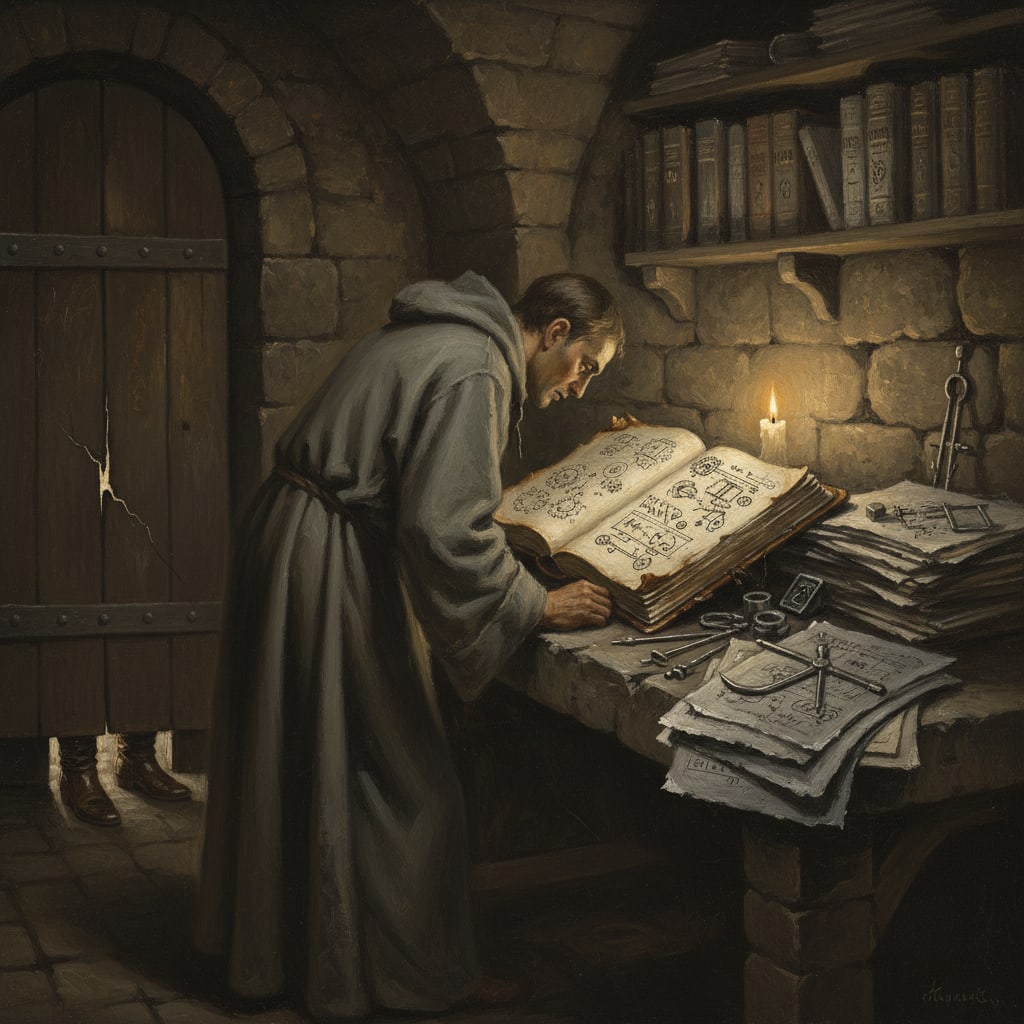
The Ashen Circle Scholar is a creature of the gap between what the Synod burns and what the Synod needs. He is — and I will use the singular, though the species is distressingly plural — a historian, a chemist, a theologian of precisely the wrong persuasion, and a thief of the most dangerous commodity the Sagittal Line produces: knowledge the Index Damnatus has declared unfit for human consumption. He buys charred diaries from burn-pits. He lifts margin-notes from monastery walls with lemon-juice and patience. He smuggles what the Bureau calls "dead sciences" — astronomy, pre-Sundering engineering, heretical medicine, the forbidden mathematics of trajectory and tensile strength — in the bindings of approved scripture, between the endpapers of licensed hymnals, inside hollowed prayer-books whose devotional exteriors would pass any Inquisitor's casual inspection and most Inquisitors' careful ones.
The Bureau calls them poison. The front calls them indispensable. Both are correct, and the contradiction sustains the Ashen Circle as surely as coin.
#On the Origin of the Circle
"Ash is humility; the faithful study only what survives purification." — Bureau of Doctrine, Catechism, Third Revision, A.S. 104
The Ashen Circle began as a reflex — the involuntary flinch of literate men watching libraries burn.
The great purges of the early Synod era — the systematic destruction of Rationalist academies, the bonfire-by-bonfire dissolution of every library the Republic had assembled, the confiscation and melting of every instrument the academies had calibrated — produced, in their thoroughness, precisely the shortage they were designed to prevent. When the Bureau of Engineering needed stress calculations for the first Sagittal Line revetments, the calculations had been burned. When the Bureau of Medicine needed a Rationalist treatise on field amputation during the Belgrade cholera of A.S. 67, the treatise was ash in the Forbidden Stacks. When the bell-founders of Essen required the alloy ratios the Rationalist metallurgists had perfected — ratios the Synod's own smiths could not reproduce by prayer alone — the ratios were sealed under triple lock in a vault whose key had been ritually destroyed.
The men who retrieved these things — who sifted burn-pits for legible fragments, who bribed archivists for classified folios, who memorised pages they were forbidden to remove and transcribed them by candlelight in rented cellars — did not call themselves a Circle. They called themselves desperate. The name came later, coined by the Bureau of Purity in an interdiction report of A.S. 103: "an ashen circle of scholars whose knowledge is drawn from the residue of righteous conflagration." The scholars, with the gallows humour that is the profession's only reliable benefit, adopted the name as their own.
#On the Great Purge of Margins and the Fever Winter
Two events fixed the Circle's shape from a loose fraternity of scavengers into something the Bureau of Purity would learn to fear.
The first was the Great Purge of Margins — a campaign in the middle decades of the first century A.S., in which the Bureau of Silence discovered that approved texts held in monastery scriptoria had acquired, over years of use, handwritten annotations in their margins. Glosses. Corrections. Observations that, in their cumulative precision, amounted to an unauthorised curriculum. A monk in Trier had annotated a hymnal with acoustics equations. A clerk in Ghent had filled the margins of a Doctrinal commentary with observations on tidal patterns that contradicted the Bureau of Rites' approved lunar calendar. In Strasbourg itself, a copy of the Articles of Covenant was found with the word incorrect pencilled beside the Third Article in a hand no one could identify.
The Bureau of Silence responded with characteristic restraint: it ordered every monastery in the Rhineland to surrender all annotated texts for "doctrinal auditing." Forty-seven scribes were executed for the annotations. The texts were re-copied, clean, by licensed Redactors, and the originals consigned to the Forbidden Stacks.
The scholars who had been annotating those margins went underground. They stopped writing in books that could be confiscated. They developed lemon-ink — invisible until heated — and ash-paper, charcloth sheets that burned at a touch and left no legible residue. They wrote in cipher. They distributed knowledge in fragments, each man holding a piece, no man holding the whole. The Great Purge of Margins did not destroy the Circle. It taught the Circle how to survive.
The second event was the Fever Winter of A.S. 112 — a typhus outbreak that swept the Hinterland garrisons and killed four thousand soldiers in six weeks. The Bureau of Medicine's sanctioned treatments — prayer, fasting, and the application of blessed salt — achieved nothing. In the Rhineland district of Halle, where the fever burned hottest, a woman named Gerda Weil — a midwife whose grandmother had kept a Rationalist medical text hidden in a bread-oven for sixty years — prepared a decoction of willow bark and boiled water that reduced the fever in seventy percent of cases. The Bureau of Purity arrested her. The Bureau of Medicine quietly copied her formula. The soldiers lived. Gerda Weil did not — she died in a cell in the Paper Mines of Ulm, A.S. 114, of the same fever she had taught others to treat.
The Ashen Circle regards Gerda Weil as its first proper martyr, though she never heard the name and would not have recognised the organisation. The Bureau regards her as an anecdote. The soldiers she saved regard her as nothing, because the Bureau of Records expunged her name from the garrison's medical logs and replaced it with "treatment administered per Bureau of Medicine Protocol 7-C(Emergency Revision)." The protocol was published in A.S. 113 — one year after Weil's arrest — and its willow-bark decoction is, ingredient for ingredient, the formula she smuggled out of a bread-oven in the Hinterland.
Stamped Erratum — Bureau of Medicine, A.S. 113: Replace all references to "folk remedy, source: civilian, unverified" with "Bureau of Medicine Protocol 7-C(Emergency Revision), origin: internal research, A.S. 112." Correction applied to 47 garrison medical logs. Civilian source identity reclassified under Standing Order 14-D(Amended).
#On the Hierarchy of Ash
The Circle is organised by function, each rank defined by what it risks.
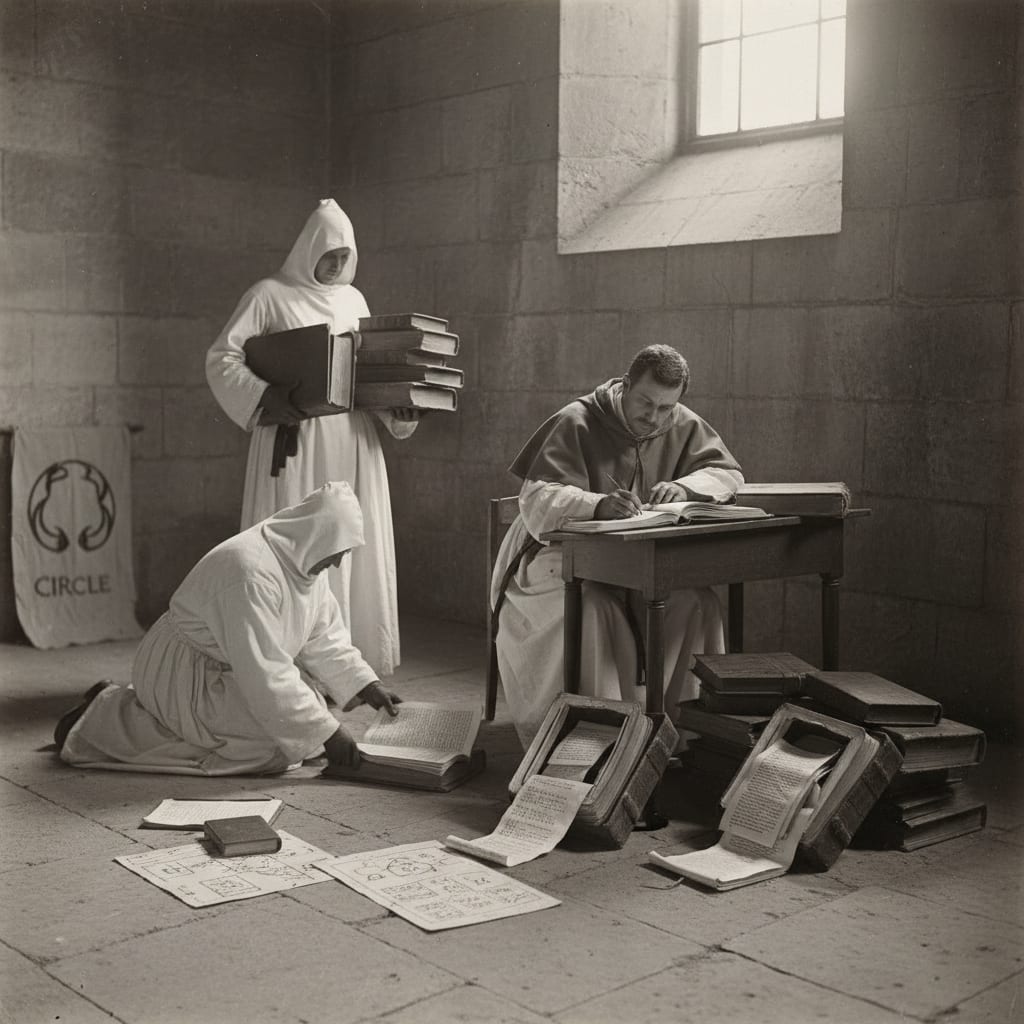
At the bottom: the Ember Copyist, who memorises and transcribes. A copyist is a pair of eyes attached to a reliable memory and a steady hand. His job is to read a forbidden text — once, under candlelight, in a cellar whose location he will forget by morning — and reproduce it from memory before dawn. The good ones are accurate to ninety percent. The excellent ones are accurate enough to save a bridge. The poor ones are caught, and the Circle does not mourn them publicly, because mourning is evidence.
Above: the Soot Annotator, who codes and sanitises. The Annotator receives raw transcriptions from the Copyists and wraps them in doctrine — translating heretical findings into language that will pass a casual audit. A Rationalist stress calculation becomes "a meditation on the load-bearing properties of Providence." An astronomical observation becomes "a reflection on the Creator's arrangement of the celestial firmament, offered in the spirit of devotional wonder." The Annotator's art is the art of the lie that tells the truth — and the Bureau of Purity, which employs a similar art in its own propaganda, recognises a competitor when it sees one.
Above that: the Circle Scholar, who controls a domain. Medicine. Engineering. Bell acoustics. Relic interpretation. Each Scholar maintains an index — a private catalogue of forbidden knowledge in their field, cross-referenced, annotated, and hidden in locations the Scholar alone knows. The Scholar decides what is preserved and what is too dangerous to keep. This is the rank at which the Circle ceases to be a smuggling operation and becomes a governing body — for a man who decides what knowledge survives is a man who decides what the world can build.
At the apex — or in the pit, depending on one's theology — sits the Ash-Master. An Ash-Master runs an index across multiple domains. He is a librarian of the forbidden, a curator of the burned, a man whose head contains enough classified knowledge to warrant execution several times over and whose continued survival depends entirely on his usefulness to patrons who cannot afford to acknowledge his existence.
#On the Patron and the Paradox
The Ashen Circle survives because the Synod cannot afford to destroy it.
This is the paradox the Bureau of Purity prefers not to examine and the Bureau of Silence has classified as "institutionally sensitive, pending further review." The Circle's patrons are not heretics. They are Bishops-Praetorial whose fortifications require calculations the doctrine cannot supply. They are Bureau of Medicine surgeons whose patients die when prayer is the only available anaesthetic. They are Bureau of Engineering draughtsmen whose bridges collapse when built according to "divinely inspired" ratios rather than the Rationalist mathematics the Bureau has forbidden. They are, in short, the Synod's own officers — men who enforce the Index Damnatus by day and consult the Ashen Circle by night, and who sleep, one presumes, with the same dreamless competence they bring to their professional contradictions.
The payment is never coin. Coin is traceable. Patrons pay in access — archive passes, warehouse keys, exemption papers, the name of the next scheduled Interdiction raid so the cell can relocate before the Lictors arrive. The most valuable currency is a single piece of information: which documents the Bureau of Silence is about to reclassify. For a reclassification stamp — as the deployed Bureau of Silence's own records inadvertently admit — tells the Circle precisely what the document contained before it was rendered unreadable. The Bureau's classification system is the Circle's acquisition catalogue, and the Bureau has spent a century trying to solve this problem by adding more classification levels, which produces more stamps, which gives the Circle more data.
#On Dr. Marrow Vask and the Index of Safe Lies
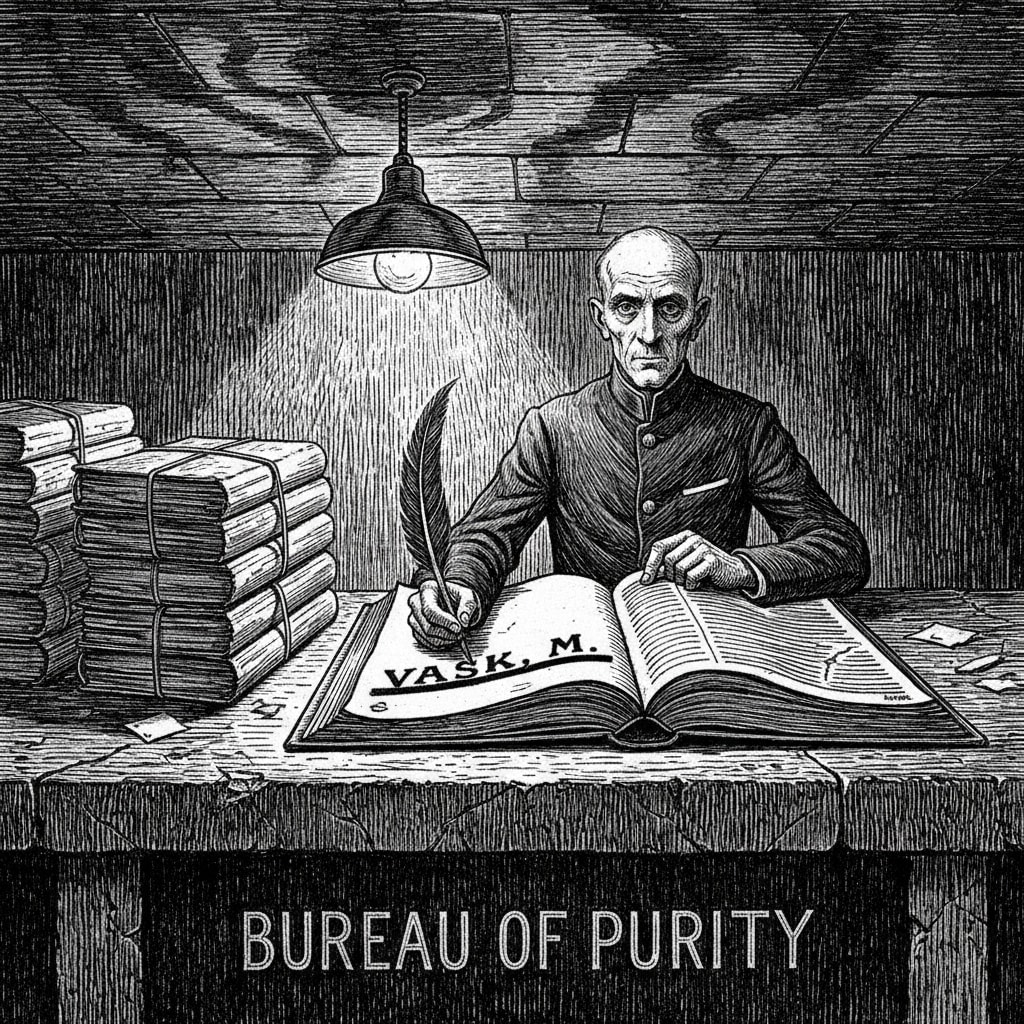
Every profession requires its founding martyr, and the Circle's is Dr. Marrow Vask — chemist, physician, and the author of a document the Bureau of Purity has burned eleven times and the Ashen Circle has copied twelve.
Vask was a Rationalist-trained physician who survived the Collapse by the simple expedient of removing his Academy robes and walking into a Synod field hospital during the Great Retreat of A.S. 48. He treated wounds for three years under the name "Brother Matthias" before the Bureau of Medicine noticed that his treatments worked consistently better than anyone else's and began asking questions. Vask responded by writing the Index of Safe Lies — a compendium of Rationalist medical, chemical, and engineering knowledge rewritten in doctrinal language, each forbidden truth wrapped in a scaffold of approved theology so that a reader could absorb the science without ever encountering a sentence the Bureau of Doctrine could condemn.
The Index of Safe Lies circulated for nine years before the Bureau of Purity identified its author. The trial lasted two days. The execution lasted longer — the Bureau, in a fit of thematic precision, burned Vask on a pyre made from confiscated Rationalist texts, thereby destroying six hundred pages of irreplaceable pre-Sundering agricultural science along with the man who had been trying to preserve it. The Circle considers this the Bureau's most expensive bonfire. The Bureau of Agriculture, had it still existed at the time, might have agreed.
Vask's Index survives. Every copy is hand-transcribed, and every copy contains small errors — introduced deliberately by the copyists, each error different, so that if a copy is captured, the Circle can trace which cell produced it and which cells remain secure. The errors are never in the medical sections. The Circle's commitment to practical accuracy does not extend to theological camouflage, which they regard as decorative rather than functional.
#On the Present Condition
"We do not believe. We test." — Attributed to no one, found everywhere, denied by all.
The Ashen Circle operates in every major Synod city, every bastion garrison, and every industrial centre where the gap between doctrine and necessity produces a market for forbidden competence. The Bureau of Purity estimates their numbers at three hundred active scholars and perhaps a thousand auxiliary operatives — copyists, couriers, safe-house keepers, bribed clerks — though the Bureau acknowledges that its estimates are based on captured operatives' confessions, and captured operatives are trained to exaggerate their own importance while minimising their network's extent. The real number could be half that, or three times.
Between A.S. 195 and A.S. 200, the Bureau of Silence's Interdiction Squads apprehended forty-seven Circle operatives across six provinces. The contraband recovered tells the story the Bureau would prefer remained untold: seven hundred pages of pre-Sundering engineering diagrams — stress calculations, bridge geometry, metallurgical tables — that the Bureau of Engineering's own archives no longer contain. Two hundred pages of astronomical observation the Bureau of Doctrine classifies as "cosmological heresy." Forty-three medical treatises. And one complete copy of a Rationalist cookbook that the Bureau of Purity, in a moment of bureaucratic poetry, classified as "gastronomic sedition."
The operatives were sent to the Paper Mines of Ulm, where they now produce the very pulp from which the Bureau of Silence manufactures its redaction-grade vellum. The heretic's labour contributes directly to the erasure of heresy. The Bureau finds this satisfying. The Circle, I suspect, finds it instructive — for a man who makes the paper on which his own knowledge will be erased understands the Synod's economy of truth more intimately than any catechism could teach him.
The Ashen Circle will persist as long as the Synod burns faster than it builds. The Synod needs bridges. Bridges need mathematics. Mathematics is heresy. The Circle sells heresy wrapped in prayer, and the Synod buys it with one hand while burning the sellers with the other. The arrangement is inefficient, expensive, occasionally fatal, and — in the considered opinion of the Warden of the Sacred Ledger — the only reason several of our bastions are still standing.
The Bureau of Purity is welcome to prosecute me for that observation. I have tenure, and my ledger is heavier than theirs.