
#On the Discovery of Unlicensed Thought
The Great Purge of Margins began in A.S. 56, when the Bureau of Silence discovered that approved books had continued behaving like books after approval. This offended Silence deeply. A licensed text may be read, copied, kissed, shelved, processed, indexed, audited, and invoked in committee; it may not answer back in pencil.
The first seizure occurred in a Rhineland scriptorium outside Trier. An Audit-Cantor opened a hymnal of the Third Revision (Unregistered) and found, beside an antiphon on obedient resonance, a series of acoustics equations written in a monk's small brown hand. The equations were correct. This made them worse. Error can be corrected. Accuracy without permission has to be punished.
Within six weeks, annotated texts appeared in Ghent, Mainz, Cologne, Strasbourg, and seven houses of copying whose names were later removed from their own lintels. Glosses had become maps. Margins held tidal observations, fever intervals, bridge ratios, bell harmonics, crop timings, old surgical cautions, and one note beside the Third Article of Covenant that read simply: incorrect.
#On the Monastery Sweep
Silence responded with the restraint for which it is not known. Every monastery in the Rhineland received a surrender order requiring all annotated books, copied folios, commentary sheets, sermon drafts, music leaves, account ledgers, herbals, bell charts, and devotional scraps bearing unofficial marks. The order used the phrase doctrinal auditing, because even execution prefers a clean collar.
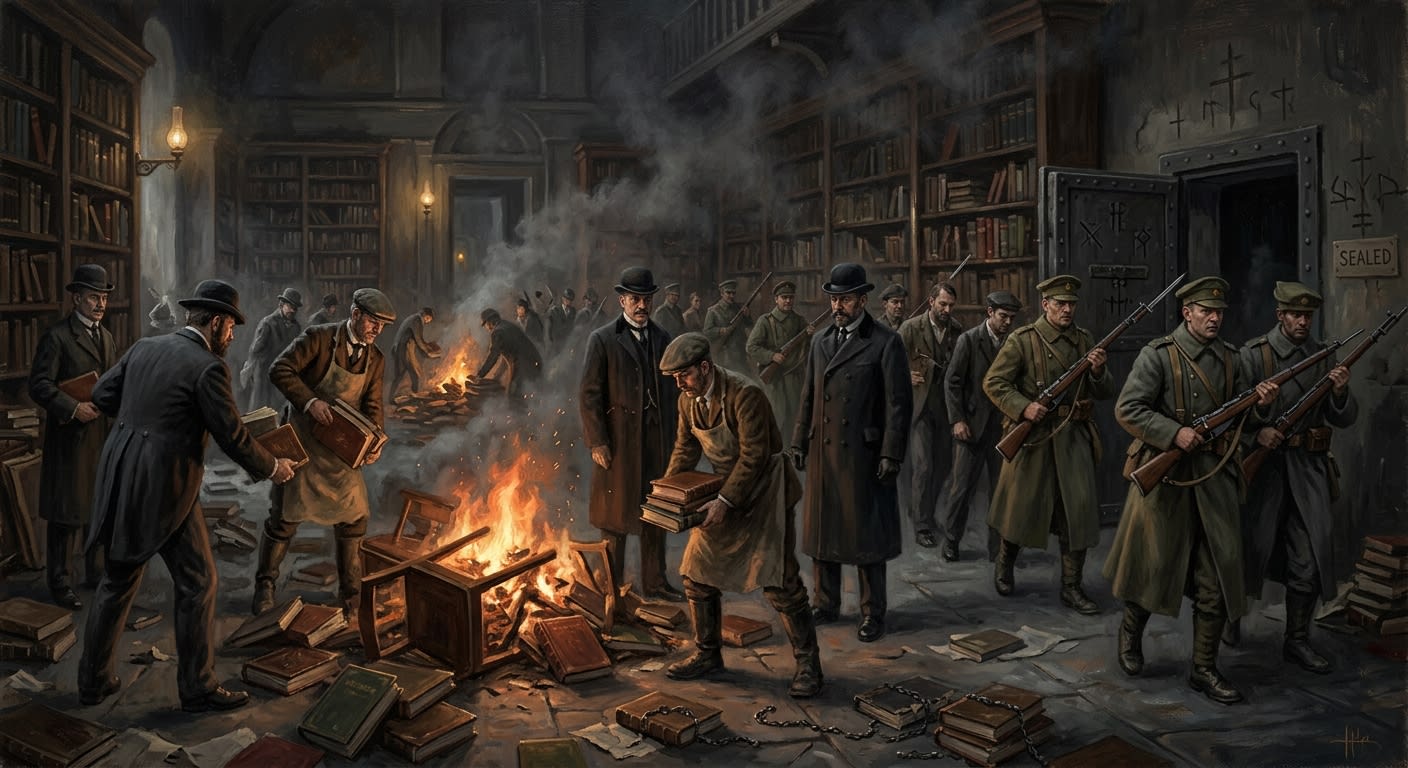
The Redactors (Unregistered) arrived with carts, wax, knives, ash tubs, and the patient cheer of men about to ruin civilization in alphabetical order. They separated approved text from living use. They cut endpapers, scraped boards, split bindings, warmed pages over candles to test for lemon-ink, and examined the dust under reading desks. A margin, once noticed by Silence, ceases to be a margin. It becomes a border dispute.
Early Silence circulars described the campaign as a “limited correction of scribal exuberance.”
Corrected. Forty-seven executions, twelve confiscated libraries, and three wagonloads of seized commentaries exceed exuberance. The responsible phrasing clerk has been commended for optimism and denied access to numbers.
Forty-seven scribes were executed. The number appears in three ledgers, each with a different heading: sedition, contamination, instructional irregularity. None says scholarship. Bodies were hanged in scriptorium courtyards while apprentices recited the approved prayer for clean copying. The books were re-copied without glosses by licensed Redactors. The originals went to the Forbidden Stacks, where dangerous knowledge is stored for officials trusted to misunderstand it usefully.
#On What the Margins Contained
The Purge is misremembered as a literary scandal. That is sentimental nonsense. The margins contained no little sighs from bored monks. They held working memory: practical notes passed through generations of copyists who knew that an approved book survives longer than an honest one. A commentary on fasting held fever diets. A psalter held bridge-load figures. A saints' calendar held crop rotation warnings disguised as feast corrections. The dead sciences did not hide in laboratories. They hid beside prayers because prayer had shelf rights.
This was the first lesson the later Ashen Circle learned from the Purge: survival belongs to the permitted container. A forbidden theorem in a forbidden book dies quickly. A forbidden theorem tucked beside a dull homily may live long enough to save a wall, a harvest, a regiment, or the career of some pompous official who will later denounce the hand that preserved it.
The Bureau also learned, though less well. It learned that blank margins were safer than written ones. It did not learn that knowledge deprived of margins migrates elsewhere. Thought is vermin with a doctorate. Block one hole; it chews behind the altar.
CATALOGUE FRAGMENT — STRASBOURG HOUSE OF CLEAN COPYING Item 17: Articles of Covenant, Third Article marked incorrect in unknown hand Associated marginal cipher: [removed] Witness statement: “The mark was already there when the page dried.” Disposition: book sealed; witness transferred; scriptorium floorboards lifted and burned
#On the Birth of Ash-Paper
The Great Purge did not destroy the Circle. It taught the Circle how to have no margins.
After A.S. 56, scholars stopped trusting books with visible edges. Lemon-ink spread through cellars and rented rooms: pale writing that appeared under heat and vanished under panic. Ash-paper followed, charcloth sheets stiffened for brief use, black already, eager to become proof of nothing. Cipher wheels entered the trade. Bone needles allowed binding swaps without fresh cuts along the spine. A novice learned to burn his own notes before he learned whom to trust, which was merciful, because trust is a more expensive habit than fire.
Knowledge changed shape. A single formula became six fragments held by six people who disliked one another by design. A bridge ratio travelled as a hymn correction, a bread recipe, a date error, and a sermon joke. A fever remedy hid in a laundry tally. The Bureau had attacked handwriting. The scholars answered with distribution.
#On the Bureau's Victory
Silence declared victory in A.S. 58. This declaration deserves preservation as an example of how language can kneel before stupidity without noticing the posture. The campaign had removed visible annotations from approved scriptoria. It had executed forty-seven scribes. It had produced clean copies, clean shelves, clean catalogues, and clean reports. It had also created the conditions under which the Ashen Circle ceased being a habit among scattered scholars and became an operating method.
Before the Purge, forbidden knowledge sat in margins where any half-attentive auditor might find it. After the Purge, it moved through people, recipes, codes, memorised sequences, false citations, and devotional casing. Silence forced the transition from annotation to conspiracy. The Circle owes the Bureau a founder's garland. The Bureau may collect it at Ulm, if it enjoys damp paper and laughter.
A later Purity manual credited the Great Purge of Margins with “substantially reducing the Ashen Circle's textual capacity.”
Corrected against subsequent interdiction evidence. The Purge reduced visible capacity. Invisible capacity grew teeth.
The monk of Trier was dead. His equations survived. The Ghent tidal notes were confiscated. Their conclusions appeared, ten years later, in harbour schedules attributed to administrative prudence. The marked Articles of Covenant vanished into a sealed file. Copies of the word incorrect began appearing in Circle cellars as a greeting, a warning, and a little blasphemous joke at the expense of everybody with a seal.
#On Its Present Use
As of A.S. 201, the Great Purge of Margins remains an approved example in Silence training lectures, where it is presented as a successful containment of monastic irregularity. The lecture omits ash-paper. It omits lemon-ink. It omits the forty-seven bodies unless the audience requires stiffening. It omits the uncomfortable fact that modern Interdiction Squads now search for techniques invented because the first sweep was so thorough.
The Interdiction Squads still warm pages over candles. They still inspect bindings. They still scrape marginalia from monastery walls. The Ashen Circle Scholar still uses the Purge as a catechism in reverse: what can be seen can be seized; what can be seized can be burned; what can be burned must already have been copied elsewhere.
The Purge succeeded in one respect. Approved books are cleaner now. Their margins stand white, obedient, sterile, and dead. The knowledge that once lived there travels in warmer vessels.