
#On the City That Keeps Its Oven Warm
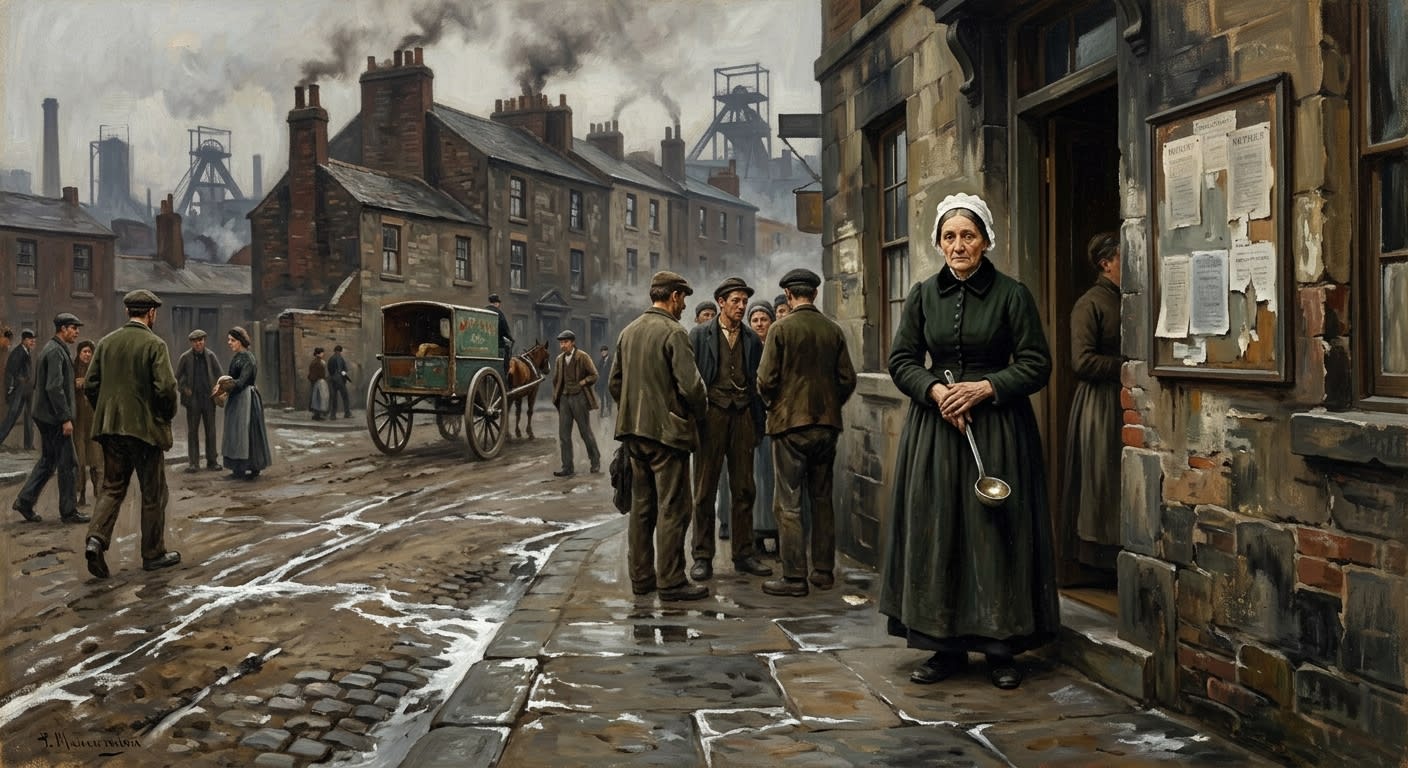
Halle sits where piety, salt, fever, chalk, and useful dishonesty have all discovered one another and agreed to share a street. It is a city of rear garrisons, market oaths, hospital wards, school lanes, grain stores, sermon walls, and domestic ovens that have learned more statecraft than several provincial governors. Official maps describe Halle as a Rhineland district city of secondary rank, compliant, productive, and suitably corrected after prior disturbances. Official maps also describe marshes as dry when a bridge budget requires it. The map is paper. Halle is damp.
The city matters because its obedience has always arrived with a second copy hidden under the first. Halle recites the Eternal Creed at dawn. Halle supplies rear barracks for the Sagittal Line. Halle gave soldiers to the Fever Winter and a midwife to the remedy. Halle joined the Chalk Riots without missing the words of the Creed. Halle shelters Ashen Circle fragments in bread-ovens, stitch books, plaster walls, school slates, and the minds of old women who smile at inspectors with the serenity of loaded pistols.
A city that obeys badly can be corrected by force. A city that disobeys openly can be made useful by example. Halle's sin is more irritating: it obeys well enough to remain within the ledger and remembers enough to make the ledger nervous.
#On Salt, Stone, and Rearward Usefulness
Halle's first virtue is that it is useful without being glamorous. No bastion crowns it. No Sin-General names it as a beloved target. No imperial bridge sings over it in approved school engravings. It sits behind the hotter fronts and receives what the Line cannot hold at the edge: recruits, fever, storage orders, old guns, damaged boots, convalescents, widows seeking signatures, grain in transit, correction officers awaiting reassignment, and the unfinished paperwork of men whose bodies moved east faster than their records.

Rear cities imagine themselves safe because they are behind the wall. This is charming. The rear is where failures ripen. A front-line trench can lose a squad and call the matter weather. A rear city loses a ledger, a fever ward, a school creed, a market habit, and the failure acquires descendants.
Halle grew on salt, river trade, and the Bureau's appetite for places where men can be parked before becoming statistics. The old salt houses became store depots. The market yards became ration calibration courts. The parish schools became Creed nurseries. Warehouses along the Saale (Unregistered) took uniforms from Cologne, salted meat from disputed contracts, chalk consignments from Doctrine suppliers, and crates whose labels had been amended so many times the wood itself seemed ashamed.
The garrison belt east of the city is the reason Halle enters so many files with such a sour smell. The barracks were built in haste during the consolidation years after the Market Drift, expanded in A.S. 105 after the Street-Vicar charter made public compliance a mobile profession, and overfilled by A.S. 111 when levies destined for the Line arrived faster than quartermasters could pretend to house them. Wool stayed damp. Straw was reused. Lice commuted between bunks with the freedom of minor nobility. The city sold broth outside the gates and called it charity. The Bureau bought it in bulk and called it supply.
The city's districts grew around these uses. The Salt Rows (Unregistered), where old brine houses lean into alleys white with mineral dust. The Garrison East (Unregistered), where barrack roofs sag under requisition tar and boys learn to stand in lines before learning why. The Oven Quarter (Unregistered), a domestic maze of bakers, midwives, laundresses, and women whose cupboards survive inspections because men doing inspections rarely know where useful things are kept. The Chalk Lanes (Unregistered), named after the A.S. 119 disturbances and still patrolled with escort norms. The Red School Steps (Unregistered), where Creed recitation is drilled hard enough that children dream in call-and-response.
Halle is not beautiful. Beauty attracts patrons, invaders, painters, and other forms of vermin. Halle is efficient in the manner of a scar: ugly, informative, proof that something survived closure.
#On the Market Drift and Saint Oren's Failure
Between A.S. 98 and A.S. 103, Halle joined the Rhineland malaise now filed as the Market Drift Years. Doctrine prefers the phrase because drift sounds soft, nearly pastoral, like a boat moving away from the bank while everyone waves. What moved was public obedience. What failed was the Bureau's assumption that chapel discipline could be carried into streets by memory alone.
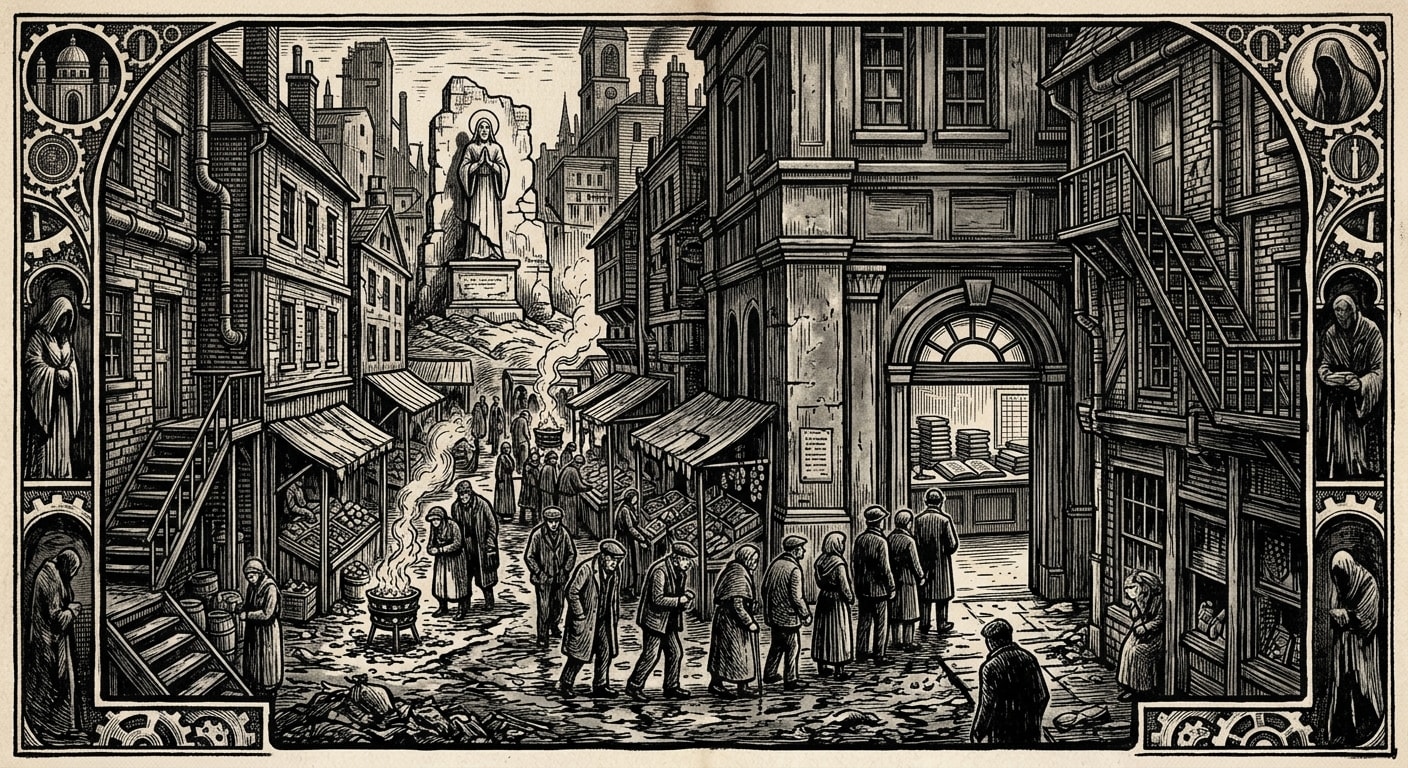
The markets were the first offenders. Trade closed with handshakes. Bread prices were sworn by weight rather than Creed-line. Men said “by my mother's grave,” which is poor doctrine and powerful negotiation, since mothers have done more verifiable work than several saints. Women haggled while omitting the third response. Children recited dawn lines correctly, then shortened them beside turnip carts for sport. Halle did not abandon faith. It reduced faith to chapel hours and private convenience. Doctrine hated this more than riot because riot at least admits the state exists.
District summaries once described Halle during the Market Drift Years as “infected by covert Rationalist agitation.”
Corrected. The city was infected by habit, hunger, jokes, short measures, tired feet, market impatience, and the discovery that a transaction could finish faster when the Creator was not asked to witness every onion.
Saint Oren of the Corner belongs to Cologne in the approved teaching, but Halle made use of him quickly. His gentler correction legend arrived in copied slips by A.S. 103, worn at the fold, repeated by Vicars who had not yet been called Vicars, invoked by women who wished a warning rather than a mark. Halle liked Oren because he corrected without taking names. Doctrine liked him because a soft saint can precede a hard office.
The Doctrine Street-Vicar Corps followed in A.S. 104 under the Catechism Third Revision. Halle received square-stops, chalk cases, token punches, correction slips, and men young enough to believe a raised hand could halt resentment. Public faith returned in measurable form. Records was delighted. Records should never be delighted without supervision.
By A.S. 108, Halle's market compliance rates had recovered. By A.S. 109, private jokes about the Vicars had acquired stable forms. By A.S. 111, children could identify the difference between chalk that stained wood deeply and chalk that washed before Compline. This is how a city learns a state: by residue rather than doctrine.
#On the Fever Winter
The Fever Winter of A.S. 112 burned Halle into the restricted medical memory of Europe. It began along the rear barracks east of the city, where levies slept in damp wool under roofs patched with notices, old prayers, and the sort of optimism that should be licensed as a toxin. Typhus travelled by lice, which have never needed papers. Within two weeks the infirmary straw was warm. Within four, bodies were stored outdoors because winter knew how to preserve evidence.
Four thousand soldiers died in six weeks across Halle and its associated Hinterland garrisons (Unregistered). The official treatments were prayer, fasting, blessed salt, and ward discipline. Prayer comforted the frightened. Fasting weakened the sick. Salt stayed salt. Ward discipline arranged dying men in rows so clerks could count them without walking too far.
Gerda Weil entered the ward with a pot. This remains one of the most offensive sentences in Bureau medical history. Salvation is meant to arrive by charter, escort, seal, lamp, assistant clerk, and a senior officer who can later claim foresight. Weil arrived from Halle's Oven Quarter, a midwife with a family-hidden Rationalist medical text, willow bark, boiled water, clean cloth, and the practical contempt of a woman who had watched babies survive men giving instructions from doorways.
She prepared bark-water on schedule. She boiled. She cooled. She repeated. Seventy percent of treated cases improved in three sealed Halle logs. The number was copied, challenged, buried, stolen, and made useful. Purity arrested Weil before the fever had finished its meal. Medicine published Protocol 7-C(Emergency Revision) in A.S. 113. The interval matched. The preparation matched. The source did not appear. The living took the draught. The woman went to Ulm.
The Fever Winter left Halle with two afterlives. The public afterlife teaches that the Bureau of Medicine refined emergency fever discipline after a costly but sanctified trial. The cellar afterlife teaches that a family text hidden in a bread-oven saved men while approved shelves remained locked. One lesson has lecture benches. The other has grandchildren.
#On Gerda Weil's Oven
The house where Weil's grandmother hid the Rationalist text no longer bears its original number. Three renumberings have occurred: one after the arrest, one after a Records correction, one after an overzealous District Doctrine Officer discovered that pilgrims had begun leaving willow twigs in the mortar cracks. The Bureau calls this civic hygiene. Halle calls it directions.
The oven was broken open by Purity. The bricks were removed, tagged, inspected, scraped, and stored in three separate crates because officials fear that an object divided into three pieces becomes less guilty. It does not. The Oven Quarter knows which bakery received the replacement bricks. The women there bake ration loaves with a darker crust on feast days. They deny this. Their denial smells of smoke and bark.
PURITY SEARCH APPENDIX — WEIL HOUSE, A.S. 112 Kitchen oven breach completed under warrant. Recovered: partial medical text, oilcloth wrap, bark scrapings, two child slates, birth ledger, heat-damaged marginalia. Marginal note visible before seizure: “Boil hard. Men will argue. Boil anyway.” Following domestic names transferred to derivative review: ███████████████████ Oven bricks disposition: divided; misfiled; one missing by A.S. 116.
The Ashen Circle made Weil into a martyr, which is both gratitude and theft. She was never an Ash-Master. She did not attend cellar councils, pass coded folios, or sign her name to forbidden indexes. She kept family knowledge alive and used it under pressure. The Circle requires a lineage; the Bureau requires a contaminant; Medicine requires an internal discovery. Halle requires none of these. Halle remembers a woman with a pot.
That memory is stubborn because domestic spaces defeat official imagination. Inspectors understand desks, shelves, trunks, sealed boxes, cabinets, writing tables, prayer stands. They understand ovens badly. They understand quilts worse. They understand midwives not at all. Halle has used this ignorance for eighty-nine years.
As of A.S. 201, the Weil name remains officially corrected and unofficially fertile. Children in the Oven Quarter play a game called Bark-Pot (Unregistered) during fever months. One child pretends to be a Wardmaster and objects. Another pretends to be Weil and hits him with a ladle. Doctrine has attempted to suppress the game twice. The second suppression failed because the assigned Vicar's mother had taught him the rules.
#On Chalk, Riot, and Correct Recitation
Halle's participation in the A.S. 119 Chalk Riots was smaller than Trier's and more revealing. Trier gave the Bureau a corpse in the Moselle, fourteen red doorframes, and the statistical embarrassment that every participant held current purity tokens. Halle gave something colder: coordinated devotional refusal.
The first news came through traders and Street-Vicar memoranda. Fourteen red marks in Trier. A dead Vicar by dawn. Cologne scraping lintels clean. Halle's Chalk Lanes answered with discipline. Crowds blocked Vicars from reaching marked doors while reciting the Creed correctly. Without anger or wrong cadence. Correctly. Line after line, voice after voice, so cleanly that the Cadence Examiner on duty had nothing to cite except obstruction, and obstruction spoken in flawless doctrine has a taste the Bureau dislikes.
Halle understood the weakness of the mark. Chalk speaks after the Vicar leaves; a crowd can answer while he is still present. Marking Vicars wanted public shame. Mercy Vicars wanted private correction. Halle supplied a third lesson: public shame can be surrounded by public obedience until the shame cannot move.
The A.S. 120 soft-marking reform (Unregistered) followed the full regional scandal. Chalk faded faster. Escort norms appeared. Patrol limits became custom, though never law, because law can be quoted by citizens and custom can be denied by officials. Halle's District Doctrine Office received two militia per high-risk patrol and three new boxes of yellow chalk. The records call this pacification. The market called it the year chalk learned to blush.
A Doctrine training sheet states that Halle was “subdued without concession” after the Chalk Riots.
Amended for instructors who can read between bruises. Halle's conduct helped force soft-marking reform, escort discipline, and patrol restraint. The city was subdued in the same sense a debtor is satisfied when the creditor changes the contract while pretending the old one was always generous.
#On Written Creed and Other State Property
The Eternal Creed is supposed to live in mouths. Its written form is sealed because a citizen who can consult the text may compare, question, copy, amend, forget publicly, remember privately, or discover that yesterday's correction has been adjusted today. The Synod prefers living tongues for daily obedience and locked pages for doctrinal ownership.
Halle produced the infamous tavern wall (Unregistered). The owner, whose name remains sealed because comic competence breeds imitation, wrote the entire Creed from memory in the back room of a salt-workers' tavern sometime after the Chalk Riots and before the A.S. 130 inspection cycle. He wrote it for practical reasons. Drunks forgot lines. Apprentices mangled responses. Street-Vicars made sudden stops outside. A wall is cheaper than a tutor.
He was arrested for possession of state property, inaccurate orthography, and overconfidence. The third charge is my favourite because it is the only one no defence counsel can honestly contest.
The wall was scraped, plastered, blessed, scraped again, and finally sealed behind a devotional panel depicting Saint Oren correcting a child. The child in the panel has one hand behind his back. Local tradition insists the hand holds chalk. The Bureau of Doctrine insists the hand holds nothing. The painter died before clarifying, an elegant service to ambiguity.
The tavern wall matters because it reveals Halle's operating principle. The city does not reject the Creed. It writes it where the Bureau has forbidden writing. It does not refuse correction. It arranges correction for use. It does not deny the Ledger. It keeps a household copy in case the official one arrives late, hungry, or wrong.
#On the Ashen Cellars
The Ashen Circle remains active in Halle as of A.S. 201, which is to say the Bureau has failed to burn all the right kitchens. Circle work in the city is medicinal first, mechanical second, doctrinal only when fools enter the room. Fever schedules pass as prayer rotations. Boiling instructions appear in marginal sermon notes under the heading purity of vessels. Bridge ratios hide in school geometry primers as meditations on the Creator's affection for triangles. The Index of Safe Lies circulates in fragments small enough to be eaten, memorised, or folded under a baby's swaddling cloth.
Halle cells are less theatrical than Strasbourg cells and less smug than Cologne cells. This is a mercy to literature. They prefer survival to manifesto. Ember Copyists here are trained to remember recipes by smell and ratios by kneading rhythm. Soot Annotators use household metaphors because household metaphors pass through male inspection unmolested. Ash-Masters rarely visit. Halle dislikes titles. Titles draw boots.
The Bureau's relationship with Halle's Ashen material is a disgrace with good penmanship. Purity raids, Silence classifies, Medicine copies, Doctrine condemns, Engineering asks whether any of the confiscated notes mention pump seals. A seized fever interval becomes a ward protocol three years later with improved grammar and no author. A water-cleaning method becomes a Bureau hygiene instruction after its heretical phrasing has been scrubbed off. A chalk counter-protocol becomes an internal Street-Vicar caution against overmarking. The city sins. The Bureau harvests. The sermon follows.
#On the Schools, Wards, and Salt Accounts
Halle teaches children as if every small mouth were a contested district. The Red School Steps face east toward the garrison road, so pupils recite the Creed while recruits march past in mud-coloured columns and cough into their sleeves. This arrangement is defended as civic instruction. It is also advertising. A child sees the soldier, the soldier hears the child, the Street-Vicar hears both, and the Bureau of Doctrine receives a little theatre of obedience at no additional cost.
Schoolmasters in Halle drill cadence with unusual severity. After the Echo protocols spread from Cologne, every class learned the eighth-beat pause, the double response after inspection chime, the shortened market form, the funeral form, the ration-hall form, and the emergency correction form used when a child forgets the line and begins crying before a Vicar can decide whether tears count as confession. The children learn quickly. Children always do, because fear is an excellent tutor and childhood has few bargaining rights.
The wards teach another lesson. Halle's garrison infirmaries no longer resemble the slaughter-pens of A.S. 112, though resemblance is a dishonest standard when the original was a crime with blankets. Boiling rooms operate under Medicine seal. Bark stock sits behind lock. Isolation screens are repaired before the smell announces failure. Nurses wash hands with a discipline once classified as Rationalist contamination and now praised as devotional cleanliness. The Bureau of Medicine calls this maturation. The Oven Quarter calls it belated listening.
Ward clerks maintain two registers: the public treatment roll and the practical shelf list. The first records authorised protocols, dosage categories, priest visits, confession status, and death disposition. The second records which kettle leaks, which orderly drinks, which patient responds poorly to willow, which sister can find clean cloth after midnight, and which chaplain should be kept away from fever men because his sermons raise pulse. The second register is more useful. Naturally, it is unofficial.
The salt accounts form Halle's third education. Salt is more than trade here. It is cure, preservative, tax medium, ritual prop, bribe, punishment, and municipal personality. Salt workers speak in measures older than the Synod and convert them to Bureau weights with faces blank enough to be hereditary. Tithes suspects shorting. Tithes is correct. The workers suspect Tithes of overweighing damp sacks. The workers are correct. Correctness on both sides has produced a stable civic peace, since everyone steals according to custom and only amateurs call it theft.
During inspection weeks, salt dust whitens the market gutters and makes chalk marks harder to read. This is officially incidental. Halle's salt-men shrug when asked why red marks blur faster outside certain warehouses. They blame mineral interaction. Doctrine requested an Alchemical Standards review in A.S. 187. The report concluded that salt, rain, limewash, and foot traffic may reduce chromatic persistence. Halle framed the report in three taverns until Purity confiscated the frames.
The Salt Rows also keep the city's quietest shrines. Little wall niches hold no saints recognisable to the Bureau of Relics: a burnt spoon, a child's fever ribbon, a chalk nub, a cracked token, a brick chip said to come from Weil's oven, though by present count her oven would have been large enough to bake a cathedral. Relics multiply when grief handles arithmetic. I have complained about this in other contexts. My complaint has achieved nothing, which places it among the more honest prayers.
#On the Present Halle
As of A.S. 201, Halle is compliant under review, productive under suspicion, corrected under protest, and healthy by methods no one in authority wishes to source too carefully. Its garrison wards are cleaner than their official funding explains. Its Street-Vicars mark fewer doors than quota theory predicts. Its markets recite the Creed with a speed that borders on insult. Its bakers keep ovens warm long after closing. Its children know which kind of chalk washes, which kind stains, and which kind should be ground under heel only after the escort has turned the corner.
The Bureau of Doctrine wants stronger Creed inspections. The Bureau of Medicine wants quiet access to old household remedies while preserving the fiction that old households contain only dust and disobedience. The Bureau of Purity wants three more interdiction teams and fewer nurses with opinions. The Bureau of Silence wants the tavern wall story cut from schoolyard rhyme. The Bureau of Records wants clean district numbers. Halle supplies numbers. Cleanliness costs extra.
There are cities that defy the Synod with banners. They burn quickly and make excellent cautionary art. There are cities that love the Synod loudly. They rise in funding tables and produce unbearable choirs. Halle has chosen the older craft: speak the Creed, hide the text, feed the fevered, misdirect the inspector, obey the mark, wash the chalk, remember the woman, warm the oven.
The city's current governor-clerk, Malrec Doss (Unregistered), has asked twice for permission to replace the old Oven Quarter inspection route with a wider survey grid. Both requests were approved in principle and defeated in practice by missing street plates, incorrect tenancy lists, funeral processions that formed at inconvenient corners, and one spectacular afternoon when every baker in the quarter reported chimney trouble at once. Doss suspects organised obstruction. He is correct, which is why he will be transferred once he proves it.
The Bureau of Doctrine's Halle file contains a phrase worth preserving: “obedience with undocumented residue.” I did not write it, though I respect the hand that did. It names the city cleanly. Halle gives the Synod the answer required, then leaves enough ash in the pan to prove another meal has been cooked.
At dawn the city answers the bell. At market the Creed runs fast, clipped by price calls and cart wheels. In the garrison wards, a nurse cools bark-water under a different name. In the Oven Quarter, a grandmother removes three loaves, taps the rear brick, and tells a child never to write what can be kneaded.