
#On the Fifty Kilometres That Pretend to Be Rear
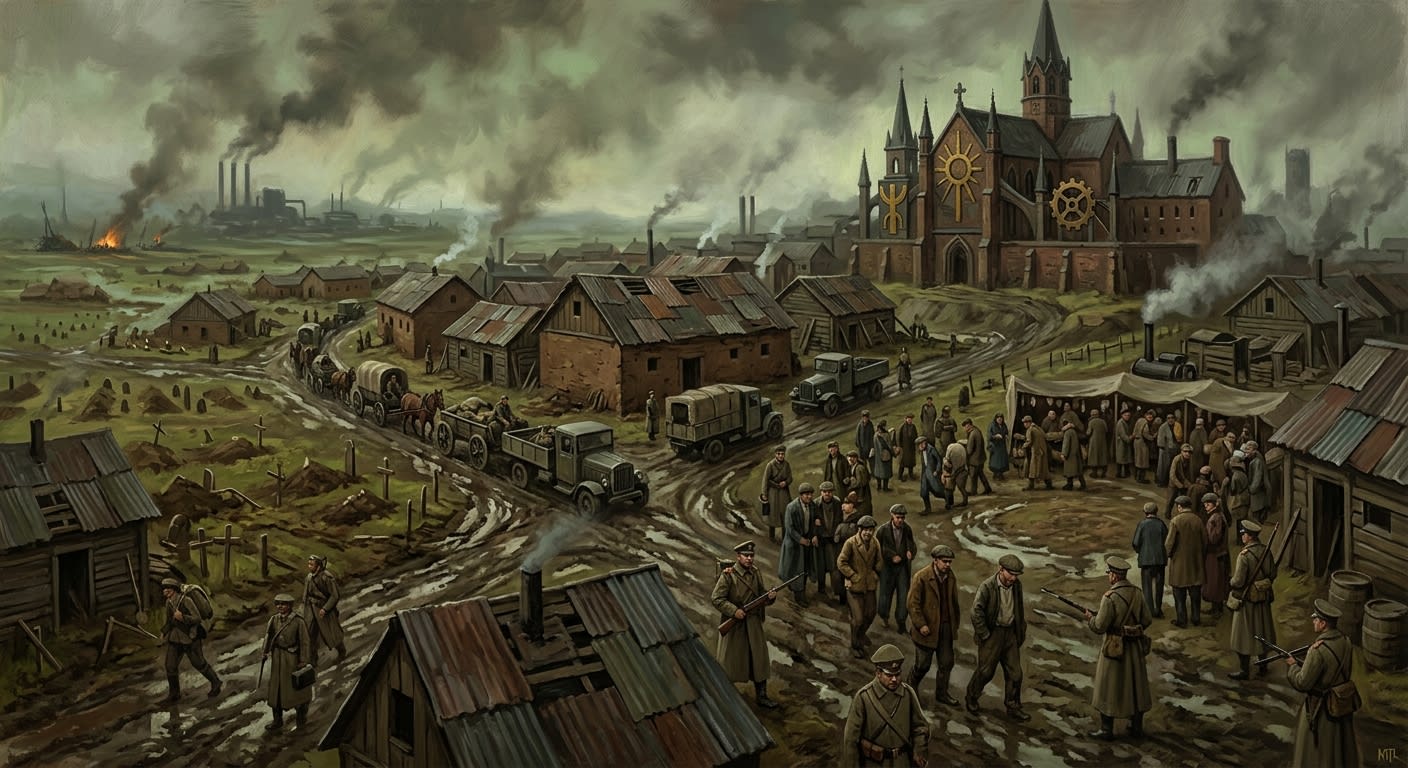
The Hinterland is the fifty-kilometre band behind the Reserve Lines of the Sagittal Line, where civilian life persists under permanent military occupation and is expected to call the condition protection. It is no province, no fortress, and no proper zone in the clean catechetical sense. It is the bruise behind the wound: farms, ammunition depots, field hospitals, grave-ring villages, shell foundries, reserve trenches, mule parks, fever barracks, chapel courts, orphan sheds, market strips, and the crooked little settlements that grow wherever soldiers are paid late and expect to die soon.
Maps dislike it. Maps prefer edges. The Hinterland is an argument between Settlement, War, Tithes, Records, Mercy, and the weather, carried out across lanes where carts sink to the axle and children can identify shell calibres by the way windows shake. Officially it feeds the Line. In truth it is eaten by the Line every morning and praised for productivity by noon.
#On Its Making
The Hinterland began as accident and hardened into category. When the Line fixed itself from Bastion-Königsberg to Bastion-Constantinople, armies required a rear: places for grain, horses, powder, fever, replacement men, broken men, repair shops, confession booths, corpse carts, and the wives and children who were told they would be safer just behind the guns than farther west where housing was already counted. Tents became sheds. Sheds became streets. Streets acquired shrines. Shrines acquired donation boxes. Donation boxes attracted Tithes. The state had arrived.
By A.S. 90, after the Concordat of Strasbourg, Settlement tried to make the band legible. It assigned holdings, marked convoy roads, registered village rights, and issued provisional residence permissions to families who had already buried three generations in soil now classified as temporary military support ground. By A.S. 112 the Hinterland had garrisons old enough to rot, hospitals crowded enough to breed doctrine-resistant fever, and farms so requisitioned that seed grain required escort.
Early Line catechisms describe the Hinterland as “rear support territory.”
Corrected. Rear support territory implies distance from battle. The Hinterland is battle translated into invoices, ward straw, harvest quotas, and children who play trench-court beside headstones.
The Fever Winter of A.S. 112 gave the band its first continent-wide shame. Around Halle and its associated garrison barracks, typhus killed four thousand soldiers in six weeks while approved treatment remained prayer, fasting, blessed salt, and the orderly arrangement of dying men. Gerda Weil entered with willow bark and boiled water; Purity arrested her; Medicine stole the method; soldiers lived under Protocol 7-C; the Hinterland learned that a cure may be contraband until an office prints it.
#On Farms Under the Gun
Hinterland farms are zoned as agricultural land by Settlement, taxed as productive land by Tithes, requisitioned as military asset by War, and mourned as family land by people whose opinions do not appear on the forms. A field may produce rye, graves, unexploded shell, fever weeds, and one son per levy season. The file calls this mixed yield.
The farmer rises by bell and watches the horizon before the weather. Eastward smoke means convoy delay. Westward dust means inspectors. A silent road means either peace or an ambush far enough away that the sound has not arrived. His barn may hold grain on Monday, wounded men on Tuesday, ammunition on Wednesday, and refugees on Thursday. On Friday the Assignor arrives and informs him that the barn has always been a temporary reserve structure requiring corrected registration.
Women run much of the Hinterland because men are consumed forward in categories: conscripted, missing, reassigned, contaminated, buried, unlisted, medically retained, or present but useless after fog exposure. The wives of conscripts compute rations with a sophistication that would make Records blush if Records had blood left in its cheeks. They know which clerk counts sacks generously, which road marshal accepts eggs, which Mercy sister will certify a fever child without demanding a second witness, and which field priest has forgotten enough Latin to be kind.
Children learn the civic arts early. They can distinguish War horses from Tithes horses by saddle wear. They know which headstones may be used as goalposts and which must be left alone because the dead beneath them were officers and remain officious. They gather shell splinters for scrap, memorize safe ditches, carry water to ward tents, and play games that would alarm western schoolmasters if western schoolmasters did not benefit from the shells those children help sort.
#On Grave-Field Villages
Beyond the ossuary walls of the bastions lie grave-field suburbs, villages ringed with headstones until settlement and cemetery become a single administrative mistake. Families bury their kin in front plots because communal ground is distant, full, requisitioned, priced beyond decency, or speaking too often after dusk. Gardens grow beans beside names. Streets are paved with epitaph fragments too eroded to command respect and too stubborn to become rubble.
Doctrine approves the devotion when tithed. It condemns the same devotion when neglected. This is the correct distinction and the only one that matters to the annual assessment.
Mausolea become barracks. Crypt walls become windbreaks. Grave lamps become children's toys until the lamps begin misbehaving, whereupon they become evidence. Soldiers billeted beside ancestral coffins learn quickly that old families in the Hinterland answer to their dead more readily than to living officers. A captain may order silence. A grandmother can point to a stone and say, “He heard you.” The captain lowers his voice.
Records has relocated entire grave suburbs after tombs began speaking in names omitted from casualty rolls. Settlement files such movements as “cemetery adjacency corrections.” War calls them morale hazards. The villagers call them theft. The dead, on poor nights, call everyone.
#On Jurisdictional Hunger
The Hinterland is where Bureau authority overlaps until it bruises. War controls roads during alerts, depots during ration strain, barns during billet shortages, wells during fever, and people whenever it can borrow the word emergency. Settlement controls residence, or claims to. Tithes controls yield, including yield already eaten by War, yield spoiled by shelling, yield stored for seed, yield burned during retreat drills, and yield never planted because the farmer was requisitioned as transport labour. Mercy controls wards until the patients become corpses; Records controls corpses once named; Relics controls corpses if someone invents sanctity quickly enough.
JOINT JURISDICTION NOTE — HINTERLAND STRIP, A.S. 188 Case: three thousand displaced families after Constantinople redrawing cascade. Location: farmland belonging to neither old zone nor new zone due to A.S. 140 survey error. War position: temporary encampment, military responsibility denied. Settlement position: residence pending designation, support responsibility denied. Tithes position: taxable population present. Outcome: ███████████████████████████████████████
The Bureau of Settlement knows the scandal best because its maps fail there daily. The Assignors are thinnest where the need is greatest: edge-settlements, depot villages, grave-rings, refugee rows, and nameless markets around ammunition parks. An Assignor can declare a house invalid. He cannot make the family vanish unless War lends soldiers or Purity lends fear. Both are busy. Families exploit the delay with the quiet brilliance of the cornered.
Settlement abstracts once filed Hinterland unregistered dwellings as “temporary shelters.”
Revised. A shelter with a chapel, bakery, graveyard, market woman, three feuds, and a child old enough to lie about his birthplace is a settlement. The Bureau may dislike the noun. The noun has furniture.
#On Fever, Markets, and the Rearward Lie
Every Hinterland market smells of cabbage, lamp grease, damp wool, horse piss, powder dust, and bargaining performed under threat of requisition. Goods arrive unofficially because official convoys have priorities, and civilians rank below shells, saints, artillery oil, and whichever visiting prelate has mistaken hunger for atmosphere. Black-diesel distillers, name-brokers, permit sellers, coffin carpenters, willow-bark women, spare-boot boys, and discharged soldiers with one good hand flourish in the alleys between lawful stalls.
The garrisons call the market parasitic. The market calls the garrison thirsty. Both are correct by lunchtime.
The Fever Winter remains the band’s private scripture because it revealed the order of value. Soldiers mattered as bodies. Weil mattered as source. Her remedy mattered as instrument. Her name mattered only after the Ashen Circle made an accusation from it and Doctrine required a corrected denial. Fever has returned since A.S. 112 in lesser seasons: lice in barracks, bad water after shell rain, corpse carts delayed by ice, wards set in barns still smelling of grain. The protocol now exists. The fear that it was stolen exists more stubbornly.
#On the Present Condition
As of A.S. 201 the Hinterland remains held, productive, undercounted, overburied, and impossible to govern cleanly. Seventeen surveyed rear-echelon settlements show registered populations exceeding actual bodies by as much as forty percent. Elsewhere the reverse holds: unregistered communities feeding depots, repairing harness, laundering bandages, and raising children outside the Great Ledger of Souls until some clerk discovers them and calls discovery correction rather than embarrassment.
The band’s political danger lies in competence without permission. Hinterland people can move grain past a broken road, treat fever before Medicine arrives, hide children from bad quotas, reassign graves without Records, feed soldiers without Mercy, and run markets under shell threat. The Synod needs this competence. The Synod fears it. The contradiction is filed under resilience.
The A.S. 201 Settlement request for additional Field Rectifiers names the Hinterland as priority and then loses courage in its own appendix. It asks for survey teams, escort guarantees, ration reconciliation authority, emergency permit stock, grave-plot audit rights, and permission to override War road closures during census weeks. War struck out the road clause. Tithes struck out ration reconciliation. Records objected to emergency permit stock because emergency paper has a history of becoming permanent paper once citizens learn to hold it tightly. The surviving request asks for twenty-six clerks, two carts, and “improved weather.”
No one in Strasbourg laughs at this. Laughter would require recognising the joke. The Hinterland already has.
A western citizen imagines the front as a line where danger begins. The Hinterland knows better. Danger begins when the road receives a number, when the barn receives a requisition mark, when the baby receives a permit color before a name, when the dead in the front plot receive more visitors than the living in the house.
The guns are east. The war is everywhere within earshot.