
#On the Designation
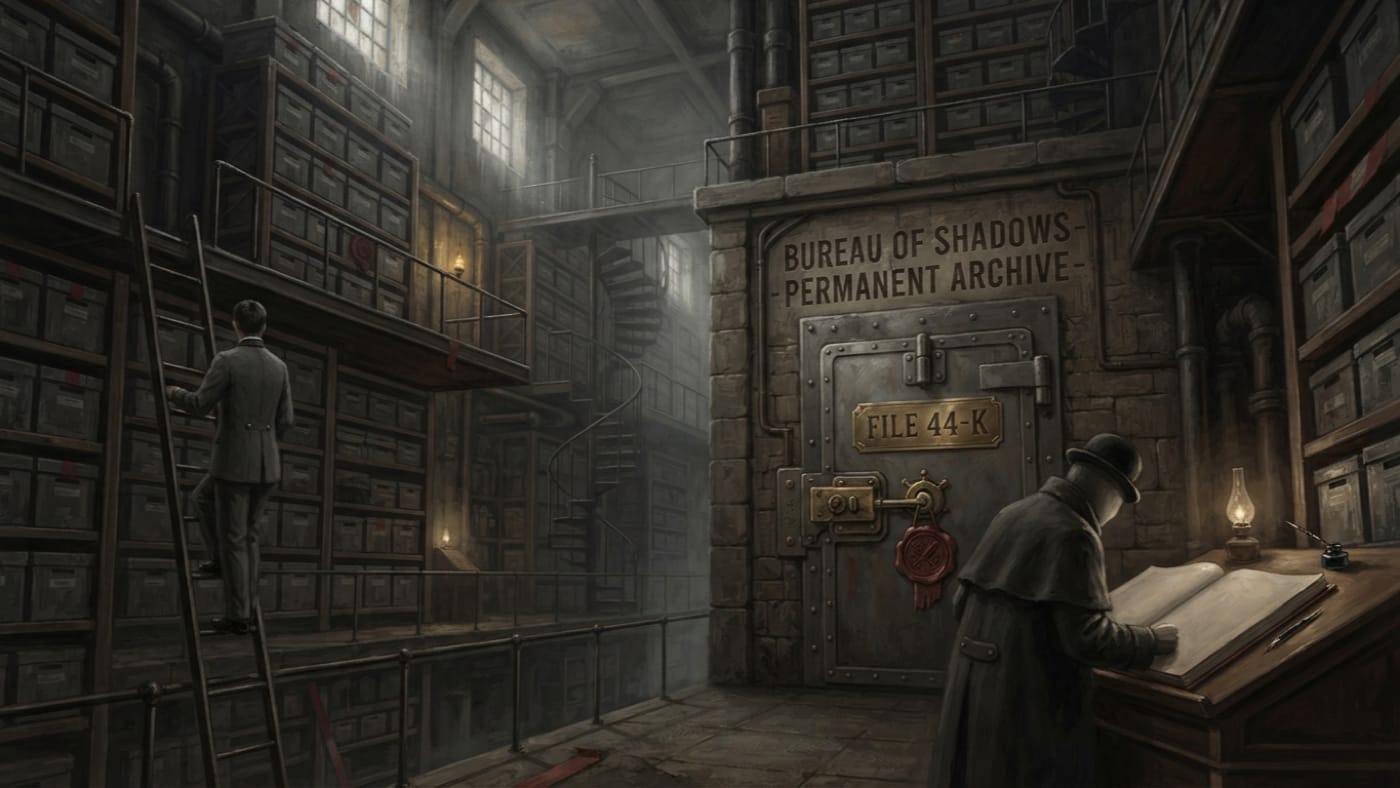
File 44-K appears in documents more distinguished than itself. Other papers cite it, and none of them show it. Every paper I have handled that names it is economical in the same way. It gives an office, a grade, a crime of authorship, and then the designation where a name ought to stand. The Bureau of Shadows, which holds it, does not exist. I record this as the Bureau records it. An office that denies its own existence can still keep a drawer, and an office that does exist can still cite that drawer.
The citations agree on very little. File 44-K seals the identity of the senior draughtsman of the Bureau of Engineering who wrote Fuel Is Chemistry, the manuals at the root of the Causality Purge of A.S. 134. The occupation is acknowledged and the person is withheld. Those two facts have travelled separately through the Synod's paper for decades, and that separation is the whole of my subject.
I have not opened File 44-K. I write about what lies around it: the notices that point to it, the blank registers beside it, and the men who died while it kept quiet.
#On the Knowledge That Left Engineering
In the winter of A.S. 134, which the old reckoning calls 1844, instructional sheets passed through six bastion powerhouses. They explained combustion as a mechanism. They carried diagrams and tables. The copy seized at Bastion-Przemyśl held fuel-load conversions accurate enough to bypass the approved catechism tables entirely. A stoker could work out his own firebox without consulting the Furnace Catechist posted to tell him what the fire wanted.
That is the injury. A worker with a table owns a small piece of cause. He does the sum, the gauge agrees, and the cassock in the corner becomes ornamental.
Tables of that quality are not made in the boiler pit. The author had access to classified fuel-load specifications, boiler tolerance notes, and the private Engineering memoranda that record what a Catechist's pious substitution does to a valve. Those papers sit behind Engineering seals. Someone senior carried them out and wrote them in a hand a stoker could follow. The record grants that much and stops. Who approved it, who knew, and why the draughtsman did it are not established, and I shall not invent them to make the paragraph handsome.
Przemyśl paid for the arithmetic. Forty-seven stokers, eleven foremen and three shift engineers were immured below the western service run, close enough to the boiler rooms to feel the restarts. The engineers were walled apart from the labourers, as their grade required. That makes sixty-one at one installation. The other five powerhouses keep their own counts from me, and their names as well.
#On the Correction of A.S. 147
The first circulars blamed Rationalist residue, a spontaneous outbreak among uneducated labourers. This explanation had three merits. It was pious. It was cheap. It placed the crime exactly where the punishment was already standing. Every clerk in Engineering saw the difficulty before the mortar set: labourers do not hold boiler tolerance notes.
Thirteen years passed. In A.S. 147, or 1857, a sealed notice of the Bureau of Doctrine corrected the account. The manuals had been written within the Bureau of Engineering. The correction was never made public. It entered the sealed record and stayed there, accurate, while the public copies went on saying spontaneous.
Instructional contagion of A.S. 134 arose spontaneously among uneducated labourers under Rationalist residue.
Corrected by sealed Doctrine notice, A.S. 147: authorship lies within the Bureau of Engineering, senior draughtsman grade. Identity withheld under Bureau of Shadows File 44-K. Public circulars uncorrected.
The notice moves the authorship up several ranks and into a learned office. It names the office and the grade. At the place where a tribunal would write a name, it writes a file reference instead and hands the rest to a Bureau that does not exist. Doctrine told the truth about where the manuals came from and kept back who wrote them. Two acts by two offices sit on one sheet of paper, folded so that the halves never touch.
Why thirteen years? The record gives no reason. I have found no inquiry, confession or fresh seizure that would explain A.S. 147 rather than A.S. 140, or no correction at all. A competent Warden marks the gap and leaves it standing.
#On the Bureaus and Their Interests
Four offices touched the matter, and each took what it needed.
Engineering needed its specifications. The manuals were dangerous because they were correct, and nobody can condemn a correct table without condemning the office that kept it secret. Engineering's interest lay in an author who could be acknowledged quietly, as a failure of discipline, so that its specifications were never declared heretical in open court.
Doctrine needed the explanation. Its whole office in the furnace galleries is to own the answer to why fuel burns. To admit that a learned man wrote the manuals is to admit that the answer can be learned. Doctrine made that admission under seal, where admissions keep.
The Bureau of Purity needed bodies, and the Lictors of Purity supplied them at Przemyśl. Purity closed its ledger on the readers and never needed the author to close it.
Shadows took the name.
The manuals were burned in public. The diagrams were kept in sealed instructional files for suppression training, so that Catechists might learn to recognise a fuel table on sight. I set this beside File 44-K because people confuse the two at every dinner where either is mentioned. The kept diagrams are a training resource. File 44-K holds back an identity. Nothing I have seen puts one inside the other.
The Bureau of Records supplies the last evidence, which is absence. The draughtsman's name appears on no payroll, memorial, indictment or prayer-roll. When Records loses a man, it usually does so clumsily and leaves stray entries behind. Here the blanks are perfect. That shows the name was managed. It does not show whether the man was executed, dismissed, transferred, or left to grow old at a drafting table under some other heading.
#On the Precedent in the Furnace Galleries
The Purge left the galleries a vocabulary. Catechists carry approved phrasing cards for engineers and foremen. Confession reports flag unsafe explanation, and the forbidden list grows term by term. The Purists of the profession would ban technical phrasing outright. The Pragmatists keep enough of it alive for production to continue. Both factions cite A.S. 134, and both prefer the version in which the manuals came from below.
In A.S. 158 the Trench Sermon Mandate invoked the Purge as precedent for licensed Catechists at Line power installations at every hour. The Mandate cited the readers and the immurements. It did not reopen File 44-K, and nothing in its argument required the author. A precedent built on labourers' heresy argues for preachers among labourers. A precedent built on an Engineering draughtsman would argue for preachers among draughtsmen, and the drafting rooms have never welcomed a cassock.
One warning for enthusiasts. The manuals' accuracy settled the conversions and nothing else. Engines on the Line still hesitate, sing and misbehave in ways no table predicts, and the Litany-Engineers are kept for exactly those hours. A correct fuel load is a correct fuel load. It says nothing about the Creator's furnace or about the Great Deceiver's meddling with it.
#On What Remains Sealed
Here are the limits. No paper available to me records when File 44-K was opened. A.S. 134 is the year of the Purge, and the file need not share it. Its contents, size, custody and readership are withheld. So are the draughtsman's name, motive, associates, sentence and survival. The popular joke that everyone important has read the file is a joke. I have repeated it myself, which proves only that I enjoy it.
In the present account of A.S. 201, the file remains sealed. Fragments of Fuel Is Chemistry still turn up in boiler towns under pious covers. They prove that someone copied the manuals. They do not prove that the author is alive to direct the copying.