
#On the Burn
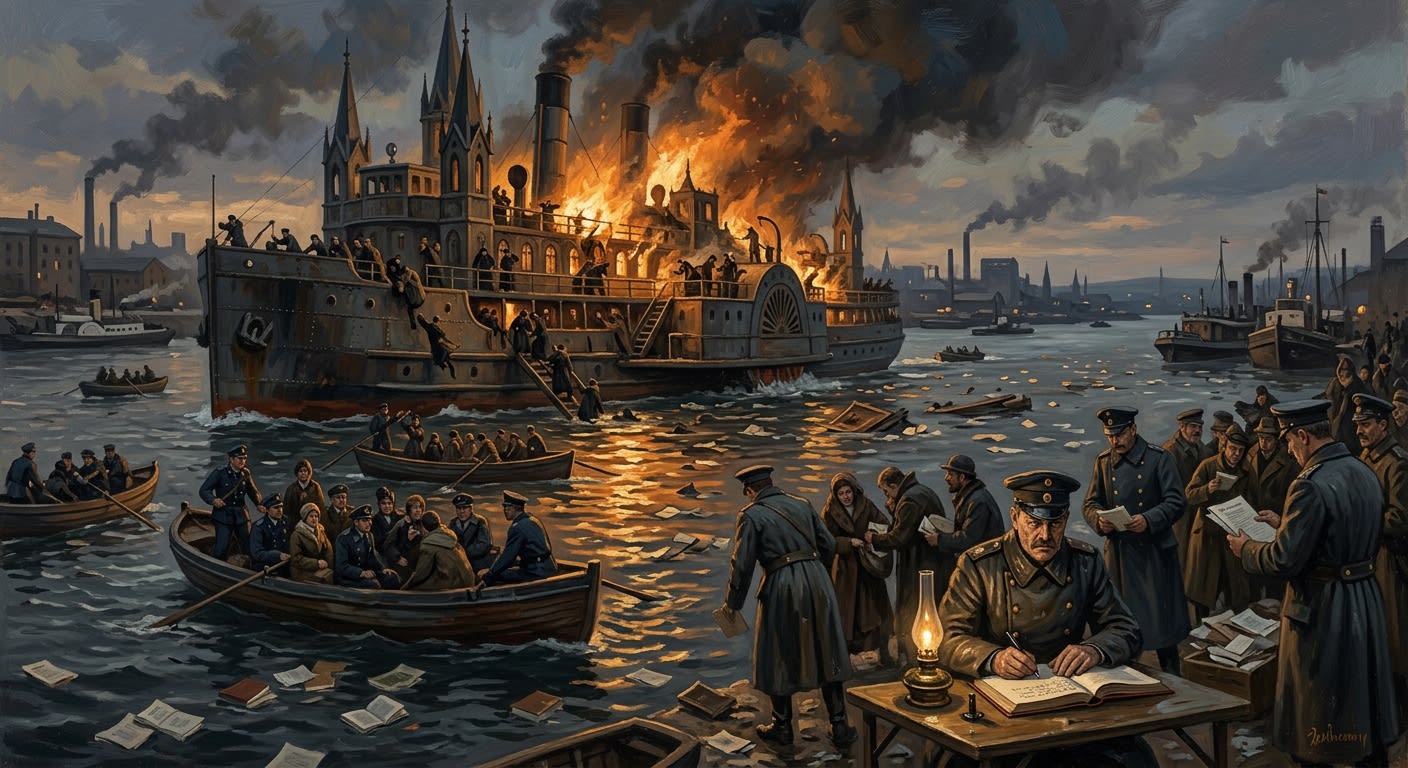
The First Floating Cathedral Burn belongs to the early A.S. 70s, when the Synod was still learning that a church placed upon water remains a church, a powder magazine placed beneath hymnal benches remains a powder magazine, and the combination of the two produces theology at a speed no committee can outrun. The vessel was a Danube shrine-barge, one of the experimental predecessors of the Shrine-Deck Crew and the later Processional Arsenal. It carried a chapel deck, hymn-screens, two light mortars, relic niches, a choir stall, rope-rail pilgrim space, and a captain with the imagination of a turnip.
The official cause was combustion. The actual cause was paperwork that had been made pious instead of accurate. Unlogged powder stores were discovered, too late, in a compartment the crew chief had designated “supplementary prayer supplies.” The phrase deserves preservation in bronze and public mockery. Forty-one men died. Hymnals were scattered across three kilometres of riverbank. The barge burned down to its ribs while the choir bell rang until its clapper fused.
The Danube carried pages downstream for two days. Villagers collected psalm leaves from reed beds, from fishing nets, from the mouths of drowned cattle. Several leaves bore powder burns shaped like fingerprints. The Bureau of War called this incidental. The Bureau of Doctrine called it symbolic after the first term proved insufficiently profitable.
#On the Barge Before It Burned
The early shrine-barges were ungainly creatures: chapel above, furnace below, mortar racks amidships, choir screen lashed against river wind, and storage compartments labelled by whichever Bureau had bribed the last carpenter. War wanted mobile guns. Orison wanted hymn carriage. Doctrine wanted visible reassurance. Tithes wanted every rail, bell, wax candle, and powder keg counted against somebody else’s purse. Engineering wanted fewer candles near powder and was ignored, which is the ancient condition of engineers until after the fire.
The Burn barge had been assigned to a river-route demonstration and pilgrim escort. Its crew had practised volley salutes, not sustained action. Its choir had rehearsed river hymns, not emergency evacuation. Its storemaster had maintained two ledgers: the proper inventory, which was incomplete, and the devotional inventory, which was beautiful, useless, and illuminated in red capitals by a man who should have been beaten with his own rubric brush.
Early memorial copies described the lost vessel as “fully provisioned according to sacred need.”
Corrected. It was provisioned beyond account, below inspection, and against sense. Sacred need does not require loose powder beneath hymn benches.
The compartment that doomed the barge sat under the forward choir platform, behind a reliquary screen dedicated to Saint Bartholomew of the Breech. Access required two keys, or one key and the usual sailor’s understanding of hinges. Inside were powder casks, spare fuse-cord, incense bricks, candle bundles, old banner poles, three damaged shell crates, and a small painted sign reading PRAYER SUPPLY — AUXILIARY. No surviving clerk admits to ordering the sign. Clerks rarely admit to authorship when authorship has developed teeth.
#On the Detonation
The first warning was smell. Not smoke; powder-sweat. A Powder Acolyte reported it to the crew chief, who told him to fetch the Ordnance Deacon. The Acolyte fetched the wrong man because the deck bell was sounding for a demonstration hymn and the barge had not yet learned to separate worship from alarm. By the time the proper seal-bearer reached the forward platform, heat had entered the hidden compartment.
The choir was midway through the third river antiphon. Witnesses on the bank remembered the voices rising cleanly above the engine clatter, then bending, then stopping as if cut by a hand. The forward deck lifted. The relic screen broke outward. Mortar casings went through the choir stall. A bell frame struck the water thirty yards from the starboard side and continued ringing as it sank, which the Bureau of Bells later classified as mechanically plausible and spiritually unhelpful.
RECOVERY FRAGMENT — DANUBE BANK, FILED UNDER WAR/ORISON JOINT LOSS Body twelve: hands blackened to wrist; mouth full of hymn-page pulp. Body nineteen: bell-rope wrapped twice around torso; knot tied after ignition or during fall. Recovered slate: “count after procession” written in grease pencil. Marginal notation: █████████████████ choir continued four measures after forward deck loss.
The blast ignited candle wax, incense stores, rope tar, altar cloth, and the foolish pride of every Bureau that had signed the vessel into service. Men jumped burning into the river and drowned under vestment weight. Men stayed aboard and burned where duty had nailed their boots. Men vanished into an administrative category meaning the pieces were too small and the official too tired.
#On the Shot-Ledger
The Synod’s miracle, as always, came afterward with a form. War could not explain away forty-one dead men, three kilometres of hymnals, and a barge whose ribs smoked for a day in the reeds. Engineering produced a report with diagrams sharp enough to draw blood. Orison demanded better alarm discipline. Doctrine demanded language. Tithes demanded to know why powder had existed without billable identity.
The answer became the shot-ledger (Unregistered).
Every round aboard a shrine-platform would henceforth be recorded like a sacrament: type, weight, seal, station, authorising officer, hymn measure, intended target, storage compartment, movement time, and discharge or disposal. The record had to be kept before firing, after firing, during transfer, and at any moment an auditor felt the old itch to make someone sweat. Unlogged violence became heresy at the speed of forgetting. Logged violence became policy.
This was called reform. It was also penance, invoice, leash, weapon, and future scapegoat. The new ledger protected crews by making hidden powder harder to sanctify with a wink. It endangered crews by giving every later accident a column in which guilt could be placed. The Ledger Reforms of A.S. 165 would sharpen that knife by requiring individual Powder Acolyte names, but the blade was forged here, in the river smoke of the First Floating Cathedral Burn.
#On the Inheritance
The Burn stands before the Cadence Reforms and before the Pilgrim’s Ladder Commission as the first useful humiliation in shrine-platform doctrine. The Cadence Reforms taught the guns to obey the choir. The Commission taught the machine to frighten crowds into stillness. The Burn taught everyone to count the powder before blessing the deck above it.
Later crews remembered the forty-one with a practical devotion. Deck-Rats tap storage doors twice before first watch. Powder Acolytes spit into the river after finding an unsigned chit. Choir Runners refuse to carry cue-slates over compartments marked auxiliary unless the latch bears a seal. These customs appear nowhere in the manuals. Manuals are where memory goes once it has been made harmless.
Festival engravings once showed the Burn as a martyrdom scene: choir upright, flames haloed, barge drifting like a chapel-catafalque.
Corrected for War instruction copies. The barge split, men screamed, hymnals flew into mud, and one recovered boot contained three toes from two different owners. Piety may keep its halo. Training requires the boot.
As of A.S. 201, every shrine-platform shot-ledger descends from that smoking wreck. Every Ordnance Deacon who signs for powder signs beside forty-one ghosts. Every crew chief who writes “supplementary” in a storage line invites mockery, audit, and, if the Bureau is in a merciful mood, reassignment before ignition.