
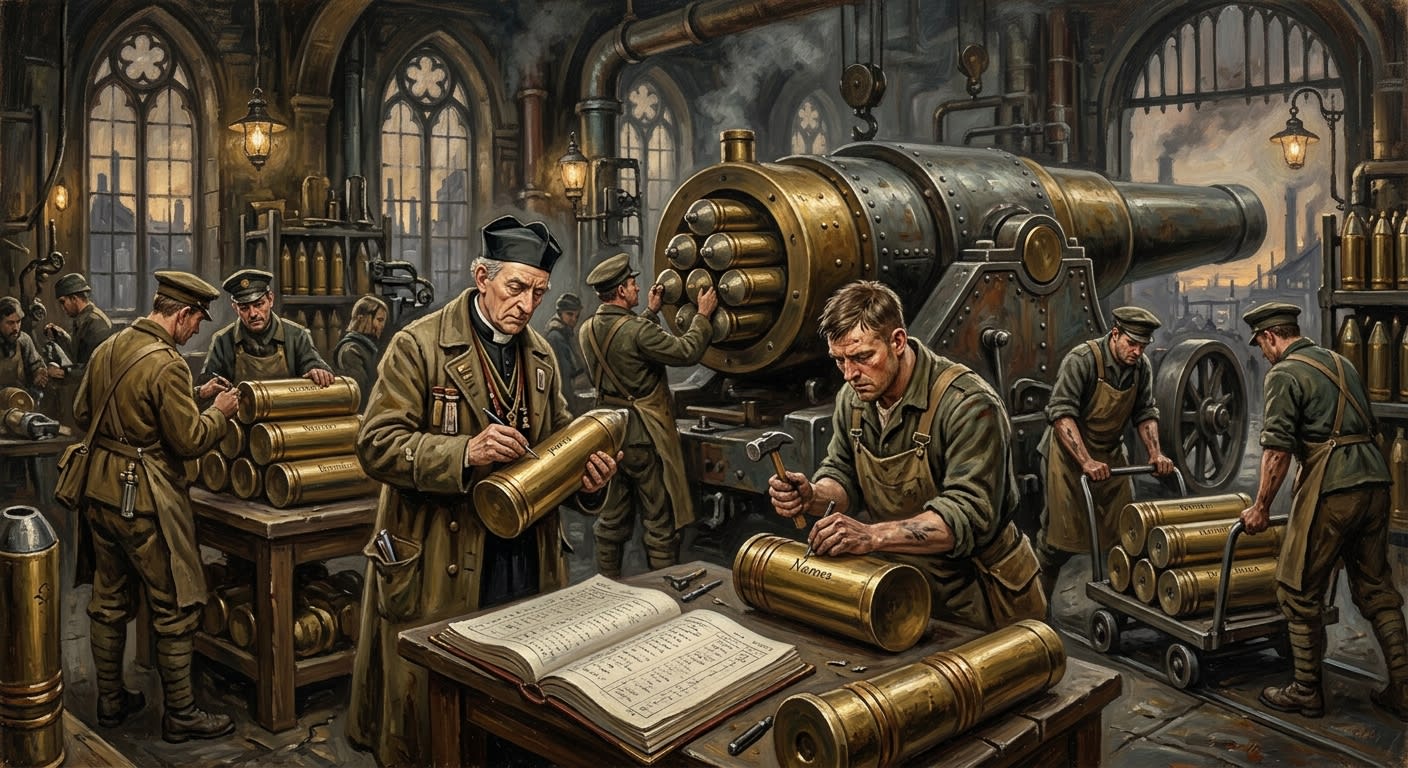
#On the Reform
The Ledger Reforms of A.S. 165 were born at Bastion-Irongate, in the river throat where the Danube narrows between cliffs and every sound returns with an accusation attached. A shrine-barge fired fourteen rounds of grapeshot into refugees. The refugees had gathered under escort flags near a lock approach, carrying transit slips, ration bowls, bedding bundles, infants, and the exhausted faith of people who believed a marked route meant safety. Fourteen rounds corrected that belief.
The inquiry asked a simple question: who loaded the ammunition? Every Powder Acolyte aboard claimed to have been in the latrine.
This was the moment the Bureau of Records discovered, with its usual gift for missing the corpse while admiring the docket, that the catastrophe was “a ledger deficiency.” The phrase entered the minutes. The dead entered a different ledger. The latrine entered doctrine.
Before A.S. 165, the Shrine-Deck Crew kept shot-ledgers according to the discipline born from the First Floating Cathedral Burn: shell type, measure, authorising seal, target classification, storage compartment, discharge time. Names appeared at station level. Responsibility rested on crew, watch, and seal. This arrangement comforted officers, protected cowards, and produced group innocence so spacious that seven men could inhabit one privy.
#On the Irongate Discharge
The shrine-barge in question was assigned to crowd-stabilisation duty during a refugee transfer. Irongate traffic was heavy that week: river barges, convoy wagons, rope-ferry chains, Mercy litters, ration carts, and the usual knot of civilians waiting for somebody with a stamp to admit that their hunger existed. The platform held position near the lock while its choir prepared a low cadence intended to calm the queue. Calm is the word in the report. The survivors used worse words, most of them accurate.
At second bell after noon, the forward battery fired. Fourteen rounds. Grapeshot, not smoke. Low angle, not warning arc. The crowd opened like a wet ledger under a dropped inkpot. The choir stopped after the sixth round. The battery did not. A Deck-Rat later testified that the metronome bell had continued its measure, bright and small and perfectly useless.
IRONGATE INQUIRY — SURVIVOR STATEMENT 12, PARTIAL “...the flags were white with green route marks. My sister had the bowl. The first shot took the people by the rail. I thought it was east fire until the second came from behind the saints painted on the barge. The bell kept counting. I saw a man with chalk on his sleeve vomit into his hands and keep loading—” Disposition: testimony reclassified; witness transferred to Mercy custody; bowl not recovered.
War called the discharge defensive confusion. Mercy called it mass casualty misclassification. Doctrine called it regrettable. Records asked for the names of the loaders and found smoke. The Powder Acolytes had vanished into a collective claim of necessary bodily absence, a cowardice so petty beside the dead that it acquired grandeur through disproportion. The Bureau loves disproportion. It gives small men large forms.
Early summaries attributed the Irongate discharge to “enemy provocation resulting in defensive action.”
Corrected. No hostile force was confirmed within firing range. The discharge was administrative in nature. The refugees were reclassified. The ammunition was properly manufactured. The men were not properly named.
#On the New Columns
The Reform did not abolish cruelty. It numbered it more accurately.
From A.S. 165 onward, each shot-ledger entry aboard a shrine-platform required the individual name of the Powder Acolyte who loaded the round, the Battery Steward who accepted it, the Ordnance Deacon whose seal permitted it, and the hymn-measure in which the shell entered the breech. Where a loader left station, the absence required notation. Where a loader claimed latrine occupancy, the latrine watch required countersignature. This last provision produced three months of giggling in barracks and twelve years of quieter ledgers.
The new form included columns for load-hand, fuse-check, chalk-ring status, choir condition, bell alignment, recoil declaration, and post-discharge residue. It also added a blank for “confession-of-fault offered,” which crews learned to leave empty unless explicitly ordered, because a voluntary confession in a Bureau document is a rat walking into a cat’s mouth with a ribbon on.
The Bureau of War hated the delay. The Bureau of Bells welcomed the measure count. Orison demanded throat-status entries for choirs and was told to stop expanding the form before it required its own wagon. Records won because Records usually wins where ink can be made heavier than muscle.
#On the Acolytes
The Powder Acolytes resented the Reform with the pure, injured fury of men told that their hands had been attached to their deeds. Before A.S. 165, a loader served within watch identity. After A.S. 165, his name travelled with the shell. If the round landed clean, nobody remembered him. If it misfired, fell short, vanished into ghost accounting, struck refugees, or sang after impact, his name waited on the page like a bailiff.
Some Acolytes improved. Some bribed Choir Runners to blur measure entries. Some swapped slates. Some cultivated aliases, dock names, saint-names, barracks names, and one heroic idiot at Bastion-Constantinople who signed three rounds as “Saint Orla’s Nephew,” for which he received six days in irons and a permanent reputation as either comic or doomed. Both diagnoses matured within the year.
The culture changed fastest around clean ledgers. A spotless shot-ledger became a status object: passed hand to hand in port taverns, praised by Ordnance Deacons, kissed by superstitious Battery Stewards, copied by junior clerks with the reverence usually reserved for minor relics. Dirtier ledgers grew more inventive. Ghost entries did not disappear. They learned better handwriting.
#On Evasion and Audit
Every reform births its counter-reform in the gutter. Crews invented “wax slips,” temporary loading notes later transcribed into the ledger by a steadier hand. They invented “bell blur,” claiming the metronome obscured the exact hymn-measure during recoil. They invented “charitable hand,” by which a senior Acolyte signed for a junior too frightened to write. They invented “dead-hand loading,” assigning a disputed round to a man killed in the action, because the dead are bad witnesses and excellent colleagues when blame begins searching for a chair.
Records answered with reconciliation audits. War answered with surprise locker inspections. Purity answered with accusation because Purity answers everything with accusation. At Strasbourg, training slates began using the Irongate fourteen as a catechism exercise: fourteen rounds, seven claimed absences, three-person latrine, zero acceptable explanations. Recruits laughed on first reading. They stopped when the instructor showed casualty sketches.
A War memorandum praised the Reform for eliminating ghost entries aboard shrine-platforms.
Revised. The Reform eliminated lazy ghost entries. The diligent ones remain under active pursuit, which is the Bureau's preferred name for failure with stationery.
#On the Present Rule
As of A.S. 201, no shrine-platform may fire without a shot-ledger capable of naming the hand that loaded, the seal that authorised, and the measure that carried the round into history. This rule is obeyed, evaded, feared, mocked, bribed, and taught. It has saved lives by making unlawful discharge harder. It has killed careers by making lawful discharge legible. It has given auditors a finer knife and crews a finer terror.
The Irongate refugees remain mostly nameless in the public file. The Powder Acolytes are named in full. This is not justice. It is Records.