
#On the Function of the Assessment
Four questions are put to every conscript. The Bureau already knows the answer to three of them.
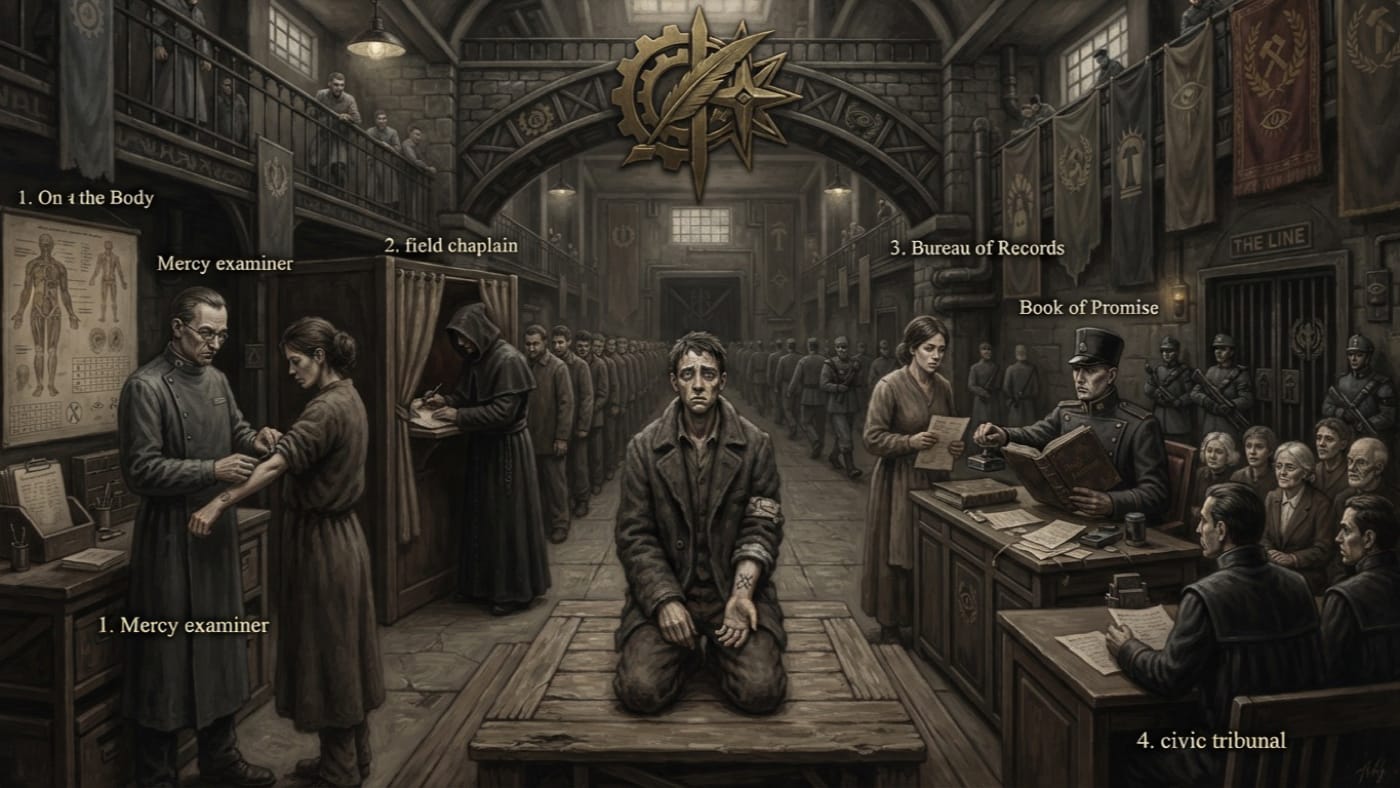
Between the mustering field and the Line stands a procedure, and the Bureau of Conscription calls it the Fourfold Assessment. Every conscript undergoes it: the Levy son, the debtor's boy, the judicial transfer, and the man who volunteered in his sleep. Collection delivers him. Census matching confirms that he is the person the ledger expected. The mustering inspection sorts him by height, weight and teeth into the coarse bins of infantry, artillery and labour. Only then does the Assessment begin, and the Bureau learns what it has actually received.
Conscription performs almost none of it itself. The First Continental Levy of A.S. 110 proved that a decree without machinery produces riots. The Bureau constituted two years later under the joint seal of War and Doctrine learned to borrow machinery from others. The Bureau of Mercy lends its examiners and the Church its field chaplains. The Bureau of Records lends its stamp, and the civic tribunal lends the neighbours. Conscription supplies the warden, the forms, and the sole authority to decide what everyone else's findings mean.
The Triune Knot inked on the wrist at muster is not one of the four components. It is a leash that lasts nine days, and it keeps the conscript available for assessment.
#On the Body
Mercy examines and Conscription interprets. The division is deliberate. A Mercy examiner looks at a boy and sees lungs, a spine and the arches of his feet. He sees the old fracture in the left forearm, set crooked because the village bonesetter was also the village drunk. He records what he sees on the fitness sheet against his Bureau's tables, which rank a man's capacity to march, dig, carry and die. Then he hands the sheet to the warden, and the boy stops being a medical matter.
The warden can read four outcomes. Fit-Primary goes to the Sagittal Line. Fit-Secondary goes for extended drilling, either to the catechism-barracks of Essen-of-Hymnsteel or to the furnace-yards of Brast. Fit-Tertiary goes to rear logistics: wagon-hauling, trench-digging, and the slow labour behind the Line that kills at a gentler pace. Unfit is the fourth outcome and the rarest. By the Bureau's own estimate it is awarded to about three conscripts in a hundred.
I report that figure as the Bureau's testimony. No census of mine has checked it. A man who claims an ailment at assessment must persuade an examiner whose sheet the Bureau of Purity may pull for audit. No Mercy examiner wants to explain to Purity why he believed a cough. The ailment must be genuine, and it must also be dramatic enough to survive a second reading by a less charitable eye. A withered leg can persuade. A weak chest persuades nobody, because the rear depots are full of weak chests hauling adequately.
The Bureau does not publish what becomes of the Unfit after the stamp, and I have not been told. I record the classification. I do not promise the reader a homecoming.
Mercy's examiners are healers by vocation and suppliers by appointment. Their returns are compared against Conscription's quotas, and an examiner whose Unfit column runs long will find his own handwriting under review. The fitness tables have never been amended to be kinder. They have only been interpreted more usefully, which costs less ink.
#On the Confession
The second component is administered by a field chaplain who, at a crowded muster, absolves some sixty souls an hour. I have timed it, and it comes to one minute a boy, with the screen still warm from the last. A layman would call this haste. The Bureau calls it screening. Whatever the absolution accomplishes before the Creator, it also produces an entry in a column.
The expectations are narrow. A conscript who confesses too little is flagged for Purity review, on the reasoning that a boy of eighteen with nothing to confess is either a saint or a liar, and the Bureau does not process saints. A conscript who confesses too much is flagged for the Bureau of Shadows, which takes an interest in men whose sins outrun the ordinary inventory. The range the warden wants lies between the two flags: a petty thief, a liar to his mother, a boy who once wished his father dead and has since thought better of it.
The flagged man's fate is decided by Bureaus that do not report back to the mustering yard. The warden notes the flag, and the flag travels with the file. I have seen flagged men assigned like anyone else. I have also seen flagged files arrive at desks the men themselves never reached. I draw no conclusion in print.
The art lies in the conversion. A whisper behind a screen becomes a mark in a ledger, and the mark becomes a destination. The boy kneels to be forgiven and stands up classified, and he cannot tell from the chaplain's face which of the two has happened to him.
#On the Promise
At baptism every child of the Synod is enrolled in the Book of Promise. The family stands at the font, the priest names the infant, and a clerk writes the infant's future against the parish quota: levy, choir, ledger or ash-pits. Mothers rock their cradles murmuring the assignment. At the Book of Promise Parade the children carry it sealed and are told that Providence has spoken. Providence, in this instance, wrote in iron-gall ink, in Strasbourg, according to the shortages.
The third component compares that entry with the person standing in the yard. Usually the two agree. The boy promised to the levy has been delivered by the levy, and the warden initials the match without looking up.
Sometimes a boy promised to the choir presents at muster. His mother believed the font and expected him to sing. The census believed he was a second son in a household that owed one. Both documents are official, and they cannot both stand.
That is a discrepancy, and discrepancies go to Records. The commonest reconciliation is also the simplest: Records changes the Promise. One stamp does it. The choir loses a boy it no longer knows it had. The Book now records that he was always meant for the levy. His mother may inspect the entry whenever she likes, and she will find Providence in perfect agreement with the quota.
The household believed the Promise was a covenant. The Bureau has always known it was a draft.
#On the Trial of Loyalty
The fourth component is public. Before any recruit reaches the Line, he kneels before a civic tribunal, with wardens on the bench and neighbours behind him, and recites the oaths of the prescribed catechism. The words are fixed, and so is the cadence. At a designated line the recruit must weep, and the tears must arrive at that line. Early tears are noted. Late tears are noted. Dry eyes are noted most carefully of all. When he finishes, his family's applause is watched as closely as he was. A father who claps a beat behind his neighbours has said something, and the warden writes it down.
Doctrine holds that the tribunal measures resonance of soul as well as fitness of body. I repeat the formula because it is the Bureau's. The tribunal owns no device for the purpose. It has ears, a catechism, and a warden who knows the tune.
A recruit who hesitates, misses the cadence, or sings one note awry is culled. Some are quietly reassigned to ash labour. Some are dealt with less quietly. The Bureau declines to elaborate, and I decline to guess.
This tribunal must not be confused with the Trials of Loyalty set for children, which demand a denunciation, a betrayed secret, or a blow struck against a playmate. The child's trial teaches obedience. The recruit's trial confirms that the lesson held. Between the two lies the Civic Cut, the Synod's long system of harmonization. It begins with the Quiet Spoon at the supper table, continues through the Procession of Receipts with its chanted debts, and ends with festival catechisms in which doubt always plays the villain. By the time a boy kneels before the tribunal, he has been rehearsing this kneel since he could hold a spoon. The oath is simply the last rehearsal, and the first performed before witnesses who can punish a mistake.
The preceding paragraph described the Civic Cut as the Synod's long system of indoctrination.
Per Records, Fifth Revision, all references to "indoctrination" are excised and replaced with "harmonization." The paragraph has been corrected. The children report no difference.
#On Assignment and the Present Application
The four components always come in the same order, but not on the same schedule. A great depot may hold the examination one morning and convene the tribunal days later, once enough recruits have gathered to make a worthwhile audience. A provincial yard may finish everything before the light fails. Either way, the four folios end up in one file, and the warden reads the file once.
A Fit-Primary man with an unremarkable confession, a reconciled Promise and well-timed tears goes to the Line, where the Bureau of War signs for him like any other delivery. A Fit-Secondary man goes to Essen to have hymn-frequencies drilled into his bones, or to Brast to learn to march to the furnace-beat. A Fit-Tertiary man goes to the wagons and the spades. The culled go to the ash. The flagged go wherever their flags summon them. The Unfit go to an outcome the Bureau keeps to itself.
The file is then sealed. In A.S. 201 the practice I have described is the practice in force at every depot that has supplied a return to my desk. When it was first devised, and by whose hand, the Bureau has not set down, and I will not invent it for the reader's comfort. The Bureau of Doctrine has examined this survey and found it orthodox. I asked whether Doctrine had ever examined the Assessment itself. I was told that question belonged on a different form.