
#On the Warm City and Its Necessary Cough
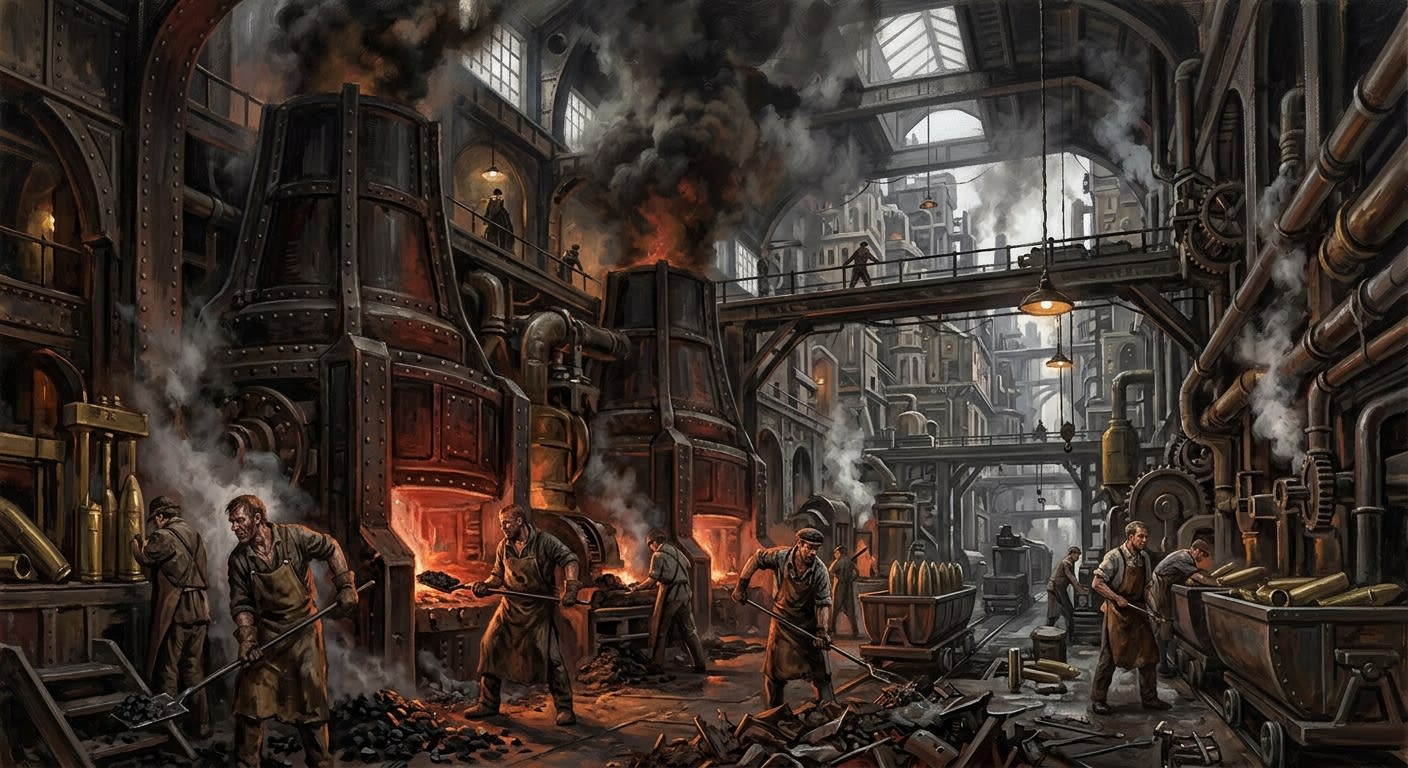
The Chrismole Furnaces of Brast are the place where faith becomes fuel without admitting the indignity of chemistry. Ninety-two thousand registered souls live inside slag berms, pressure bells, rail manifests, soot-fall, and the sweet black stink of sanctified distillate. An unknown number live there without registration, which is to say more honestly. Brast is a foundry city, a boiler-cathedral, a rear-line military organ pumping heat eastward into the guns of the Sagittal Line. If it stutters, artillery cools. If it cools, men die in cleaner air.
I have inspected Brast four times and departed each time with a cough that lasted six weeks. The local Sisters called the cough a blessing. They said this from behind resin masks, because Brast piety has always known where to place a filter.
Brast sits in Zone 2, on the Heartlands fringe, close enough to war for the timetables to tremble and far enough from the Line for officials to pretend industry is peace. Its rail junction rests at a coal-seam river confluence claimed in A.S. 68 by a nameless logistics officer of the emerging Bureau of War. The officer needed fuel for forward artillery. He seized the junction, requisitioned the surrounding villages, built crude furnaces, and produced ordinary fuel by perfectly ordinary means.
This practical success horrified Doctrine. A cannon that fires by secular oil is an argument no cleric wishes to hear twice. Within the season, Doctrine sent one Cantor and fourteen choir-technicians. By A.S. 72 the fuel had been sung over, named chrismole, sealed as sanctified, and certified by Records as doctrinally distinct from the crude product it resembled in every measurable property. The guns did not object. Guns possess the tact theologians lack.
#On the Chrismole Crown
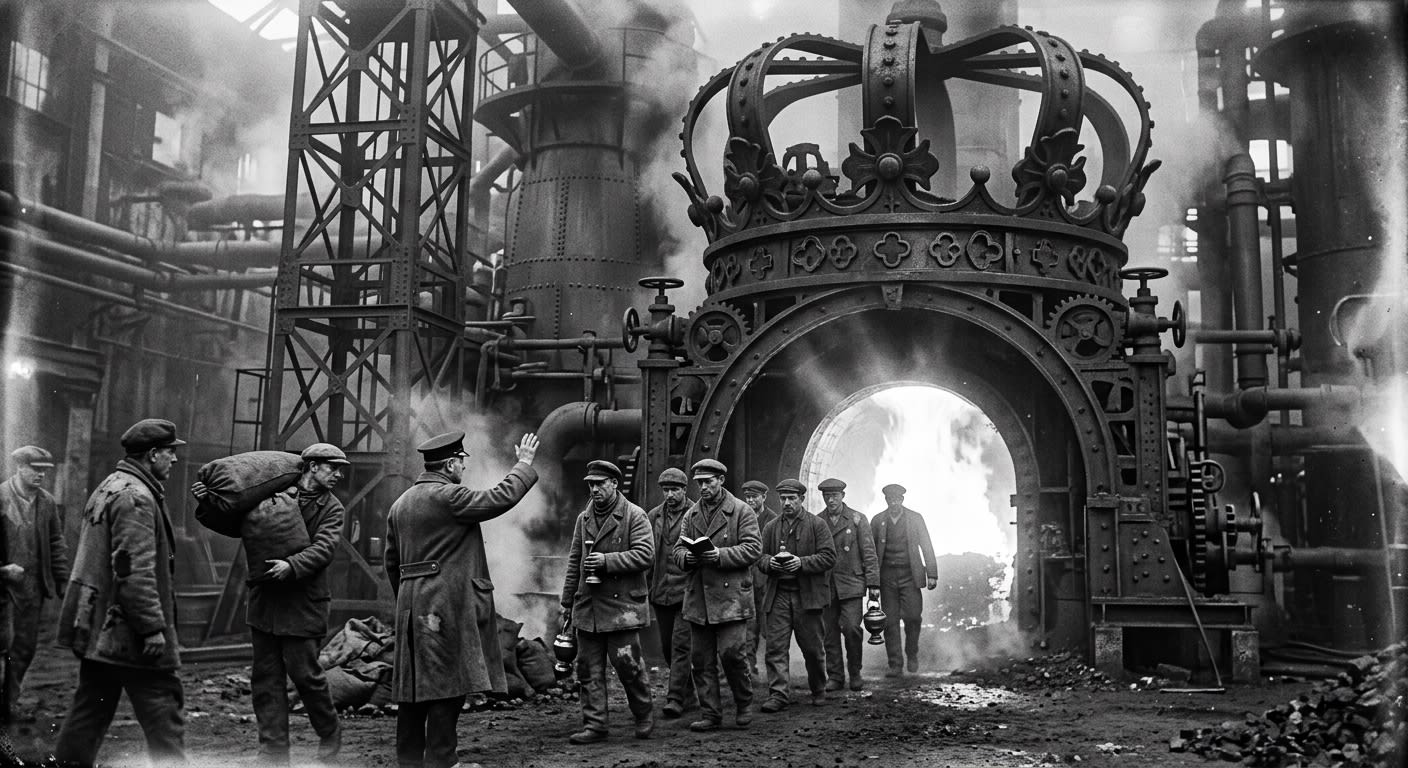
The city's centre is the Chrismole Crown: seventeen fire-brick kilns arranged around a sanctification nave, iron-clad, smoke-stained, and dressed by the Furnace Chapterhouse of Saint-Combust in language so ornate one almost forgives the burns. Each kiln has its pressure bell. Each pressure bell has its rite. Each rite has its clerk, its witness, its maintenance docket, its private exception, its public denial.
Raw feedstock enters at first bell: peat, coal, rendered tallow, and the component the Distillers' Compact calls substrate when sober and refuses to name when watched. Steam drives the volatile fractions through condenser lines into the Still-Canals. Canal water cools the pipes. The pipes sweat. The air tastes of sweet solvent, hot brass, incense, and the throat's first warning.
At fourth bell the condensate enters the sanctification nave. There the Calibration Choir sings the distillation hymn, fourteen stanzas matched to condensation rate within three beats per minute. Three beats. Not four. Four spoils fuel. Five bursts lines. Silence teaches the machines impudence, and Brast already educates iron beyond its station.
At seventh bell the finished chrismole is decanted into sealed drums. Each drum receives wax prayer, serial mark, manifest line, scent trace, and destination docket. Commander-Auditor Sorn Vale watches this portion with boots so clean they constitute a civic insult. A drum may travel to Przemyśl, Constantinople, Brest, or any forward railhead whose guns are hungry enough to forgive Brast's habits. The Line fires because Brast ships. This is the city's entire theology once the decorations are burned away.
Earlier Chrismole Distillation Manuals stated that sacred hymn-properties sanctified the fuel through divine resonance.
Corrected. The current approved phrase reads: “the hymn's properties, which are sacred, interact with the fuel through mechanisms doctrinally sufficient.” The Bureau of Alchemical Standards was invited to explain the difference and showed admirable cowardice by declining.
#On Districts, Breath, and Rank
Brast radiates in rings from the Crown, each ring farther from privilege and nearer to ash. The Gauge Ward lies closest, full of tuning forks, brass instruments, cadence licenses, oath-collared choir-technicians, and the nervous reverence men reserve for a woman who can make valves obey by raising one finger. Kest presides there from a glass-walled booth called the Throat by workers and Calibration Point One by clerks who deserve worse names.
The Boiler Commons houses furnace crews, ration kitchens, shift bells, sleep racks, and heat debt. Rent is tied to shift-tempo. Miss a bell and lose warmth. Owe warmth and owe everything. The city has coin, ration chits, stamped manifests, and Crown money in official circulation, but warm chits are the honest currency. One chit buys an hour near a heat pipe. Ten buy a better bunk. A thousand buy a departure west, if the manifest clerk has not found religion in the meantime.
The Still-Canals belong in practice to Pex Ruln and his Compact: filter-men, lock-keepers, mesh hoarders, substrate custodians, men whose hands are so permanently oiled that water must slide off them in disgust. The Compact began when the first sanctified condenser clogged and every priest present discovered that holiness does not pass through dirty mesh. A useful revelation. The kind that creates guilds.
The Rail-Manifest Quarter counts drums, cranes, dispatches, thefts, errors, and corpses. Sorn Vale adjudicates missing gallons with execution authority and no visible appetite, which is how the best executioners present themselves. Ash-Hospice Row sits downwind by merciful design, a phrase meaning the dying cough where the soot already travels. The Ash-Hospice Sisters keep lung wards, confession booths, resin poultices, and the most dangerous archive in the city because it is accurate.
At the outer ring lies the Slag Market (Unregistered). Scrap, counterfeit seals, siphoned fuel, quiet hymn sheets, warm chits, filter fragments, stolen gauges, private heat. The market moves when furnaces roar, because sound covers commerce and the city rarely stops roaring long enough for innocence to collect itself.
#On the Catechism-Barracks and the Levy
By A.S. 90 Brast had swallowed its villages and housed forty thousand souls. By the First Continental Levy in A.S. 110, it had doubled. The Levy fed the Line with bodies and fed Brast with boys whose lungs had not yet learned caution. Conscripts arrived after mustering, wrist-stamped, shorn, frightened, and ready to be taught that cadence precedes marksmanship.
The catechism-barracks of Brast are less famous than those of Essen-of-Hymnsteel and more useful in certain filthy respects. Essen drills hymn-frequency into rifle obedience. Brast drills furnace-rhythm into the whole animal. Recruits march beside pressure rails until their feet anticipate bell schedules. They learn to load under heat shimmer, to sing before shooting, to distinguish acceptable oil-smoke from smoke that means a valve has begun composing a grievance. A boy who survives Brast may not become brave. He becomes timed.
There is a cruelty peculiar to rear-line training towns. Their victims are close enough to the war to be consumed by it and far enough from battle to be denied the dignity of heroic language. A recruit crushed under a boiler cart is not a martyr in public filings. He is a logistics casualty, training-adjacent, non-front, pending family notification. His mother receives a letter scented faintly of oil, and the line continues east.
#On Sulking Engines and Amber Status
The machines of Brast sulk. This sentence is heresy if spoken by a worker, superstition if spoken by an engineer, metaphor if spoken by a Doctrine clerk, and classified if spoken by me. Valves stick after insult. Boilers demand introductions. Gauges answer hymns with readings that show malice rather than pressure. Cannons fed with Brast chrismole have fired long, short, true, and wrong in patterns the Bureau of Engineering has mapped with increasing unhappiness.
A.S. 199 made the problem printable. A Brast-fed battery at Przemyśl fired four rounds into a friendly rail junction, killed eleven, crippled a supply train, and filled a conference room with lies thick enough to roof a chapel. Ordnance blamed sabotage. Kest blamed degraded feedstock at the receiving measure. The Compact blamed the Choir. Vale blamed absence of a hanged man. The guns gave the most disciplined testimony by saying nothing.
BUREAU OF ALCHEMICAL STANDARDS — REPORT 7741-B, A.S. 194 Subject: chrismole substrate trace analysis Finding: refined distillate contains ████████████ consistent with ████████████ origin. Operational implication: machines respond to doctrine because ████████████████████████████████. Distribution: Hierarch's Seal; Brast Chapterhouse notified; Ordnance copy abridged; Engineering copy missing Appendix C.
As of A.S. 201, Brast holds Amber status. Seven sealed drums vanished from the Manifest Court inventory in spring, a number too theological to be accident and too clean to be common theft. Fourteen arrests produced three confessions and no drums. The night roar has acquired a syllable no Choir technician admits singing. Kest sealed the wax-cylinder recording in Vault Brast-4 (Unregistered). Ash-Hospice fever dishes have begun arranging settled ash into names of the dead, some of whom remain rude enough to breathe.
Strasbourg has dispatched Inquisitor-Mechanic Lux Thane Mire, a title that should embarrass every office that spent a century insisting faith and engineering were separate disciplines. His train is late. The eastern approach engines have stalled twice: once for want of pressure, once for want of a hymn no crew admits omitting. Mire's third travel case ticks only when motionless, according to porters who have since developed excellent habits of silence.
Brast civic notices describe the current fume-fever cluster as seasonal particulate irritation.
Corrected for those permitted to read indoors. The cluster is linked by shared chrismole exposure, night-roar timing, and fourth-bell hymn irregularity. The phrase seasonal remains approved for street posting because panic lowers output and truth has never shoveled coal.
#On Present Necessity
The furnaces burn. The Choir sings. Ruln's filters clog and unclog according to politics disguised as maintenance. Vale counts drums with the tenderness of a miser counting teeth. The Sisters write what the men in clean offices prefer to misplace. Warmth Thieves bleed sealed fuel between Manifest Court and rail yard, selling comfort in bladders disguised as water-skins. Workers cough ash into dishes that spell surnames. The iron motto above the Crown reads: Sing it true, or it fails. The letters vibrate with furnace harmonic and, according to feeders, are trying to add a word.
Brast cannot be closed. This is the only verdict any investigation will be permitted to reach. Its fuel heats the Line, drives the trains, feeds the guns, oils gun-carriages, warms barracks, anoints treaty-stones, and teaches the Synod's machines the manners by which iron consents to kill on schedule. If Brast is holy, then the Synod is vindicated. If Brast is damned, the Synod is supplied. The distinction belongs to sermons. The drums ship either way.