
#On the Post and the Brielle Spur
"Pay wet, pass dry." — road saying of the Salt-Vigil Causeways
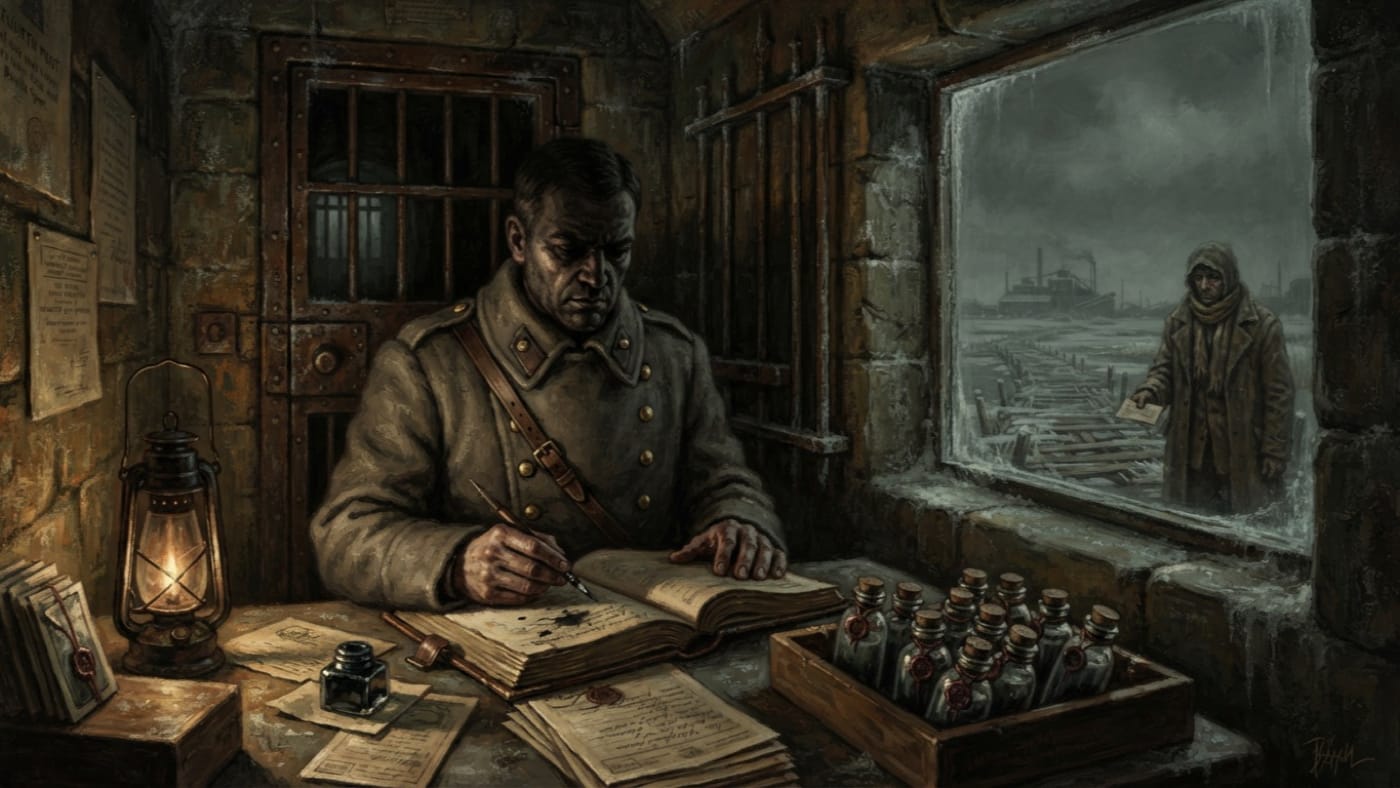
Fourth Post is a toll station of the Salt-Vigil Causeways, kept on the Fourth Causeway, which convoy clerks call the Brielle Spur. The spur runs seven miles across the shallows between Brine Fork and the Brielle salt-panning station. Seven miles is the length of the road. The post stands somewhere along it, and the Bureau of Records has never troubled to publish where, because nobody who has walked the spur in a hard January asks for mileage. They ask for the window.
The window belongs to a squat stone toll-house. The road beside it does not. Like its sister causeways, the Brielle Spur is rebuilt each season from timber, reed, clay, shell and salt, and it is a road only when the shallows freeze beneath it. In a good winter it carries salt toward the Fork, and grain, oil and paper toward the pans. In a bad winter it carries nothing at all, and the toll-house remains as a stone fact on a seasonal premise.
The order that keeps the post holds its mandate from Veyrault's charter of A.S. 82. The charter was issued under the Bureau of Records eight years before the Concordat of Strasbourg gave the Synod its formal name. It fixed Brine Fork, where the marsh divides its traffic among the Candlewick Spur, the Long Salt and the spur toward the Queue Road. It gave Fourth Post no birthday, and I decline to invent one for the sake of a tidy dateline. The post answers to the Brine Fork chapter, where Prior Idris governs seasonal road use, salt allocation, toll discipline and the custody of everything collected. He is a prior. He rules a road, not a province, and he will tell you so before you have finished bowing.
At the booth the traveller meets the whole system at once: a brother behind salt-stung iron, a ledger, a tallow lamp rationed to the width of a thumbnail, and a question about papers.
#On Passage and the Wet Seal
The procedure at Fourth Post is the procedure of every station on the Causeways, and that uniformity is its virtue. The traveller presents a stamped pass, a convoy writ or a pilgrim token. The brother checks the paper and then the face, looking for salt burns, cracked lips, and tear tracks that might mean the traveller has already wept somewhere less accountable. Then comes payment. Coin is accepted with faint contempt. Salt blocks, ration chits and labour-hours on the span meet with less. A traveller whose coin, salt, scrip and exemption all fail goes to the Weeping Chamber.
There they sit without fire, with a Salt-Vigil witness and a vial clerk, and confess until the tears come. The clerk holds the glass phial and stoppers it. The witness presses the wet seal, and the post writes its record: date, station, collection hand, seal, origin. The origin field says where the grief came from. To the traveller it is the only part of the label that matters, and it is the first part to fail.
What follows is arithmetic. Enough tears buy passage. Fewer buy soup, or a place against the wall of the common room, or a wait while the convoy behind is served first. No tears buy a locked door and the rest of the night to reconsider one's dryness. The road calls this exposure, and the ledger calls it equal access by penance. Both names are accurate, which is how I prefer my institutions.
Sealed phials wait on a local rack in the brothers' custody. On the appointed day they are packed into a locked crate and carried down the spur to Brine Fork under escort, to be entered in the ledgers and in time admitted to the Phial Cellar. Every causeway forbids stepping over a vial crate. Travellers learn the rule the first time a brother's boot finds their ankle.
#On the Winter Without a Crossing
In the winter of A.S. 199 the Brielle Spur failed to form. The failure is filed as the Fourth Causeway Anomaly under Category Two, and the file is a quarrel between instruments and people. The instruments recorded freezing cold, yet the shallows stayed water. Brothers and travellers who stood at the edge reported warmth coming off the surface, and the thermometers declined to confirm it. More than one Bureau has offered an explanation, and the anomaly file sets them side by side for any reader with a strong stomach. I choose none of them here. A toll station has no opinion on hydrology. It has opinions on traffic, and that winter there was none.
The network entry for the Salt-Vigil Causeways describes the A.S. 199–200 closure as the first in the order's history.
Correction. The closure of the Fourth Causeway is documented and stands. The same entry records earlier winters in which the Second Causeway failed to form. The Causeways have failed before. On those occasions nobody thought to bottle the result.
Fourth Post stayed open. With no road to sell, it sold what it still had: shelter, soup, the wall by the stove, and a place in the convoy for whenever the ice returned. Travellers still came to the window. Those who could not pay went to the chamber, and the chamber went on filling glass. The published account of the Weeping Chamber records that the post kept collecting through the whole closure, and that denied passage was entered as recorded payment. I know of no cleaner demonstration of the tear-tithe. The road the Creator froze may fail, but the ledger keeps its hours.
Brother Erasmus served the post that winter. After the failure Prior Idris denied his transfer, and he remains at Fourth Post. The file gives no reasons and I add none. A brother kept at his station by his prior is a disposition, not a biography.
In March of A.S. 200, Engineering surveyed the spur and reported ordinary shallows and an operational Brielle station. I accept that as a description of March. It tells me nothing of what the pans or the post endured in January, and to its modest credit Engineering never claimed that it did. The road was rebuilt that autumn. It froze, and traffic resumed.
#On the Phials Sent Down
The road reopened. That settled the transport. It did not settle the crates.
Fourth Post phials gain mass without gaining volume, and they remain the watched samples for that reason. The glass is the same glass. The meniscus sits where the clerk left it and the seal is unbroken, yet the phial is heavier than a twin from another station holding the same measure. In the A.S. 200–201 season the road was open again and the samples were still arriving heavy. Assessor Maren Gault of the Bureau of Alchemical Standards compared them against Brine Fork controls and found thirty percent excess. She does not collect tears. She weighs what others collect and writes down what follows. What has followed includes the phrase "grief without owner" and the instruction "Do not lower a phial." I have read her reports, and the verbs are leaving them one by one.
The second difficulty belongs to the Fading Winter. This station's case is cross-filed with it for investigation, though the file asserts no shared cause. Across the Causeways, origin fields have faded on sealed phials. The date stays legible, and so does the fee. The obligation survives intact, while the name of the place and person the grief came from goes pale under the wax. A Fourth Post phial can therefore reach the Fork heavier than it should be and less certain of whose grief it holds.
Prior Idris settled custody in one sentence: every Fourth Post phial rests overnight in a salt circle before it is admitted below. The Vial Vault clerks complained that this delays the accounts. The prior's answer is in the record, and I see no reason to improve it: "So does drowning."
The cellar that receives these samples is a Category One Passive Accumulation Site. The road whose failure produced them earned Category Two. Fourth Post is neither. It is a collection station sending glass from one classification to another under Amber practices that touch both. The Bureaus would happily merge the three files into one convenient horror. I keep them as three files, separately sealed.
#On the Rules Still Kept
The spur is open, the post is staffed, and the samples are watched. The rules below remain in force through A.S. 201. I record only those a traveller might break out of ignorance.
At Fourth Post, lanterns are covered after second watch. The brothers do not explain this to passengers, and a passenger who uncovers a lantern to look at the shallows is relieved of the lantern.
Prisoners in transit do not halt at the eel bend. Widows are not lodged in the south room. These instructions came without published reasons, and the brothers keep them exactly. One widow who passed a night at the post later reported a voice beneath the floorboards. Her name is held under Amber, and I leave it out. Her account is filed as testimony and nothing more. Nobody has interviewed the floorboards.
No phial is to be immersed for any purpose, whether cleaning, testing, cooling or ceremony. No one is to taste the water of the spur. The second rule sounds absurd until you remember that the brothers live on brine soup and salt, and that a thirsty clerk at the end of a long count has no imagination at all.
The count at the window goes on as before: date, station, collection hand, seal, origin. The crate is locked and the escort walks beside it. The salt circle is laid and kept for the full night, whatever the clerks below say about their accounts.