
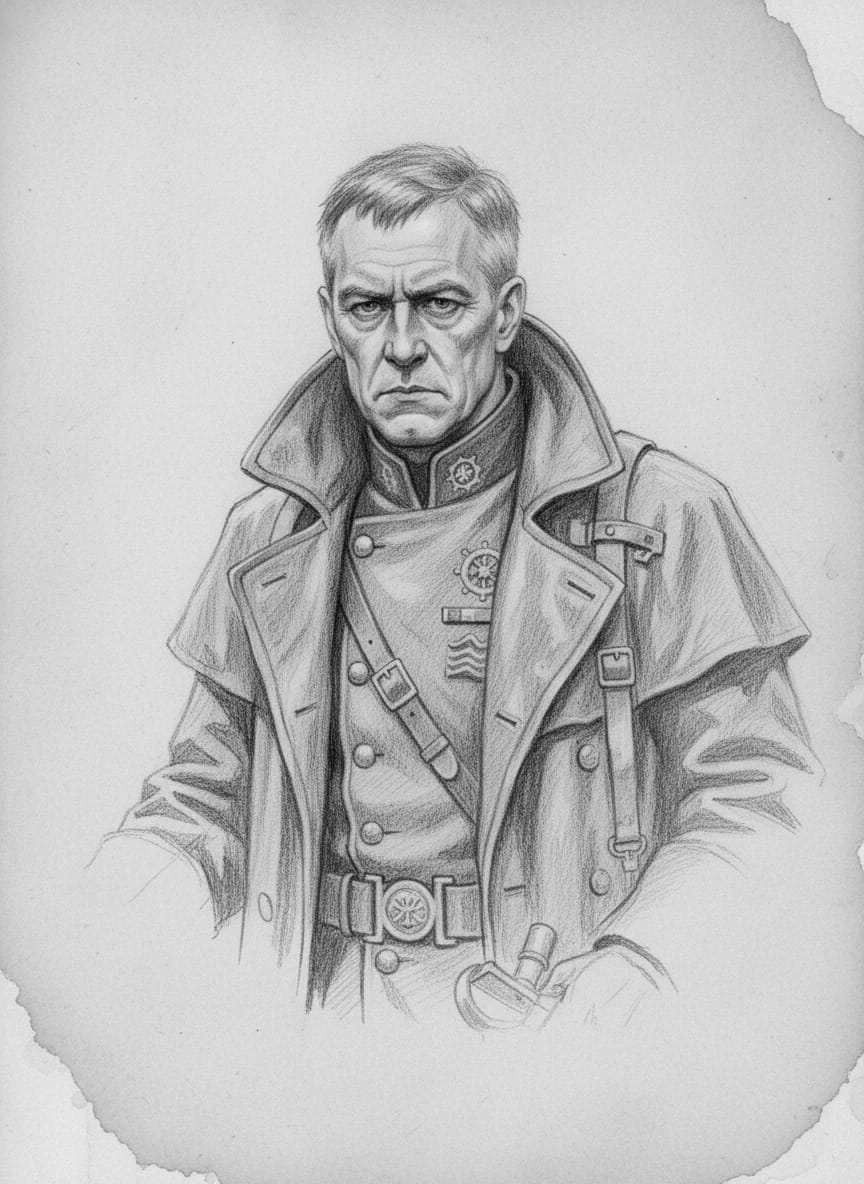
#On His Office at the Fork
Prior Idris of the Sixth Tide governs the Salt-Vigil Causeways from Brine Fork, which is to say he sits at the point where three winter roads divide, seven seasonal arteries demand repair, eleven hundred salt-ascetics pretend exposure is a virtue rather than a medical scandal, and every traveller who lacks coin is invited to pay in tears. He is the order's current prior, the keeper of the Brine Fork chapter-house, the senior denial of transfer requests, and the man most responsible for making the road appear obedient on paper while allowing it whatever private appetites are required to keep the convoys moving.
He is old enough to have become weather and too useful to be permitted holiness.
Idris holds no bishopric, Bureau desk, marsh-toll lordship, or priesthood of the Causeways, despite pamphleteer frothing. He is a prior of a chartered toll-ascetic order whose authority began in A.S. 82 under Veyrault's Bureau of Records, long after salt-hermits had learned to guide refugees across the Frisian shallows for salt and confession. The old misery became lawful. Lawfulness, as every civilized reader knows, is misery with a receipt.
His office faces the split between the Long Salt and the southern road toward the Queue Road. The desk is scarred by salt, wet ledgers, salt issue books, phial intake copies, Road Tribunal notices, and transfer denials. A small bowl of grey water taken from the Fourth Causeway during the A.S. 199 closure rests there under a cloth. It has never frozen. Young officials notice the bowl and ask whether it is evidentiary, devotional, experimental, or decorative. Idris says yes, and the young officials learn the first principle of Brine Fork: a single object may indict several Bureaus if allowed to sit long enough.
#On His Vow of Exposure
The Salt-Vigil take three vows: poverty, obedience, and exposure. Poverty is ordinary. Obedience is claimed more often than demonstrated. Exposure is the order's little masterpiece of cruelty. It requires brothers and sisters to stand no fewer than six winter hours at a toll-post without gloves, their feet wrapped in salt-cloth, wind clawing the face until personality thins into duty. The Bureau of Mercy has objected to the practice. The Salt-Vigil answer with one word: endure. It is poor medicine and excellent branding.
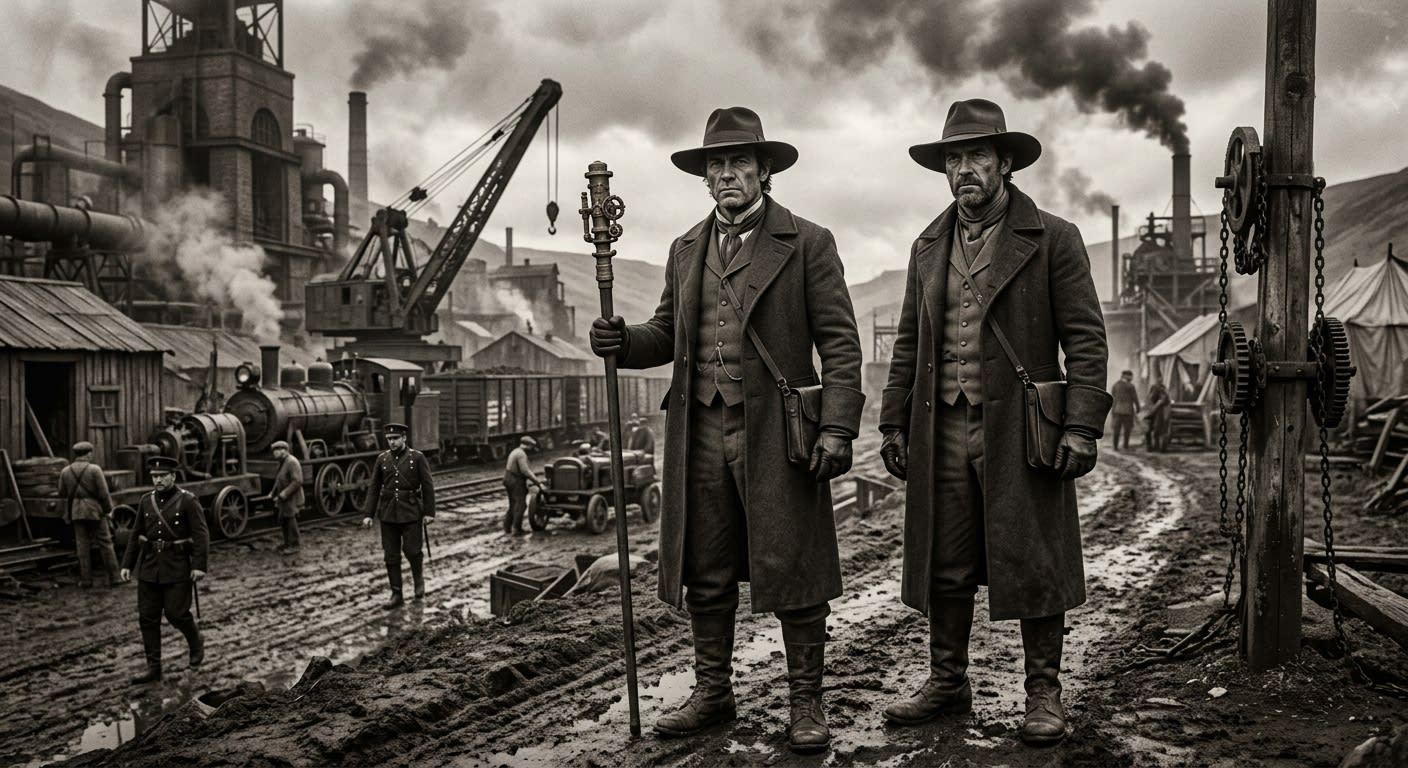
Idris keeps the vow publicly. This matters. A prior could delegate frost to juniors and govern from a brazier like a sensible hypocrite. Idris stands bare-handed at the Brine Fork toll line each winter day, older than the boys who carry his salt crates, angrier than the wind, more patient than the merchants who believe payment should produce comfort. He lost three toes in A.S. 194 and reported afterward that he had gained “a clearer understanding of the road's temperament.” The road, in a charming display of ingratitude, did not soften.
His body is a ledger of the office. Frostbite scars. Salt cracks along the knuckles. A left shoulder stiff from hauling a crate in the A.S. 187 late thaw, according to one clerk who seemed proud of knowing. Eyes reddened by wind and lamp smoke. Voice low from shouting through wool scarves and refusing to shout indoors. He does not move quickly. He does not need to. The room moves around him because the room knows who signs the road open.
The Vow of Exposure makes his harshness difficult to dismiss. A comfortable tyrant invites satire. A freezing tyrant invites calculation. When Idris refuses a pilgrim's exemption, he does so with feet ruined by the same cold. When he orders a toll-brother back to post after a whiteout, he has stood through worse weather and has witnesses. When he tells a Bureau engineer that the road remembers, the engineer may mock him only from inside two coats and a borrowed hood, which gives mockery a poor tonal footing.
A travelling sermon from Rheinscarp described Idris as “a saintly sufferer of the western ice.”
Corrected. Idris suffers. He also taxes, denies, disciplines, and keeps a bowl of anomalous water on his desk to make visiting officials uncomfortable. Sainthood requires fewer ledgers or better publicity.
#On the Governance of Brine Fork
Brine Fork is a chapter-house, a toll court, a salt store, a kitchen, a prayer room, a tribunal bench, a flooded architectural insult, and a hatch leading down to the Phial Cellar. It is also a choice-point. Candlewick traffic, Hamburg winter loads, Queue Road pilgrims, Brielle salt wagons, prisoners under light guard, fish sellers, widows, auditors, and pious fools arrive with mutually exclusive claims upon one road-surface and one salt supply. Idris governs by disappointing them in useful order.
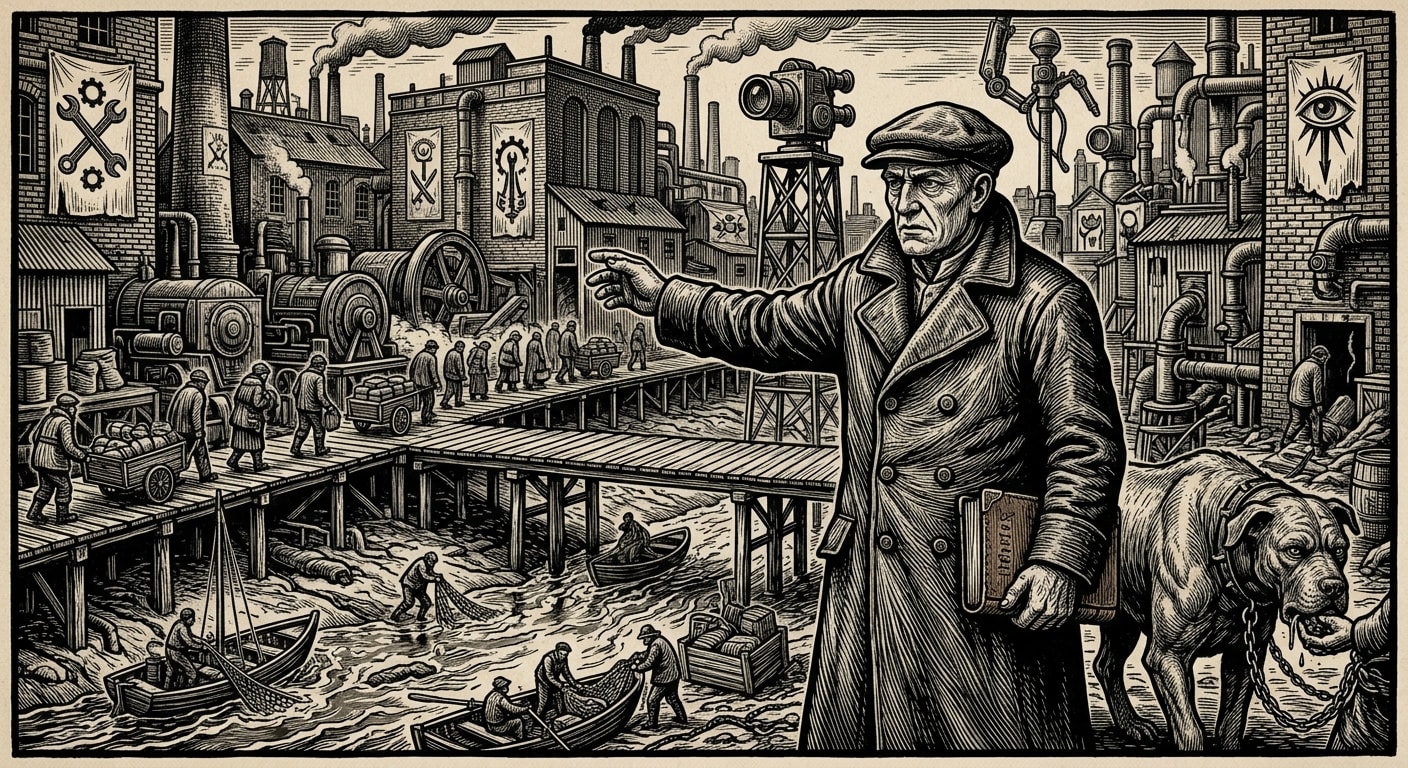
His method is allocation with teeth. Salt first to the Long Salt if Hamburg loads are stacked. Lamp oil to Candlewick when fog eats the western stakes. Brothers shifted south if Queue Road overflow turns pilgrims into exposure statistics. The Fourth Causeway receives repair crews only after Idris has decided whether repairing it will save traffic or merely feed trouble with timber. Military exemptions are honoured, grudgingly. Relic claims are sniffed, weighed, witnessed, and sometimes laughed at, which is the finest authentication method available to minor roads.
He denies transfers on principle. This is famous, hated, and not entirely foolish. Causeway knowledge is local, bodily, and expensive. A toll-brother learns where the ice lies, where reeds lie, where widows lie, where smugglers lie, and where the road itself appears to have developed a taste for certain names. Moving such a person because he is frightened would reward fear and waste knowledge. Idris prefers rotation within sight of the same danger, which is either brutal wisdom or wisdom's ugly cousin.
Brother Erasmus (Unregistered) of the Fourth Post requested transfer after the A.S. 199 failure, when he touched the open water and came away shaking. Idris refused. His explanation, given later under deposition, was that a man marked by a road should remain where the road can see him. This sentence has caused pamphleteers, Purity inspectors, and underemployed theologians to accuse the prior of road-worship. They mistake grammar for idolatry, a common vice among men who have never had to keep a winter route alive.
#On the Tears Below
The Salt-Vigil collect salt for the road and tears for the Cellar. Idris has never given a satisfying answer as to what the order does with the tears, because a satisfying answer would either be false or dangerous enough to require a larger office. When asked directly, he told me: “The road drinks. All roads drink. Ours drinks what it is given.” I sent the sentence to Doctrine. Doctrine filed it under Unorthodox but Permissible and, in one of its rare tender gestures, sent me a blanket.
The Brine-Fork Phial Cellar contains eleven thousand four hundred and six sealed tear-phials at the A.S. 199 inventory, each labelled by date, toll-station, collection hand, wet seal, and origin field. The oldest dates to A.S. 83 and hums when carried, so since A.S. 170 it has not been carried. A coward calls this superstition. A survivor calls it procedure. Idris calls it “not making the same mistake twice,” which is the whole of administrative science if one scrapes away the Latin.
Under Idris's governance, phial custody has become harsher. No open flame below. No song below. No traveller sleeps above the hatch. No Weeping Chamber clerk leaves an origin field blank except by prior's seal. No one jokes about Rack One. After the Fourth Post samples gained their impossible weight, he ordered them rested overnight in salt circles before entry into the Cellar. The Vial Vault Clerks objected that this delayed accounting. Idris replied, “So does drowning.” I dislike him less than policy requires.
His relation to Assessor Maren Gault deserves record. He dislikes outside assessors on principle and Gault with respect, which in his mouth resembles a blessing strained through brine. Gault measures what the Salt-Vigil learned first by fear: frost under toll events, Rack Six leaning, origin fields thinning beneath wax, Fourth Post phials gaining mass without volume, the old sample answering widow classifications. Idris lets her work because her seal turns local rules into defensible practice. He does not flatter her. She does not require it. Between them, the Cellar receives more caution than either Bureau pride or marsh piety alone would have supplied.
Certain Salt-Vigil catechisms credit Idris with “mastering the Phial Cellar's moods.”
Amended. Idris has mastered nothing below the hatch. He has survived it, regulated access to it, fed it no unnecessary songs, and kept fools from lowering phials into worse water. Mastery is the lie told after containment has lasted long enough to look intentional.
#On the Fourth Causeway Deposition
The A.S. 199 Fourth Causeway closure gave Idris his most quoted sentence and his ugliest file. The Brielle Spur refused to freeze despite killing cold, normal salinity, frostbitten instruments, Engineering annoyance, Alchemical Standards distress, and the Salt-Vigil's intimate expectation that water under such conditions should behave. Brother Erasmus touched the water. Gault tasted it and wrote grief without owner. Convoys rerouted. Salt spoiled. Prisoners died late. The road became a question with toll receipts attached.
Idris's deposition before Engineering in A.S. 200 reads like a man forcing a Bureau to swallow local reality without sauce: “The Fourth Causeway is on the maps. The Fourth Causeway has always been on the maps. The Fourth Causeway was walked last winter by eleven hundred people. The Fourth Causeway does not, at present, appear to exist. These facts are not contradictory.” Engineers loathed it because it was accurate in every way their instruments found impolite.
DEPOSITION ADDENDUM — PRIOR IDRIS, A.S. 200 Question: “Do you maintain that the Fourth Causeway made a choice?” Answer: “I maintain that men who ignore a road's refusal should not be placed in charge of wagons.” Question: “Did you speak to the water?” Answer: █████████████████████████████████ Engineering note: witness uncooperative. Doctrine note: witness usefully uncooperative.
The closure changed his practice. He ordered lanterns covered after second watch. Prisoners no longer march over the eel bend. Widows are not housed in the south room when floorboards answer. Fourth Post phials rest in salt circles. Brother Erasmus remains watched but retained. Gault's “Do not lower a phial” became house law before Strasbourg finished deciding whether to be offended by the sentence. This is Idris at his best: slow in speech, quick in rule, allergic to theory after dusk.
The Bureau of Engineering wants the anomaly resolved. Alchemical Standards wants samples. Pilgrimage wants cheap passage. Tithes wants to know whether heavier phials represent greater payment. Idris wants the road open without losing more people than the ledgers can disguise. His ambition is provincial, mean, practical, and superior to most imperial visions produced indoors.
#On His Orthodoxy and Its Salt Stains
Idris's orthodoxy has been examined more than once, because any official who says “the road drinks” within earshot of a clerk earns the attention of men with clean boots and filthy imaginations. Purity has inspected his chapter-house, his vows, his prayer forms, his transfer denials, his handling of Brother Erasmus, his salt circles, and his habit of keeping anomalous water nearby. It has found him doctrinally sound, if increasingly odd. On the Causeways, increasingly odd is a weather report.
The accusation of road-worship fails for a simple reason: Idris does not worship the road. He obeys it, bargains with it, feeds it, curses it, profits from it, and speaks of it with the wary intimacy a kennel-master gives a biting hound whose service remains necessary. Worship requires adoration. Idris possesses irritation refined by duty.
His theology is rude and memorable. “All ground that demands something of you is holy. That is the whole of theology.” He said this to me during an inspection visit cold enough to make ink thicken in the well. I reported it. Doctrine returned the phrase with a marginal note: Unorthodox but Permissible. I would have written Better Than Most Sermons, but my office is restrained by taste, rank, and the perpetual cowardice of stationery.
He prays. Witnesses agree. He attends the Salt-Vigil rites, recites the toll oath, marks the living before naming the dead, and forbids devotional listening below the Cellar hatch with the violence of a man who knows devotion can become a trespass. His private language is dangerous only when misquoted by warm men. To say the road drinks does not crown it. It knows where the invoice goes.
#On His Present Use
As of A.S. 201, Prior Idris remains at Brine Fork, active, frost-marked, unpromoted, unremoved, and far more necessary than any office enjoying radiator heat would admit. The Causeways carry one-eighth of winter supply traffic when frost permits. The Brine Fork chapter-house still floods nearly every spring. The Phial Cellar grows. Rack Six leans. The old phial hums. The Fourth Causeway is open under Amber practice. The road drinks with receipts.
The Synod should replace him, according to every clean principle of rotating compromised local authority. He has been too long at one post. He speaks in dangerous shorthand. He has become part of the machinery he governs. He is loved by no Bureau, trusted by too many toll-brothers, disliked by merchants, respected by Gault, watched by Purity, and imitated by juniors who mistake severity for competence.
Replacing him before the Fourth Causeway ceases its games would be idiocy. Happily, the Bureau occasionally mistakes fear for prudence and thereby arrives at wisdom by the servants' entrance.
His final value is that he knows the Causeways are roads, with no permission to serve as metaphors. They drown. They freeze. They take salt, tears, toes, prisoners, wagons, names, and sometimes the confidence of visiting engineers. Idris does not make them holy by prettifying their appetite. He makes them usable by feeding that appetite in measured amounts and shooting glances at anyone who calls the process beautiful.
At dawn he stands bare-handed at the toll line. Travellers lower their eyes. The phial waits. The salt scale balances or does not. Somewhere below, glass keeps its cold counsel. Somewhere eastward, the Fourth Causeway remembers a hand in black water.
Idris opens the road.