
#On the Station and Its Approach
"Brielle station: operational." — Bureau of Engineering survey return, Fourth Causeway, March A.S. 200
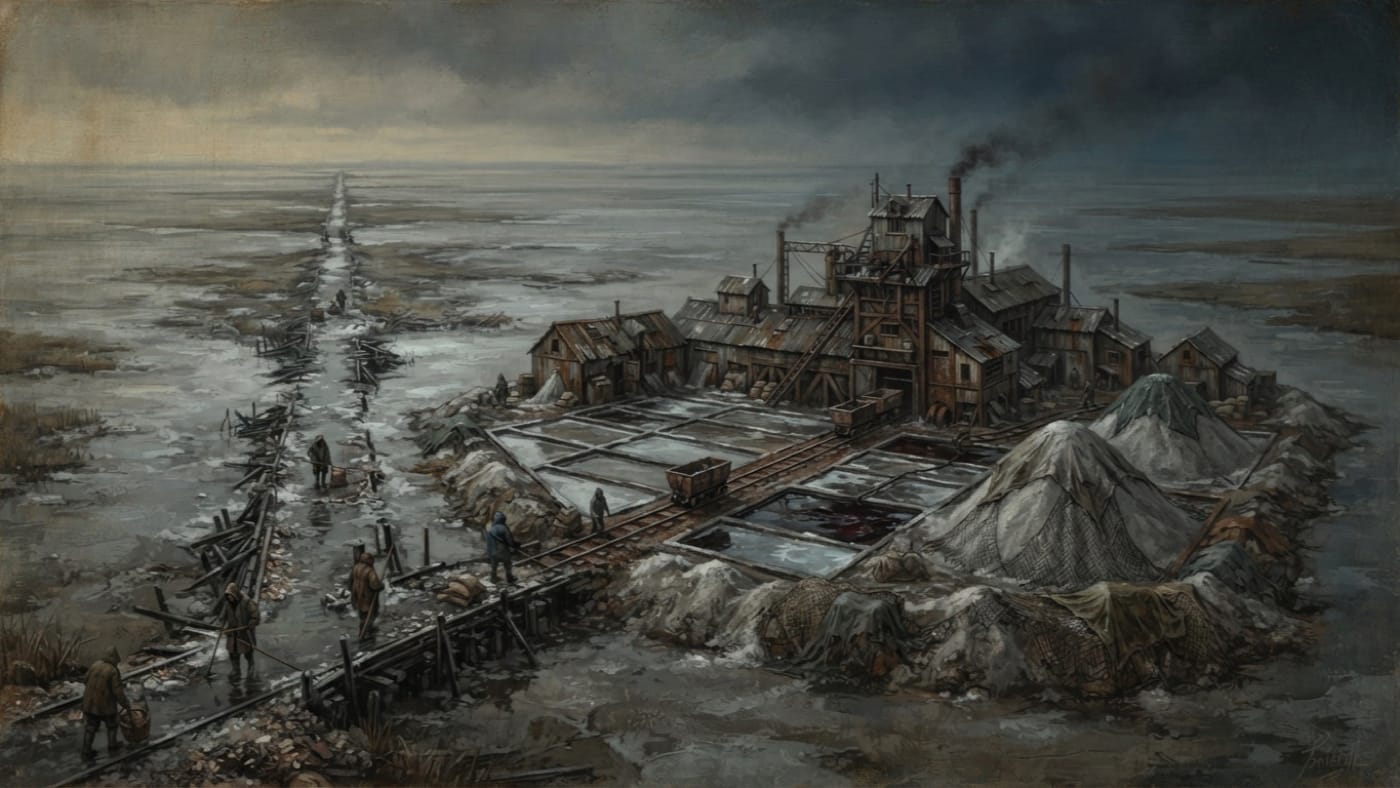
At the far end of the Fourth Causeway, seven miles out from the Brine Fork, the Brielle salt-panning station makes salt. The Codex can certify that much without difficulty.
It stands in the tidal country of the western approaches, in the long grey belt of marsh and flat that runs from the Frisian shallows through the Zeeland sands to the drowned mouths of the Scheldt. It is the sort of terrain the Bureau of Engineering colours green on its summer maps, the green it reserves for ground of no administrative consequence. The water comes in, the water goes out, and the salt is what the water leaves behind on its way. Brielle's whole reason for existing is to get there first.
The Fourth Causeway, which the older registers call the Brielle Spur, is its only recorded road. The seven miles belong to the road. Of the station's own grounds the file gives no measurement, no boundary and no orientation. It does not even give a distance from any other named town, a gap the reader may resent as much as I do.
What the file does establish is the governing fact of the place. Its overland connection exists only when the marsh freezes. In a proper winter, ordinarily from November into March, frost sets the mud hard, the Salt-Vigil lay their reed and timber and shell across it, and Brielle is joined to the Church's supply roads. In every other season it is joined to them by a theory.
#On Salt and Its Handling
The file calls Brielle a salt-panning station. Then it stops. The clerk who wrote it was paid by the line and gave the Church the fewest lines he could.
So the Codex will not tell you whether Brielle's brine is drawn into shallow beds and left for the sky to reduce, or boiled over a fire, or worked by some marsh method of the western flats that the Bureau has not bothered to name. I have no record of its fuel, the size of its pans, its yearly output or the size of its labour rolls. I could make these up. Certain of my predecessors would have, and their editions now sit in the Bureau of Records in a cabinet labelled Superseded, where I intend never to keep them company.
What the station handles is recorded well enough by the nature of the work. Brine. Wet salt drying to grit that gets into cuffs, hinges and the creases of the knuckles. Reeds bundled against the wind, cold iron that tears the skin of an ungloved hand and keeps a little of it, and sacks and loads waiting on the frost. The workers are recorded only as workers. I name none of them, because the file names none of them.
Salt matters in the western approaches for two reasons. It is a trade good, and it is a building material. The Salt-Vigil take a tithe in salt at their toll-houses, store it at the Brine Fork, mix it with the aggregate the Bureau of Alchemical Standards blesses each year, and spread it over the causeways when they rebuild them every autumn. The road is made partly of the thing the road carries, which suits the Salt-Vigil's idea of thrift.
Brielle sits inside that economy. Its exact share of the work is unquantified. No contract, exclusive buyer or percentage of regional supply appears against its name, and the Codex will not print a figure the Ledger has never seen.
#On Passage and the Accounts
Whatever leaves Brielle by land leaves by the Fourth Causeway, and whatever travels the Fourth Causeway is counted twice.
The Bureau of Tithes takes a crossing fee at the toll-houses in scrip, salt tokens or Palatinate trade chits, and guards that right with a jealousy usually seen only in cathedral chapters and dogs. Beside it, the Salt-Vigil take their own tithe of salt and tears. They do not regard the two as competing. The Bureau does not regard them as comparable. The traveller has to pay both, and on the Causeways the traveller's opinion is recorded only in the toll-booth confession registers.
For a saltworks this creates an odd liturgy of payment. A carter bringing a load of salt along the Fourth Causeway may well pay part of his fee in salt. The order then takes it to the Brine Fork, adds it to the stores, and spreads it over the next year's road. If any of that salt came from Brielle, Brielle is helping to pave its own road out and paying a fee to use it. The Bureau of Tithes calls this efficiency. I call it a closed loop, and I record it without comment, because comment is beneath the Ledger and the carter has said it all already, in language the confessors took down.
Everything goes through the Brine Fork. The order's priory is there, the salt cellars are there, and the junction where the Fourth Causeway meets the rest of the network is there. Prior Idris of the Sixth Tide governs the order from that marshy island. His jurisdiction covers the road and those who tend it. The file does not make him master of the saltworks, and the Codex will not promote him.
Ownership of the station itself is unrecorded. So is its management, and so is the question of which authority, if any, holds the deed. The independent Netherlands lie near these waters, and the Synod administers the route. Neither fact tells us whose station it is. The road is the Church's business, and the station is in the file because the road ends there.
#On the Winter Closure
In the winter that began in A.S. 199, the water under the Fourth Causeway did not freeze.
The Bureau of Alchemical Standards instruments recorded the water at its expected seasonal minimum. Salinity was ordinary and the air was well below freezing. By every measurement the Bureau had, the shallows should have set hard. They stayed liquid. The rest of the Causeways froze as usual, and the Brielle Spur remained open water from end to end.
The road's own witnesses described it differently. The toll-brothers of the Fourth Post reported that the water beneath them was warm. Brother Erasmus of the Fourth Post said in his deposition that it tasted of salt and of something else, "like tears, but older." The instruments say cold. The brothers say warm. The Codex records both and does not reconcile them. Reconciling them is not the Ledger's job, and no one has asked me to.
The Fourth Causeway was closed for the A.S. 199–200 season. For Brielle, that meant the frozen road it depended on was not built. Whatever the station needed to bring in or send out that winter, it could not count on the Causeway. How it managed, by what boats or paths or stores, the file does not say. I decline to supply a rescue fleet. I decline equally to supply a famine. The record holds neither.
The principal Codex entry on the Salt-Vigil Causeways describes the A.S. 199 closure of the Fourth Causeway as "the first closure of any causeway in the order's history."
The same entry records that in late-freezing years the Second Causeway "does not exist," and that its traffic is rerouted through the Queue Road. A road that fails to exist has also been closed, whatever wording the order prefers. The superlative is withdrawn. The A.S. 199 closure stands as the only recorded closure of the Brielle Spur.
In March A.S. 200, after the thaw had settled the question of freezing for that year, the Bureau of Engineering sent a survey team. It found the shallows ordinary. The water was cold, and the mud was mud. The team also recorded that the salt-panning station at Brielle was operational.
That one sentence is the station's best evidence. It says Brielle was working in March A.S. 200. It does not say that Brielle worked without a break through the closed winter, that its salt was unaffected, or how much salt it made. A survey that finds a station working proves the station was working on the day the surveyors stood in it, and the Codex claims nothing beyond that day.
The Causeway was rebuilt in autumn A.S. 200. It froze, and traffic went back to the Brielle Spur. During the A.S. 200–201 season, Assessor Maren Gault measured the tear-phials collected at the Fourth Post's Weeping Chamber as thirty percent heavier than those from any other toll-station. Those phials come from the road's toll-house. They are not Brielle's salt. Gault measured no salt, and no one has reported any change at the pans. The Fourth Causeway Anomaly has its own entry, and the reader with a taste for such things is referred there.
#On the Recorded Condition
The last direct record of the station's condition is the March A.S. 200 survey, which found it operational. No later inspection of Brielle is on file.
The road has been assessed more recently. As of A.S. 201, the Salt-Vigil network is classed as seasonally operational, and the Fourth Causeway alone is Amber, under monitoring. That classification applies to the road and to what the road collects. It says nothing new about the station, and an Amber road is still the only overland road the station has.
So Brielle sits at the end of seven monitored miles and makes salt in the frozen months and the thawed ones alike, for whoever comes to fetch it when the marsh allows. Its owner is unnamed. Its method and its output are unrecorded, and nobody has inspected it since the spring of A.S. 200. The Church has received from this place exactly one certification of good health in the whole of its file, and it has kept that certification carefully.