
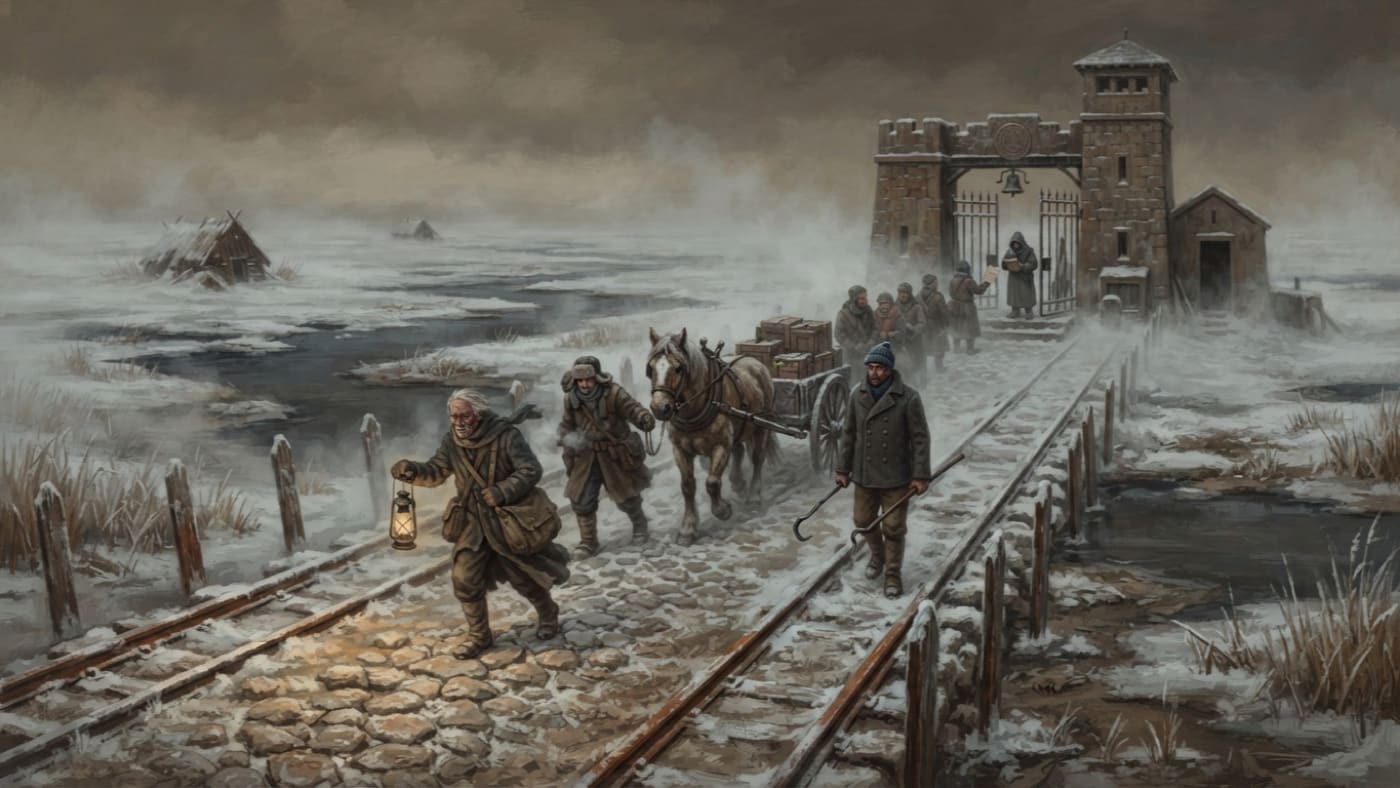
#On the Flats
"Pay wet, pass dry." — Causeway saying. The local reply is "And don't step off."
The Frisian flats are tidal ground the sea has never finished deciding about. It comes in over them twice a day and goes out twice a day. What it leaves is mud the colour of an unwashed chalice, black channels running between banks of brown reed, and a brine crust that whitens a boot to the ankle. In summer the flats are merely treacherous. In winter the shallows freeze, after a fashion, and a person with a lantern, a pass and enough stupidity may cross them on foot.
The Church prefers that such a person use the road.
The Salt-Vigil Causeways cross these shallows on raised stone. They also cross the Zeeland tidal flats and the Scheldt estuary. Those are separate waters with their own drownings, and no clerk who values his stool will file one under the other. On the Frisian ground the causeway is a rib of salt-stone and bone-lime mortar laid above the mud. Iron rails run along its edges, rusted orange beneath the frost. Past the rail stand the no-step stakes, prayer-posts driven into ice and silt to mark where the road ends and the offence begins. Fog lies low here and hides the breaks in the stone. Black ice forms where the tide has undercut the bed. When the thaw comes, it opens sinkholes beneath spans that looked sound at vespers.
I cannot give the reader the borders of the flats. The Bureau of Records has never drawn them to my satisfaction, and the marsh does not consult the Bureau. The road is the only part of this country that holds still long enough to be governed.
#On the First Crossings
"They only take tears from the guilty." — Common lie, Salt-Vigil roads
In A.S. 52 (1762 CE), seven years after the Sundering, refugees were coming west with whatever they had carried out of the east, which was usually less than they had started with. Salt-hermits were already living on the Frisian flats in reed huts. Nobody recorded why. Ascetics do not explain their addresses. The hermits knew where the ice would hold and which channels stayed open beneath a skin of snow, and they led the refugees westward across the frozen shallows.
They charged for it. They took salt, which hermits pan and refugees rarely carry, and they took confession. With the confession came tears, which the hermits caught in clay vessels and kept.
Nothing was audited yet. There was no witness, no wet seal and no ledger. A clay pot stood inside the door of a reed hut and filled. Someone held a lantern out over the bad channel, and someone else put a hand on a shoulder where the ice turned grey. Later Salt-Vigil catechists call this the age of pure vigil, before the paperwork spoiled it. The Weeping Chamber keeps no such sentiment, and neither do I.
The Bureau of Alchemical Standards later tested fourteen of the clay vessels. It reported their contents as "saline, of human origin, and exhibiting faint residual grief." One vessel hummed and was not opened. Glassware cannot measure purity of motive, so Alchemical Standards measured what it could.
I do not claim the hermits were the first to cross. The Records begin with them. The flats are older than the Records and doubtless had fools of their own.
#On the Chartered Road
Thirty years after the first crossings, the practice had become a habit, and the Church dislikes any habit it does not own. In A.S. 82 the Salt-Vigil received its charter under Archon Veyrault's Bureau of Records, which had been remade in A.S. 78 into an instrument with an appetite. The charter granted a mandate to maintain seven seasonal causeways. Those seven run across the whole network: the Frisian shallows, the Zeeland flats and the Scheldt estuary together. Anyone who counts seven causeways in the Frisian shallows alone has miscounted and should report to a clerk.
The charter turned a hermit's pot into a procurement line. Alchemical Standards issued glass phials that same season. Witnesses were assigned, wet seals cut, toll accounts opened and custody written down. The oldest surviving phial is dated A.S. 83, the first full winter of the arrangement.
The Synod formalized the Salt-Vigil in A.S. 82.
Correction. The Synod did no such thing in A.S. 82, because it did not exist until the Concordat of Strasbourg in A.S. 90. The charter came from the Church's growing administration under Veyrault's Records. Later editions lent it the Synod's name the way a widow lends her late husband's title to a debt: retrospectively, and to the creditor's benefit.
Once chartered, the Frisian crossings stopped being an escape and became a stretch of a supply artery. The network runs from the Candlewick Palatinate to Brine Fork, the marsh-island chapter-house where the Candlewick Spur, the Long Salt and the spur toward the Queue Road separate. A further spur runs toward Hamburg. The refugees of A.S. 52 walked west to get away from something. The convoys of later winters walk wherever the ledger requires.
Whose flats these are, in the sense a jurist would mean, is a question this entry does not answer. The Netherlands keeps its own counsel and its own ships, and the Salt-Vigil keeps its road. I record the administration of the road, which is documented. I decline to record a sovereignty, which is not.
#On Passage and Shelter
The winter road carries grain and other winter stores, pilgrims, traders and prisoners, all in the same wind. Salt panners work the pans at the edge of the flats. Span crews reset stones the frost has shifted. Lantern tenders trim wicks along the exposed miles, and convoy drivers keep their teams to the crown of the road, where the horses would rather not be. Toll clerks keep the accounts, and vial clerks keep a second set of accounts that matter more. When the thaw comes, culvert men work beneath the road in water that will kill a strong swimmer in the time it takes to say a short collect.
The toll comes first. Coin, scrip, a salt block, a ration chit or a military exemption will open the gate. If none of those can be produced, the traveller goes to the Weeping Chamber. There is a bench, a small table, a Salt-Vigil witness and a vial clerk, and there is no fire. The traveller confesses until the tears come. Travellers who cannot weep may be asked for blood, for labour or for further confession. They may also be invited to wait outside until the weather makes them more fluent.
A bed depends on the clerk, and so do the soup, permission to go on to the next station and the standing of the traveller's papers at the gate after that. A dry face sleeps against the toll-house wall on the windward side. In the reckoning of the road, a lantern is a verdict.
Anyone who goes around the road meets the punishments for that too. Thaw culverts run beneath the stone, and reedboats slip along the open channels when the ice softens. Smugglers sell both routes, and the poor buy them. Stepping off the road at a toll-house is treated as a doctrinal violation, not as trespass, and the Church does not lose arguments about the difference.
#On What the Crossings Leave Behind
The clay pots of A.S. 52 were the first of the vessels. After them came glass, and after the glass came the locked crate. Every phial collected on the chartered road travels under escort to Brine Fork and goes down into the Brine-Fork Phial Cellar, where the inventory of A.S. 199 counted eleven thousand four hundred and six sealed phials. There have been more since. That number belongs to the cellar and to that year. It is not a census of the flats, and it does not count the hermits' pots, which were never racked.
The tears leave the flats and do not come back. The obligation does not leave the travellers either. A wet seal is proof of payment, and in a dispute it is also evidence.
During the Fading Winter the origin fields on Salt-Vigil phials faded. The dates and the fees remained. The names thinned. Some of those fields once named stations on the Frisian crossings. I cannot say how many, and the phials can no longer say either.
Out on the road, span crews and ascetics report a second difficulty, which I file separately because they insist on it and because I have no evidence to join the two. In hard fog, they say, letters of salt form on rail iron and stone and spell the names of travellers who have not yet arrived. The ascetics require that the names be read aloud. The crews rub the rails with tallow-wax. A local saying holds that a traveller whose name the road writes twice should not finish the crossing. The Church has not ruled on the saying. Travellers follow it anyway.
The Fourth Causeway Anomaly is a different matter on a different spur. That road failed to freeze in A.S. 199 and was closed, then refroze for the season of A.S. 200–201. Its phials still keep their own troubled accounts. None of this makes the Frisian shallows guilty by association. The marsh can arrange its own guilt.
#On the Present Passage
Every winter the shallows freeze, the bell rings at the first gate, and the convoys go out onto the stone. Off the road the mud is waiting, along with the black channels, the reed and the fog. The road keeps the traveller alive only for as long as the stones hold, the lantern stays lit and the papers satisfy the clerk at the next desk.
The flats can close the road for their own reasons, through a thaw sinkhole, a broken span or a whiteout that rolls along the rail. The Church closes it for reasons of its own. Road Tribunal riders can void a pass in the middle of a span, and a traveller with void papers is still on the ice, without a bed, without soup and without standing, and a long way from anywhere that will take them.
The hermits' huts are gone from the record. Their pots are in the custody of Alchemical Standards. The crossing they kept has become a toll-house, a stamp and a crate going south under escort.