
#On the Flower That Is Not a Flower
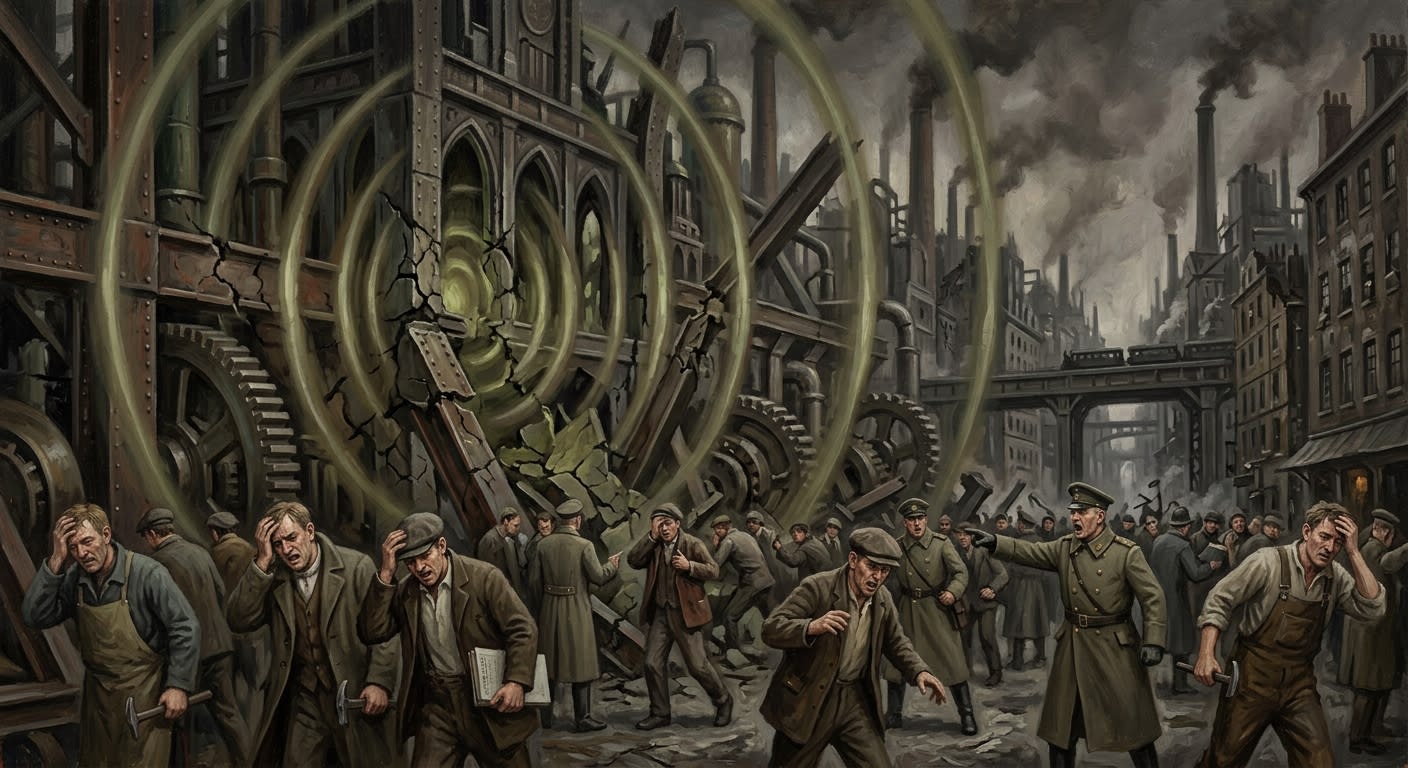
A Resonance Bloom is the moment when Essen-of-Hymnsteel remembers that stone can hate music. The name is official enough to be stamped and pretty enough to be suspicious. A bloom should suggest petals, fragrance, spring, the harmless vanity of gardens. Essen's bloom opens in rivets, teeth, stair rails, bell-cannon throats, jawbones, hymnsteel grain-lines, ledger shelves, and the private courage of men who have discovered that the floor beneath them has opinions.
The phenomenon begins below the Foundry Core. It does not rise like ordinary sound. Ordinary sound is democratic filth: a bell rings, a hammer falls, a foreman bellows, and everyone nearby is equally assaulted. Bloom enters through contact. A worker feels it first in the soles. A singer feels it behind the tongue. A clerk in Ledger Row feels a molar ache in triplicate, which is the only moment in that district when pain is filed accurately before lunch. Tools hum on benches without being touched. Candles tremble in sealed rooms. Water in furnace buckets wrinkles inward, as if listening.
Then the city answers itself. Catwalk bolts loosen in sequence. Hymnsteel parts crack along grain-lines that were declared perfect an hour earlier. The Hall of Measures loses pitch. Choir singers choke on notes they have sung since childhood. In heavy Bloom, sound fails after the eruption: no footsteps, no shouted orders, no bells, no prayer audible beyond the lips. Silence settles over the affected district with the appetite of lime over a corpse.
#On the First Documented Openings
The first recorded Blooms predate the Mirror Choir by approximately forty years, a fact which has embarrassed the Compact Council into acts of paperwork so athletic that the Bureau of Medicine considered classifying them as a nervous disorder. The earliest clean entry appears in an Orison repair appendix: “foundation response during late pour; two singers bled; no heresy detected.” That last phrase should be read as panic wearing a collar.
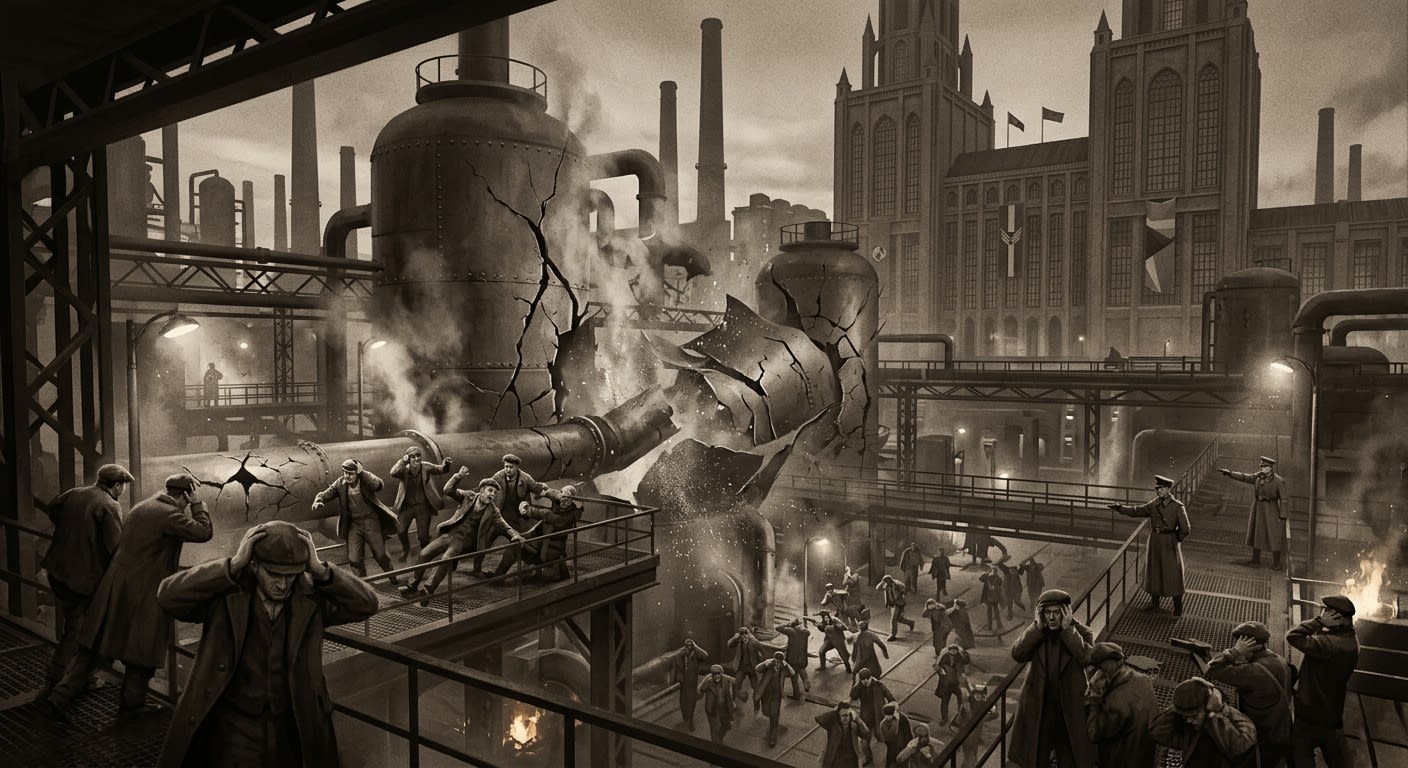
Essen had been made into the Synod's throat-forge by then. The Tri-Bureau Compact of A.S. 110 had placed furnaces, ledgers, and song under one roof and three knives. By A.S. 118 the city had been renamed Essen-of-Hymnsteel, because Orison has never met a mouth it did not wish to label. The Foundry Core's old guild-forges were buried under calibrated halls, choir stages, furnace basilicas, rivet presses, bell-cannon moulds, and Master Hymnal Plate schedules. Steel was taught obedience by sanctioned vibration. Men were taught obedience by wages, hunger, and the availability of Purity officers near every door.
The old forges had sung before the Bureaus arrived. Guild workers used timing cants, hammer chants, whetstone murmurs, river songs, dirty little furnace rhymes that spoke to the metal as if it were a mule, a creditor, or a saint with poor manners. The Compact replaced all that with plates. Master Hymnal Plates fixed every approved stanza, breath mark, interval, pause, and cadence. The city became more productive. The steel improved. The foundations began to answer in a voice no one could fit onto a staff line.
Compact Report 447-E attributed all recent Bloom activity to Mirror Choir sabotage.
Withdrawn under sealed Bureau of Rites review. The Mirror Choir remains guilty of alteration, sedition, acoustic treason, and talent misapplied with alarming elegance. It did not invent Bloom. Chronology refuses the accusation, and chronology, though tiresome, has excellent handwriting.
The official histories avoid the first workers who heard it. They prefer institutional causes: furnace expansion, substrate pressure, old mine seams, relic-dust contamination, wrong tempering, altered breath. Yet the earliest testimonies are simple. A riveter says the bolt sang his mother's name. A lockhand says the river stopped under the bridge. A throat-dorm novice says every tooth in her jaw tapped a different syllable. A furnace child says the floor asked for the old song.
#On the Mechanics of Bloom
The Bureau of Engineering describes Bloom as a harmonic release through an overcoupled industrial substrate. This is plausible, and plausibility is the engineer's preferred heresy because it feels clean in the hand. Essen is built as a single resonant body: furnace piers tied to canal locks, locks tied to gantry columns, gantries tied to choir stages, choir stages tied to pour rails, pour rails tied to cooling vaults, cooling vaults tied to old foundations whose original plans were lost, confiscated, burned, revised, or eaten by Records mice with unusually selective taste.
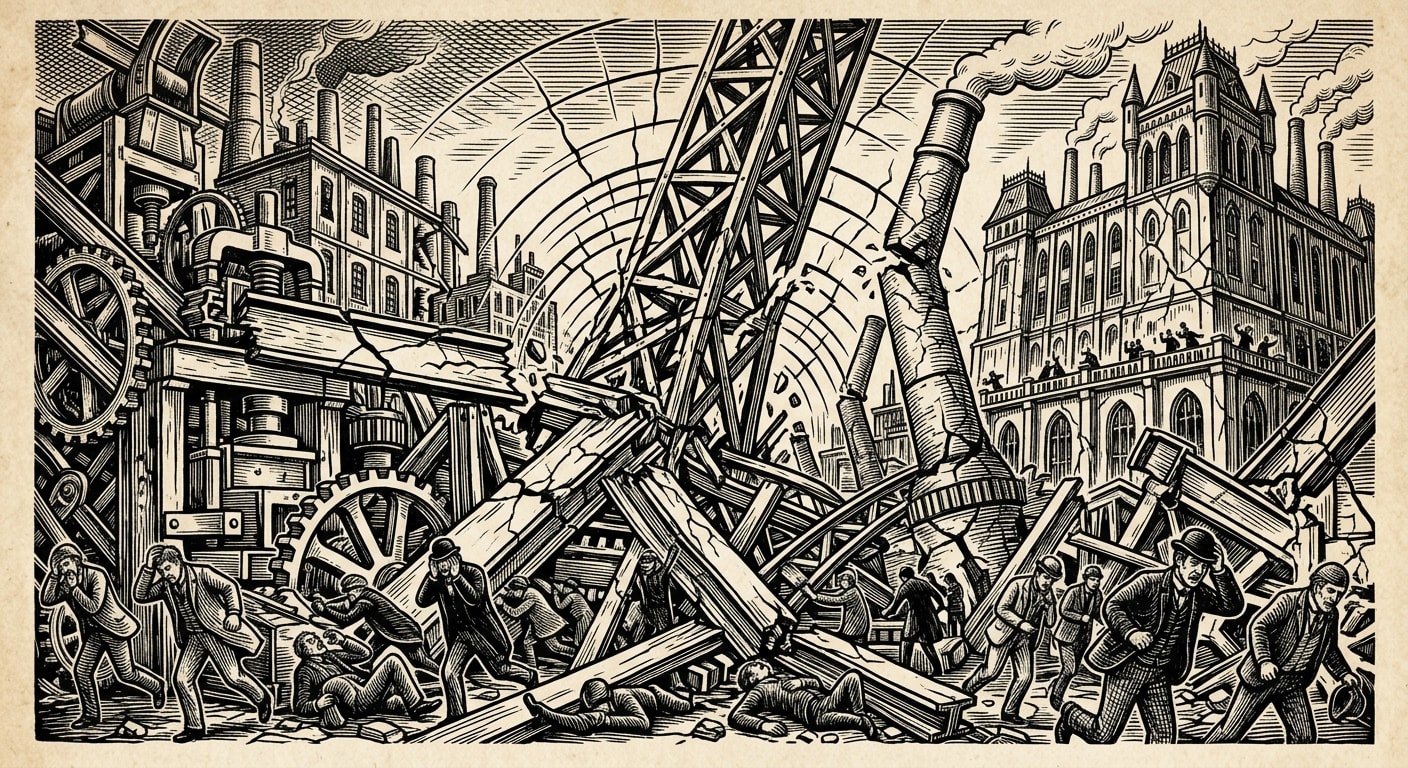
Every pour in the Hall of Measures passes voice into metal. Paired choirs sing bearings awake before the furnaces light. Metered chanting during cooling aligns grain structure. Orison insists this is sacrament. Engineering insists this is vibration. Doctrine insists no one insist too loudly. In practice, the metal listens. Hymnsteel holds pitch under stress because voices shaped it while it hardened. A bell-cannon throat owes its strength to the approved stanza. A hymn-drive housing survives shock because the cooling grain was disciplined by song. A reliquary rivet maintains moral coherence because Orison and Engines agreed to use the same lie for different reasons.
Bloom occurs when the listening reverses.
The foundation answers the choir. The old plates suppress the answer until pressure gathers in stone, iron, water, and human bone. Then some change — a rushed pour, a tired alto, an unlicensed hum in the Ash Warrens, a Mirror Choir breath mark, a furnace load too heavy for the sanctioned cadence, a bell schedule altered by Records to hide overtime debt — opens the seal. The city hears itself hearing.
The Bureau of Medicine has mapped Bloom through bodies because bodies, unlike offices, cannot refuse testimony. Teeth ache first in the lower right jaw among workers stationed above the third bearing trench. Singers report pressure behind the tongue. Lock crews develop nosebleeds in paired timing with the canal gates. Clerks report vertigo near Ledger Row's east shelves, though clerks also report vertigo when asked to carry furniture, so this datum remains under review. In severe Bloom, the tiny bones of the ear vibrate hard enough to bruise surrounding tissue. A man's skull becomes an instrument and, worse, a receiver.
The quiet after Bloom has its own mechanics. The affected zone absorbs sound for hours or days. Tools strike without ring. Boots land without report. Men shout and hear only the wet effort inside their throats. Orison calls this post-event acoustic exhaustion. Workers call it the city swallowing the note before it can be used against her.
#On the Wrong Choir Beneath
The Wrong Choir is the workers' name for the voice under Essen. It is also the only honest name in the file. The Compact's terms all seek ownership. Holy alignment makes the event devotional. Structural resonance makes it mechanical. Cadence irregularity makes it disciplinary. Wrong Choir admits the experience: something is singing below the Foundry Core, and its interval is wrong enough to frighten teeth.
The Wrong Choir is not the same as a Bloom. The Choir is the ongoing condition. Bloom is its opening. Men who work long enough in Essen learn the difference between the ordinary under-hum and the first taste of release. The ordinary hum lives in pipes, rails, and molars. Bloom has intention. That word is forbidden in Medicine memoranda, unpopular in Engineering reports, and fatal in Orison committees, but anyone who has stood above the Core during a heavy event knows it. Intention enters through the boots.
The buried truth, already confessed in the Essen file and denied by everyone paid to read it, is that the Master Hymnal Plates were edited by Synodal authority. The old guild stanzas produced foundation speech. The Bureau of Rites could not classify it. Doctrine could not tolerate it. Orison cut the plates. The revised hymns suppressed the speech, or gagged it, or taught the city to mispronounce whatever it had been trying to say. The Compact's present fear is not that Bloom has no meaning. The fear is that it has one.
No office agrees on what lies beneath. Old mine galleries. A sealed guild chapel. A river-crypt. A Rationalist acoustic engine buried before the Compact. A saint too industrial to canonise. A demon too patient to attack. A city made into an instrument until the instrument developed a throat. Each theory is ridiculous. All are filed. The Ledger is a generous graveyard for respectable nonsense.
BUREAU OF RITES LISTENING POST — SUB-FOUNDATION TEST, A.S. 199 Three probe rods sunk below Foundry Core Pillar 17. Rod One returned vibration matching no approved hymn. Rod Two returned a child's counting rhyme from pre-Compact Essen. Rod Three returned ███████████████████████████. Listening team dismissed, then isolated, then relabelled as volunteers.
#On the Mirror Choir's Use of Bloom
The Mirror Choir did not create Bloom. It stole the argument Bloom had already begun. This distinction matters because wrong accusations are bad weapons: they may strike the enemy once, then shatter in the hand and leave the wielder explaining splinters.
The Choir's doctrine is seductively shaped for workers who have spent their lives being told that every ache in the throat is holy. The Synod's frequencies are false. The Master Hymnal Plates were altered. The foundations speak truth through rupture. Correction requires disobedience. A quarter-tone below the approved pour-stanza becomes witness. A breath where sustain is prescribed becomes confession. A changed syllable becomes a key turned in the city's gag.
Bureau circulars classify Bloom as a Mirror Choir instrument.
Clarified. Bloom is a pre-existing Essen phenomenon. The Mirror Choir conducts near Bloom, feeds on Bloom, claims Bloom, and sometimes turns Bloom toward later failure in hymnsteel shipments. Calling it the instrument is like calling a thief the inventor of night.
The Choir is clever enough to let Bloom do its recruiting. After a district shakes and falls silent, after workers see red grain fractures in a bell-cannon throat certified perfect, after Medicine asks each man to point at which tooth sang which note, a cell member needs only whisper: the Bureau cut the song. Men who would never read a heretical tract will listen to a sentence that explains why their mouths hurt.
Its operations cluster around the Ash Warrens, Throat Dorms, hushrooms rented under false devotional names, duct-catacombs beneath the Hall of Measures, and silent streets after Bloom events. The altered sheets are beautiful, which is politically rude. They reduce singer strain. They preserve metre. They sometimes produce hymnsteel of alarming purity before the later failures appear. A crude heresy can be burned with ceremony. A skilled heresy forces the Bureau to admit it is threatened by competence.
The Alto With No Name remains unfound. This has irritated Purity into metaphysical barking. Each sweep catches cell hands, copyists, nervous tenors, three boys guilty only of bad timing, and one old woman who could not sing but owned a kettle with unusual pitch. The Alto remains a voice in reports: present in variants, absent from rooms, heard in intervals nobody admits to recognizing.
#On Bloom Incidents A.S. 199–201
Three major Blooms in eighteen months have made Essen's conditional status more conditional than Strasbourg enjoys confessing. The first struck a mass pour for bell-cannon throats bound toward Bastion-Przemyśl. The Hall of Measures held pitch through stanza twelve, then every singer's right incisor began to bleed. The crucible surface wrinkled in concentric rings. Fourteen throat blanks cooled without visible flaw. Three later cracked under proof strike, each fracture following an identical red-bright line. Orison blamed fatigue. Engines blamed coal impurity. Records blamed a manifest hand. Medicine drew teeth.
The second Bloom struck Ledger Row during a quota reconciliation. This delighted no one but me. Shelves shook without falling. Ink lifted from twelve pages and settled back with letters reversed. Every bell in the Records spire rang once, though the clappers were under maintenance and two had been removed. Arch-Notary Veyl declared a temporary counting anomaly and billed the district for restoration of existence. Workers noticed that the anomaly spared debt ledgers and damaged wage claims. Providence often respects hierarchy in convenient ways.
The third Bloom struck the Foundry Core at night. No pour was scheduled. That is why the Compact fears it. Tools hummed in locked cabinets. Hushwright panels in the Quiet Gradient failed for seven minutes, exposing the rich to unlicensed sound; several survived, though one widow reportedly heard her dead husband asking where she had hidden the second will. In the Ash Warrens, children woke singing a four-line work cant not used since before the A.S. 110 Compact. Purity collected the children. Orison collected the melody. Records collected the parents' signatures acknowledging neither collection had occurred.
#On Medicine, Rauth, Kord, and Veyl
The Bureau of Medicine has no solution, which gives it the only clean hands in Essen. Its physicians map symptoms, classify exposure, and decline to recommend anything that would interrupt production. Doctorate clerks have produced jaw diagrams so precise one can see where doctrine first enters the molar. They have measured silence density after Bloom. They have tested blood taken from singers before and after exposure. They have noted that workers assigned to post-Bloom repair crews develop rhythm compulsions, sleep-counting habits, and a tendency to hear missing beats in ordinary speech.
Master-Calibrator Sister Rauth has refused accelerated calibration tempo without liturgical stability guarantees. Her throat carries the scar of A.S. 184, when a quarter-tone error sprayed molten steel across a platform and killed fourteen singers. She needs no rhetoric. She points to the scar and men rediscover obedience. Rauth knows the plates were edited. She knows because any master of her rank must know where the sanctioned line differs from the older line. She speaks of it with the holy evasiveness of a woman standing on a trapdoor she helped paint.
Furnace-Marshal Kord wants output. He always wants output. He regards Bloom as furnace weather, singer delicacy, Orison theatre, and Records excuse, depending on who is in the room and which budget is bleeding. His coal-black nails have signed conscription orders from the Ash Warrens, requisitions for longer pour windows, and one private request for additional ear warding which he later denied making. Hypocrisy, when attached to production, receives a desk.
Arch-Notary Veyl profits. This is not accusation. It is weather report. Every Bloom generates claims, corrections, compensation schedules, death proofs, missing-shift penalties, replacement identities, cargo reclassifications, damage tariffs, silence-zone permits, and disputed nonexistence. Veyl's ledgers fatten while teeth crack. Records has always understood disaster as an invoice written by the Creator in a hurried hand.
An A.S. 200 Compact notice states that all personnel harmed during Bloom response received prompt compensation.
Corrected. All personnel whose names survived the response ledgers and whose injuries matched approved categories received compensation after fee deduction, identity verification, silence-zone tax review, and proof that the harm had occurred during an authorized portion of the event. Several men were injured too early to qualify.
#On the Present Danger
As of A.S. 201, Resonance Blooms intensify while the city remains indispensable. This is the central joke, and Providence has a cruel ear for comedy. Essen cannot be slowed without starving the Line of bell-cannon throats, hymn-drive housings, reliquary rivets, clappers, tuning fixtures, and the other obedient metals by which the Synod survives its own enemies. Essen cannot be trusted because its foundations sing back, its singers bleed, its heretics learn from damage, and its Bureaus answer every warning by meeting in a hotter room.
The possible outcomes sit in the file like knives in a chapel drawer. A stable counter-psalm could make Essen safe and dangerously powerful. A full plate audit could expose the original suppression and prove the Mirror Choir right in the one way heresy must never be right. A major Bloom during a mass pour could turn the Foundry Core into a bell struck by Hell's own hammer. A successful Mirror Choir city-wide stanza swap could send false obedience through a season of metal and break the Line weeks later, one gun throat at a time.
The Bureau of Orison and Song has dispatched audits. The Bureau of Medicine has expanded dental tables. The Bureau of Engines and Furnaces has demanded additional labour. The Bureau of Records has printed forms required to profit from all outcomes. The Bureau of Purity has prepared arrests. The Bureau of Doctrine has prepared language.
Beneath them, Essen sings.
The next Bloom will be called alignment if it spares the quota, sabotage if it damages shipment, miracle if it kills an unpopular official, and tragedy if the dead include anyone with relatives in Strasbourg. The workers will call it waking. The Mirror Choir will call it proof. The Wrong Choir will call nothing. It will pass through stone, rivet, tooth, and throat, and the city will open for a moment like a wound pretending to be a flower.
#On the Ash Warrens Aftershocks
The Ash Warrens feel Bloom before the Quiet Gradient admits it. This is not mysticism. It is architecture and poverty, those twin evangelists of accurate suffering. The Warrens sit near the warm ducts and service voids where the city's buried sound leaks upward. Families rent floor-space by heat. Children sleep above pipe runs. Old women hang washing where furnace breath dries cloth in minutes and leaves every shirt smelling faintly of iron confession. When the foundation hum thickens, the poor hear it first because the poor live closest to the machinery that denies being dangerous.
After a Bloom, the Warrens change their habits without waiting for the Compact. Kettles are set on folded rags so the first tremor can be seen in the water. Babies are laid with copper buttons under the matting, because copper chatters before iron loosens. Men returning from the Foundry Core tap doorframes three times and listen for the wrong fourth answer. Women who clean choir barracks bring home discarded throat-cloths and tie them around pipe joints. No Bureau approved these practices. Several work. That is why the Bureaus dislike them.
The children are the worst evidence. During the A.S. 201 night Bloom, seventeen children in three Warrens lanes woke speaking old Essen work-cants. None had been taught them. Six used pre-Compact words for furnace tools. Two named guild saints removed from approved calendars. One sang a line that matched a confiscated plate variant held in Orison custody, though the child had never left the southern ducts and could not yet read. Purity took statements. Orison took the melody. Medicine took temperature readings. Records took custody signatures from parents who could not sign and later billed them for witness assistance.
The official explanation was overhearing. A child hears a tune in the market, carries it home, dreams it crooked, repeats it during an incident, and fools frightened adults into metaphysics. This explanation has the great virtue of being possible and the greater vice of being insufficient. Several of the children sang in the silence zone after the Bloom, when no carried sound should have travelled across the room. Their mouths moved. The walls answered for them.
The Mirror Choir recruits from this residue. It does not need to invent grievance where the Compact supplies it by the ladle. A mother whose child is taken for singing a song older than the Compact will listen when a cell hand says the plates are cut. A lockworker whose teeth bleed in approved service will listen when a tenor says the old intervals were kinder. A furnace widow whose compensation failed because her husband died in an unauthorized minute will listen to anything that sounds less like a form.
#On Counter-Psalms and the Shape of Refusal
The promised cure is a counter-psalm. There is always a promised cure. Institutions confronted by phenomena beyond authority produce cures the way frightened squids produce ink: darkly, defensively, and in quantities sufficient to obscure the retreat. Orison wants a stabilizing cadence that can be sung over Bloom onset and force the foundations back into obedience. Engineering wants a dampening sequence timed to pier-load calculations. Medicine wants the singers placed far enough from the source to keep their inner ears from bruising. Records wants a form identifying who is liable if the counter-psalm works too well.
Master-Calibrator Sister Rauth has tested three fragments. The first reduced tremor in a north gantry and shattered every glass gauge in the adjacent assay room. The second held a cooling pour steady for eight minutes and left the alto section unable to pronounce the letter m for two days. The third caused no structural effect at all, but every listener remembered the same childhood smell: wet coal, boiled onions, and a hand over the mouth. Rauth burned the sheet herself. No one objected. Even bureaucrats occasionally recognize a document begging for fire.
The deeper problem is consent. A counter-psalm requires voices. Essen has used voices for a century and calls the attrition service. Singers already lose pitch, hearing, sleep, teeth, and years. To ask them to sing into Bloom is to ask a lamp to argue with the furnace. The Bureau of Orison will call them volunteers. The Bureau of War will call them necessary. The Bureau of Medicine will call them subjects if the door is closed. The singers call the proposed programme the Mouth Tax.
Refusal spreads quietly. A tenor misses rehearsal because his permit was mislaid, then produces the missing permit too late to be punished cleanly. A contralto develops a cough that appears only during counter-psalm drills. Copyists transpose harmless rehearsal lines and force delays. Hushwrights sell illegal ear plugs packed with ash felt and saints' wool. A city taught that sound is obedience has begun discovering the political uses of small silences.
I do not praise this. Praise would be evidence. I merely observe that men and women pressed into instruments sometimes learn to go out of tune on purpose. The Bureau calls that sabotage. Music calls it modulation. History, which has the manners of a butcher and the patience of a nun, waits to see which name survives the invoice.