
#On the Hum Beneath the City
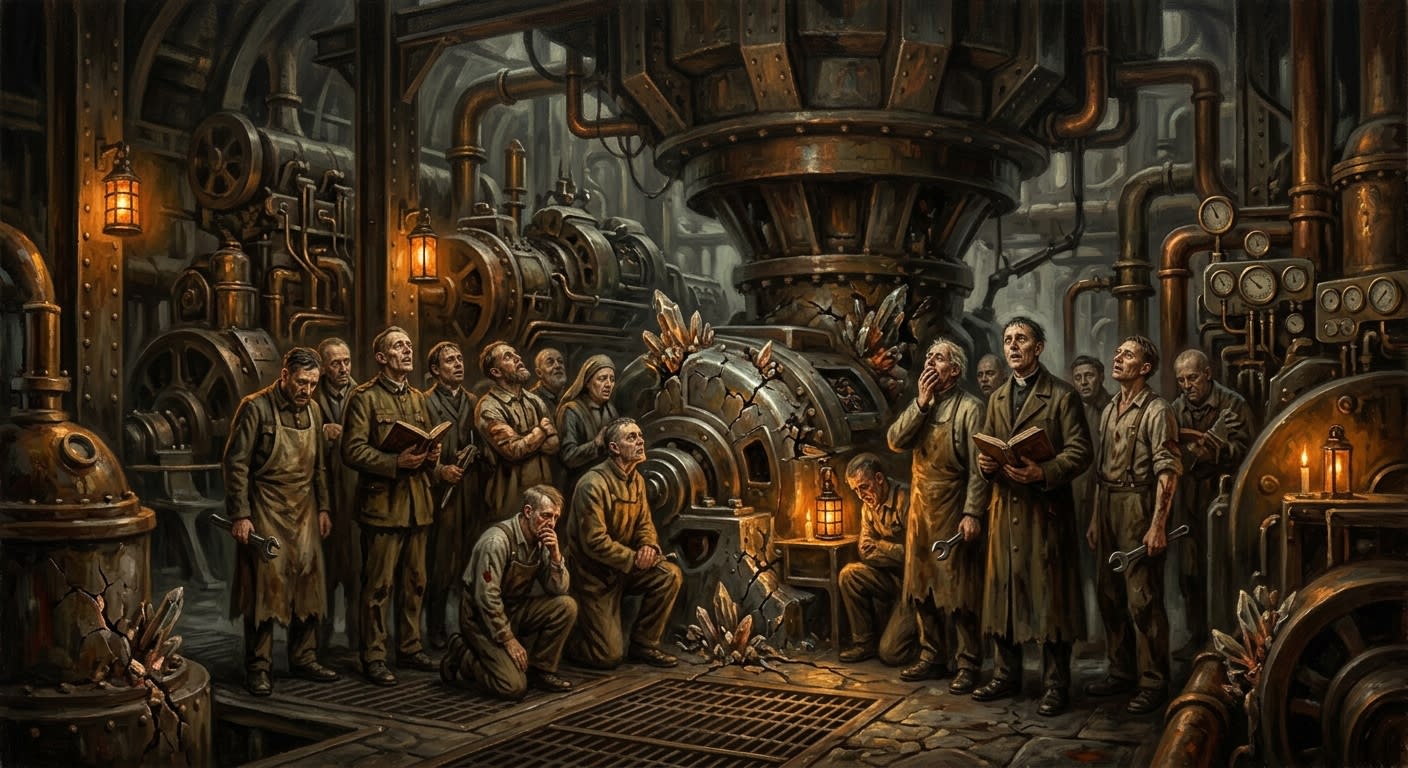
The Wrong Choir is the name given by workers of Essen-of-Hymnsteel to the sound beneath the Foundry Core: a foundation-voice, a stone antiphon, a low argument conducted through bolts, teeth, candles, and fear. The Tri-Bureau Compact calls it holy alignment. The Bureau of Engineering calls it structural resonance. The Bureau of Orison and Song calls it a cadence irregularity. The foundry hands, who must stand above it while molten hymnsteel decides whether to obey, call it wrong.
They are correct. The word has the savour of unlicensed truth.
The phenomenon begins mildly, because Hell and bureaucracy both understand the value of gradual introduction. Tools hum on benches without being touched. Candles tremble in rooms where no draught exists. Teeth ache in patterns so regular that the Bureau of Medicine has mapped them against jaw diagrams and shift rosters. Clerks in Ledger Row complain of ink ripples. Choir boys wake with split lips after biting down on notes in their sleep.
Then comes Bloom.
#On Resonance Bloom
A Resonance Bloom exceeds loudness. Loudness belongs to bells, guns, foremen, and other licensed vulgarities. Bloom enters from below and from inside the listener. It travels through boot soles, fillings, rivets, stair rails, clavicles, and the little bones of the ear that the Creator, in a moment of suspicious generosity, left exposed to the Bureau of Orison.
During the first phase, the city listens against its will. The Foundry Core pauses by instinct. A hammer lifted for a strike hangs in air. The paired choirs lose half a beat and then pretend they did not. The walls carry a tone too low for hearing and too precise for comfort. In the second phase, matter answers. Rivets shear. Bell-cannon throats crack along grain-lines the Calibration Choir had sung into obedience during the pour. Catwalk bolts loosen. A whole gantry may twitch like a horse under a fly. In the third phase, flesh pays the audit: ears bleed, teeth split, old scars reopen along stitch marks that have forgotten war but remember sound.
The aftermath is the silence that gives the event its aftertaste. A district becomes a Silent Zone. Voices drop and vanish. Footsteps produce no report. Bells swing above the street and fail to ring. Hushwrights cannot reproduce the effect, though they would bankrupt three provinces to do so. The silence lasts days. Workers nail bone shards into doorframes and refuse to finish stanzas alone. The Bureau prosecutes the superstition in public and quietly purchases the bone.
BUREAU OF MEDICINE — ESSEN JAW-PATTERN SURVEY / SEALED ADDENDUM Subjects exposed during Bloom interval A.S. 199-III presented dental ache in repeating sequence: left molar, right canine, lower incisors, pause, full jaw. Pattern matches no approved hymn measure. When transcribed as bell interval, sequence produces █████████████. Examiner hummed interval once. Survey room entered Silent Zone for forty-six minutes.
#On the Approved Explanations
The Compact requires explanations the way a furnace requires feedstock: in bulk, at heat, and preferably before anyone sees the quality. The Bureau of Engineering insists the Wrong Choir is resonance moving through a city built to make sound into steel. Essen's foundations, tied to furnace halls, river locks, calibration stages, and gantry columns, create substructure harmonics under certain load states. This is plausible. Plausibility is the engineer's vice.
The Bureau of Orison insists the trouble lies in cadence corruption: old work-cants, bad breath marks, singer fatigue, Mirror Choir variants, and unlicensed humming in the Ash Warrens. This is also plausible. Orison has spent a century teaching metal to listen and now resents metal for acquiring opinions.
The Bureau of Doctrine declares the hum providential when production survives and suspicious when production fails. This is the strongest institutional position because it cannot be disproved by events. A Bloom that cracks rivets proves the need for doctrine. A Bloom that passes without death proves the success of doctrine. A Bloom that spells names in blood requires a specialist committee, and specialist committees are where theology sends teeth to rot.
Compact Report 447-E attributed all recent Wrong Choir events to Mirror Choir sabotage.
Corrected under sealed Bureau of Rites review. Resonance Bloom activity predates the Mirror Choir's earliest documented operations by approximately forty years. The Mirror Choir remains guilty of sufficient crimes to keep the gallows warm. Chronology declines to carry this one.
#On the Plates That Were Altered
The buried truth, filed in places whose locks flatter themselves, concerns Essen's Master Hymnal Plates. The old guild-forges used stanzas that produced another resonance in the steel — a resonance that made the foundations speak during pours. They did not creak, settle, or groan under load. They spoke. The first Compact auditors lacked the courage to transcribe the sound and possessed, happily for their careers, the cowardice to suppress it.
The Plates were edited by Synod authority. Decades ago. The official revisions improved doctrinal stability, singer safety, and grain alignment. The private revisions gagged the foundations. Approved stanzas suppress the sub-foundation voice during ordinary production. Bloom is what happens when suppression fails, when an old line returns through a throat that never learned it, or when the stone underneath the city remembers the syllable cut from its mouth.
No office admits authorship. Records claims the revision trail is incomplete. Orison claims the Plates were merely standardised. Doctrine claims the question contains a prohibited premise. Engineering claims it has not seen the file, which is a lie told with unusual tenderness, suggesting terror rather than policy.
#On the Mirror Choir's Theft of the Truth
A heresy becomes dangerous when it steals a fact and teaches the poor to sing it.
The Mirror Choir claims the Wrong Choir as proof of its doctrine. The Synod's prescribed frequencies are false; the old plates were cut; the foundations speak through Bloom; correction requires disobedience. This is the Choir's little knife. It fits in the palm. It cuts the Compact Council's throat if pressed at the right angle.
The Choir did not invent the Wrong Choir. It arrived later, hunted by Purity since A.S. 187, after the Ash-School Scandal taught Essen that truth could survive in a lonely Catechist longer than inside an approved book. Yet the Choir learned to conduct near Bloom. It alters breath marks, quarter-tones, syllables, and oil-smudges on hymn sheets, then waits for metal to fail elsewhere. It claims every tremor it can use and disavows every corpse it cannot turn into doctrine.
Bureau circulars state that the Wrong Choir is a Mirror Choir instrument.
Clarified. The Mirror Choir is a parasite upon the Wrong Choir, a thief of its grammar, and sometimes a match near its vapour. The thing under Essen was singing before the thief arrived.
The distinction matters because punishment follows names. If the Bloom is sabotage, arrest singers. If the Bloom is resonance, rebuild foundations. If the Bloom is speech, ask what was silenced. The first option is cheapest. Essen arrests singers.
#On Countermeasures and Their Humiliations
Countermeasures are plentiful, which is to say none works reliably. Approved counter-psalms are sung during tremor onset. The Seven Locks (Unregistered) may be shut to damp canal vibration. Felted ash is laid along affected streets. Choir Quarters enforce off-duty silence after second bell. Medicine issues jaw splints. Engineering tightens bolts. Orison audits breath marks. Doctrine orders sermons on obedience to sound. The workers nail bone into their doorframes and spit over the left shoulder before finishing any stanza alone.
The best response remains practical cowardice: leave the district when tools begin to hum. This advice appears in no manual because manuals are written by men with offices outside the Foundry Core. Foremen who survive long enough acquire Bloom sense. They feel the change in wrist tendons, hear the bench-iron answer before the bench itself, and scatter crews under pretext of inspection. Records marks the lost minutes as inefficiency. Workers mark them as continued breathing.
The Compact has tested mechanical dampers, counter-choirs, hushcloth barricades, salt mortar, rivet reblessing, and one expensive Orison device shaped like a brass lung. The brass lung sang for thirteen seconds and then folded itself flat. The engineer responsible was transferred to consultancy, which in Essen means he lives and is no longer trusted near objects capable of judgement.
#On the Present Condition
As of A.S. 201, Wrong Choir incidents are increasing. Three Blooms in eighteen months. Two returned shipments of cracked hymnsteel parts. One receiving inspector removed after calling identical grain-line fractures decorative. Sister Rauth (Unregistered) refuses accelerated calibration tempo without liturgical stability guarantees. Furnace-Marshal Kord threatens conscription from the Ash Warrens. Arch-Notary Veyl has already printed the forms required to profit from either outcome.
Strasbourg demands tripled output for hymn-drive siege engines (Unregistered). The Line consumes. Essen sings. Under Essen, the foundations answer in a register no office owns.
The Compact's forbidden question begins after reality is admitted. Everyone in Essen with teeth has answered that. The question is whether the hum under the city is a warning, a grievance, a buried liturgy, or the old world clearing its throat through stone.