
#On the Place That Would Not Stay Sealed
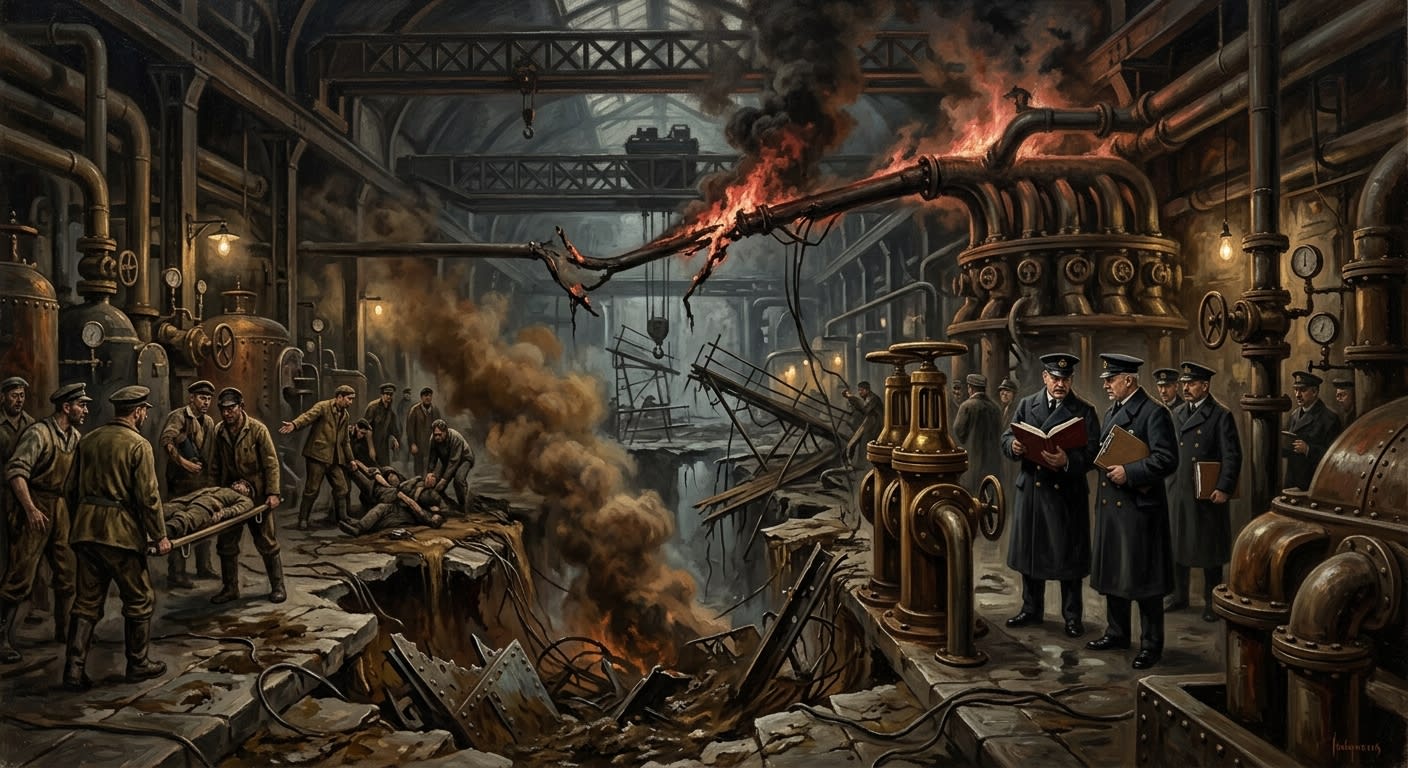
The Furrow of Pest is a wound-site in the southern extraction corridor (Unregistered), classified after A.S. 152 as dormant, sealed, profitable only in recollection, and unsafe in every sense that matters to flesh. Such classifications are not descriptions. They are administrative pleas addressed to geography.
The site lies along the supply arteries that run toward Bastion-Irongate and the lower southern Line, on ground the Bureau of Engines & Furnaces once catalogued as low-yield seepage with modest pressure variance. Modest. A lovely word. It belongs to gloves, debts, parish hats, and all official estimates written before the screaming begins.
Before the rupture, the Furrow was a ditch with paperwork. Wound-Site Prospectors walked its lip, drove ward spikes, poured chalk salt, listened for pressure pitch, and drew black seep into gasketed drums for the furnaces that keep the Synod’s war warm. It belonged to the class of wounds nobody writes hymns about because they pay too regularly. Small horror is easy to monetize. Large horror attracts Doctrine.
#On the Rupture of A.S. 152
The crew entered at first bell with three drums, a hand-pump, a chapel sled on cracked runners, and a gasket hymn singer whose name remains disputed between two Records ledgers. The first ledger gives Iven Marr. The second gives Yvan Maar. The Bureau has resolved the contradiction by declaring both spellings “operationally deceased.” The family received no clarification. Clarification is expensive.
The seam sounded low, one octave below middle bell-toll, the old desirable note. The pump began. The singer held cadence. The foreman, under quota pressure from a charter office that would later deny urgency in writing, ordered the draw continued after the pitch fell by three half-steps.
At the fourth hour the first drum shivered. At the fifth the chapel sled moved six inches uphill without hands upon it. At the sixth the seam answered the singer, matching his closing cadence in a second voice beneath the ground. Witnesses at the second shrine-stake reported that the sound did not echo. It corrected.
The gasket failed cleanly. No shrapnel. No heroic blast. The clamp teeth opened as though released by a careful mechanic. The wax seal lifted from the drum-mouth in a single ring and settled around the singer’s boots. Then the vapour rose.
MERCY RECOVERY NOTE — FURROW OF PEST, A.S. 152 Thirty-seven counted dead. Four bodies standing. Two bodies kneeling. One body fused from the wrists to the pump handle. Hymn singer recovered █████████████. Mouth condition: open. Sound issuing after death: ███████████████████.
Those nearest the drum died without falling. Those farther off burned in no visible fire. One runner reached the perimeter shrine and wrote two letters in chalk salt before his fingers blackened from the nail outward. The letters have been read as MA, IV, YV, and PA by four commissions. The Bureau of Records filed the marks under “maternal invocation, probable,” a mercy only a clerk could devise.
#On Wrong Flame (Unregistered)
The Furrow’s yield should have been destroyed. This was proposed, dismissed, revived, amended, and defeated by fuel need within the hour. The drums were routed to three refinery chapels under caution tags. Caution tags are paper. Boilers are hungry.
Wrong flame appeared first in a southern depot furnace: green-blue, cold to iron, ruinous to skin, obedient to no damper. It spread through the supply corridor by batch and residue. Chapel stacks burned in colours that Bells claimed corresponded to no approved tonal family. Hospital boilers warmed the air and froze the water. A pilgrim kitchen near the southern routes reported bread blackening in ovens whose bricks were rimed white. Engines called it contamination. Bells called it cadence inversion. Doctrine waited to see which answer would cost less.
The wrong flame lasted three weeks. By then thirty-seven workers had become a number, six chapels had replaced their furnace throats, two charter accountants had discovered piety, and the phrase “singing at holes” had entered Bureau correspondence with the force of accidental scripture.
#On the Reform Born There
The Gasket Hymn Reform did not memorialise the Furrow. It consumed it. The site became the argument by which Engines & Furnaces gained clamp tolerance revisions, pump cadence rules, chapel sled clearances, singer placement mandates, and emergency seal doctrine. The Bureau of Bells gained pitch authority over extraction throats. The Bureau of Rites gained nothing, having declined to participate on the grounds of insufficient theological precedent for singing at holes.
Several provincial summaries describe the Furrow of Pest as a furnace accident.
Corrected. The furnaces misbehaved afterward. The crime began in the ground. A wound-site seam answered an extraction hymn, opened a sealed drum without violence, killed thirty-seven workers, and taught the corridor’s fuel to burn wrongly for three weeks.
After A.S. 152, no licensed extraction crew could draw without a singer on consecrated footing, no singer could seal without approved cadence, no drum could move without witness marks, and no foreman could plead ignorance unless the Bureau needed him to do so. Vapor deaths fell. Fees rose. The Furrow sat quiet under new ward spikes, admired by auditors from a distance they described as professionally sufficient.
#On the Present Scar
As of A.S. 201, the Furrow of Pest is marked on private prospector maps with three short strokes and a hooked line: seam answers singers; do not trust low pitch; do not camp near old wax. Public maps show a restricted extraction depression, low-yield, inactive, periodically inspected. The discrepancy is a civilised one. Public maps exist to move clerks. Private maps exist to keep men alive.
The ground still sweats after rain. Chalk salt laid at the western lip crawls east by morning. Birds avoid the ditch unless dead. Once a year, usually in the week of the old rupture, the ward spikes ring softly under no wind. Engines calls this residual compression. Bells calls it unauthorized sympathetic tone. Prospectors call it the Furrow clearing its throat.
The Furrow is sealed.
Clarified. The Furrow is sealed in the manner of a mouth held shut by tired hands. The distinction is operational.
The Furrow gives no current yield worth naming. That is official. Unofficially, black drill crews still scrape its outer soils for wax-dark grit sold to refineries willing to forget provenance. The grit burns hot. The ash smells of wet bells. Somewhere in the southern corridor a boiler-man opens a furnace door, sees a lick of green-blue at the coal’s edge, and decides his report can wait until morning.