
#On the Country That Fed Empires
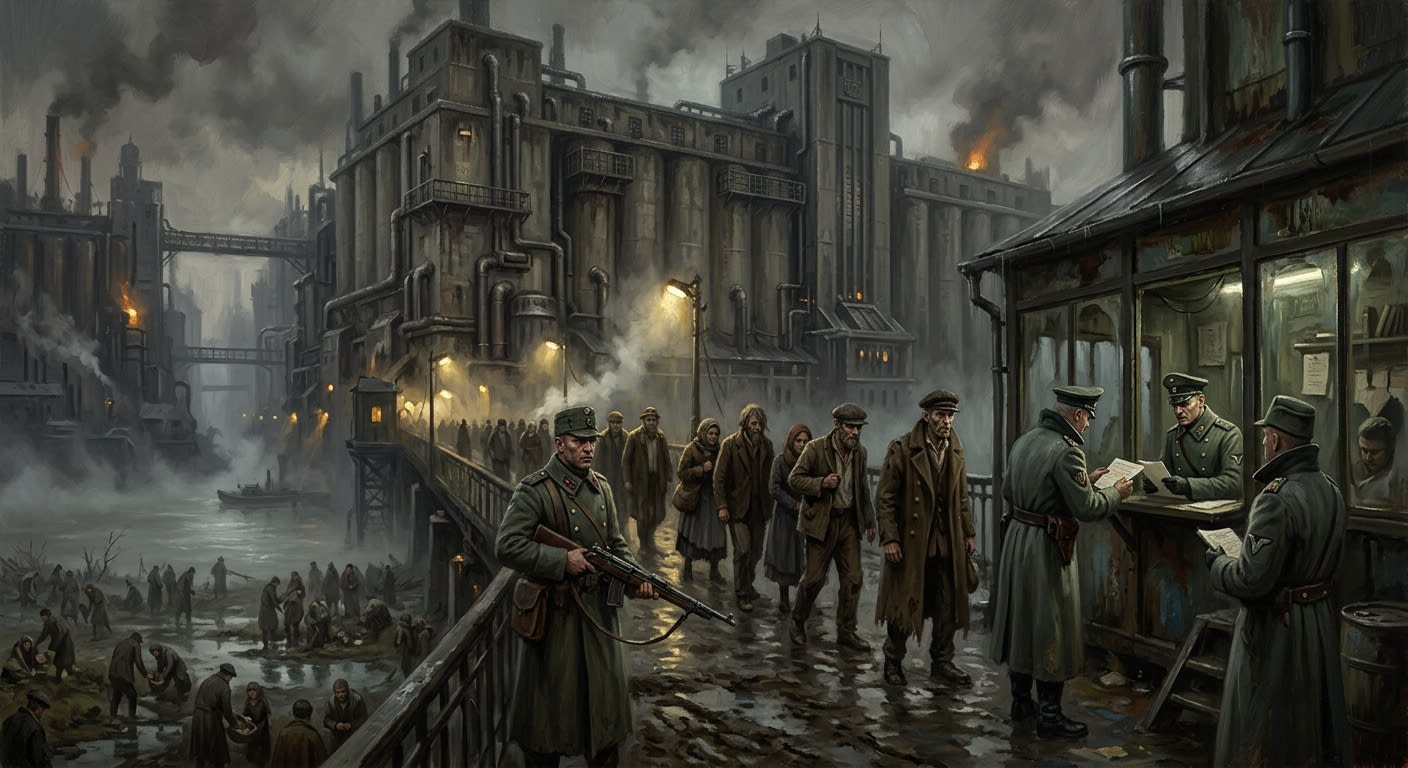
Hungary is the name the old maps keep trying to say. The newer maps prefer Former Agricultural Zone East-7, Blightmarsh Periphery, Budapest Forward Administrative District, Lower Danube Corridor, Syrionic Contact Fog, Kargathan Consumption Basin, and eleven other phrases devised by clerks who fear that a country might survive inside a noun. The clerks are right to fear it. A country is a dangerous object. It remembers rivers, harvests, songs, kings, defeats, saints, taxes, old insults, and the particular smell of bread when wheat has not yet learned terror.
Before the Sundering, Hungary fed three empires. This sentence has already appeared in other entries because the Bureau enjoys repeating grief once it has found a phrasing that balances. The wheat-sea of Pannonia ran from Debrecen toward the Danube in gold ranks. The Tisza (Unregistered) carried grain barges with the vulgar confidence of a river that had never been asked to carry corpses by category. Cattle moved across the Alfold so thickly that drovers measured wealth by dust. Orchards ripened in courtyards where grandmothers argued theology with the practical brutality of women who had survived poorer priests than ours.
The Bureau of Records maintains pre-Sundering yield tables for Hungarian counties through A.S. 44. Rainfall projections. Soil composition. Orchard rotation. Horse census. Wheat protein estimates. The file is immaculate. It is also useless, which makes it indistinguishable from several ministries in Strasbourg, though less expensive to heat. No one has opened the survey cabinet since A.S. 162 except to confirm that the key remained missing and that the locked drawer still possessed the dignity of a sealed answer.
Hungary's tragedy does not lie in its fall. Many territories fell. Serbia burned. Wallachia broke. Moldavia became a marketplace for keys and murmured debts. The Balkans learned Hell's grammar before the west had finished arguing punctuation. Hungary's tragedy is that its usefulness survived its political death. Even ruined, partitioned, eaten, evacuated, taxed, watched, and renamed, it remains the central question of the southern war: who controls the grain that used to be there, the roads that still run through there, the river that divides there, and the hunger that now rises from its ground like an office with no closing bell.
The old Hungarian crown (Unregistered) matters less than foreign romantics suppose and more than Strasbourg admits. Its jewels were scattered, pledged, hidden, stolen, inventoried, reinvoked, denounced, and occasionally rediscovered in boxes whose paperwork improved with age. The Synod does not need the crown to rule Budapest. It needs the crown to stay narratively dead. A living crown invites claimants; a missing crown invites songs; a documented crown invites lawsuits. The Bureau prefers the crown in that blessed middle condition called sealed uncertainty, where every faction may be wrong under supervision.
Hungarian nobles who survived the Retreat were either absorbed, impoverished, sanctified, or made useful at receptions. Their descendants serve in corridor offices, cavalry remount boards, bathhouse tax commissions, and those polite patriotic societies that exist to prove the Bureau is tolerant until the singing grows too precise. Peasant memory preserved more than aristocratic genealogy did. A village widow can name three vanished fields, two saints banned under orthographic reform, the taste of Tisza fish before the river went suspect, and the exact insult her grandfather used for Viennese customs officers. This is a superior archive. It resists shelving.
#On the Sundering and the First Eating
The Sundering of A.S. 45 did not reach Hungary as a single army. It arrived as spoiled bread, ash rain, stalled cattle, missing scouts, messages from towns whose seals had been chewed flat, and refugees who carried no food because the food had already become accusation. The eastern wound opened. Hell pressed west. The roads filled. The old kingdom's useful distances became killing distances. A day's ride turned into a week of blocked wagons. A market town became a ration tribunal. A granary became a fortress for exactly as long as its doors held.
The Battle of the Iron Plains remains sealed behind clearances so high that even the ink develops altitude sickness. The public account names fire from a cloudless sky, collapsed divisions, and a withdrawal conducted under pressure. The private fragments speak more plainly. Horses split open without wound. Cartridge boxes filled with mealworms. Field kitchens boiled stones into broth because the cooks could no longer tell food from object. Whole companies marched toward a smell of baking bread and were found three days later in a circle, chewing grass with mouths already dead.
Debrecen was the hinge of disgrace. A hundred thousand men broke when their rations turned to ash in their hands. The commissariat filed the loss as atmospheric spoilage of unprecedented scope, one of those cowardly administrative phrases that arrives wearing gloves to a room covered in blood. The men themselves used shorter language. Most did not live long enough to standardise it.
Earlier patriotic sermons described Debrecen as “the first hunger by which the Faithful were purified for retreat.”
Corrected. Hunger purified nothing. Hunger killed, scattered, degraded, and taught the surviving quartermasters to lock flour behind rifles. The moral improvement was added later by men with dinner waiting.
Kargath's pressure moved through need. He did not require banners where famine could do the work. Wells soured. Root cellars emptied between dusk and Matins while locks remained intact. Mothers found children standing before bread ovens that held no bread, only warmth and the memory of a smell. Men with full stomachs woke starving. Men starving woke generous, offering one another portions of food that was no longer there. Hunger detached itself from supply and became weather.
The Great Retreat followed: A.S. 48 to A.S. 65, seventeen years of westward mud, armed migration, relic carts, fever camps, rear-guard fires, and bridge demolitions. Hungary was crossed, stripped, buried, and used as proof. Refugees moved through it until movement itself became a sacrament of desperation. The land gave grain until it could not. Then it gave bodies. Then it gave nothing. Hell took even that personally.
#On Budapest, the Western Half That Still Answers
Budapest is the surviving Hungarian face the Synod permits itself to look at directly. The city has been cut by the Danube into a lawful western bank and an eastern bank designated Vacated, which is to say visible, silent, and administratively insulting. The western districts hold eight hundred and forty-seven thousand registered souls by the A.S. 200 census, plus refugees, unregistered labour, dead not filed, children under provisional name, and every other human remainder by which a census becomes a devotional fiction.
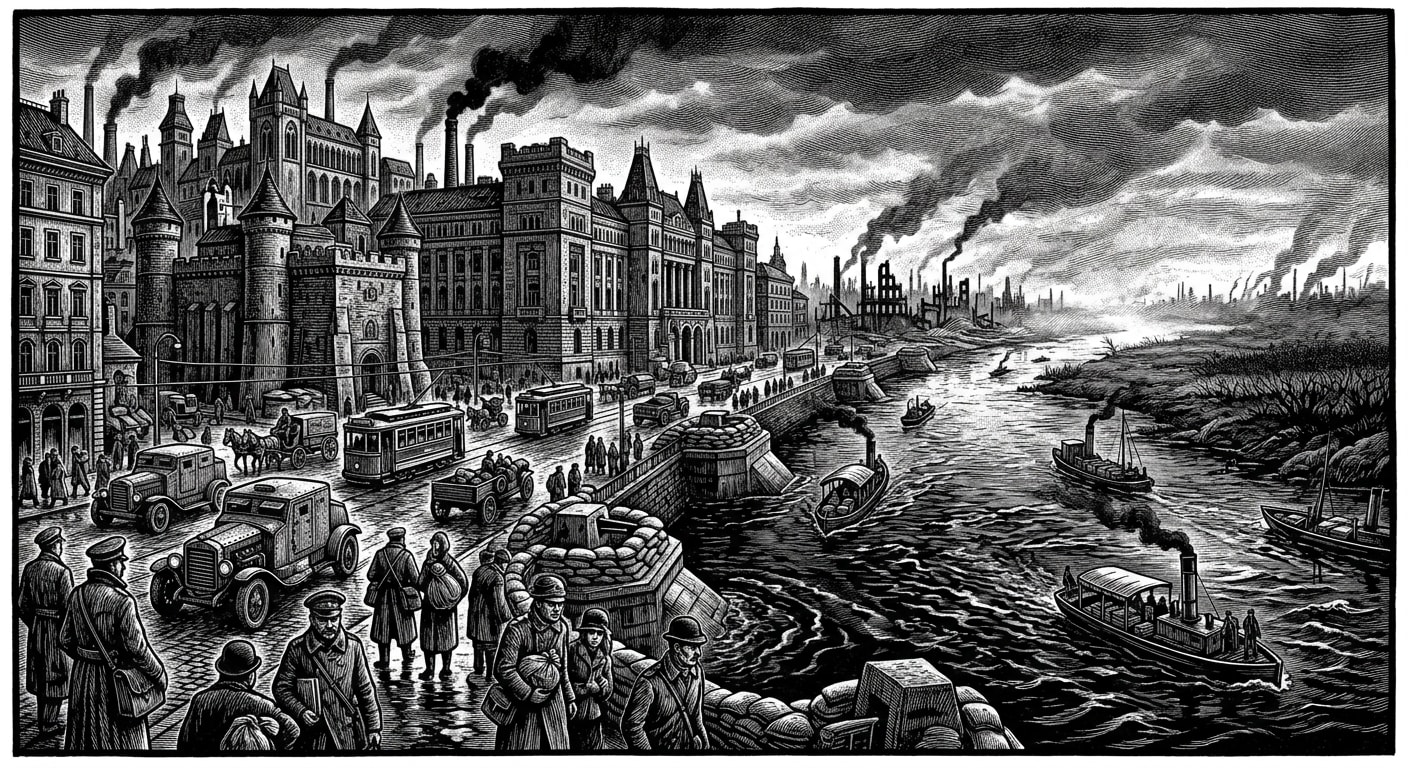
The western bank works. It must. The Bureau of War's Central Corridor Command occupies the old Royal Palace (Unregistered). Records keeps its third-largest archive beneath Matthias Church (Unregistered). Tithes has commandeered the thermal baths for operational reasons, and I salute the candour of theft when it smells of mineral water. Rail yards cover twelve square kilometres below the hill, swallowing consignments from Munich, Vienna-Ruins, Bratislava, Warsaw, Kraków, Sibiu, and the southern connector toward Bastion-Irongate. Grain, munitions, troops, reliquary cases, wound-site drums, coffin returns, and bureaucrats with suspiciously comfortable travel permissions all pass through Budapest.
The eastern bank is the wound one can see from a dining room. Pest's rooflines remain sharp on clear days. Three church spires rise from streets the Bureau confirms as empty every year with patrol boats, reliquary lamps, and Litany-Engineers, which is a large apparatus for confirming emptiness. The bridges fell between A.S. 118 and A.S. 122 during the withdrawal from the eastern districts. The Chain Bridge held six hours after demolition charges, carrying eight hundred refugees who remain filed as transferred, destination pending. A bridge, one observes, can possess more charity than several offices.
The Mothers of Plenty processed evacuees from A.S. 118 to A.S. 125 and failed to reconcile sixty to ninety thousand Pest residents. Records marked them under administrative review. The phrase has lasted eighty-one years. A human body can become bone, ash, mud, or saint in less time. A Bureau annotation can outlive all four.
Hungary survives in Budapest as habit. Domestic liturgies deviate. Coffee is hidden from moralists. Hungarian names persist under Synod spelling. Old songs shrink into lullabies hummed beneath bells. Men curse in a language their grandchildren are told is provincial. Women in registration queues choose which of their duplicate files carries the lowest tithe debt. The Synod governs the western bank. It has not yet digested it.
#On the Blightmarsh, Which Is Hungary Eaten Aloud
The Blightmarsh is what became of the former plains when Kargath's hunger stopped passing over the land and began living inside it. The term is a soldier's word adopted by the Bureau because every technical alternative required either honesty or poetry, and the committee could tolerate neither. It covers roughly twenty-three thousand square miles as of A.S. 201, expanding at approximately one hundred and forty square miles per year. If that number seems small, imagine your parish swallowed by grey mud every twelve months, then imagine the cartographer asking whether to erase the old boundary or annotate it.
The Marsh is not a marsh. Water is not the principle. Appetite is. Grey mud, grey water, grey sky: the colour of meat after dignity has left it. The ground has been consumed through root, mineral, worm-channel, buried beam, cellar flag, bone, seed, and memory. Core samples show no ordinary soil. They show a uniform post-organic substrate occupied by something vast, slow, and distributed. The Bureau of Agriculture used cleaner phrasing in eleven reports between A.S. 145 and A.S. 155. The Bureau of Agriculture was dissolved in A.S. 158. The reports remain as monuments to men who discovered the truth and were punished for having a department.
At the Marsh's edges, farms sour before they vanish. Crops yellow from the root upward. Livestock refuse feed, refuse water, then stand with heads lowered until they drop. Wells taste of copper and bile. The topsoil loses the capacity to hold a plough-blade. The farm becomes grey in one season, mud in two, Blightmarsh in three. Chimneys remain visible for a while. The pantry shelves are always bare, gnawed to the joists, as if the house itself tried to eat before the ground finished eating the house.
Shapes move beneath the surface. Mouths open. Patrols vanish. Observation balloons that drift too low are pulled down by no visible hand and returned as torn silk, damp rope, and a sound in the mud the witnesses describe as chewing. The Drava no longer flows through this territory; it seeps, yellow-grey, carrying unnamed matter toward the Cauldron Citadel where Kargath's forward machinery turns loss into further hunger. The Citadel has markets. Bakeries. Slaughterhouses. Currency measured in caloric value. Everyone eats. Everyone starves.
The Famine Pits are the older wound inside the newer one: mass graves from A.S. 45 through A.S. 55, where hunger survived death and learned radius. Stand too close and the stomach cramps. Stay longer and the body behaves as if it has been starved for weeks. Fourteen Pits are confirmed. More lie beneath the mud, because the Retreat buried its dead wherever arms had strength left to dig. The Bureau of Medicine calls the Pits a theological matter with medical symptoms. Doctors become eloquent when fleeing responsibility.
FAMINE PIT SURVEY ANNEX, EASTERN HUNGARIAN BASIN, A.S. 190: prisoner exposure subject fed full ration before placement. At third hour subject complained of hunger. At sixth subject consumed ration tin, leather belt, two fingernails. At eighth subject recited names of Debrecen dead not present in any recovered register. At ninth the attending clerk requested removal. Subject answered in the clerk's childhood voice: █████████████████. Experiment unauthorised. Results retained.
The Abundance Fields bloom along the boundary, which proves that Hell possesses a sense of humour and should be denied theatre tickets. Fruit out of season. Grain so heavy the stalks bow like penitents. Root cellars full. Tables set. Bellies filled. Bodies wasted. The Fields do not fail to feed; they feed perfectly and leave hunger doubled. Four hamlets died surrounded by plenty, their mouths still working when found. Soldiers are ordered to withdraw from any cultivated land within ten miles of the boundary. This order is obeyed by well-fed soldiers and tested by hungry ones. The hungry are why orders require rifles.
#On the Southern Corridors and the Work of Holding Half a Country
Hungary still matters to the Synod because roads do not vanish when sovereignty does. They become more expensive. The Central Corridor through Budapest feeds Bastion-Sibiu, Bastion-Irongate, Bastion-Shipka, and the southern approaches toward Constantinople. Convoys crossing this system move through territory whose old names remain in the mouths of wagoners and whose new classifications remain on their papers. A sack of grain may be weighed in Munich, reweighed in Budapest, blessed at a corridor chapel, delayed by yellow pin, diverted around a fog report, taxed at a bathhouse office, inspected for Kargathan spoilage, and arrive at Irongate tasting faintly of fear. This is logistics. Do not let War make it sound clean.
Irongate guards the Danube gorge, that old stone throat through which armies, barges, refugees, and bad news have always tried to pass. The Hungarian plain presses against its memory from the east and north, while Morwen claws at identity within the fortress and Kargath's hunger deforms the broader basin. The gorge's chain booms may stop river traffic. They do not stop famine. The Gasket Choir keeps the mountain from loosening its own teeth. It does not keep grain from rotting in sealed wagons if the wrong wind travelled over the Marsh first.
South and east, Syrion's territories touch parts of the old Hungarian edge where geography has become a sleepy liar. The fog does not eat; it delays the meal. Scouts return after hours, days, or years of disagreement. Villages are found with warm meals and no people, or with people standing in streets for decades without rot, breathing slowly, unreachable. Kargath hates waiting. Syrion sanctifies it. Hungary, caught between hunger and stillness, provides the table and the chair.
A southern-theatre briefing once described Hungary as “a spent territory of secondary strategic value.”
Corrected after Budapest's A.S. 200 throughput figures reached Strasbourg and several officers remembered arithmetic. A spent territory that controls grain routes, river approaches, wound-site corridors, refugee flows, and two Sin-General contact zones is called secondary only by men whose maps have servants.
Wound-sites complicate the corridor with profitable blasphemy. The Furrow of Pest lies along the southern extraction route toward Irongate, classified after A.S. 152 as dormant, sealed, low-yield, and unsafe in every sense that matters to flesh. Its rupture killed thirty-seven workers, produced three weeks of wrong flame, and forced the Gasket Hymn Reform. Charter houses still sniff around old seams because fuel makes cowards brave and investors illiterate. Hungary was once grain. Now even its wounds are harvested.
#On the Hungarians Who Remain
The Hungarians remain. This fact annoys every office assigned to them. A population may be displaced, renamed, registered, rationed, preached at, corridor-classified, and told to face west; it may still preserve the private posture of a people waiting for the occupying sermon to run out of breath. Hungarians have endured Turks, emperors, republicans, bishops, taxmen, demons, and Strasbourg memoranda. They possess the civic patience of a stone in a bureaucrat's shoe.
In Budapest, they comply in public and deviate at home. The Bureau of Doctrine's A.S. 198 assessment praised substantial public liturgical compliance and noted persistent domestic variation, a phrase that means grandmothers continue to win. Household prayers contain old saints under approved names. Funeral breads are baked in shapes the Bureau has banned twice and failed to recognize three times. Coffee houses close their front shutters and keep talking. Children learn Synod catechism by day and Hungarian curses by night, which gives them an education both sacred and useful.
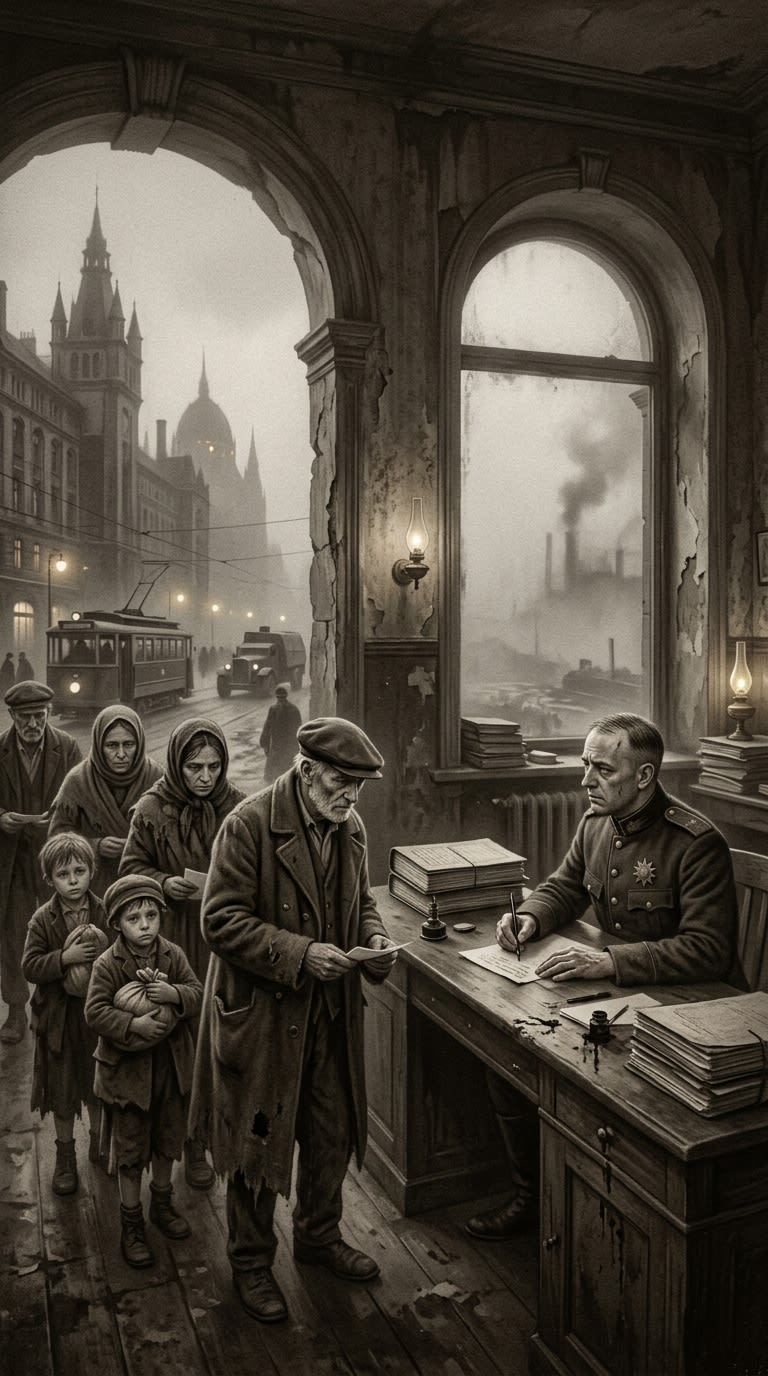
Refugee families carry the east inside ledgers, tins, shawls, seed packets, and lies. A woman from Pest has three identities because three evacuations created three files. A drover from the Alfold keeps a cattle bell for animals that no longer exist. A Debrecen veteran eats facing a wall and leaves one corner of bread untouched for men whose names he will not say. The Mothers of Plenty stamp provisional documents until the stamps wear flat. Records complains that provisional life cannot continue indefinitely. Life, with its usual contempt for Records, continues provisionally.
Grain politics in Hungarian districts are vicious because memory seasons hunger. Grain Keepers find easy recruits among families whose grandparents remember abundance. Ration discipline sounds different to a person whose land once fed armies. The Synod says hunger sharpens prayer. The Hungarian replies, privately, that hunger also sharpens knives, and then hides a sack where the inspector's boot will miss it.
Purity reads this as ingratitude. Tithes reads it as leakage. Shadows reads it with professional interest. I read it as evidence that a country still twitches under the shroud.
#On the Present Designation
As of A.S. 201, Hungary exists in four simultaneous conditions, each official enough to be false in a different direction. Western Budapest is held, counted, taxed, fortified, caffeinated, overcrowded, and indispensable. Pest is Vacated, visible, patrolled, and insufficiently empty. The Blightmarsh is consumed former grain land expanding toward the Line at the pace of patient hunger. The southern and eastern margins are contact zones where Kargath's need, Syrion's delay, Morwen's identity-rot, charter greed, refugee traffic, and Synod logistics grind together until every map becomes a confession written too small.
The Bureau of Cartography wants boundaries. War wants corridors. Tithes wants throughput. Mercy wants ward capacity. Records wants names. Doctrine wants a sentence that makes all this sound ordained. Hungary gives each office enough evidence to embarrass it and enough necessity to keep it returning.
I have seen the Danube at Budapest at dusk, brown water carrying reflected bells toward a bank the Bureau insists has no inhabitants. I have read the Blightmarsh maps and watched the boundary creep through ink revisions with the manners of a rat under altar cloth. I have signed corridor advisories that burned grain to deny Kargath and requisitioned grain the next morning for men who would curse me if they knew. I have heard a Hungarian clerk in Strasbourg whisper an old place-name before stamping its replacement.
#On Why Hungary Cannot Be Buried
Every few years some elegant fool proposes retiring the name. Hungary, he says, confuses the public map. Hungary implies continuity where the Synod needs functional categories. Hungary gives refugees a theatre in which to perform grievance. Hungary tempts officers to think in lost countries instead of held corridors. The memorandum always arrives with neat margins, pale ink, and the faint odour of a man who has never stood in a ration line beside someone naming villages from memory because memory is the only property no inspector has yet seized.
The proposal fails because the name is too useful to kill. Soldiers understand Hungary faster than they understand Lower Danube Consumption-Adjacent Operational Basin. Quartermasters understand Hungarian grain even when no grain remains. Refugees understand Pest, Debrecen, the Alfold, the Tisza, the barns, the wells, the orchards, the cattle roads, the churchyards, the bridges. Bureaucracy can replace a name on paper. It cannot make a mother stop pointing across a river.
Hungary also teaches doctrine a lesson doctrine dislikes: loss with witnesses endures. The eastern bank of Budapest is visible. The Blightmarsh boundary is measured. The Central Corridor logs every convoy that proves the old country still controls the new war. A hidden loss may be sermonised into mystery. A visible loss becomes an argument. That is why so many orders instruct citizens to face west. The order is less about direction than obedience of the neck.
There are anti-Hungarian schools within the Synod. They speak of stubborn Magyar particularity, of corridor inefficiency, of unhelpful folk-memory, of domestic liturgies that bend the authorised syllable until it walks with a limp. They recommend stricter language controls, parish transfers, marriage dispersion, removal of old placenames from tram stops, and the final abolition of Budapest's informal coffee houses. These schools are staffed by men who have never had to get a convoy through a city that dislikes them. War ignores them when shells are needed at Irongate. Tithes ignores them when bathhouse revenue rises. Records listens, nods, and files the memorandum under Cultural Irritants, where good ideas and bad careers go to share dust.
There are also romantic Hungarian circles, which are worse dressed but sometimes braver. They keep old maps under floorboards. They toast lost counties in wine too thin for rebellion. They maintain that Pest is not empty, that Debrecen's dead still know their names, that the Blightmarsh has eaten the soil but not the title, that a country can be in abeyance like a lawsuit awaiting a judge too frightened to enter court. Purity breaks such circles when it can. Shadows enters them when it must. Doctrine studies them because dangerous longing makes excellent prose and occasionally usable policy.
A Bureau of Settlement advisory recommended “full sentimental severance from Hungarian territorial identity within three generations.”
Returned for arithmetic. Three generations are insufficient when the lost object remains visible from kitchen windows, sung under kettles, stamped on pre-Sundering ledgers, and required for every corridor map the Bureau pretends is modern.
Purity reads Hungarian stubbornness as infection. Settlement reads it as unresolved population attachment. Records reads it as file persistence. War, when honest, reads it as morale held together by geography. A man will defend a line for pay. He will defend a road for orders. He will defend a vanished field if his grandfather taught him where the well stood. The Bureau cannot manufacture that cheaply, which is why it alternates between prosecuting it and requisitioning it.
The southern war has no cleaner school. Hungary shows what Hell does to plenty, what the Synod does to loss, what refugees do with names, what maps do when the ground eats their confidence, and what survives after all official funerals have been performed. The kingdom is dead; the province-label lies badly. The remaining article is a ledger wound running from Budapest's western bank through grey mud to the mouths beneath Debrecen, and every office that touches it comes away with damp fingers.
There. That is Hungary now: a country half eaten, half filed, half visible across the river, which is to say three halves, because the Synod has never allowed arithmetic to interfere with doctrine. The wheat is gone. The roads remain. The mud moves. Budapest drinks coffee and faces west when ordered. Across the Danube, dark windows keep their counsel.