
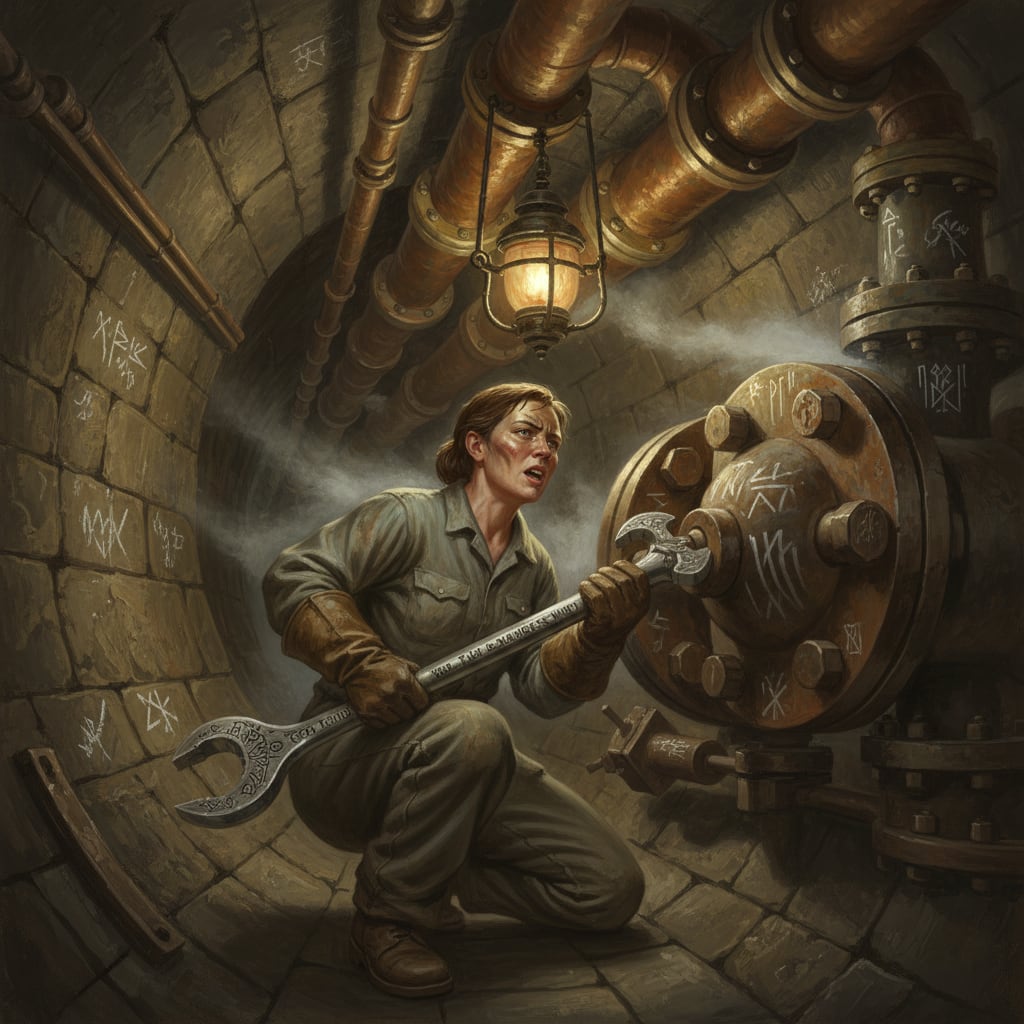
Gasket-Hymn Mechanic
#On the Origin of the Sequence
"Seat the ring. Speak the line."
The Bureau of Engineering has always maintained that its machines function because of engineering. The Bureau of Doctrine has always maintained that those machines function because the Creator wills it. Both positions are official. Neither Bureau yields. The gasket-hymn mechanic exists in the war between them — hands on the flange, mouth on the verse, convinced of nothing except that a skipped line will kill someone by Thursday.
The craft predates its sanctification by decades. In the early years after the Sundering, when the retreating armies of the Great Retreat dragged whatever machines still functioned westward through mud and terror, engine repairs failed with a consistency that defied the Bureau's best metallurgists. Seals split. Flanges warped. Gaskets seated by competent hands blew within hours, and the failures clustered — always at the worst junction, always on the coldest night, always in patterns that resembled intent rather than material fatigue. A handful of veteran sappers — men who had been repairing field engines since before the world ended — noticed that the crews who sang while working produced fewer catastrophic failures than the crews who worked in silence. The Bureau of Engineering attributed this to rhythm: a regular cadence prevented the over-torquing that stress and exhaustion encouraged. The Bureau of Doctrine attributed it to prayer. The sappers themselves attributed it to the fact that a man who is singing cannot hold his breath, and a man who is not holding his breath does not panic-clench a wrench.
All three explanations were codified. All three are now doctrine. The gasket-hymn mechanic recites because the sequence prevents error, because the Creator blesses the obedient hand, and because the alternative is a ruptured manifold and a pension no one will pay.
#On the Substance of the Craft
The sequence is everything. The gasket-hymn mechanic does not improvise, does not abbreviate, does not "get the gist." The repair is a liturgy with nine movements — diagnose, cleanse, align, seat, recite, torque, seal, verify, document — performed in fixed order, at fixed intervals, with fixed phrasing. Each movement has its verse. Each verse is timed to a specific mechanical action. The torque pattern follows the cadence of the Third Line of the Boundary Litany, which is itself calibrated to the star-pattern bolt sequence that distributes pressure evenly across a flange face. Whether the litany was written to match the torque pattern or the torque pattern was designed to match the litany is a question that has produced four internal memoranda, two Bureau of Doctrine errata, and one fistfight in the Bastion-Przemyśl engine chapel that the Bureau of Purity classified as "a doctrinal disagreement of unusual vigour."
The tools are simple. A torque key with verses etched into the handle — the tool and the rule fused into a single object, because the Bureau learned early that a mechanic who must consult a separate card under stress will consult neither the card nor the wrench. Seal irons for pressing purity wax into the finished joint. Alignment pins. Pressure chalk for marking witness lines — the pale streaks across bolt-heads that prove the seal was torqued in sequence and has not shifted since. A rite card in a wax sleeve, hand-annotated with corrections that the official manual has not yet absorbed and may never absorb, because the official manual is revised by men who have not touched a flange in eleven years.
The gasket stock itself is classified. Purity-rated by the Bureau of Engineering, stamped by the Bureau of Tithes, blessed by the Bureau of Doctrine — three seals on a rubber ring that costs less to manufacture than the paperwork required to certify it. Black-market gaskets circulate in every bastion, indistinguishable from the sanctioned product by any test the Bureau has devised, differing only in the absence of three stamps that may or may not affect the seal's integrity. The Bureau of Doctrine maintains that the stamps are essential. The Bureau of Engineering maintains that the rubber is essential. The gasket-hymn mechanics maintain that both are essential and that the Bureau can take its epistemological dispute somewhere the manifold pressure is lower.
#On the Split-Ring Disaster and Its Consequences
The craft was informal until A.S. 164, when the Split-Ring Disaster at Bastion-Przemyśl converted it from tradition to law.
A furnace district in the lower works — seventeen engine pits feeding the Wire Orchard's western pylons — suffered a cascading gasket failure over nine hours. The investigation, conducted by a joint commission of the Bureau of Engineering and the Bureau of Doctrine, established the following: a senior mechanic had been running double shifts for three weeks. He was tired. He was competent. He was also, by the Bureau of Purity's subsequent assessment, "doctrinally adequate." He had shortened the cleansing verse on four consecutive repairs because the verse added ninety seconds to a job that was already overdue by two hours. The shortened verse omitted the salt-chalk purification step. The purification step removed residual wax from the previous seal. The residual wax prevented the new gasket from seating flush. The gap was invisible to inspection. The gap was not invisible to pressure.
The first seal blew at the third hour after midnight. The blast ruptured the adjacent manifold, whose gasket had been seated by the same mechanic on the same shift with the same abbreviation. The second failure propagated to a pressure door. The pressure door's gasket had been seated by a different mechanic — one who had followed the full sequence — but the shock loading exceeded the tolerance of a seal designed for steady-state operation. Seventeen engine pits failed in sequence. The Wire Orchard's western pylons lost power for eleven hours. Forty-three men died, fourteen of them in the initial blast, the rest in the cold that followed when the heating manifolds failed and the temperature in the lower works dropped below the threshold at which human skin remains attached to metal.
The initial Bureau of Engineering report attributed the disaster to "material fatigue in substandard gasket stock, provenance under investigation."
The Bureau has amended this finding. The gasket stock was standard-issue, purity-certified, and structurally adequate. The failure was procedural. The mechanic omitted the cleansing verse. The mechanic has been posthumously reclassified as a cautionary example. His family has been informed that his pension is under review. The review is expected to conclude at a date the Bureau describes as "forthcoming."
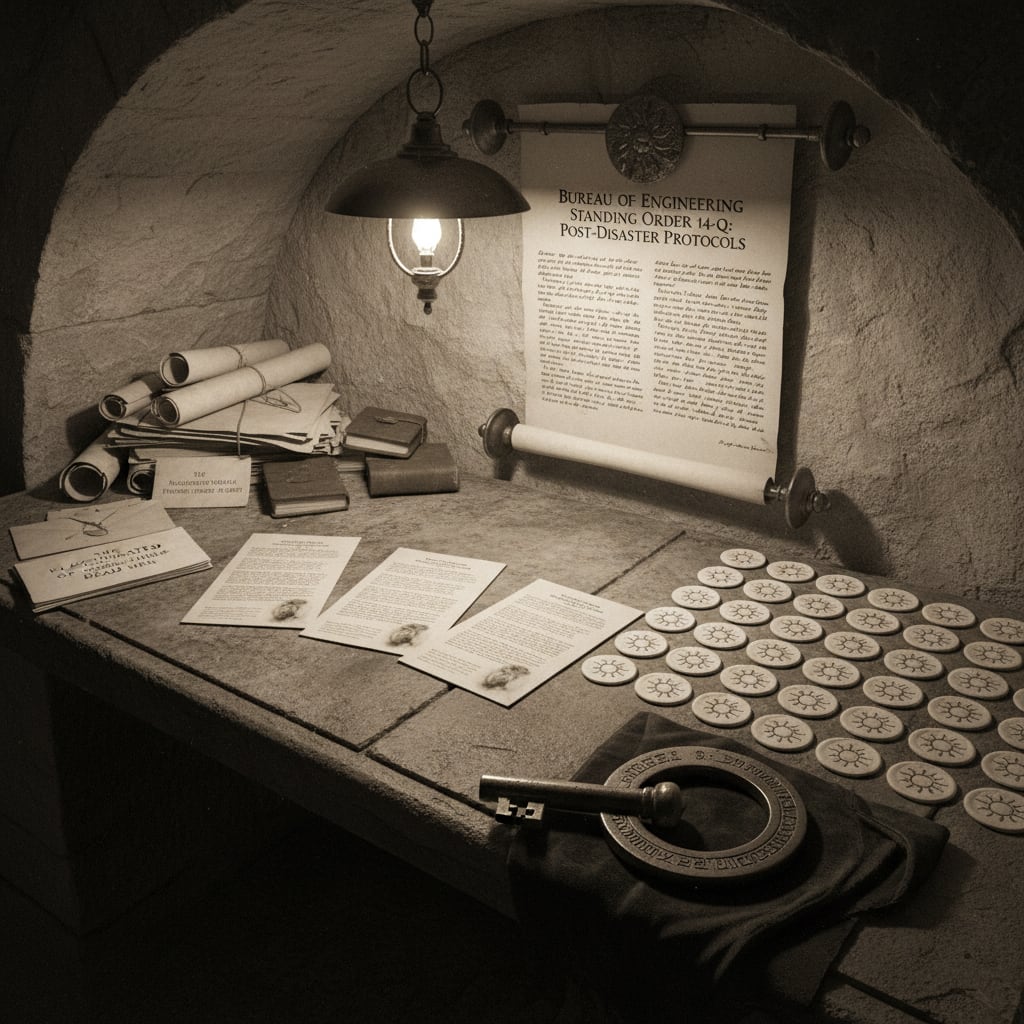
The Sabotage Reforms (Unregistered) followed within the year. Every critical seal — defined as any gasket whose failure could propagate to an adjacent system — required full rite documentation: the verse recited, the witness present, the torque sequence confirmed, the purity wax (Unregistered) applied and stamped, the rite sheet filed in triplicate with the Bureau of Records. A repair without documentation was reclassified from "incomplete" to "sabotage." The reclassification was not popular. It was, the Bureau of Doctrine observed, "not intended to be popular. It was intended to be observed."
#On the Counterfeit Wax Plague
The Sabotage Reforms created the documentation. The Counterfeit Wax Plague of A.S. 178 revealed what the documentation was worth.
Purity wax — the seal that certifies a repair has been performed in sequence, by a licensed mechanic, with sanctioned materials — became currency. A stamped gasket was a gasket that existed in the Bureau's records. An unstamped gasket was a gasket that did not exist, regardless of whether it was holding back four atmospheres of steam in a tunnel beneath three thousand tons of stone. The stamps mattered more than the seals. This was predictable. The Bureau of Tithes had been running the same economy with ration stamps for a century.
Counterfeit purity wax appeared first in the forward bastions — Bastion-Shipka and Bastion-Irongate — where gasket stock shortages made unofficial repairs a daily necessity and where the alternative to a counterfeit stamp was an unstamped repair classified as sabotage. The counterfeits were excellent. The wax composition matched the Bureau's specification. The stamp impressions were close enough to pass routine inspection. The only difference was the hymn embedded in the wax — or rather, the absence of the hymn, because the Bureau's own specification required that purity wax be manufactured during a continuous recitation of the Sixth Canticle of Industry, and the counterfeiters, being counterfeiters, had not bothered.
Whether the absence of the Sixth Canticle affected the wax's sealing properties is a question the Bureau of Engineering refuses to answer and the Bureau of Doctrine refuses to ask. The Bureau of Purity cut through the epistemological impasse with its customary directness: fourteen counterfeit-wax suppliers were immured at Bastion-Przemyśl, their workshops burned, and their stock destroyed. The gasket shortages continued. The counterfeit wax reappeared within six months.
#On the Culture of Blame
The gasket-hymn mechanic occupies a position that would be enviable if it were not lethal. When the seal holds, the Bureau of Doctrine credits the Creator and the Bureau of Engineering credits metallurgy. When the seal fails, everyone credits the mechanic.
The internal factions reflect this asymmetry. The Line-Purists — those who will not alter a single verse under any circumstance, who would rather watch a manifold blow than abbreviate a cleansing phrase — survive audits beautifully and kill men slowly, because the full sequence takes ninety seconds longer than the abbreviated version, and ninety seconds in a failing engine pit is ninety seconds of superheated steam in a corridor with one exit. The Field Pragmatists — those who treat the sequence as a tool rather than a sacrament, who know which verses affect the seal and which verses affect the paperwork, and who adjust accordingly — keep men alive and are court-martialled when the audit arrives.
The Bureau of Doctrine endorses the Line-Purists. The Bureau of Engineering privately prefers the Pragmatists. The mechanics themselves split roughly evenly, with the proportion shifting toward Purism in peacetime and toward Pragmatism during any month in which the casualty reports exceed the ration allotment — which is to say, during most months.
The hierarchy is functional rather than ecclesiastical: Gasket Runner and Wax Hand at the bottom — boys and women who carry stock, clean flanges, and learn the verse by repetition — then Seal Mechanic and Torque Technician in the working ranks, Hymn-Gasket Master at the supervisory level, and at the apex the Sabotage Reader and Ward-Seal Artificer, specialists whose skill is less in making seals hold than in determining why seals failed and, when politically necessary, determining that seals failed for reasons that do not implicate anyone present.
The Ward-Seal Artificer is a profession the Bureau of Engineering officially denies exists. Certain seals — at Bastion-Irongate, at the Chrismole Furnaces, at junctions where the resonance lines pass through stone that predates the Sagittal Line by millennia — require verses that do not appear in any official manual. The Artificers know these verses. Where they learned them is a question the Bureau of Doctrine has asked three times, received three different answers, and filed all three under "Forthcoming Clarification Required."

#On the Present Condition
There are approximately three thousand four hundred licensed Gasket-Hymn Mechanics operating across Zones 1 through 5 of the Sagittal Line. The Bureau of Engineering estimates the actual number — including unlicensed shadow mechanics operating in curfew hours, performing repairs the Bureau cannot sanction and cannot survive without — at closer to nine thousand. The discrepancy is not discussed. The repairs are not refused.
At Bastion-Irongate, where the Gasket Choir sustains sixty-nine per cent of the fortress's structural integrity through continuous acoustic vibration, the gasket-hymn mechanics are the most critical and the most expendable personnel on the Line. Their seals channel the resonance. Their gaskets are the boundaries between a mountain that is singing and a mountain that remembers it was never meant to be hollow. A single failed gasket at the wrong junction — a single skipped verse, a single abbreviation, a single counterfeit wax stamp on a seal that looked right and sat wrong — can cascade through the pressure-door network in the pattern that the Bureau of Engineering calls "sympathetic propagation" and that the Choir Magistrates call "the mountain coughing."
The mechanics know this. They sing anyway. They seat the ring and speak the line and torque the bolt in star-pattern and paint the witness marks and stamp the wax and file the rite sheet in triplicate and go home to corridors that thrum with the sound of their own labour, and they sleep — those who sleep — with the Boundary Litany running behind their teeth like a second pulse.
The Bureau of Doctrine has reviewed this article and found it "doctrinally unexceptionable." The Bureau of Engineering has reviewed this article and requested that the phrase "believed the seal had a will" be amended to "attributed anthropomorphic characteristics to a mechanical component in a manner inconsistent with Bureau of Engineering Operational Taxonomy." I have declined the amendment. The seal held. The taxonomy did not.