
#On the Second Level
"Omne rarum carum." — a proverb from the auction houses. The Vault seems to have read it.
The Gallery of Rarities is the second level of the Vault of Ten Thousand Keys. It lies below the Hall of Surplus and above the Counting Halls, within the Gilded Chasm that Velmora holds across from Bastion-Sibiu. That sentence holds everything the Bureau can certify about where the Gallery is, and I have written it plainly because the subject leaves room for no other luxury.
The Hall of Surplus above deals in crowns, coin, silk and fur, the plain arithmetic of wanting. A sinner of modest education understands it at once. The Gallery is a different school. Its chambers narrow and its objects grow stranger. A soldier who walked past a sceptre without blinking finds that nobody drilled him for a clock.
Nobody has surveyed the Gallery. Some men passed through it, a few came back, and the Bureau has bound what they said into a file. That file holds the Second Expedition's seventeen pages, the Third Expedition's passage, which later became the baseline for comparison, and the Fourth Expedition's relay from its second day. This dossier is indexed to A.S. 196 / 1906 CE, the year of that relay. The date marks an observation. It does not mark a founding, a survey or a seal. Nobody knows when the Gallery was built, or by whom, or whether "built" is even the right verb.
#On the Rarities
Four kinds of object recur in the reports. I set them down as the witnesses gave them and I decline to improve on them.
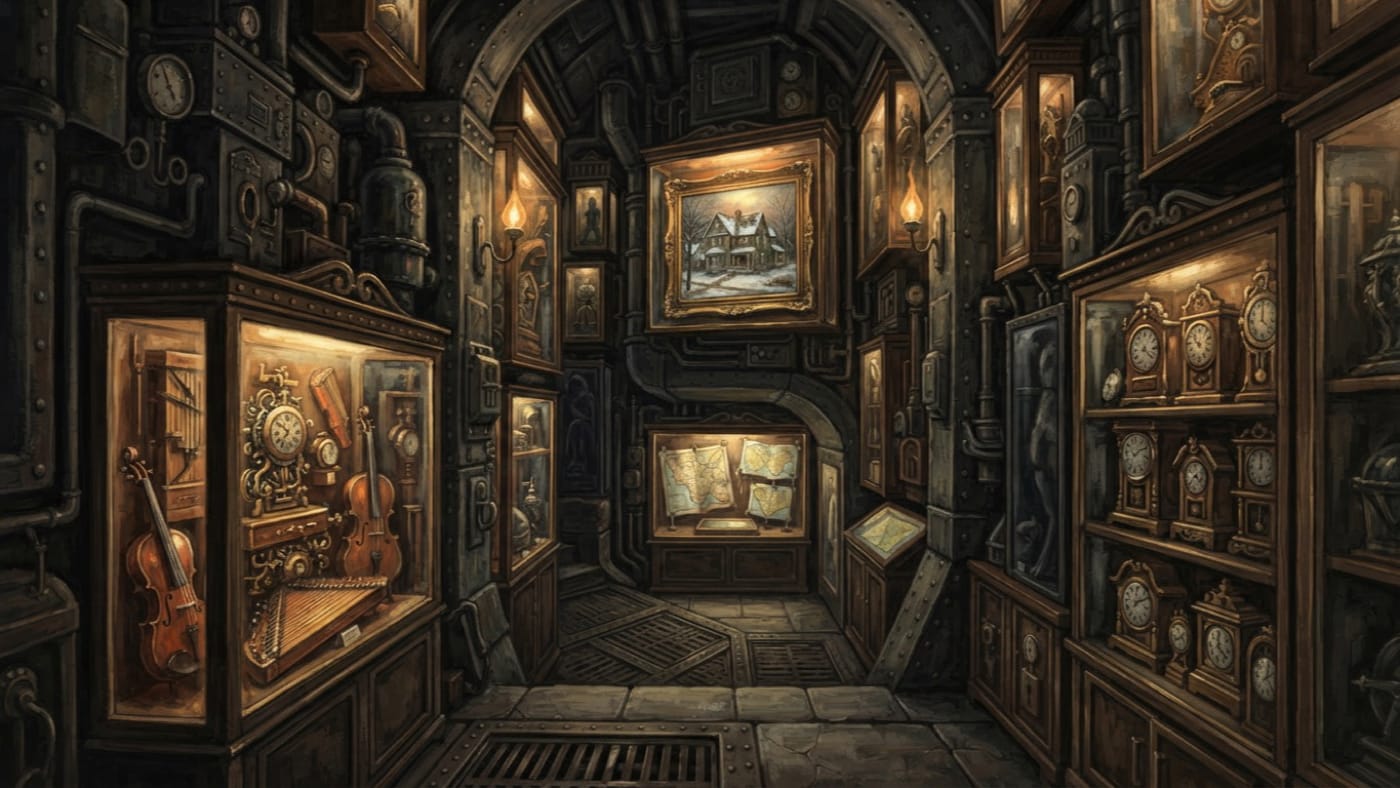
Instruments that play themselves. The reports describe no performer, no hidden bellows-boy and no mechanism. The tune is not recorded either. That omission frightens me more than anything else in the file. The Second Expedition once spent nine pages on a single cabinet of jewelled mechanisms, yet no one in any expedition wrote down a bar of what the Gallery played.
Clocks that count something other than time. What they count is also unrecorded. The Bureau of Bells would ask for the unit, and there is no unit to give them. A clock is a liturgical instrument at bottom, since it calls the hours to prayer. A clock that keeps some other reckoning is calling something else to attention, and the witnesses did not stay to learn what.
Maps of territories that the Bureau of Cartography does not recognise. An expedition leader wrote that they "seemed more correct than ours." That is one officer's judgement, and nobody has checked it. Cartography has verified no line on any of those maps, and it will send no one to try. The danger is in the officer's sentence. A cartographer who prefers the enemy's map has already started to emigrate.
A painting that showed each viewer his childhood home. Each viewer saw a different house, and each house was accurate. No painter, title, frame or provenance is recorded. Neither is the means by which the canvas knew. The reports establish only that it made no mistake.
The order matters. The Gallery's objects begin with the ear, move to the hour, then to the world, and end with the self. A crown has to be wanted. A childhood house only has to be remembered.
#On the Broken Chain
The Second Expedition of A.S. 147 was a joint operation of the Bureau of War and the Bureau of Cartography. It was as well prepared as Synodal ingenuity allowed. Every member wore prayer-wards and was linked to the next by a consecrated chain, and all of them were ordered to touch nothing. The chains held through the Hall of Surplus.
In the Gallery, the expedition's chaplain came to a reliquary. Inside was what appeared to be an authentic finger-bone of Saint Aldebrand. The record does not give the chaplain's name. He reached for the bone and the chain snapped. The display absorbed him. His colleagues withdrew with seventeen pages of notes.
The word appeared carries the whole of what the Bureau knows. Saint Aldebrand's bones have always been plentiful. The Amsterdam heretics counted two hundred and forty-three of his relics, and Cologne keeps seventeen of his femurs, each one notarised and each one holy. A finger-bone in an enemy cabinet that looked authentic to a devout man shows that it looked authentic to a devout man. The question was then disputed for three years. The Vault entry assigns the debate to the Bureau of Doctrine, while The Locked names Relics. The Ledger records both versions and assigns the debate to neither. Either way, the debate was inconclusive and the bone is still inside.
The Bureau's own taxonomy leaves the chaplain's fate open. He may have joined the Locked, or the wall, or the reliquary, or some fourth unpleasant category. I do not close that question, and anyone who does is writing fiction on Synodal paper.
The chain failed once, for one chaplain, in one chamber. The Bureau wanted a law about consecration and got an incident report. Those are different documents, and only one of them is useful.
#On the Altered Displays
The Bureau of War authorised the Fourth Expedition in A.S. 196 over Doctrine's formal objection. It sent twelve operators of the Bureau of Shadows, whose names I may not record. They entered on the morning of the fourth day of the Feast of Doctrinal Submission. On the first day their bell-signal relay reported the outer galleries: consistent with earlier surveys, no casualties. On the second day it reported the Gallery.
Each clause should be read on its own terms.
Contents have changed. So the Gallery is not a fixed collection, and any inventory of it describes one visit only. The four classes of object described above are what witnesses saw. They are not a catalogue of what is there.
Appear to reference. These are the operators' words and the operators' judgement, made in a room built to persuade. The relay names no priority and no object. I will not supply either. A reader who wants to know what the Synod most wants to learn may consult his own appetite. The Gallery evidently did.
Advise extreme caution. This was good advice, sent by men who were already standing inside the danger.
The Bureau trained twelve men to want information above food and sleep, then delivered them to a hall that stocks information. War calls this an operation. I call it a delivery, with the recipient's signature on the receipt.
The third day's transmissions are classified under Seal Amber, and so is the final message of eleven words. No member of the Fourth Expedition has returned. The day-two relay does not say where any of them was lost, and I will not place them in the Gallery for the sake of neatness. Neither does the relay prove that they went deeper, or that anything in the Vault spoke to them. It proves that on the second day they were in the Gallery, that the displays had changed, and that they were frightened enough to say so.
#On the Visitor as Exhibit
The Locked places the Treasure-Locked in the Hall of Surplus and the lower cabinets of the Gallery. They are living men and women behind glass, holding the thing they came for. This is why the Gallery's furniture matters. A vitrine on this level may hold an object, or a person holding one, and a weary eye at the end of a long corridor may not tell them apart at once.
The Keymasters carry the keys and arrange the displays. The Bureau of Purity's bestiary says they curate, which means they decide which cabinet shows what and to whom. No report names a Keymaster as the cause of the chaplain's absorption, and I name none.
Doctrine's reading is that the Vault completes a desire and then keeps it as property. In the Gallery, that reading suggests the Vault stops offering what anyone would want and starts offering what this particular visitor wants. I add my own argument, and it is mine. The Hall of Surplus asks what you want. The Gallery asks what kind of man you are. Whatever you answer is put on a shelf.
A.S. 181 Mercy memorandum recommended "selective humane extraction of preserved captives."
Rejected by Doctrine, War, Purity and Tithes. Nothing in the Gallery is to be extracted, humanely or otherwise, and that includes the bone.
#On the Limits of the Record
The Gallery's origin is unknown. Its layout has never been established. The Third Expedition found the Vault rearranging itself behind the retreating party, and the Fourth found the Gallery's contents changed. Its chambers have never been counted or measured, and its passages have never been mapped. Every account agrees on only two things: the chambers narrow, and the objects are strange. A clerk who submits a floor plan has drawn his own wishes onto Bureau vellum.
The Vault is under permanent interdiction, and no recovery operation is authorised. Proposals to retrieve the chaplain, the bone or the maps fall under the same standing order as every other recovery request. The order is short, and the clerks enforce it gladly.
The Gallery sells nothing to a man who refuses to look. It has a great deal to sell everyone else.