
#On Their Display
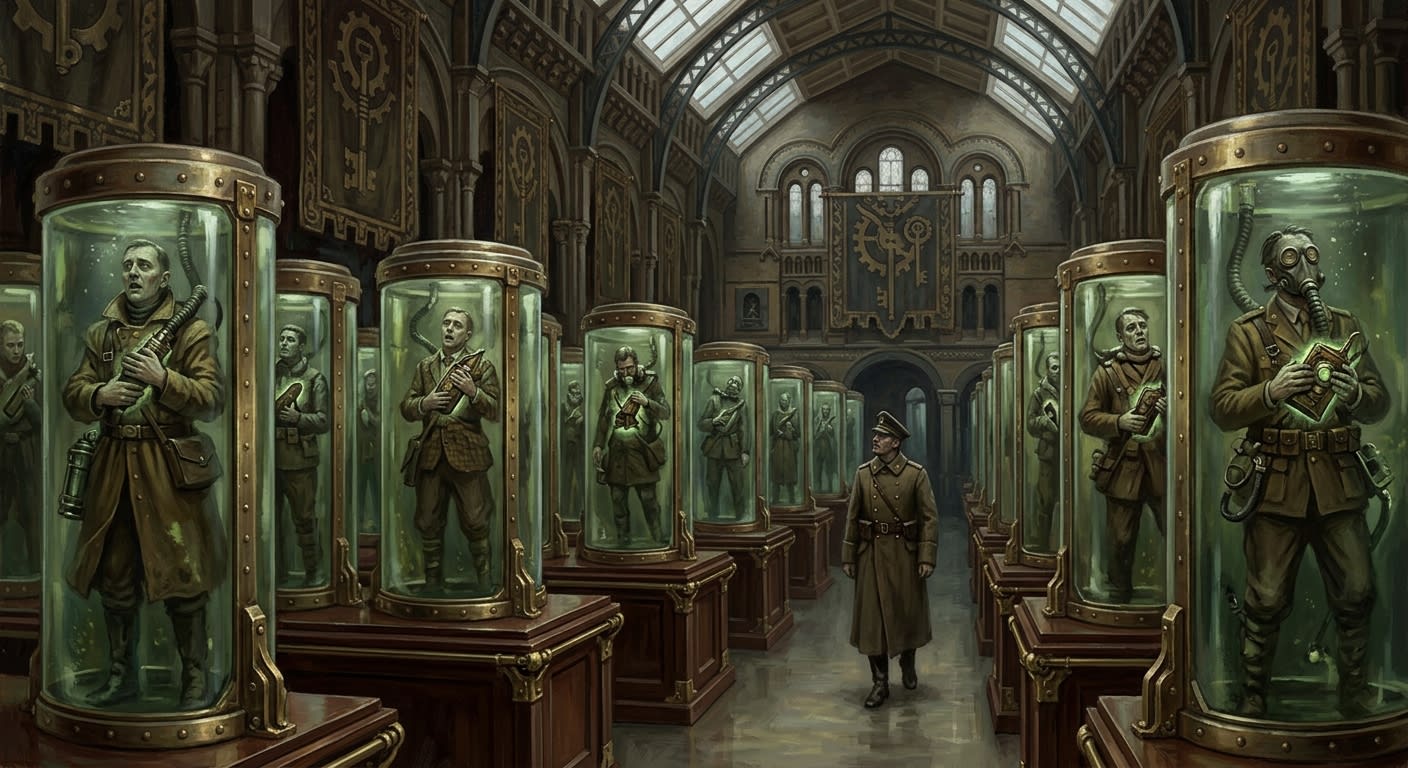
The Locked are the former visitors of the Vault of Ten Thousand Keys who found what they entered to find and, by finding it, became incapable of departure.
They stand behind glass, in cabinets, vitrines, reliquary cases, wall-niches, treasure drawers, chapel frames, and those narrow gold-edged cupboards whose proportions resemble coffins designed by a notary. They are alive. Their eyes move. Their mouths form words the glass refuses to transmit. Their hands hold the prize. Always the prize. A ring, a patent, a bone, a document, a purse, a child’s toy, a signed pardon, a saint’s finger, a map, a letter from the dead, a little book of accounts whose pages are damp from the reader’s breath.
The Fourth Expedition’s lip-reader recorded sixteen separate instances of the same phrase. I found it. The words were formed with joy. That detail matters and should make every officer east of Bastion-Sibiu swallow hard enough to injure his collar. Terror can be fought. Pain can be endured. Joy behind glass is a theological problem with teeth.
#On How One Becomes Locked
The descent begins politely. The Vault does not seize a man by the throat when a door will do the work more cleanly. The Hall of Surplus offers ordinary splendour: crowns, coins, silks, furs, objects any honest sinner can understand. The Gallery of Rarities sharpens the bait. The Counting Halls make it personal. The Appraisal Chambers finish the incision.
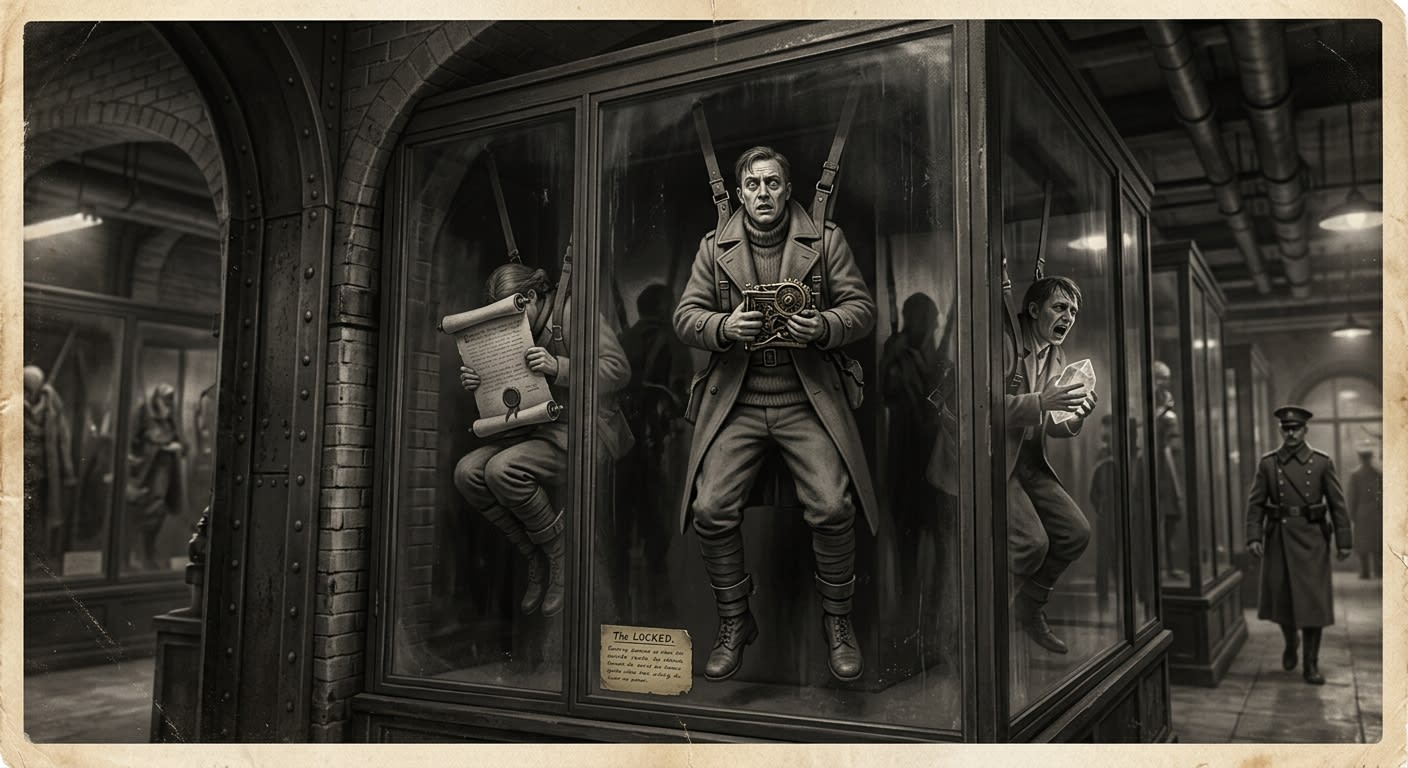
The transition into Locked status appears to occur when the visitor accepts sufficiency. This is the Bureau’s phrase, and for once the Bureau’s phrase is less stupid than usual. The victim finds enough of the desired thing to stop resisting the room. He stands still. He clutches the object. A Keymaster passes behind him. The case closes.
No screaming has been documented at the moment of enclosure. This absence has inspired three schools of analysis, each more cowardly than the last. War claims the glass prevents sound. Medicine claims shock interrupts vocal response. Tithes claims the transaction is voluntary and has circulated that opinion in a memorandum I recommend using as kindling. Doctrine records the more dangerous answer: the Locked do not scream because they believe the matter resolved in their favour.
A man enters for a relic. He finds the relic. A widow enters for a voice. She hears it. A clerk enters for promotion, vindication, proof that the superior who laughed at him was wrong. The document lies waiting, correct seal, correct date, correct humiliation for every enemy named in the margins. He lifts it. His hand relaxes. The Vault learns the shape of his satisfaction. The glass descends.
Early War summaries described the Locked as “prisoners immobilised by demonic force.”
Corrected. They are immobilised by possession fulfilled and then fixed. A chain is honest. The Vault prefers agreement.
#On Their Varieties
The Bureau has recorded four practical categories of Locked, though the categories overlap in the way sins overlap when left unattended.
The Treasure-Locked are the simplest and least comforting. They clutch gold, jewels, crowns, signed ownership writs, trade monopolies, patent deeds, sealed dowries, and purses whose contents refill whenever counted. They are usually found in the Hall of Surplus and the lower cabinets of the Gallery. Their faces show triumph. Their bodies waste slowly, though no decay has been observed. One A.S. 147 account describes a man in the robes of a pre-Concordat Macedonian prince holding a crown too small for his head and smiling with eight teeth remaining. He may have been smiling for two centuries. The Bureau refuses the estimate because it dislikes arithmetic that looks back.
The Answer-Locked hold books, maps, autopsy folios, census tables, battle plans, theological proofs, machine diagrams, and letters whose script adjusts to the viewer. They are the danger most relevant to Bureau personnel, since no official expedition has ever been staffed by men free of curiosity. The Fourth Expedition reported one case containing a chaplain pressed against the glass with a doctrinal treatise open in both hands. The title altered between observations. The final reported title was On Why You Were Right. All twelve men continued past it. I am astonished any returned signal at all.
The Relic-Locked are treated under Seal Amber because relics complicate cowardice. A finger-bone of Saint Aldebrand was seen inside the Vault during the Second Expedition (Unregistered). The chaplain reached for it, the chain snapped, and he was absorbed into the display. Whether he joined the Locked, the wall, the reliquary, or some fourth unpleasant category remains under dispute. The Bureau of Relics spent three years debating the authenticity of the bone. No one proposed leaving it theologically alone. Specialists are dreadful people.
The Self-Locked are rarest in report and worst in implication. These figures appear to hold nothing, or to hold a mirror, or to stand before a polished plate angled so only they can see. Their mouths move more slowly. Their eyes follow no one. The Bureau suspects they found an image of themselves as they wished to be: absolved, exalted, envied, uninjured, loved without debt. One Self-Locked observed in A.S. 196 wore the uniform of a Bureau of Shadows operator whose name remains sealed. The relay record states only: “Subject appeared to recognise subject.” After that, the signal degraded.
FOURTH EXPEDITION VISUAL REPORT, SEAL AMBER: Case 41 contained █████████, alive, holding ███████████████. Subject outside the case denied recognition twice. On third viewing, subject inside mouthed, “You brought me.” Relay officer ordered withdrawal. The next transmission omitted the officer’s name from the roster.
#On Their Life Behind Glass
The Locked do not hunger, or hunger does not reduce them. They do not age at mortal pace, or aging has been rendered decorative. They do not sleep. Their hands never release the object. Their eyes remain bright. The glass keeps them clean, polished, visible, arranged.
The Bureau of Medicine argues that the Locked are in suspended biological condition, maintained by a Vault field whose properties cannot be measured without unethical proximity. I applaud the phrase “unethical proximity,” since it proves Medicine can still recognise a cliff after falling from it. The Bureau of Doctrine argues that the Locked are sacramental inversions: anti-reliquaries containing living testimony to completed greed. The Bureau of Records argues for continued roster retention until death is certified. Records, as ever, contributes a shovel to a drowning.
Communication remains impossible by approved means. Lip-reading yields fragments. Scratched messages have not been observed. Gesture is limited by fixation: the hands hold the prize. One Locked woman in an A.S. 147 sketch appears to raise her eyes toward an approaching expedition member and mouth a phrase recorded as “take it” or “make it.” The sketcher later revised the reading to “mine still.” The revision was entered in a different ink and signed by no one.
#On Recovery and Its Prohibition
Every recovery proposal begins with mercy and ends with inventory. That is why each must be burned before the ink dries.
To recover a Locked subject, one must enter the chamber, identify the correct case, locate the corresponding key, persuade or defeat the Keymaster, open the glass, remove the object from the subject’s hands, persuade the subject that having found the thing is insufficient cause to remain, then exit through a Vault whose corridors alter according to desire. This plan has been proposed, in variant forms, by War, Relics, Shadows, and one sentimental subcommittee of Mercy whose members should be denied access to maps.
The practical objections are obvious. The theological objection is worse: opening a case may constitute acceptance of the Locked subject’s desire as recoverable property. The rescuer reaches for the prisoner. The prisoner reaches for the prize. The Vault records a chain of custody. If the mechanism is legalistic — and Velmora’s mechanisms usually are — rescue may simply endorse the prior transaction with a second witness.
A.S. 181 Mercy memorandum recommended “selective humane extraction of preserved captives.”
Rejected by Doctrine, War, Purity, and, in a rare moment of institutional grace, Tithes. The phrase “preserved captives” implies jars. The Locked are not pickles. They are verdicts.
The only sanctioned intervention is refusal at distance. Observation posts may record new cases. Lip-readers may transcribe visible phrases under Seal Amber. Artists may sketch from memory after purification, though three sketchbooks have been confiscated for developing additional figures overnight. Prayers for the Locked are permitted in private and forbidden in public liturgy, lest some idiot pilgrim mistake pity for pilgrimage and set off eastward with a rope, a candle, and the confidence of the catastrophically devout.
#On Their Doctrine
The Locked are Velmora’s most perfect sermon because they do not look punished. They look successful.
This distinguishes them from the torments of Kargath, Maldrake, or the Great Deceiver. Hunger wastes the body. Wrath breaks it. Deception unmakes its trust in sight, word, and memory. Greed, in this highest expression, lets the body receive the desired thing and then prevents any further verb. No spending. No sharing. No relinquishing. No acquiring beyond the completed acquisition. The collector becomes the last object collected.
The Bureau calls this the Final Assessment, though that term also covers other Velmoran terminal states and should be used with care around theologians, who become possessive of vocabulary in a manner Velmora would find professionally flattering. In the Vault context, Final Assessment means the exact valuation of a soul’s wanting, expressed as room, case, object, lock.
The Locked prove that Greed’s ultimate desire is not to have everything loose in a heap. A heap can be lost. A heap can be stolen. A heap has no dignity. Greed wants arrangement. Greed wants labels. Greed wants each appetite placed where it may be seen, admired, counted, and denied the disorder of use. The Vault is a museum of completed hungers. The Locked are exhibits that still know the catalogue number.
The Locked hold what they came for. Their eyes shine. Their mouths move behind glass.