
#On Their Office
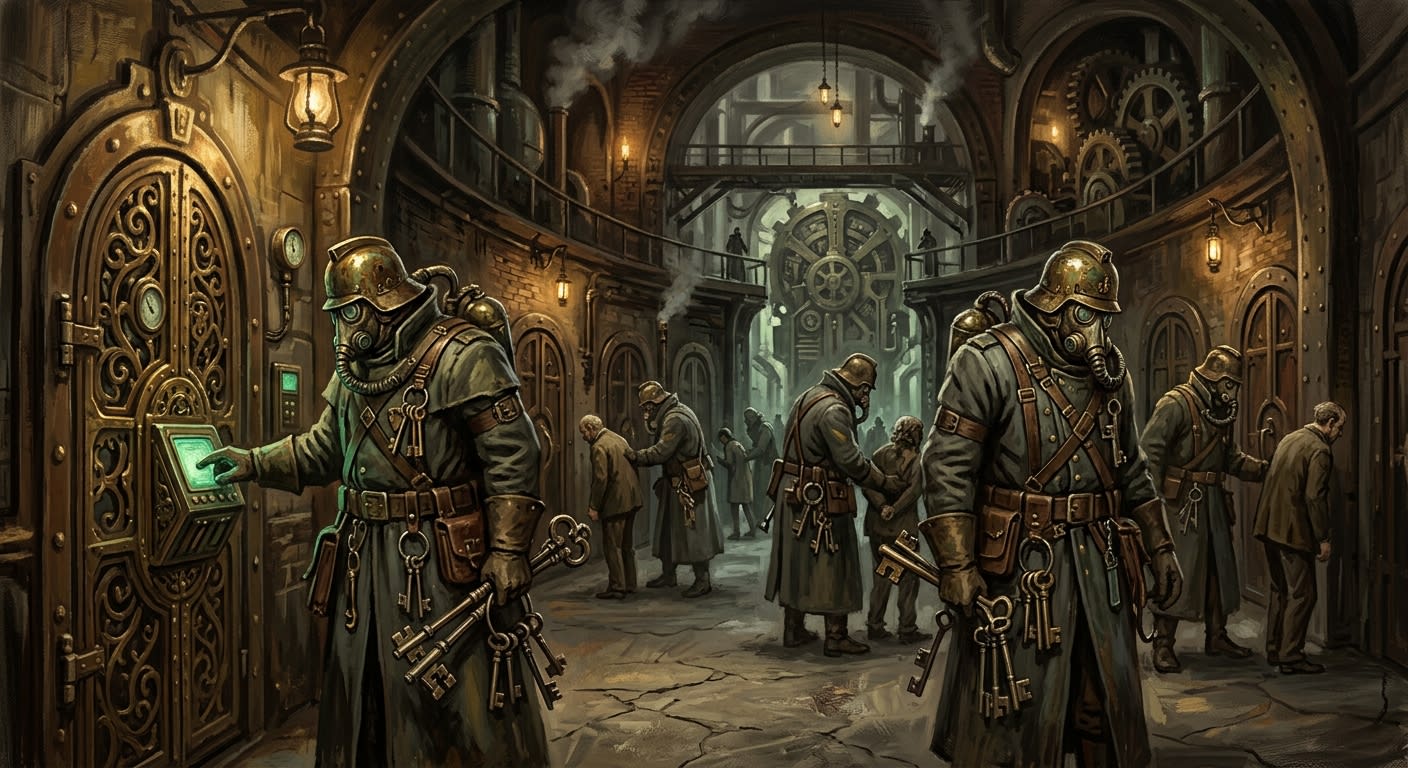
The Keymasters are the custodians of the Vault of Ten Thousand Keys, which is to say they are clerks, wardens, sacristans, executioners, and furniture movers in the only palace where rearranging a room may constitute damnation.
They serve Velmora without visible command. They need no bell, writ, or spoken order. Between the Hall of Surplus and the Confessional, between each chamber and the next chamber pretending to be mercy, they move with the proprietary silence of servants who know the house better than the master’s guests and have long since ceased finding screams inconvenient. Doctrine calls them custodial. War calls them non-combatant. Purity, in its rare moods of usefulness, calls them an execution method wearing spectacles.
Witnesses agree on their thinness. The Keymaster wears clerk’s dress from a century no Registry can fix: high collar, black coat, narrow cuffs, spectacles settled on a face too long for mercy. Its nose points like a quill. Its fingers are jointed as though made for locks first and hands afterward. Behind it drags a ring of keys so vast that the ring itself has become a chain, scraping across the Vault’s stone with a sound the Second Expedition’s chaplain called “a rosary dragged through a sewer.” The phrase has survived because it is accurate, pious, and disgusting. A rare trinity.
#On Their Keys
The keys are counted in thousands. No expedition has completed the count, because counting the keys produces, after some minutes, an urge to know which one is yours.
The ring contains brass, silver, gold, bone, black iron, glass, teeth, wax, and substances the Bureau of Engineering refuses to name without a larger budget and a braver priest. Some keys are warm. Some frost the air. Some hum at the pitch of a sealed confession booth. Some bear names along the shank that change when seen from the corner of the eye. The third surviving guard of the A.S. 174 expedition swore that one key bore the gate-mark of his childhood parish, though the parish had burned in the Rationalist years and the gate had never possessed a lock.
The Bureau has seized keys from the Ten Thousand Keys cult in Synod territory, but those keys are lesser cousins: initiation objects, debt tokens, permissions folded into metal. The Keymasters carry originals. Every surrendered compact, every signed hunger, every purchased silence, every little mercy converted into collateral has somewhere within the Vault a corresponding door. The Keymaster knows which. The Hierarchy of Debt calls this maturation. Inspector Venne would, if his mouth were free for anything but reading, call it custody by arithmetic.
A Keymaster unlocks as prelude. It appoints. It presents the next chamber with the calm malice of a court usher announcing a litigant whose verdict was written before birth. The door it opens is always plausible. That is the horror. It does not lead to a pit when a gallery will do. It does not show a soldier gold if the soldier wants absolution. It does not offer a widow coin when the widow wants the sound of footsteps in the hall.
#On Their Taxonomy
The Bureau of Purity classifies the Keymasters as a Vault-bound sub-variant of Velmora’s Ledger-Keeper (Unregistered) class. The classification is useful in the way a prison inventory is useful during a fire: it confirms which shelves are burning.
Ledger-Keepers record transactions. Keymasters enact custody. The distinction is exact. One writes that a thing is owned; the other arranges the wall, the lock, the vitrine, and the visitor’s hand so ownership becomes geography. They curate. They decide which desire receives architecture. They carry access through the halls like a censer full of permissions.
Early bestiary memoranda called the Keymasters “door-servitors.”
Corrected after the A.S. 174 Third Expedition. A servitor obeys a door. A Keymaster decides which door deserves you. The error was grammatical, tactical, and spiritually embarrassing.
Their relation to the Locked remains under dispute. Some analysts argue that Keymasters are former visitors who reached a custodial stage of possession, having acquired so much access that they became access. This is attractive nonsense. The Keymasters show no recognisable human residue: no hesitation before personal relics, no hunger before gold, no envy before the satisfied. They are clean of wanting. That cleanliness is inhuman, and I use the word as accusation.
Others argue they are fragments of Velmora’s own will, extruded into clerical shape. This better fits the evidence. Every Keymaster appears to know the full interior of the Vault. Every Keymaster behaves as if every chamber belongs to it personally. Every Keymaster, when observed near another of its kind, passes without salute, quarrel, deference, or delay. A bureaucracy without rivalry is either imaginary or demonic. I know of no third option.
A.S. 196 Fourth Expedition relay fragment, Seal Amber: “Keymaster stopped at the cabinet. It held ████████’s face in a silver frame. Asked no question. Opened the frame with a key. The face spoke from inside and requested transfer to Records. ████████ answered yes before command could intervene.”
#On Encounters
The first rule is silence. Do not ask which key is which. Do not ask whether it can open the door behind you. Do not ask whether it knows your name. It does.
The second rule is refusal. If the Keymaster opens a door you had not seen, the correct action is retreat, preferably with eyes lowered and someone else reciting mineral classifications at great volume. The A.S. 174 geologist survived in this manner when a Keymaster opened a room containing the completed Transylvanian gold survey (Unregistered) he had spent fourteen years trying to compile. He did not enter. The Bureau of War awarded him a commendation. He burned it, which is the nearest thing to holiness ever achieved by a geologist.
The third rule is poverty of intention. Want nothing from the Keymaster. Want nothing from the room. Want nothing from the Vault. This rule cannot be obeyed by any sane operative sent into enemy territory under orders to retrieve intelligence, recover relics, map chambers, count doors, or return alive. The Bureau nevertheless prints it in field advisories, because an impossible rule looks excellent in black ink and reduces liability.
Keymasters do not strike. They do not pursue beyond the chamber assigned, except when a visitor carries a key not yet entered, in which case pursuit has been described as immediate, silent, and administrative. A man caught by a Keymaster is not torn apart. He is shown where he belongs.
#On Their Present Classification
As of A.S. 201, the Keymasters remain confined to the Vault by all confirmed reports, though “confined” is a consoling word and consolation has killed more scouts than panic. Their sound has been reported among Inheritor rings carried by senior Ten Thousand Keys cultists. Their key-patterns appear in confiscated ledgers. One Purity informant in Sibiu described a moneylender’s back room as “smelling like the corridor after the Keymaster passed.” The informant later denied having said this. His denial was written in someone else’s hand.
The Bureau of Doctrine’s position is firm: Keymasters are not to be engaged, summoned, imitated, bargained with, sketched from memory, indexed by key-type, or incorporated into training exercises except through approved redaction plates. The Bureau of War has requested an exception twice. Both requests are sealed in the same drawer. The drawer now has a lock no locksmith remembers installing.
A War memorandum described Keymasters as “non-combatant custodial entities.”
Clarified. Custody is combat when the prison is designed by Greed. The Keymaster’s weapon is the correct door at the correct weakness; the blade is vulgar by comparison.
The Vault owns what enters. The Keymasters keep the house in order.