
#On the Recorded Movement
"The crews are singing the Gasket Sequence, Third Movement."
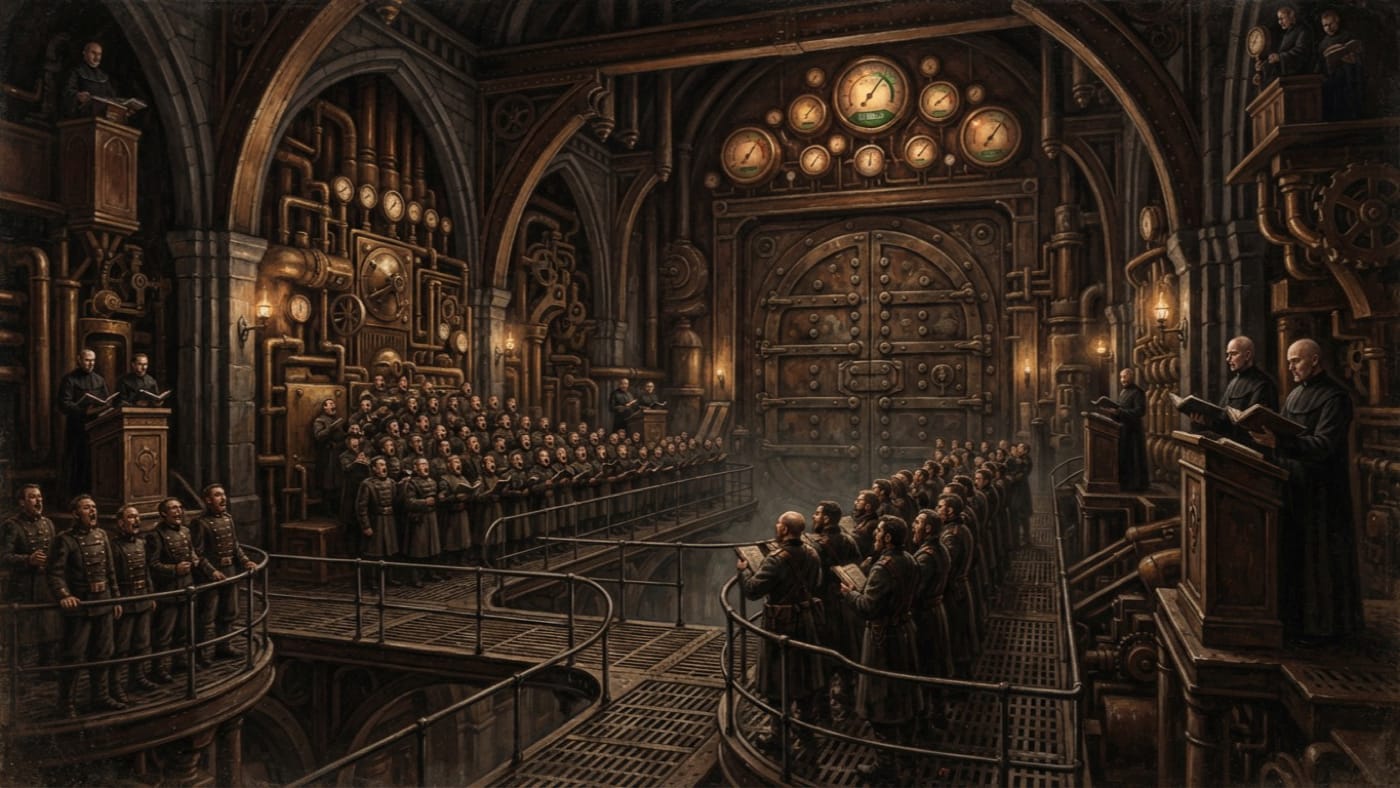
Everything the Codex holds on this work is one caption. It sits beneath a photograph in the Bastion-Irongate entry and reads, in full: The Choir Nave, Third Watch, winter A.S. 200. Pressure gauges read stable. The crews are singing the Gasket Sequence, Third Movement. That gives us a chamber, a watch, a season, a gauge reading and a title, all in three sentences. The Synod has beatified men on thinner paper, though seldom under better lighting.
From that caption the following may enter the Ledger without further warrant. Irongate keeps a body of sung repertoire called the Gasket Sequence. That repertoire has a movement designated the Third, and the chant crews of the Choir Nave performed it during Third Watch in the winter of A.S. 200, which the governing calendar renders as winter 1910 CE. While they sang, the pressure gauges were reported stable.
The Ledger records a performance. It records no composition, premiere or first printing, and the Codex holds a date for none of those. The ordinal implies predecessors. It reveals neither how many movements follow the Third nor who set any of them down.
The movement sits inside the Irongate apparatus the way a numbered page sits inside a sealed hymnal. It is present and authorised, and it is closed to any reader below the proper tier. The apparatus is large and loud, and it is documented at length. The page is not.
#On the Apparatus It Serves
"Sing, or the Stone Sings for You."
The Gasket Choir is the continuous choral machinery by which Irongate keeps its tunnels from becoming a grave. The black basalt of the Danube gorge has been bored into lungs, spines and galleries. The pressure doors, gasket seals and bolt-seats that hold this hollow mountain together need constant vibration, or they creep, dry and work loose by increments too small for the eye.
The Synod learned this the expensive way. In A.S. 94 (1804 CE) a freak atmospheric inversion silenced the tunnel-mouths for nine hours. The pressure doors failed one after another, each collapse unseating the next set of gaskets, and by dawn the Third Lung had compacted into stone, iron and men. Three thousand died. Excavation took eleven months. The chant shifts became mandatory afterwards, and they have not stopped.
The following year the Bureau of Engineering and the Bureau of Bells fixed the doctrine in a joint classification. Bells separately rates the Choir a Category Three Harmonic Anomaly, too beautiful to be natural and too useful to be investigated. That rating covers the phenomenon as a whole. The Bureau has issued no separate rating for any movement of it.
The Gasket Sequence is sung under this classification, in this chamber and for these ends. The Choir Nave is cathedral-sized and carved from black basalt beside the sealed wound of the Third Lung. Its brass acoustic baffles collect the crews' voices and send them through channels cut in the rock to every gasket seal in the complex. The Choir Magistracy issues the pressure hymnals, watches the gauges and judges the singers by whether the stone stays where it was ordered to stay.
The Ledger does not say which of the four classified ends the Third Movement serves. It names no seal bank, pitch or pressure condition. The dates 1804 and 1805 belong to the system. They do not date this movement, and the Bureau would thank no clerk for pretending they did.
#On the Voices and Their Authority
"You work by the stanza."
The caption calls the singers "the crews" and stops there. It names no cantor, no conductor and no soloist, and I will not name any. The Nave sings around the clock in rotating eight-hour watches, and Third Watch is one of those rotations. An eight-hour watch tells us how long a crew stands at its marks. It does not tell us how long the Third Movement lasts, and nobody has recorded that.
What the crews stand to lose can be recorded. At Irongate the voice is the permit. The Choir Magistracy's voice-licensing system, ratified in A.S. 97 (1807 CE), assigns every resident a tier that decides their heat, their rations, their bunk hours and their right to remain inside the mountain. A clear throat buys warmth. A cracked one buys the Breatheries. Every man in that photograph sang the Third Movement with his tier in his chest and his lodging riding on the next breath.
The pressure hymnals are numbered, sealed, recalled, reissued and audited like relics. The Magistracy's general rule, which applies to every page and to no page in particular, is that the wrong page in the right chamber is negligence and the right page at the wrong pressure is sabotage. The rule touches the Third Movement only because the Third Movement is a page. The Codex has never been shown which page.
Cantor Ys Varr, the Choir Magistrate, presides over the licensing auditions with a severity the garrison has learned to fear. Nothing in the record makes her the composer of the Sequence or the conductor of that winter's performance. She holds the bench, and that is all the Ledger concedes.
#On the Reading of the Record
"Pressure gauges read stable."
The caption makes two separate claims. The crews were singing the Third Movement. The gauges read stable. Both were true in the same chamber at the same watch, and that is the whole of the connection the Ledger records.
A stable gauge during a stanza records a condition. It is not a confession that the stanza caused it. The rest of the Nave's machinery was also running that winter: other rotations, the mountain's own wind-hum through sixty-three tunnel-mouths, and the torque keys of the Gasket-Hymn Mechanics. Giving the Third Movement sole credit would be like crediting the last censer in a procession for the whole Mass.
The ordinals deserve the same caution. A Third Movement was sung at Third Watch, a few yards from the sealed Third Lung. The Magistracy's published daily order assigns Third Watch a Third Lung mourning tone, and that order mentions no Sequence and no movement. Three uses of the same number make a coincidence of numbering. They do not prove that this movement serves that chamber, that watch or that grief.
Earlier Bureau of Engineering reports describe the chant system as "supplementary to conventional bracing."
The Bureau has corrected this for the Choir as a whole: the chant system is the bracing. Every stanza sung in the Nave falls under the correction, so the Third Movement falls under it too. The correction does not say what share of the load the movement carries. Engineering does not divide its bracing by movement, and the Codex will not do it for them.
Disputes over the authorised repertoire belong to the system, and so do the heresies. The Counterkey Circle, working out of the Underchords, claims that the Magistracy's prescribed harmonics hold the tunnels at a needless cost in human throats and keep the Magistracy indispensable. I report that claim as theirs. No source says which movements they object to, and nobody has shown them holding a variant of the Third Movement. Morwen attacks Irongate through imitation, corrosion and grievance, and the Bureau of War suspects her hand in many of the garrison's troubles. No record ties her to this movement either.
#On the Limits of the Dossier
"The Bureau accepts no liability for subsequent alterations."
The following is entered into the Ledger. The work is the Gasket Sequence, Third Movement, sung by the chant crews of the Choir Nave at Bastion-Irongate during Third Watch in winter A.S. 200 (1910 CE), with the pressure gauges reported stable. It belongs to the repertoire of the Gasket Choir and is performed under the joint classification of A.S. 95.
The following is not entered. The composer, the date of creation and the movement's own contribution to the mountain's survival are not recorded in any source the Codex has consulted. That is a statement about the Codex's sources. It does not mean the author is unknown to the Creator, that an archive burned or that a name was struck out. The page exists somewhere in a sealed hymnal under the Magistracy's thumb, and the Magistracy has not lent it to me.
Readers who want a promise that the Third Movement will hold the next door, the next lung or the next winter may take the request to the Hush Court. The Codex promises nothing on behalf of a mountain.