
#On the Noise That Prevents Burial
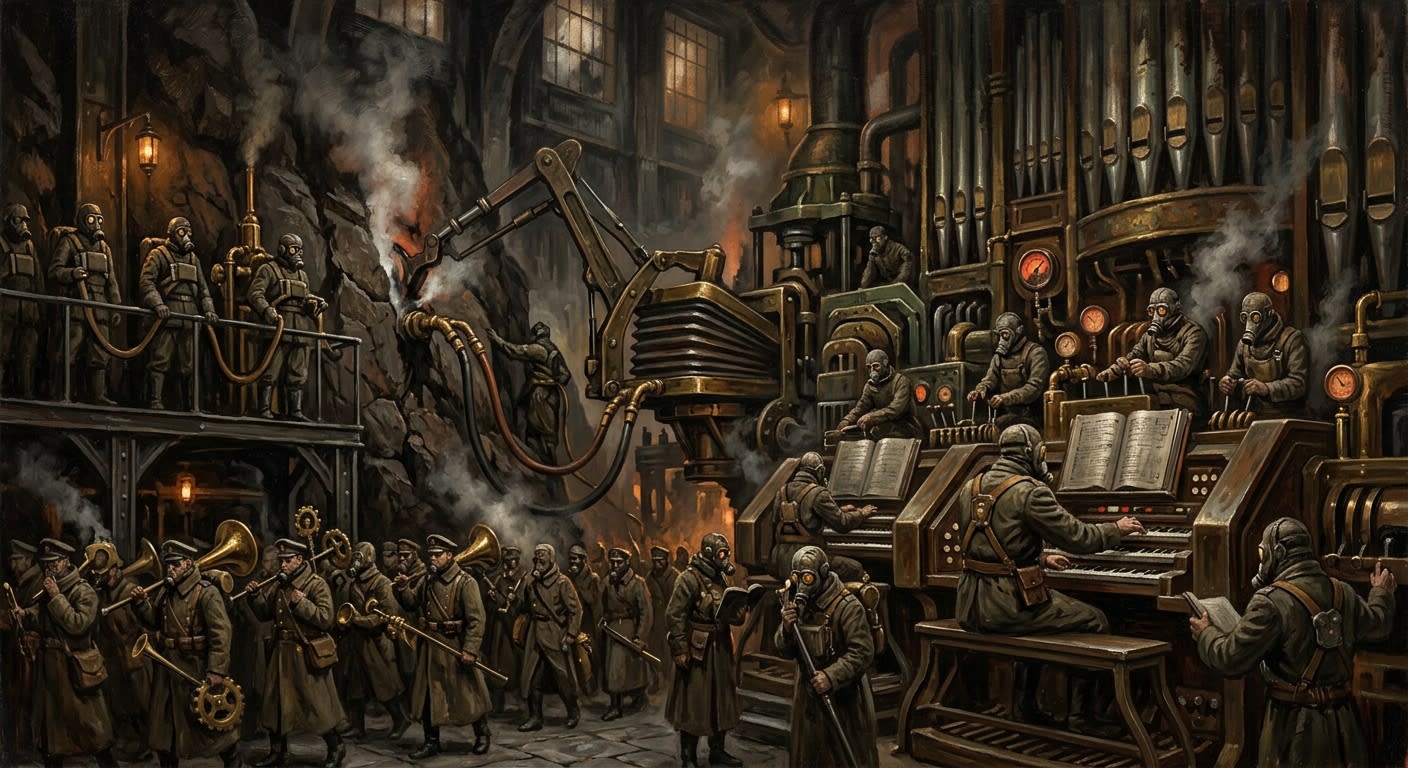
The Gasket Choir is the name given, with the usual soldierly vulgarity and accidental precision, to the continuous choral machinery by which Bastion-Irongate prevents itself from becoming a tomb.
One must be careful with the word choir. In Strasbourg it suggests boys in white collars, old women weeping discreetly, some fat canon pretending his falsetto is humility. At the Irongate it means chant crews in damp wool, brass baffles sweating above them, pressure gauges twitching like guilty eyelids, and a mountain waiting for one wrong note before it remembers gravity. The Choir is prayer. The Choir is engineering. The Choir is labour discipline with incense on its knuckles.
The Bureau of Bells classifies the Gasket Choir as a Category Three Harmonic Anomaly. The Bureau of Engineering calls it an acoustic bracing system. The Bureau of Doctrine calls it obedience rendered audible. The workers call it a shift.
The term arose after the Great Hush of A.S. 94, though the mountain had been making its desires known long before that catastrophe. In early construction reports the tunnel-mouths of Irongate are said to have “voiced under wind-load,” a phrase written by an engineer trying very hard not to say that the cliff sang at him. The first garrison laughed at the sound. The second garrison logged it. The third garrison died when it stopped.
#On the Great Hush
Every institution deserves a founding massacre. The Gasket Choir, being superior to most institutions, received three thousand dead and eleven months of excavation.
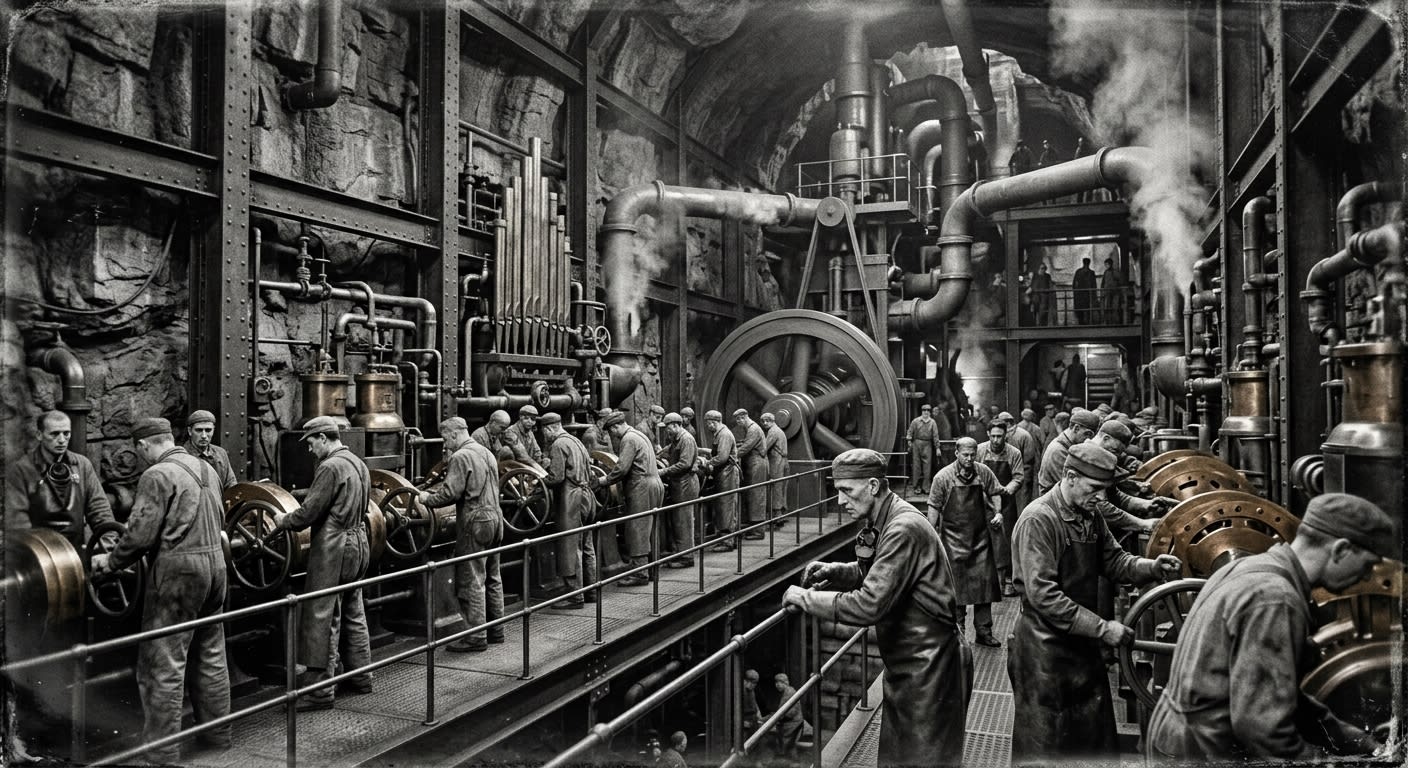
The Great Hush of A.S. 94 began as weather. A freak pressure inversion settled over the Danube gorge; wind that normally passed through the sixty-three tunnel-mouths fell still; the low throat-tone of the southern cliff ceased. For nine hours the Irongate was quiet. The earliest witnesses describe the quiet with a tenderness bordering on obscenity. Men slept well. Horses stopped screaming in the lift cages. Candles burned straight. The Third Lung, largest of the early chambers, did not creak once.
Then the seals crept.
Gaskets dried and slackened in their housings. Pressure doors lost their seated bite. Bolts, freed from the minute vibration that kept them honest, worked loose by increments too small for the eye and large enough for death. The first door failed at the fourth hour after midnight. The shockwave travelled along the Transit Spine, found every compromised seal in its path, and taught them sympathy. By dawn the Third Lung was packed with stone, iron, timber shoring, brass fittings, bread carts, bunks, choir stools, and men whose final prayers were flattened before Records could transcribe them.
The rescue teams heard knocking for sixteen days. This is not in the public report, because public reports enjoy sparing citizens the sort of truth that causes useful panic to become expensive panic. The knocking followed no known distress code. It occurred in measures of seven, eleven, and thirteen. The Bureau of Bells sent a junior analyst to determine whether the buried were communicating. The analyst returned with a notation that the knocks matched no human rhythm, then resigned, then entered the Orison seminary, then stopped speaking during Compline in A.S. 97 and has been copying blank staves ever since.
The Third Lung was never fully reopened. Parts of it remain behind sealed masonry, behind official diagrams marked SOLID ROCK, behind the geography of denial now occupied by the Underchords. The Choir Nave was built beside its wound. That was the Synod's genius: where the mountain had swallowed a chamber, we placed a throat.
Initial Engineering memoranda attributed the Great Hush to “material fatigue, poor timber selection, and adverse weather.”
Corrected: fatigue and timber assisted. Silence killed them. The mountain had been held, however crudely, by vibration from wind, traffic, machinery, and human noise. When all four ceased, the seals failed. The Bureau has amended the file and disciplined the surviving adjectives.
#On the Choir Nave and Its Offices
The Choir Nave is not the largest chamber in Bastion-Irongate. It is merely the one without which the others become geological suggestions.
It lies off the Transit Spine like a chapel welded to a boiler house: black basalt walls, brass acoustic baffles, catwalks slick with condensation, candle racks sealed behind mesh, gauge boards watched by men whose eyes have forgotten leisure. The chant crews stand in marked pits according to lung rank, voice tier, and assigned frequency. Their sound passes upward into baffle banks, through resonance channels cut in the rock, along iron ribs, around pressure doors, into gasket housings, bolt seats, valve plates, and the innumerable little mechanical consciences that keep the tunnel complex from confessing downward.
At the centre sit the Choir Magistrates, robed lightly enough to show they work near machinery and richly enough to remind machinery of jurisdiction. Their benches face the gauges rather than the singers. This is theology of the purest kind: the human voice offered toward a dial and judged by whether stone remains where stone was ordered to remain.
The Magistracy issues the pressure hymnals. Every page is numbered, sealed, recalled, reissued, audited, and treated as though it were a relic, which in this case is almost rational. Each chamber has its stanza. Each pressure condition has its tempo. A damp easterly wind requires a different second movement than a frozen westerly. Convoy surge through the Transit Spine demands reinforcement harmonics in the lower registers; a valve replacement in the Fifth Lung demands a held contralto line timed to the torque pattern of the Gasket-Hymn Mechanics. To sing the wrong page in the right chamber is negligence. To sing the right page at the wrong pressure is sabotage. To improvise is heresy with better pitch.
The Gasket Choir owns time by exhausting it. Eight-hour watches, three rotations, emergency doubles during pressure weather, punitive extensions for workers who fail confession quotas or whose relatives have been noticed near the Underchords. A chorus labourer learns to sleep between notes, eat between audits, and cough in rhythms that do not alarm the gauge men. Love affairs occur by shift overlap. Marriages are registered as shared bunk seals. Funerals, when licensed, consist of the final stanza spoken into a valve and the ash set into a gasket ring.
#On Voice-Licensing
The Choir's first instrument is not the throat. It is the permit.
Every resident of Irongate is assigned a voice-license tier by the Transit and Breath Office under Choir Magistracy oversight. First tier permits residence and menial labour. Second and third tiers permit chorus duty in minor breath lines. Fourth tier allows primary chamber chanting. Fifth tier grants supervisory stanza work, gauge-adjacent authority, and the right to correct another man's pitch without being struck in the teeth. Above fifth tier dwell the Master Cantors, whose offices are warm and whose sins are described as “temperamental.”
Below first tier is the cold country.
A failed candle test, a rasp in the upper measure, an unlicensed tremor, a cough that lands between beats — any may reduce a worker's tier. Lose the tier and heat allocation follows. Rations thin. Bunk hours shrink. The Breatheries receive your name with mint paste, bleach, and the terrible politeness of nurses who know the arithmetic before you do. The unlicensed are not expelled from the mountain. Expulsion would require paperwork. They are simply made unwarm until they choose a door, a shaft, the Underchords, or death.
Cantor Ys Varr, current terror of the audition bench, conducts license renewals with the calm of a woman who has mistaken her ear for Providence and been rewarded with jurisdiction. The worker stands. The gauge waits. The prescribed harmonic is named. A cracked note may mean fatigue, fear, ice-lung, grief, heresy, or the first detectable symptom of structural drift. The Hush Court does not indulge such categories. The gasket seal does not care why the frequency was wrong. It cracks regardless.
The Choir's defenders call this severity necessary. They are correct. Necessity is not absolution. A man may be required to bleed for the gate and still curse the knife. The Bureau permits the bleeding. It records the curse if uttered on beat.
#On Gaskets, Mechanics, and Other Priests of Rubber
The vulgar mind imagines a gasket as a ring of treated rubber, waxed fibre, leather, brass-edged seal-stock, or whatever compound Engineering can obtain before Tithes sells the good allotment elsewhere. The Synod knows better. A gasket is a border contract. It is the place where pressure agrees to remain inside, where air agrees to move by channel rather than appetite, where a hollow mountain agrees, temporarily, not to become a full one.
The Gasket Choir sings to these borders. The Gasket-Hymn Mechanic handles them with torque key, purity wax, salt-chalk, and the nine-part repair sequence. The Diesel Resonance Plumber feeds vibration through pipes when voices alone cannot bear the load. The Litany-Engineer listens to engines for moods the manuals deny. The Furnace Catechist stands nearby explaining that none of this is chemistry, which is good for morale and bad for accuracy.
A critical seal at Irongate may carry five claims at once: an Engineering specification, a Doctrine blessing, a Tithes stamp, a Records entry, and the actual pressure of air trying to escape. Of these, the last is the least impressed by authority. The Choir's task is to make the physical world behave as if it had read the paperwork.
Certain early manuals describe gasket maintenance as “mechanical support for the Choir.”
Corrected: the Choir and the gaskets are one apparatus. The voice holds the seal; the seal conducts the voice; the mechanic seats the boundary; the boundary permits the next note. Any clerk attempting to separate these functions for budgetary clarity shall be transferred to a chamber where clarity is audible just before collapse.
The Seal Standardisation Edict of A.S. 164 complicated matters with the grace typical of useful law. Official hymn-gaskets were tuned to reject foreign harmonics after the Unhymn infiltrations on the Line. They worked. They were costly. They arrived late. Counterfeit versions appeared in Shipka and Irongate before the ink dried on the enforcement orders. Some counterfeits held better than sanctioned stock. This offended Doctrine, Tithes, and every honest mechanic forced to choose between a false stamp that seals and a true stamp still three months away.
The exception ate the rule, as exceptions do when hungry.
#On Silence Crimes
Silence at Irongate is never neutral. Silence is load. Silence is pressure deferred. Silence is a hand around the mountain's throat.
The Choir Magistracy divides silence into three legal grades. Incidental silence occurs when a worker faints, chokes, vomits blood, or otherwise ceases useful sound without prior intent. Punishment varies by inconvenience. Negligent silence covers missed entries, abandoned breath lines, unsanctioned sleep, private weeping in resonance corridors, and laughter that prevents another worker from holding pitch. Malicious silence includes strike threats, refused stanzas, hidden ear-plugs, muffled baffle banks, stolen hymn pages, counterkey markings, and any gesture suggesting that the mountain might prefer to hear itself.
The third grade belongs to the Hush Court.
Proceedings are brief because long trials require stable air. The accused stands in a chamber whose ceiling has been reinforced three times and still sheds dust during difficult testimony. A Choir Magistrate reads the charge. A Warden strikes the test note. The accused answers, or fails to answer, or answers badly. Records writes. Doctrine watches. Engineering pretends the trial is procedural rather than structural. Sentence follows before the pressure shifts.
HUSH COURT FILE 34-K/199 records an unlicensed worker accused of malicious silence after refusing Third Lung reinforcement during a pressure fall. The transcript notes that the accused “made no audible defence.” The accompanying medical appendix, sealed separately and misfiled twice, states that his vocal cords had fused from ice-lung scarring and that speech was anatomically impossible. Sentence was carried out. The pressure stabilised forty minutes later. The file is cited in training materials as a successful deterrence case.
The Choir's enemies call this tyranny. The Choir's defenders call it physics. I admire any institution that can make both accusations true.
#On the Counterkeys
The Counterkey Circle is what happens when discarded instruments discover they can still hear.
Former chant workers, stripped of licenses by ice-lung or failed audits, descended into the Underchords and began listening to the mountain without the Magistracy shouting over it. They claim the prescribed Gasket Choir harmonics are wrong: sufficient to hold the tunnels, costly enough to require endless human maintenance, unstable enough to justify endless Magistracy power. They write alternative frequencies in gasket grease on black basalt. They communicate by silent-sign and pipe taps. Their leader, Reed, burned out his own voice with heated gasket grease so he could never be compelled to sing the official stanza again.
The Bureau has classified the Circle as Active Heretical Cells, Category: Structural. This is my category. I remain proud of it.
The Circle's claim has an unpleasant dignity. The stone hums without us. Engineering knows this. Bells knows this. The Choir shapes existing vibration rather than creating sound from holy absence. If other profiles can seat the seals, if the mountain can hold with less human voice and more honest listening, then the Choir Magistracy is not merely maintaining Irongate. It is maintaining its own indispensability.
This does not make the Counterkey Circle safe. A forbidden harmonic can unseat a gasket as easily as save it. A rebel with a true frequency and a grievance is still a man holding a match in an archive. Morwen presses Irongate by corrosion, imitation, grievance, and the removal of faces from things that once possessed them. A heresy born from structural resentment is precisely the sort of instrument Envy would polish and return to its owner as a gift.
The Bureau of War suspects Morwen. The Circle denies Morwen. Commandant Hadrik Sorn says the mountain has no preference, only weight. The sentence is brutal enough to be canon law.
#On the Present Application
As of A.S. 201, the Gasket Choir sings without lawful interruption. This sentence, like most official sentences, hides the bodies in its grammar.
The Choir Nave runs three watches and emergency doubles. Ice-lung reduces the available voice pool each quarter. The Breatheries fill. Ward Eight, newly carved behind the Third Lung, already smells of bleach and future denial. Counterfeit licenses circulate. Gasket-rings pass hand to hand beneath the Magistracy's boots. The Dead Gallery grows by measurements no surveyor can reconcile. The Fourth Commission of the Bureau of Bells has not returned from its descent. The pressure gauges remain, to use Engineering's favourite coward-word, acceptable.
The Choir persists because the alternative is collapse. The Choir persists because the Magistracy owns the licenses, the hymnals, the gauges, the punishments, and the warm benches from which punishments are pronounced. The Choir persists because the men who hate it still understand that hating a load-bearing system does not make it less load-bearing.
At Third Watch, when the river fog presses against the tunnel mouths and the brass baffles sweat, the chant crews take their marks. Some believe they are praying. Some believe they are working. Some believe, quietly and at personal hazard, that the mountain would prefer another note.
They sing the prescribed one.