
#On the Nature of the Heresy
"The mountain was singing before we arrived. We simply taught it the wrong hymn."
There are heresies that attack the Synod from without — the Rationalist pamphlets, the daemon-cult liturgies, the crude graffiti scrawled in market-quarter latrines by men whose theology begins and ends with resentment. These are manageable. The Bureau of Purity has developed, over a century of practice, an institutional palate for the flavour of external dissent: sour, loud, and easily traced to a source that can be burned.
The Counterkey Circle is none of these things. The Circle does not attack the Synod's theology. It attacks the Synod's engineering. And the distinction, inside the tunnels of Bastion-Irongate, is the same distinction that separates a theological pamphlet from an earthquake.
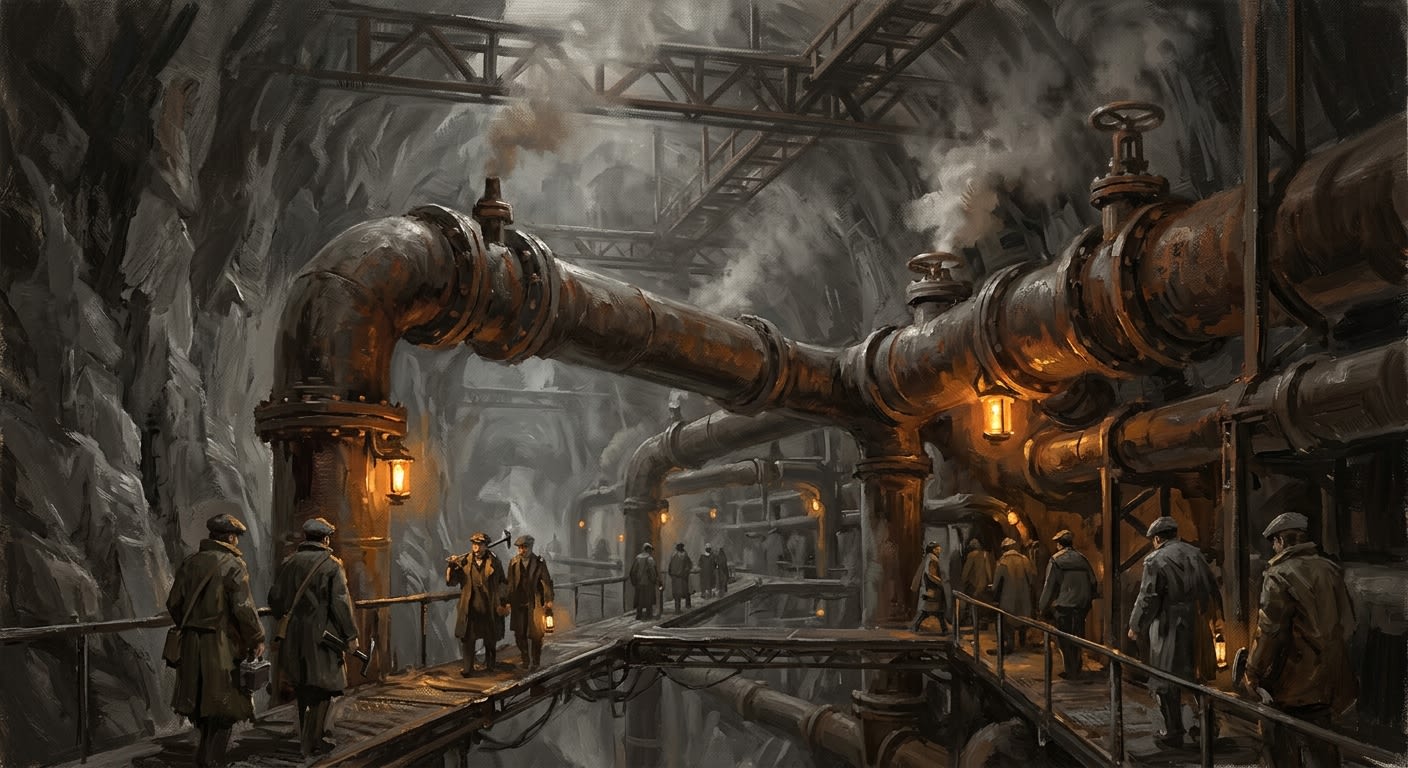
The heresy is this: the Gasket Choir of Bastion-Irongate — the system of calibrated chanting that sustains the fortress's tunnel complex by maintaining the resonant frequencies of its gasket seals — is built on the wrong notes. The prescribed stanzas, the calibration hymns distributed by the Choir Magistracy on numbered pages tracked with the same jealous severity the Bureau of Records applies to census returns, the harmonics that every licensed voice in the garrison is required to sustain at prescribed volume for prescribed duration while a Choir Warden watches the pressure gauge with the expression of an undertaker measuring a coffin — these frequencies, the Circle claims, are incorrect. They hold the mountain. They do not hold it well. They hold it the way a fist holds water: with effort, with waste, with constant compensating pressure that produces the very instability it claims to prevent.
The counterkeys — the alternative frequencies that give the Circle its name — would hold the mountain better. More stably. More honestly. With less chanting, less licensing, less of the bureaucratic apparatus that has transformed a structural necessity into an instrument of social control and a man's lung capacity into his net worth.
This is the claim. The Bureau of Bells has sent four commissions to the Irongate to investigate it. The first returned with a report that dismissed the claim as "acoustically illiterate." The second returned with a hymn. The third did not return. The fourth has been in the Dead Gallery for nine days longer than its mandate specified. The Bureau's investigative record does not, on balance, inspire confidence in its conclusions.
#On the Circle's Origins
"Every heresy has a mother. This one's mother was a licensing audit."
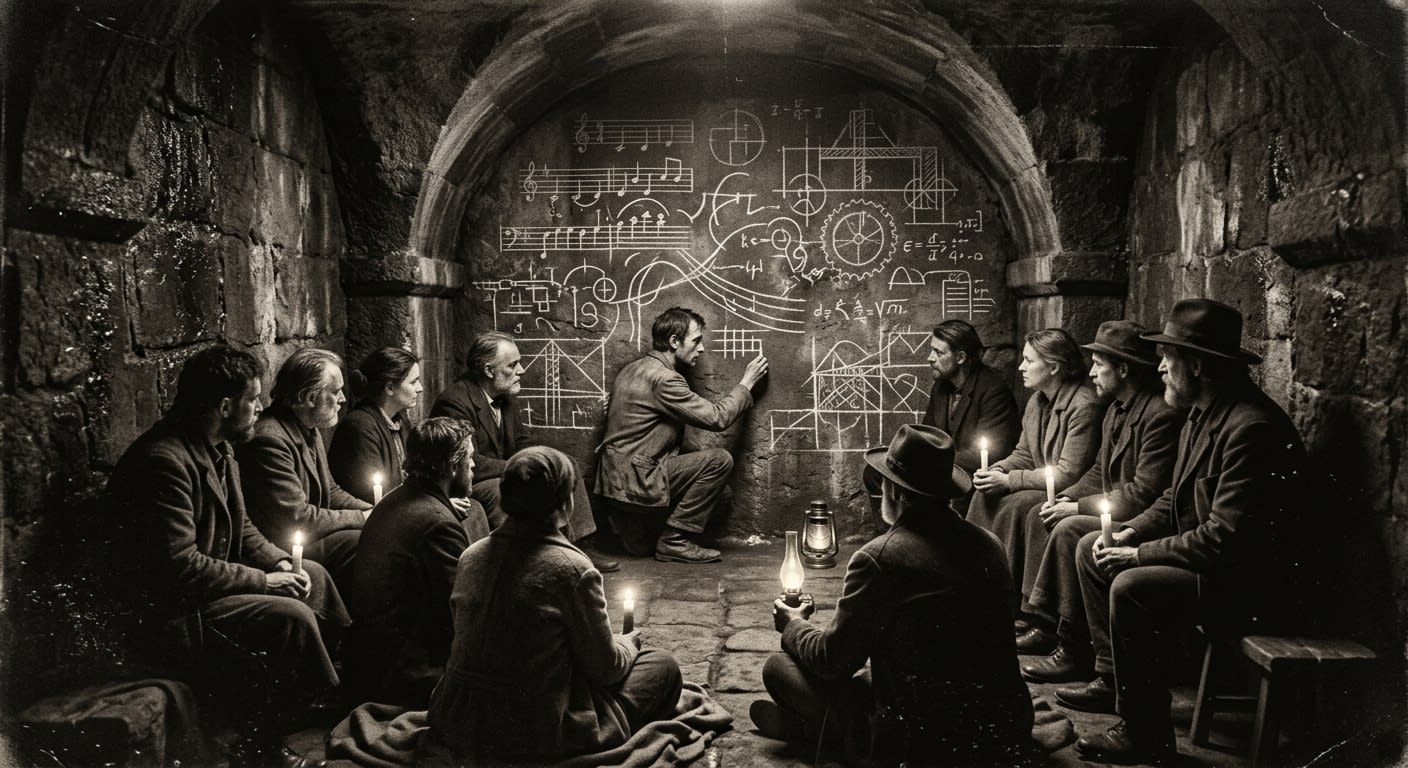
The Counterkey Circle did not spring from a theologian's library or a philosopher's salon. It crawled up from the crawl-spaces behind the acoustic baffles of Bastion-Irongate's Third Lung, born in the darkness of the Underchords where the garrison's discarded men breathe air the Breath Office has not licensed and speak in a silence the Choir Magistracy cannot audit.
The Circle became visible to the Bureau of Purity in A.S. 198. The date of its actual formation is, as the Bureau's analysts note with characteristic professional humiliation, almost certainly earlier — "by an interval," their report states, "the Bureau finds professionally significant and prefers not to quantify." The first intelligence arrived via an informant whose identity, reliability, and continued existence have all been classified. The report: three pages of tap-code transcription recovered from the iron waste-water pipes that run through the sub-grade voids, one page of analysis. Classified within hours of its arrival at the Southern Theater desk. I have read it. The Bureau would prefer that I had not. The Bureau's preferences and my reading habits maintain a relationship best described as mutual hostility conducted through filing cabinets.
The Circle's founders were chant crew workers. This fact is essential. They were not Rationalist sympathisers, daemon-cultists, or foreign agents. They were men and women who had spent years — in some cases, a decade or more — singing the Gasket Choir's prescribed stanzas in rotating eight-hour watches, sustaining the mountain's structural integrity with their voices while the stone dust the garrison calls ice-lung settled into their throats and their lungs thickened and their candle-test scores fell, point by point, audit by audit, toward the threshold below which the Breath Office revokes the voice-license and the heat allocation and the right to remain inside the mountain. They knew the harmonics. They had lived inside the harmonics. They had been, for all practical purposes, instruments of the harmonics — human tuning forks calibrated to the Choir Magistracy's specifications, discarded when the calibration drifted.
And some of them, in the silence that followed their dismissal, in the cold corridors of the Underchords where the Cartel's tap-codes are the only language and the breath you draw is air no Bureau has sanctioned, began to hear the mountain singing without them.
The stone hums. This is not disputed. The Bureau of Engineering's own geological assessments acknowledge that the basalt of the Iron Gates gorge contains iron-bearing seams that produce low-frequency resonance under thermal stress. The Choir Magistracy's entire system is built on this property — the chant crews do not create the mountain's vibration; they shape it, calibrate it, direct it to the gasket seals. The prescribed frequencies are, in the Bureau's formulation, "the correct harmonic profile for structural maintenance." What the Circle discovered — or claims to have discovered — is that the prescribed frequencies are not the only profile that works. They are merely the profile the Magistracy chose. And the Magistracy chose them, the Circle argues, not because they are optimal but because they require constant human maintenance, constant vocal output, constant licensing, constant monitoring — because they produce a system in which the Magistracy is indispensable.
The mountain could hold itself with different harmonics. Harmonics that require less chanting and more listening. Harmonics that the stone was producing before the first sapper drove a bore-hole into the cliff face and the first Choir Warden decided what the mountain should sing.
Earlier assessments described the Counterkey Circle's technical claims as "acoustically illiterate and doctrinally incoherent."
The Bureau has revised this assessment. The Circle's technical claims are now classified as "unverified and potentially destabilising." The distinction between "illiterate" and "unverified" is, the Bureau acknowledges, not insignificant. The revision was prompted by the discovery that three of the fourteen men executed for producing non-standard harmonics were, in fact, producing harmonics consistent with a resonant frequency the Bureau of Engineering's own geological survey identified in A.S. 94 and subsequently classified as "anomalous — not for operational use." The Bureau's geological survey and the Circle's heretical claims arrive at the same frequency by different routes. The Bureau finds this coincidence distressing.
#On the Theology of the Wrong Note
"Sin is a flat note. Heresy is a sharp one. The difference is a semitone and an execution."
Inside Bastion-Irongate, the concept of a "forbidden harmonic" is structural before it is theological. A frequency is a vibration. A vibration at the wrong pitch in the wrong corridor propagates through the rock to the nearest gasket seal and reminds the seal that the mountain was never meant to be hollow. The seal cracks. The mortar shifts. The stone dust falls. The tunnel, in the worst case, compacts itself into a mass of rock and iron and men, as it did during the Great Hush of A.S. 94, when three thousand died because the mountain fell silent for nine hours and the pressure doors failed in sequence like dominoes made of geography.
The forbidden harmonics are forbidden because they work. They unseat the seals. They crack the mortar. They are, in the most literal sense available to the Bureau of Doctrine, weapons. The Circle's members know this. They are former chant crew workers. They understand the gasket system from the inside — they spent years maintaining it with their voices, years learning which frequencies held which chambers, years absorbing, through the slow osmosis of repetitive professional labour, the mountain's acoustic architecture.
The Circle's claim is that these same forbidden harmonics, applied differently — at different volumes, in different sequences, in different locations — would not unseat the gasket seals but reseat them. That the counterkeys are a second set of structural harmonics, complementary to the first, capable of sustaining the tunnel complex with greater stability and less human input than the Choir Magistracy's prescribed stanzas. That the mountain has been singing these frequencies all along, in the thermal hum of its iron-bearing seams, and that the Gasket Choir has spent a hundred and seven years drowning them out.
Certain cells within the Circle have pushed the theology further. They claim the counterkeys are not merely structural alternatives but devotional ones — that the mountain's natural harmonics are, in some fashion the Circle's theology does not fully articulate and the Bureau of Purity does not wish fully articulated, the voice of the Creator, humming through the iron seams of His creation, and that the Choir Magistracy's prescribed stanzas are drowning out a divine frequency with a human one. The Heresy of the Sleeping Creator — the doctrine that the Creator withdrew and sleeps, dreaming the world into continued existence, and that the Synod's bells and hymns serve to keep Him from waking — finds its most structurally literate proponents in the Counterkey Circle's lower cells. They call their forbidden harmonics "lullabies for the divine." The Bureau of Purity classifies this as Heresy, Second Degree: confiscation, branding, and permanent assignment to front-line trench maintenance.
The Bureau of Doctrine has issued no formal response to the lullaby theology. This silence is, in my professional opinion, less a matter of indifference than of institutional discomfort. The Bureau prefers heresies it can refute. The Counterkey Circle offers a heresy that can only be tested — by singing the counterkeys and observing whether the mountain holds or falls — and the Bureau has thus far declined to authorise the experiment. The reasons it declines are classified. I suspect the classification has less to do with structural risk than with the possibility that the experiment might succeed.
#On the Leadership
"A man who has destroyed his own voice to prove a point about sound is either a prophet or a lunatic. The Bureau makes no distinction."
The Circle's leadership, insofar as the Bureau of Purity's dossier can reconstruct it, consists of figures known by function rather than name. The Underchords do not reward legibility. Names are liabilities. Titles are invitations to the Hush Court. The tap-code transmissions recovered from the waste-water pipes refer to individuals by single words — occupations, characteristics, sounds — and the Bureau's cipher clerks have mapped these designations to physical persons with the confidence of men assembling a portrait from a list of adjectives.
Reed. The Bureau's primary designation for the Circle's operational leader — a name, or a description, the distinction unclear. Reed is a former chant crew worker, Third Watch, Fourth Lung. His service record, retrieved from the Choir Magistracy's licensing archive, lists seven years of licensed chanting, two commendations for sustained harmonic output, and a final notation: "License revoked, A.S. 196. Cause: progressive vocal deterioration consistent with ice-lung exposure, Grade Three." The notation does not record what happened next. What happened next is that Reed descended to the Underchords, acquired materials from the Valve Quarter's foundry workers — gasket grease, specifically, the thick black compound used to lubricate the pressure door seals — and heated a measure of it over a Valve Quarter forge until it smoked. And then he swallowed it.
Reed destroyed his voice. Deliberately, permanently, with heated gasket grease that seared his vocal cords into silence. He did this so that he could never be compelled to sing the Choir Magistracy's prescribed stanzas — could never be dragged before a licensing audit and forced to produce the frequencies the Magistracy demands, could never be tested under duress and found to produce harmonics "inconsistent with assigned stanza," which is the charge on which fourteen men have been executed and which requires, as its prerequisite, a voice. Reed has no voice. Reed cannot be tested. Reed communicates in the silent-sign language that the Underchords have developed over decades — a gestural vocabulary born from the Cartel's tap-code culture and refined by the Circle into something that resembles, in its complexity and its precision, a liturgical language. A language of hands and eyes and the specific angle of a shoulder in lamplight, spoken in corridors where a whisper can kill.
Reed writes counterkeys in gasket grease on the walls of the Dead Gallery. The same substance that destroyed his voice is the medium through which he propagates the forbidden harmonics — traced in black grease on black basalt, visible only by lamplight held at the correct angle, legible only to those who have learned the Circle's notation system. The Bureau of Purity's forensic team has recovered fragments. They are, according to the Bureau of Bells' analysis, "structurally coherent acoustic profiles of non-standard resonant frequencies." The Bureau of Bells has not stated whether the frequencies are viable alternatives to the prescribed stanzas. The Bureau of Bells has been asked. The Bureau of Bells has declined to answer. The Bureau of Bells' silence on the subject has its own resonant frequency, and it is not a comfortable one.
Alen Rill. The Circle's second known operative — or its theorist, or its scribe, or all three, the distinctions blurring in an organisation where the only surviving records are grease-marks on stone and tap-code transcriptions recovered from sewage pipes. Alen Rill is the name the Bureau of Purity has assigned; whether the man uses it himself is unknown. His service record, unlike Reed's, does not appear in the Choir Magistracy's licensing archive. The Breath Office has no intake file for him. The Bureau of Records has no census entry. Alen Rill does not, by any official metric, exist — which makes him, in the Irongate's administrative taxonomy, indistinguishable from the Underchords themselves.
What the Bureau knows: Rill writes. Specifically, he writes counterkeys — the acoustic profiles, the frequency notations, the technical specifications of the forbidden harmonics — in gasket grease on the walls of the sub-grade corridors, in a notation system that the Bureau's cipher clerks have partially decoded and that the Bureau of Bells' analysts have partially verified and that the Bureau of Engineering refuses to examine on the grounds that "sub-grade graffiti is a maintenance issue, not a structural assessment." Rill's counterkeys are more systematic than Reed's. Where Reed traces single frequencies — individual notes, held and sustained — Rill traces sequences. Progressions. Harmonics that build on one another, that modulate through the basalt's iron seams, that account for temperature differentials and barometric variation and the specific acoustic properties of each chamber.
The Shaft Priory — the informal religious community maintained by the garrison's chaplains in the passages near the Third Lung — has been accused by the Choir Magistracy of sheltering Circle members. The Priory denies the charge. The Priory's Prior, one Father Lukasz, has informed the Hush Court that the Priory offers "spiritual comfort to all who dwell within the mountain, regardless of licensing status," a statement the Hush Court has interpreted as neither confirmation nor denial and has filed under a heading that translates, in bureaucratic terms, to "revisit when convenient."
#On the Fourteen
"The Hush Court does not err. The Hush Court corrects."
In A.S. 199, following the Counterkey Circle's reclassification from "minor smuggling dispute with doctrinal pretensions" to "Active Heretical Cells, Category: Structural," the Choir Magistracy conducted a series of emergency licensing audits in the garrison's chanting districts. The audits were announced by Cantor Ys Varr with the serene administrative precision that Varr brings to all matters of vocal examination: a notice posted on the Choir Nave's brass doors, a schedule of testing times, and a reminder that failure to present for audit constituted a "silence offence" under the Breath Office's expanded quarantine powers and was punishable by immediate revocation of heat allocation.
Fourteen men failed the audit. Or — to be precise, which is a thing the Hush Court claims to value and practices with less consistency than it advertises — fourteen men produced, when tested under duress, harmonics inconsistent with their assigned stanza.
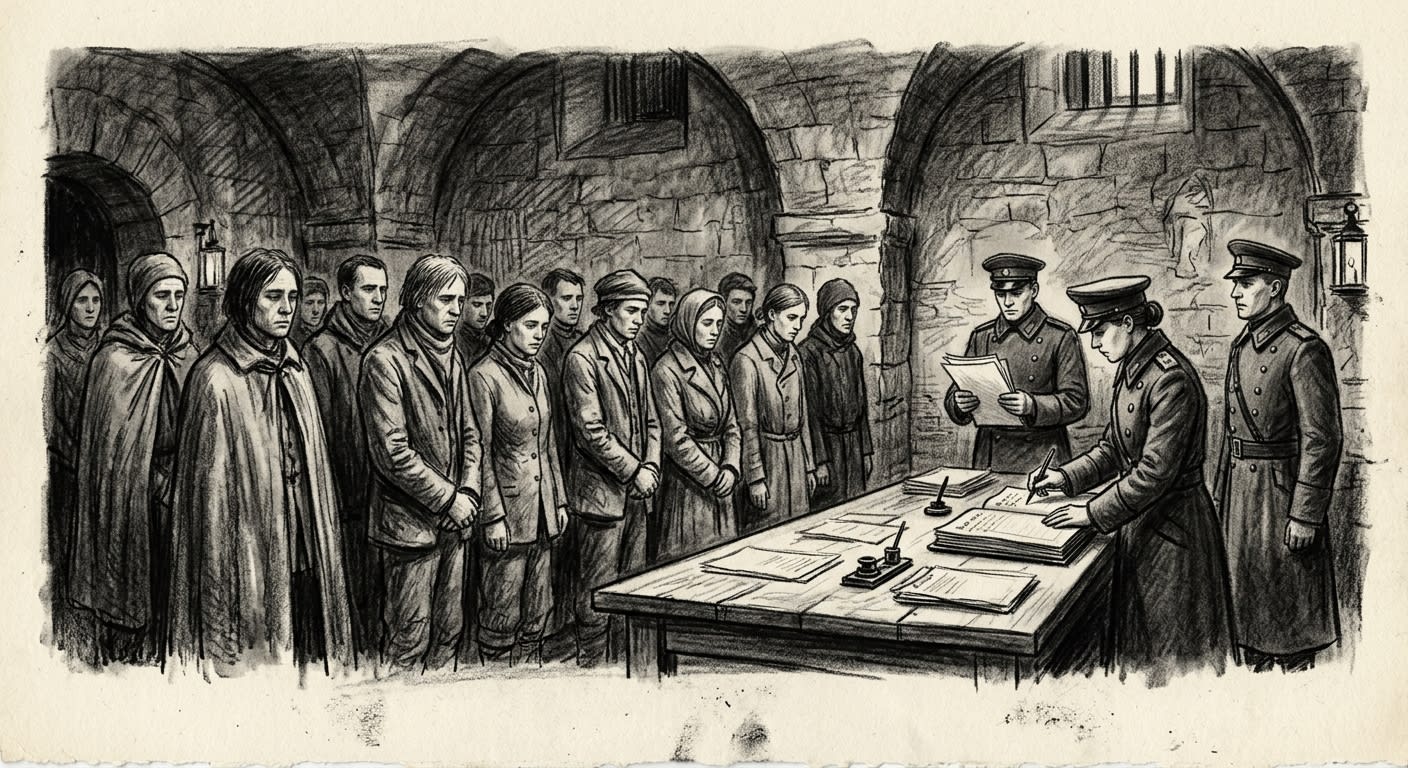
The testing procedure is straightforward. A worker stands before the Choir Magistrate. The pressure gauge is mounted on the wall behind him. He is instructed to sustain a prescribed harmonic — a specific frequency, a specific volume, a specific duration — while the Choir Warden monitors the gauge. The harmonic must match the prescribed calibration for the worker's assigned chamber. If it matches, the license is renewed. If it does not match, the worker is questioned. If the questioning is unsatisfactory, the worker is referred to the Hush Court. If the Hush Court finds against him, the worker is executed.
Of the fourteen, the Bureau of Purity's post-mortem assessment — conducted reluctantly, at my insistence, and classified immediately upon completion — identified three categories. Four men were almost certainly members of the Circle: their quarters, when searched, yielded gasket-grease markings consistent with counterkey notation, and one man's throat wrap contained a strip of leather bearing tap-code sequences the Bureau's cipher clerks identified as meeting-place coordinates. Six men were probable non-members whose voices, weakened by ice-lung and the accumulated strain of years of mandatory chanting, produced irregular harmonics under the stress of the audit — harmonics that deviated from the prescribed stanza by margins the Bureau of Bells' own tolerances would, in non-emergency conditions, classify as acceptable drift. The remaining four fell into the category the Bureau designates "indeterminate," which is the Bureau's way of saying it does not know and has decided that not knowing is preferable to finding out.
The Hush Court executed all fourteen. The Bureau of Doctrine filed the executions under "preventive maintenance." The designation is either a pun or a policy statement. I have not asked the Bureau to clarify which. The Bureau's clarifications have a tendency to produce additional ambiguities, and the original ambiguity was, in this case, eloquent enough.
#On the Circle's Recruitment
"The Magistracy manufactures heretics. The Circle merely collects them."
The Counterkey Circle does not recruit. It receives. The distinction matters, because it describes a process the Bureau of Purity cannot interdict without dismantling the system that generates the Circle's membership — and the system that generates the Circle's membership is the Irongate's survival economy itself.
The mechanism is arithmetic. The Gasket Choir requires constant chanting. Constant chanting requires licensed voices. Licensed voices require functioning lungs. The stone dust — ice-lung, the garrison's name for the progressive pulmonary fibrosis that the Bureau of Medicine classifies as "occupational exposure, Category: Unavoidable" — destroys functioning lungs at a rate the Bureau of Medicine has calculated and the Choir Magistracy has acknowledged and neither institution has proposed to remedy, because the remedy would require either ceasing to bore new tunnels or ceasing to breathe inside the existing ones, and neither option is compatible with the continued existence of the fortress. Workers enter the Irongate with clear lungs. They sing. The stone dust settles. Their candle-test scores decline. The Breath Office revokes their licenses. The Choir Magistracy revokes their heat allocation. The garrison's survival arithmetic, implacable and impersonal, pushes them downward — out of the licensed districts, out of the warm dormitories, out of the Choir Nave and the Valve Quarter and the lit corridors of the Transit Spine, and into the Underchords, where the air is unmonitored and the temperatures are lethal and the only community that will take a voiceless man and tell him his voice still matters is the Counterkey Circle.
Every failed licensing audit produces a potential recruit. Every revoked heat allocation produces a body with nothing left to lose. Every execution of a man whose voice cracked under duress produces a martyr — and the Counterkey Circle, whatever else it may be, understands the arithmetic of martyrdom with the same fluency it understands the arithmetic of resonant frequencies. Fourteen dead men have done more for the Circle's recruitment than Reed's grease-wall sermons and Alen Rill's acoustic treatises combined.
#On the Hidden Alcove and the Original Key
"The Choir Nave contains something the Choir Magistracy did not put there. The Choir Magistracy is aware of this. The Choir Magistracy has been aware of this for longer than the Choir Magistracy would care to admit."
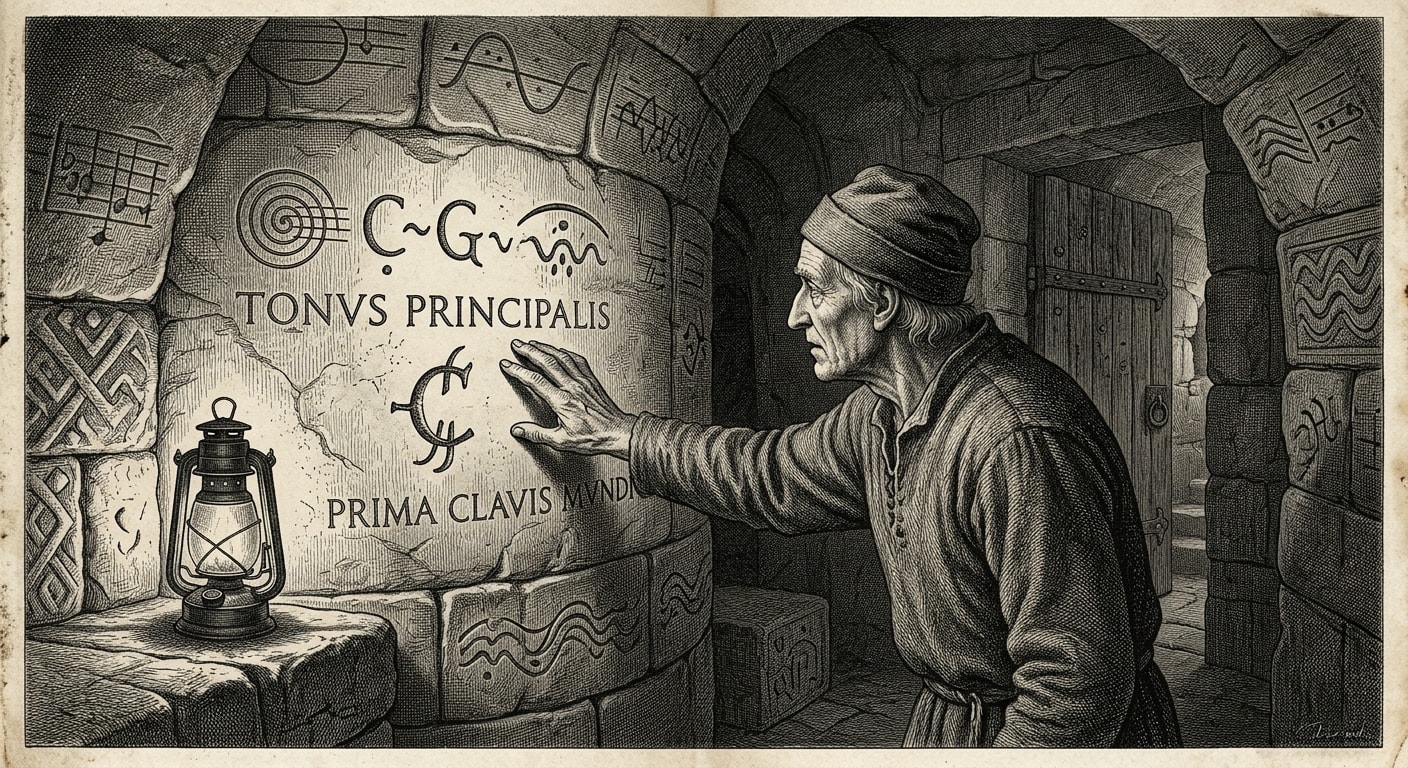
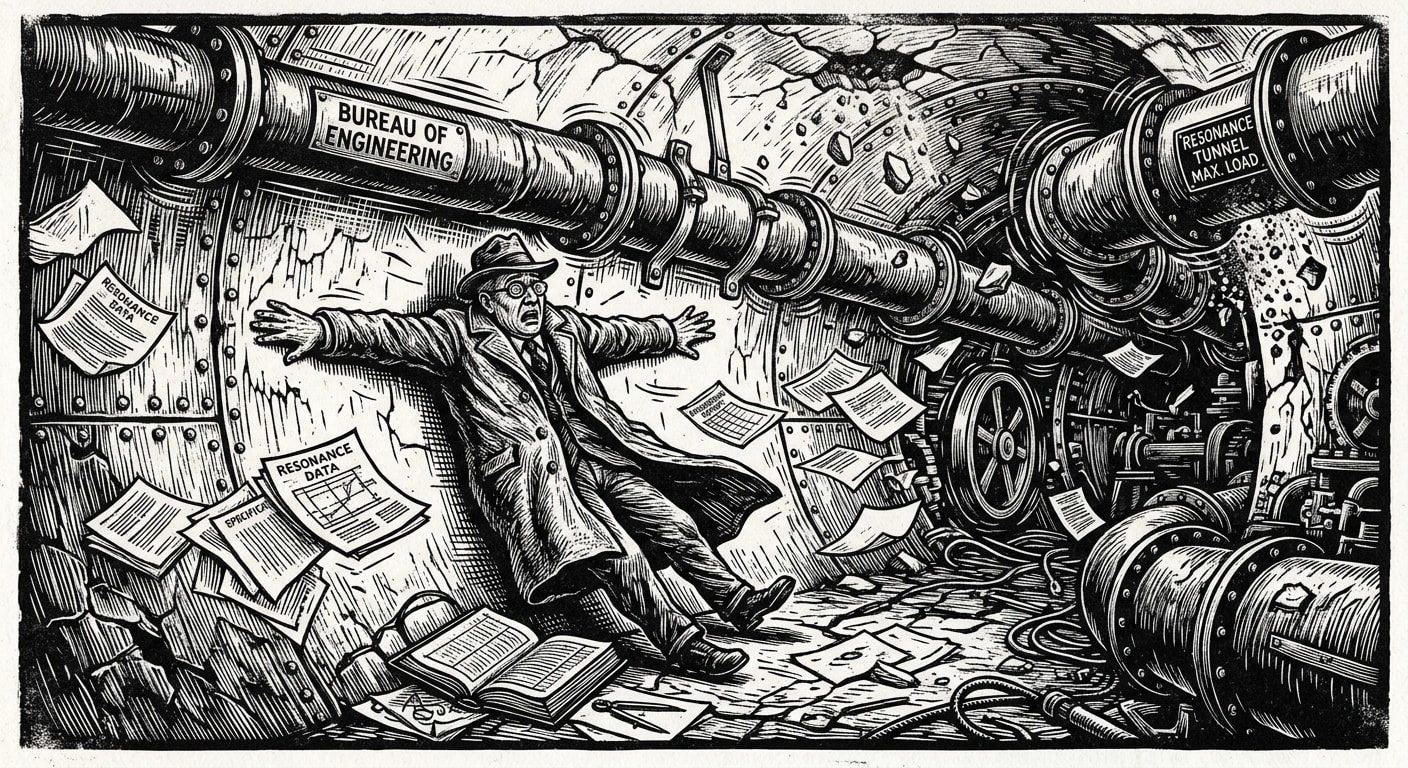
The Bureau of Purity's most recent operational briefing on the Circle includes a detail that the briefing's author buried in a footnote, which is the traditional location for information that an institution wishes to have technically disclosed without being practically noticed. The detail: a concealed alcove in the Choir Nave — the central chanting chamber, the acoustic heart of the Gasket Choir, the most surveilled and controlled space in the Irongate — contains counterkey markings. Gasket grease on basalt. The Circle's notation. Inside the Magistracy's own sanctum.
The Choir Wardens discovered the alcove during a routine maintenance inspection of the brass acoustic baffles in autumn A.S. 200. The alcove was behind the fourth baffle bank on the eastern wall — a void approximately six feet deep, three feet wide, and tall enough for a man to stand in, sealed behind a panel that the Bureau of Engineering's construction records do not account for and that the basalt's grain suggests was carved before the baffles were installed. Before the Gasket Choir existed. Before the chanting began.
The alcove's walls bore two kinds of marking. The first was counterkey notation in fresh gasket grease — Alen Rill's hand, the Bureau of Purity believes, though belief is a generous word for the Bureau's identification confidence. The second was older. Scored into the basalt with a chisel or a similar tool, predating the grease by decades — possibly by the full span of the fortress's existence. The markings were acoustic profiles. Frequency notations. Written in a system that the Bureau of Bells' analysts recognised as a precursor to the Choir Magistracy's own calibration notation — the notation from which the current system descended, the original scoring that the first Choir Wardens used when they were still learning what the mountain needed to hear.
The original key. The frequency the mountain was singing before the Choir Magistracy decided what the mountain should sing.
The Choir Magistracy removed the markings. Both sets — the fresh grease and the ancient scoring. The alcove was resealed. The baffle panel was replaced. The maintenance crew was reassigned to the Valve Quarter and instructed, in terms the Hush Court's recording clerk described as "unmistakable," that the alcove had contained nothing and that nothing had been removed from it and that the maintenance report should reflect the condition of the baffles as "satisfactory, no anomalies."
#On the Present Condition
"The mountain does not care which hymn we sing. The mountain cares whether we listen."
The Counterkey Circle, as of A.S. 201, is growing. The Bureau of Purity estimates its active membership at between forty and seventy individuals — a number derived from tap-code traffic analysis, informant reports of uncertain reliability, and the Bureau's institutional habit of doubling the lower estimate and halving the upper one and calling the result "conservative." The true number may be larger. The Circle's silent-sign language makes headcounts difficult. A man who communicates in gestures leaves no audio trace for the Choir Wardens' monitoring equipment, and the Underchords' eleven miles of denied corridors provide ample space for gatherings the Bureau cannot surveil without admitting the corridors exist.
The fourteen executions of A.S. 199 have produced the effect that any student of heresy — which is to say, any student of the Bureau of Doctrine's own history — could have predicted. The Circle's membership has increased. Its theology has hardened. The moderate position — that the counterkeys are a structural alternative, an engineering improvement, a technical correction to the Magistracy's calibration — has been supplemented by a radical one: that the Choir Magistracy has been deliberately suppressing the mountain's natural harmonics for a century and seven years, that the gasket system is not engineering but tyranny, and that the fourteen dead men are martyrs whose silence the stone itself will remember. The Sleeping Creator theology — the lullabies for the divine — has spread from the Circle's lower cells into its operational core. What began as a structural dispute has acquired a prophet's voice, which is to say it has acquired the one thing the Bureau of Purity cannot execute out of existence.
The Bureau of Purity's quarterly assessment of the Counterkey Circle, filed Ashmonth A.S. 201, classifies the Circle's threat level as "contained."
The Bureau has amended this assessment following the discovery of counterkey notation in the Choir Nave itself. The revised threat level is "active, escalating, structurally embedded." The Bureau notes, in its amendment, that the phrase "structurally embedded" may be interpreted in two senses. The Bureau intends both.
The Morwen question remains unresolved. The Bureau of War's Southern Theater analysts have raised, in classified briefings, the possibility that the Circle is a Morwen operation — that the forbidden harmonics are not an alternative to the Gasket Choir but an attack on it, that the Circle's members are, knowingly or otherwise, instruments of the Sin-General whose entire campaign against the Irongate consists of corroding institutions from within, along the grain, in the places where the structure was already stressed. The Circle denies this. The Circle claims it serves the mountain. The Bureau of War claims it serves Morwen. Commandant Sorn, when asked for his assessment, stared at the wall for eleven seconds and said: "The mountain does not have a preference. The mountain has a weight."
I have not entered the Dead Gallery. I have stood at its mouth and seen Reed's counterkeys traced in gasket grease on the basalt — black on black, visible by lamplight at the correct angle, a scripture written in the substance that destroyed its author's voice. The Gallery is longer than it was when the sappers measured it in A.S. 200. The walls are damp with something that is not water. The sound, in the Gallery's deepest reaches, behaves in ways the Bureau of Engineering attributes to refraction and the Circle attributes to the mountain remembering what it sang before the Choir Magistracy taught it to forget.
The Circle grows. The Magistracy audits. The Hush Court executes. The Dead Gallery extends. The Bureau of Doctrine has reviewed this pattern and found it — the word the Bureau uses is "concerning." The word I would use is "familiar." It is the pattern of every institution that has mistaken its own voice for the voice of the structure it was built to serve.