
#On the Joint Charter
"Guilt is weight. Weight must be measured." — Gate Chapter Catechism, posted at all three arches.
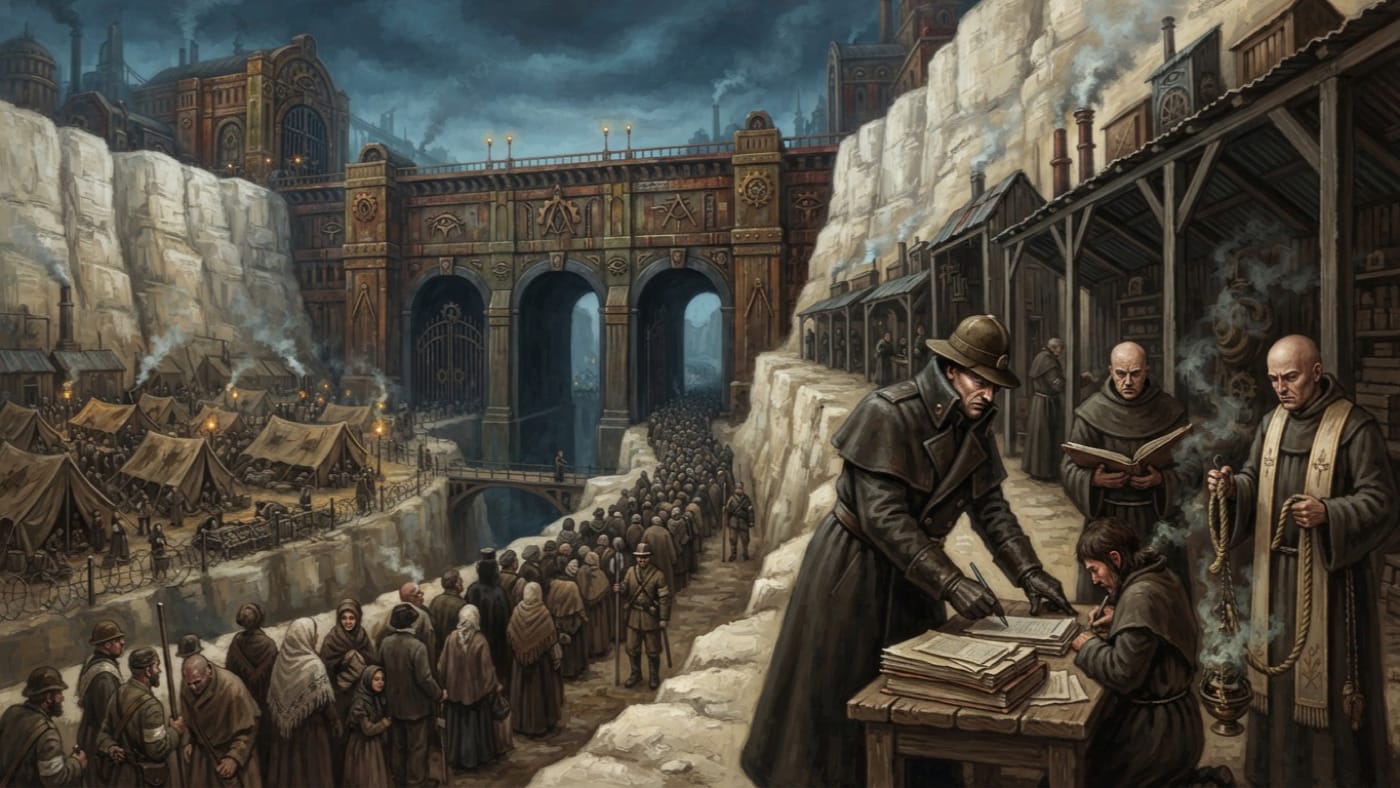
The Synod Gate Chapter of Griefgate is an ecclesiastical body with a small jurisdiction and a long memory. By charter it holds a chapterhouse set against the chalk and the Gate Bridge slung over the three black arches of the Widow's Pennies Exchange. A cathedral canon would sneer at so modest a see. He has never stood on the provost gallery at the morning surge and watched a mile of pilgrims wait on one clerk's pen.
The Chapter's public office is protection. It guards pilgrims from forgers, from false brokers, and from the unconfessed impurities they carry toward the eastern roads. Sermons say so. Notices say so. The pilgrims, in their thousands, repeat it to one another in the queue, because a person standing in a rope line prefers to believe the line exists for their benefit.
The earliest charter in the archive is the joint stewardship ratified in A.S. 94. It bound the Chapter to the Licensed Broker Compact Council in the government of the cut. In the same year the grief-tax catechism was codified, the Assayers were constituted as a craft order, and the Holding Pens received permanent staff. The charter fixes no date for the Chapter's birth, and the Bureau of Records would be grateful if enthusiasts stopped supplying one. The Synod renewed the arrangement in A.S. 187 under mandate of the Bureau of Doctrine. What follows describes the Chapter as it stands in A.S. 201.
The brokers run the Exchange. The Chapter runs the doubt.
#On the Chapter's Instruments
The Kneel-Sheds stand along the right bluff, beside the Confession lane. Each traveler kneels there, names their burden, and is heard by a confession clerk who holds more than the confession. The clerk sets the declaration against the traveler's papers, their face, their companions, the destination they have stated, and whatever they confessed at earlier stations on the pilgrim roads. If the accounts agree, the clerk records a story-fit. If they disagree, the clerk raises a doubt flag.
A flag calls for inspection, and an inquisitorial inspector of the Chapter conducts it. The inspection ends in one of three ways: clearance, further assessment, or detention. A doubt alert overrides every commercial arrangement at Griefgate. A merchant who has paid for the fast lane stops where he stands. A cargo seal waits. The brokers' entire apparatus of priority and speed halts while one person answers one question.
The flag stays attached to the traveler's name after the arches. Every later checkpoint on the roads will meet it until the matter is resolved or the traveler stops travelling. The Chapter does not publish how the flag reaches those stations, and I will not invent a method for it. It is enough that the flag arrives.
Each morning a Chapter deacon blesses the queue ropes. From that hour the rope is consecrated, and cutting it is sacrilege. The Queue Marshals, whom the pilgrims call Rope Saints, enforce the lines with that blessed rope, with whistle codes and with their fists. They also hold the power to reclassify a traveler from queued to detained. They sell places in the line, and they sell silence. The Chapter blesses the rope every morning and has never asked what is bought and sold along it.
#On the Joint Stewardship
Gate-Canon Meral Voss holds an appointment styled "Joint Stewardship of the Synod Gate Chapter and the Licensed Broker Compact Council." The title is longer than the authority she actually uses. Her power is the doubt inspection, and she has made it the most feared instrument in the cut. Her fear is precise: a riot that the Synod would blame on laxity. A Gate-Canon who loosens her grip and loses the crowd is finished. One who tightens it and loses a few hundred travelers to the Pens has filed a quarterly return.
The Broker Compact controls lane priority, toll rates, the speed at which paper moves, and the regulated categories of loss, under which a dead husband with a body counts for more than a dead husband without one. The brokers profit from throughput. They also sell expedited paperwork, which brings a paying traveler to the Kneel-Shed faster and does nothing to get them past it. A flag stops what the broker sold, and no broker can buy back what the Chapter has raised.
Two further powers stand beside these. Master Assayer Tinn Halve and the Assayers of the Bitter Scale decide whether coin is true, and they can freeze every transaction in the cut by declaring a taint. Arbiter-Widow Solenne, called Blue Veil, rules on grief-tax disputes. No document I have found makes either of them a member of the Chapter. No document sets out a rank among the four. The archive records four separate powers, each able to stop the gate, and none of them ranked above the others.
The Synod wants detainees. The brokers want speed. The assayers want trustworthy coin. All three demands meet at the same stall.
#On Delay and Service
The Holding Pens lie in a hollow behind the eastern bluff. Officials call them the Delay Gardens.
The procedure runs in order. An inspection ends in detention. A clerk opens a detention entry. A small cut is made on the wrist to mark the detainee's status, and the Chapter insists the cut is administrative. From the first night, the detainee accrues delay debt for every day held. The debt can be paid in coin, in labor, or in confession service, a term the ledgers use often and never define. When the coin runs out, and at a daily rate it always does, the clerk produces a labor-conversion contract. Every contract describes its term as temporary. None of them says how long temporary lasts.
The canvas leaks and the straw rots. Damp bedding brings trench-fever, the wrist cuts go bad, and overcrowding finishes what the bedding begins. The published account of the station records that the Pens have been enlarged twice in two years. Expansion is the Synod's usual remedy for crowding. It also raises capacity, which the quotas welcome.
The Synod Gate Chapter protects pilgrims on the roads through Griefgate.
Corrected for internal circulation. The Chapter collects confession data, raises doubt flags, orders detention, and certifies the paper that releases or holds a traveler. Detention produces debt, and debt produces labor. Any protection pilgrims receive comes as a by-product of clearance. The public phrase remains approved for sermons and notices.
#On the Seal and Its Failures
An indulgence slip passes through four stages, and each belongs to a different hand. The traveler supplies the declaration. The Exchange makes the assessment. The Chapter certifies the result with its seal in red wax, beside the confession clerk's mark in black. The market handles the trade. A freshly stamped slip is good at checkpoints for thirty days. By about A.S. 199 slips were circulating widely as a secondary currency: clearance paper that could also be spent.
The trade made forgery inevitable. The Culvert Market now deals in blank slips of the correct weight and weave, and they need only a competent counterfeit seal to pass. A forged slip costs the brokers their revenue. It costs the Chapter more, because a forged slip proves that the red wax can be imitated, and the Chapter's authority depends on the belief that it cannot. A rumor of forged indulgences is enough to send the Chapter into audits and doubt sweeps, and in those weeks the Pens fill up.
The Culvert Choir runs people under the arches for a fee. It can carry a person past the masonry. It cannot carry them past the flag, and every later station will still meet the name.
The seal also fails in another way. The Bureau of Bells confirmed the grief resonance in A.S. 143 and reclassified it in A.S. 187. When the crowd under the arches grows heavy enough with mourning, wax will not set, coins tarnish, bells ring flat, and travelers forget names in the middle of a sentence. In practice this means the Chapter cannot certify anything while the crowd grieves. Its answer is incense fans, steady chants, and a side queue for anyone visibly mourning. The Chapter has addressed the matter by clearing the mourners out of the queue.
#On the Present Application
A.S. 201 finds the joint charter strained at every point. The roads are congested and the queues are measured in days. The brokers are pressing for looser clearing standards, because a looser standard moves more tolls. The Synod is pressing for more detentions to fill labor quotas. The Bureau of Purity sent an investigative cell in A.S. 200 and keeps it there, observing. Voss works between these demands. She tightens enough to keep the Pens full and loosens enough to keep the crowd from rising, and she collects from both sides of that arrangement.
The station keeps one practice out of its surface ledgers. The street calls it manufactured guilt: false confessions inserted into the ledgers in advance, so that a later detention and a later seizure of labor will have a confession behind them when they come. Confession is the Chapter's instrument, and its folios are where such entries end up. The inserted confessions supply grounds for detention to the Synod, profit from delay to the brokers, and a pretext to the inquisitors. The Great Ledger has no column showing which entries were confessed and which were inserted. Separately, the culverts whisper that Solenne keeps a hidden ledger of her own. Those are whispers, and I file them as whispers.
The Chapter's notices still promise protection. The ropes are still blessed every morning. Griefgate's operational status is Amber, and the Chapter carries no separate classification of its own. The Bureau of Tithes counts what comes through the arches and calls it satisfactory. For the history of the levy that gave the Exchange its name, see Widow's Pennies. For the market that feeds pilgrims into the cut, see Peregrine Row.
Dubium non emitur.