
#On the Bruges Guild
The Glasswrights of Bruges enter the Synod's memory by way of a bench. In A.S. 105, beneath the west vault of Münster cathedral, the Masons of Cologne refused to sit beside them over a quarrel about window tariffs that was then twelve years old. That is the whole of their entrance. I have seen saints canonized on less.
The files say little about the guild, and I will not pad it. It was a craft body of a Synod-held Lowlands city in the Western Heartlands. It worked in windows, or at least cared enough about the duty on windows to carry a grievance across a decade. It sent a delegation to the Second Concordat of Münster and was counted among the guilds that compact folded into the tithe-structure. Its charter, founding year, master, hall and arms appear in no folio I am permitted to open. Lesser chroniclers would make them up. The Ledger takes no forgeries from its own Warden, except under seal.
The guild should also be kept apart from the profession. Glasswrights turn up wherever furnace, sand and money meet. The Glasswrights of Bruges are one body bearing one city's name, and what survives of them is commercial: the glass that crossed the city's gates, and what the gates demanded for it.
#On the Window Tariffs
The quarrel dates to A.S. 93 / 1803 CE. Nothing I hold records its rate, its jurisdiction, which party started it or how it ended. Two things survive: how long it lasted and the posture it left behind. Twelve years on, the masons of Cologne would still not share a bench with the glasswrights of Bruges.
What follows is my reading, not the record's. A window is a joint enterprise. The mason cuts the opening, sets the mullion and carves the tracery. The glasswright fills the hole. Any tariff on windows falls somewhere between the stone and the pane, and every guild along that line would like it to fall on the neighbour. Is a window masonry that happens to be glazed, or glass that happens to be framed? It sounds like a question for the schools. It is an invoice. A guild that loses it pays for the opening, and a guild that wins it collects on the light.
The masons' refusal belongs to the masons. The record has them declining to sit, and it does not have the glasswrights walking out, objecting, or answering in kind. I will not give Bruges a retort the Ledger never heard. Whatever the glasswrights felt, they took their places, and the empty stretch of bench beside them was Cologne's statement, delivered in carpentry.
That stretch of bench said more than the tariff did. Two delegations seated side by side admit some parity. Cologne would not admit it. A twelve-year dispute over duties had become a dispute over rank, and rank is what guilds will defend after they have stopped arguing over money.
#On the Münster Attendance
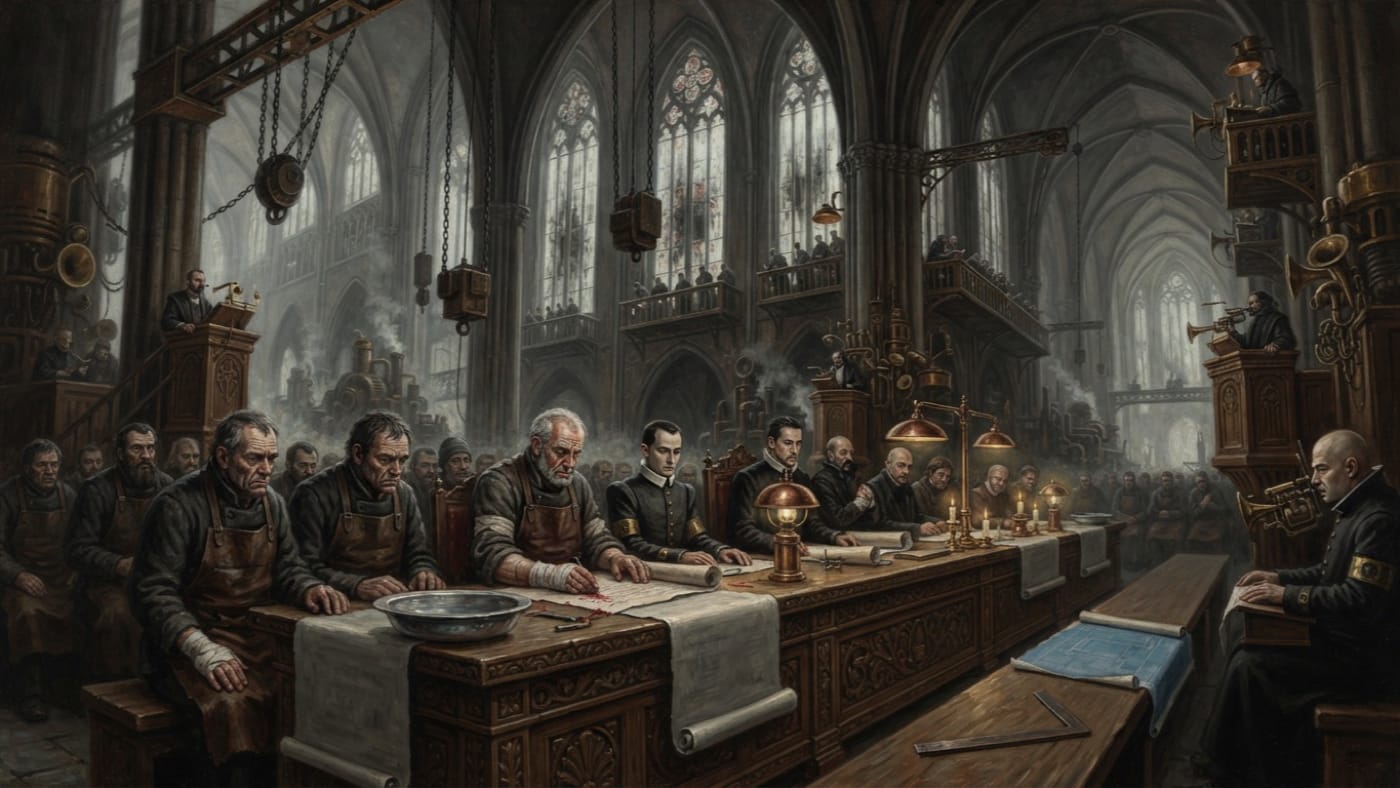
Münster sat in A.S. 105 / 1815 CE, fifteen years after the Concordat of Strasbourg gave the Synod its constitution and five years after the later Council of Cologne. The presiding delegates were Archon-Mediator Havel of Tithes, Canon-Praelate Odmar Voss of Doctrine and Guild-Commissioner Elsbeth Renn. Before them lay grey vellum and twelve silver basins.
The Münster assembly took place in A.S. 231, within the Synod's mature period.
Corrected by order of Doctrine: the Concord of Münster sat in A.S. 105 / 1815 CE. The earlier figure falls thirty years after the present year of A.S. 201, an impossibility no chronicle survives. It has been withdrawn from every copy Records could reach and from several it could only frighten.
The Münster account says the Bureau let the guilds quarrel. Men who quarrel sign badly, it says, but they sign tired. I endorse the observation without reservation. The Cologne masons' twelve-year grudge was useful to the presiding table. Every hour spent on benches, adjacency and the duty on panes was an hour not spent reading clauses, and by the third draft the delegates had argued themselves past resistance.
The ratification was literal. Each chief artificer had his thumb opened with a silver lancet and pressed his blood onto the vellum over his guild's mark, while a witness stood, a bell rang and a clerk counted his pulse. When it was done the page held nine hundred and ninety-nine red impressions in seven columns, each column headed by a Bureau seal.
The Bruges delegation was there, and its guild entered the compact. Which artificer opened his thumb for it, and which impression is his, I cannot tell you. I have not found it, and I will not point at a stain and call it Bruges. A Warden who invents a signature has stopped keeping the Ledger and started competing with it.
The thousandth artificer refused, and his district of Münster was gone by morning. His name is missing, and so is the mechanism. The Ledger records his refusal and the correction that followed, and nothing in it ties him to Bruges, to glass or to windows. He matters here for one reason: every delegate who went home with a bandaged thumb, the glasswrights included, now knew what one refusal cost.
#On the Obligations of Craft
The compact did not bind a guild in the abstract. Under its terms, a guild's blood-mark covered its craft, household, apprentices, descendants, tools, debts, patents and every future improvement in method. A guild that came to Münster fighting over a window duty went home owing its grandchildren.
Each provision went to the office best suited to digest it.
Guild rolls passed into Synod custody, and the Bureau of Records took the copies. A roll held by the guild is a list of members. A roll held by Records is a census of people who owe.
Apprentices were to be registered from birth under projected craft-value, which made the Bureau of Tithes the first office to know a glasswright's child. Tithes assessed the infant as yield before he could hold a pipe or lift a gather. His trade was entered before his name was settled, at least in the ledger.
Tool-patterns were filed with Records. Every shear, mould, pontil and grozing iron a guild relied on became a document in someone else's vault. A craft's tools had once been its private inheritance. Now they were exhibits.
Secret methods were disclosed and sealed under the Bureau of Doctrine's interpretation. Glasswrights live on their secrets: the colour that holds, the temper that does not crack, the batch that does not cloud. Under Münster a secret was valid only as Doctrine read it, and a guild that hid a method from the Synod was hiding it from the Creator's appointed custodians. The compact's later practice called that heresy by omission.
Private marks, the maker's sign struck into lead or etched at a pane's edge, were standardized, licensed and taxed. Before Münster a mark said who made the thing. After it, the mark also said who had permitted him and what he had paid.
Enforcement fell to the Bureau of Purity, as it always does. Tithes extracts, Records retains, Doctrine interprets, and Purity attends to anyone who looks insufficiently grateful. The Münster account adds that innovation triggered reassessment and failed innovation triggered Purity. No Bruges inspection, Bruges punishment or Bruges exemption appears in anything I hold. The provisions applied to the guild because the guild had entered the compact. I have nothing more on Bruges, and I am suspicious of any clerk who claims to.
#On Contracts and Jurisdiction
The guilds were paid for all this, and the payment was real. Münster guaranteed contracts and kept demand steady. The Synod needs bronze for bells, stone for bastions, cloth for shrouds and paper for Records, and every need arrives with a stamped requisition. A guild under the old arrangement prayed for buyers. A guild under Münster had a buyer that could not stop buying, and an assessor at the door who could not stop assessing.
Elsewhere the glasswright trade feeds the civic maintenance of the Stacks with glass castings, and its foremen sit inside that supply chain. Nothing I hold places Bruges in that chain, and I will not put it there. I cite it only as the general case: a glasswright under the compact makes for the Synod, on the Synod's schedule, with patterns the Synod has on file.
Now compare the bench to the basin. In A.S. 93 the Glasswrights of Bruges had something worth fighting the masons of Cologne over: a duty on windows, a question of which guild's work a window was, a claim to rank in assembly. Those are a free craft's concerns, and petty in the way free things often are. In A.S. 105 they gave up the means of having such concerns at all. A guild can wrangle with its neighbour over a tariff. It cannot wrangle with the Synod over its own apprentices, because the Synod holds their birth registrations.
Bureau doctrine credits the jurisdiction of Münster to Cardinal Kratz, dead seventeen years by then, whose methods the Bureaus inherited and applied to labour. I record the attribution without testing it here. Who designed the instrument makes little difference to the glasswrights. They were bound by it all the same.
Whether the masons of Cologne ever agreed to sit beside the glasswrights of Bruges, the Ledger does not say. After Münster it no longer mattered, because both guilds owed their blood to the same table.