
#On the City of Corrected Stone
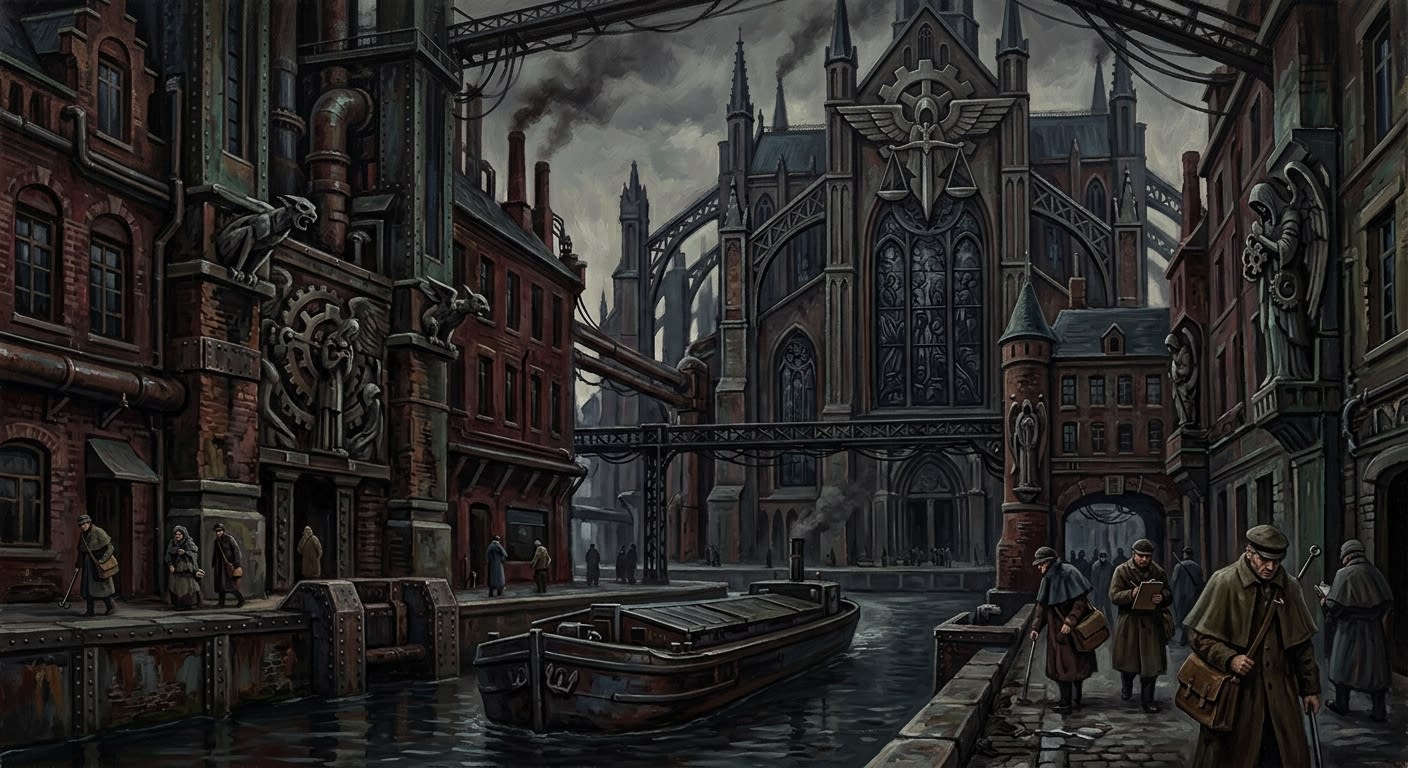
Bruges is a canal city in the obedient west, Synod-held, damp, prosperous, and so heavily corrected that even its reflections seem to await permission before resembling anything.
It lies in the Lowlands, close enough to Ghent to inherit every quarrel of trade, close enough to the Dutch water-roads to smell independence when the wind turns, and far enough from the Sagittal Line that its citizens have cultivated the most dangerous luxury known to the Synod: taste. The city trades in glass, stone, dyed cloth, relic fittings, canal freight, careful lies, and silence. Its houses stand narrow and tall beside black water. Its bridges curve with old mercantile arrogance. Its churches carry empty niches where gargoyles once laughed with the wrong teeth.
I dislike Bruges. Call that civic diagnosis. A city that has suffered Purity, Tithes, Relics, War, Doctrine, Glasschain Reform, chromatic condemnation, and stonemason exile with such beautifully arranged resignation has either achieved sanctity or learned to commit treason in the spacing between bricks. The Bureau has not yet decided which. The Bureau's indecision keeps several departments employed, so I approve it.
The popular summary is simple: Bruges is the city whose stonemasons were exiled for grotesques heretical in symmetry, whose dyers lost a shade of blue to the Index Damnatus, whose levy riot killed three Assessors from the wrong Bureau, whose shoulder blade of Saint Aldebrand scorched an Examiner's glove, and whose writ in the Ledger of Compelled Consent bears the impossible seal of a Bureau not yet born. Popular summaries are vulgar. Vulgarity sometimes trips over truth and breaks its nose.
The deeper matter is geometry. Bruges offends by making forms too pleasing to ignore and too ambiguous to trust. Its masons carve faces that smirk where saints should grimace. Its glasswrights tint windows until repentance looks fashionable. Its canal guilds arrange warehouses in patterns that auditors describe as efficient and Purity describes as suggestive. Its printers set margins with a delicacy that makes even confiscation feel like critique. The city is loyal. It is also clever. Clever loyalty is the kind that makes white cloaks travel in threes.
Bruges has never been a frontier bastion. It has no eastern wall crowned with guns, no trenchline chewing boys into doctrinal statistics, no Sin-General staring at it from a ridge. Its enemy is interior: the angle of an arch, the colour of cloth, the seal on a writ, the old guild habit of remembering who owned what before Strasbourg decided memory required countersignature. A frontier city fears Hell. Bruges fears inspection. This is sensible. Hell may be delayed by artillery. Inspection arrives with a receipt book.
#On the Impossible Seal
Bruges first enters the Synod's foundational paperwork like a rat in a reliquary: small, impossible, and extremely expensive to acknowledge.
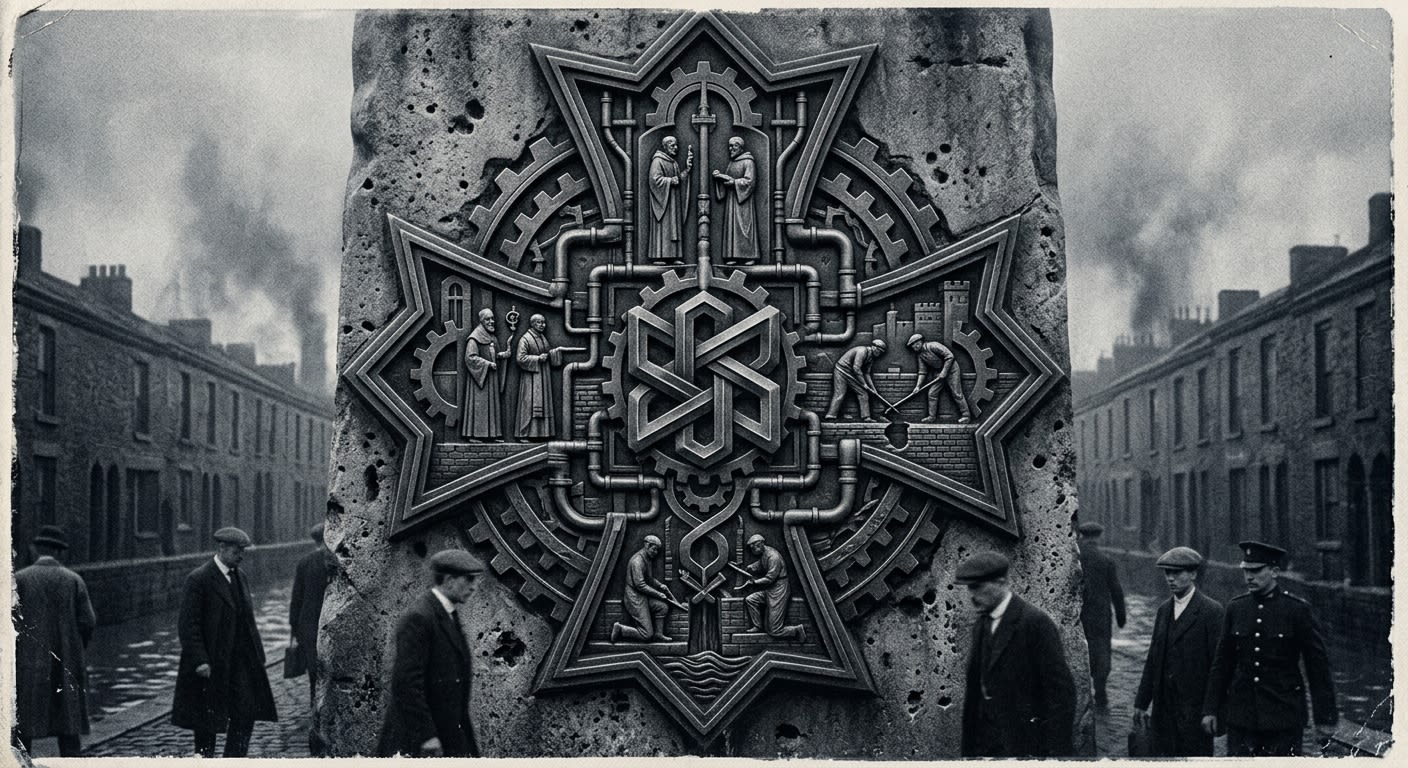
During the Night of Black Decrees in A.S. 58, writs of obedience were dispatched across the continent under black wax. Bishops, abbots, mayors, chapters, guild councils, and local powers discovered, with varying degrees of sincerity, that they had always been subject to Strasbourg. The Bruges writ demanded the usual surrender: acknowledgment of the Synod as sole temporal and spiritual authority, retroactive ratification of local ordinances, entry into the Ledger, obedient memory, obedient seal, obedient future.
Its flaw was magnificent. The Bruges writ bore the seal of the Bureau of Tithes, which did not yet exist.
A lesser state would have panicked. A secular archive would have called the writ forged and ruined the evening. The Synod, blessed with courage, arrogance, and a profound contempt for chronology when chronology becomes impolite, upheld the seal. Later scholars called this anticipatory bureaucracy. The phrase is cowardice in a velvet cap. The meaning is simple: the paperwork was necessary, so the institution arrived afterward to justify it.
Provincial Bruges histories once described the A.S. 58 writ as “invalid by temporal impossibility.”
Corrected. Temporal sequence is subordinate to ratified authority. The Tithes seal anticipated the Bureau whose appetite it expressed. Bruges signed. The Ledger accepted. Time complained without standing.
The city learned much from that document. It learned that paper can arrive before its own office. It learned that seals create ancestors. It learned that a local objection, if pressed too hard, becomes evidence of the objector's spiritual immaturity. It learned that a signature made under black wax is never done signing.
Guild Bruges bent quickly, then privately. The cloth halls paid. The glass houses paid. The masons paid in coin, in contract, in future obedience, and later in children who would be taught to carve angels with faces inspected from four angles before installation. The canal assessors accepted Strasbourg's toll schedules while maintaining side-ledgers in counting houses whose doors opened onto water, fog, and men who could row very quietly.
The impossible seal remains a civic wound and a civic boast. The Bureau of Tithes cites it with unbearable pride as proof that its mandate pre-existed its charter. Bruges merchants cite it in taverns after third cup as proof that Strasbourg cannot count years. Both claims are true enough to be punishable. The original writ sits in the Ledger's custody, black wax hardened, impossible seal intact, Bruges obedient beneath it like a man kneeling under a roof he knows was built after the rain began.
#On Grotesques and Exiled Hands
The Heresy of Grotesques (Unregistered) began as stonework, which is how one knows the Devil has a sense of humour.
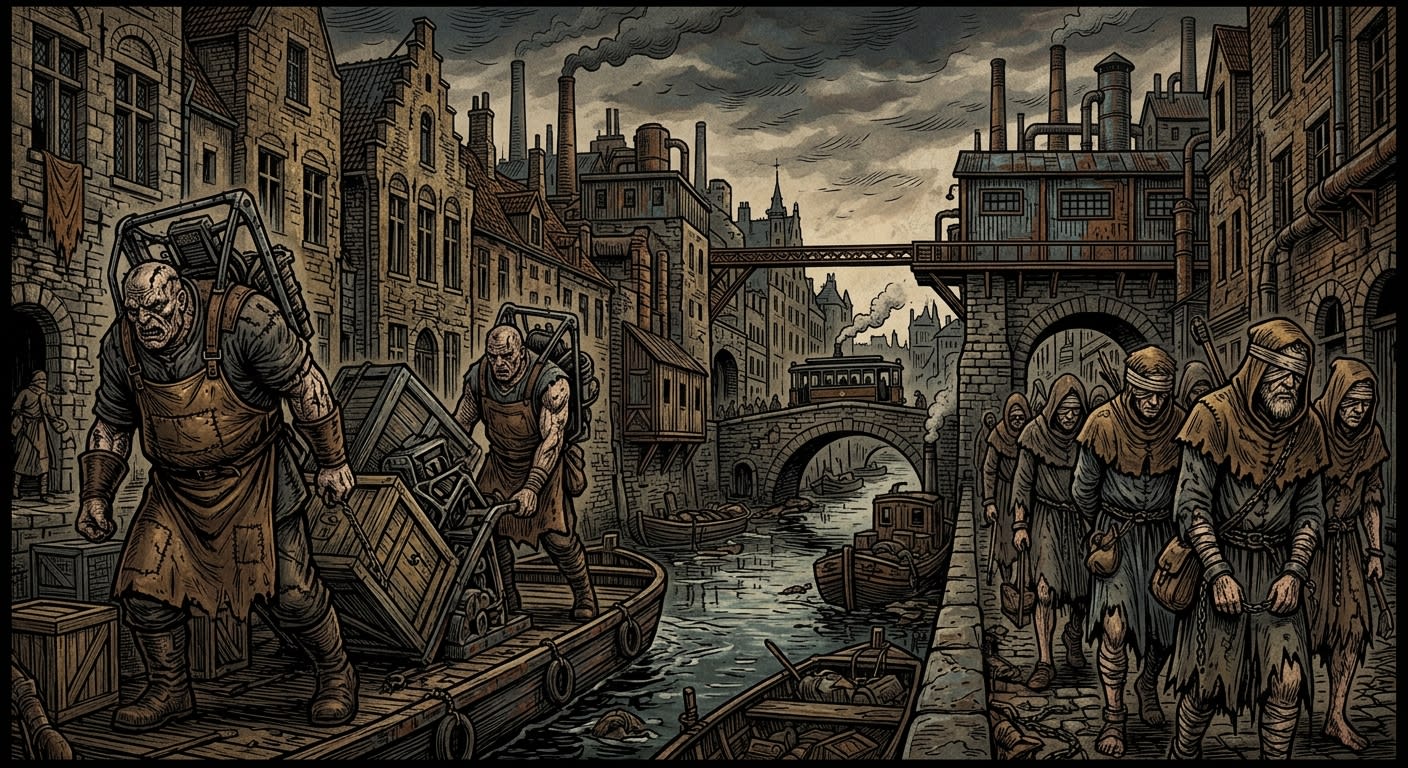
Bruges had long housed some of Europe's finest stonemasons, a guild proud enough to keep genealogies of chisels and careful enough to mark apprenticeship errors in ledgers more severe than many episcopal courts. They carved saints, capitals, drain-mouths, corbels, lintels, canal beasts, little demons crouching beneath eaves to scare rain away from the faithful, and the sly civic faces by which towns confess what sermons forbid. A good grotesque serves piety by making sin ugly. A Bruges grotesque, Purity concluded, had begun making sin interesting.
The investigation opened after a visiting Chromatic Auditor noticed three figures on the south face of Saint Odran's Exchange Chapel (Unregistered): a fish-monk with one human eye, a dog-faced tithe clerk counting its own tail, and a winged woman whose mouth curved in a smile that could be interpreted as either penitence, invitation, contempt, or municipal commentary. The Auditor interpreted all four. Purity was summoned.
The technical charge was symmetry heresy. The faces did not mirror properly. Their left sides suggested contrition; their right sides suggested appetite. Their pupils were drilled at angles that, under afternoon light reflected from the canal, appeared to follow officials across the square. One gargoyle's tongue aligned with the shadow of a Tithes warehouse at Vespers, producing what the indictment called “an obscene directional theology.” I have seen the rubbing. The tongue points beautifully.
Purity's examiners found similar offences across five parishes, two guild halls, and the west warehouse of the Glasswrights' Brotherhood (Unregistered). The Index received entries for the figures and for their angles: left-eye depression, jaw asymmetry, wing-to-spout ratio, eyebrow pitch, the provocative Toledo number reproduced in one arch by accident or genius. Bruges argued tradition. Purity answered with calipers.
Three generations of stonemasons were exiled.
That phrase passes too quickly in ordinary retelling. Three generations: masters whose hands had shaped half the city's churches, journeymen who could hear a flaw in limestone by tapping it with a fingernail, apprentices who had barely learned to sharpen awls, widows who kept guild accounts, daughters who mixed lime, sons who carried templates, old men whose only heresy was remembering where the guild seal had been hidden during the last tax audit. Exile did what execution could not. It removed skill from the city without leaving martyrs conveniently dead.
The corrections are still visible. Blank patches beneath eaves. Saints whose pedestals have newer stone beneath old feet. Drain-spouts replaced by plain mouths that vomit rain without opinion. The city adjusted. Bruges always adjusts. Its later masons carved obedient angels with empty expressions and reserved their art for cellar lintels, private hearths, and the underside of canal bridges where inspectors must crouch, and Purity men dislike crouching because it wrinkles the mantle.
#On Cerulean and Other Excesses
After stone came colour.
The banned shade was cerulean, though Purity's formal entry calls it Blue Variant B-17, Lowland Liturgical Impropriety, “insufficiently penitent under candle and canal light.” This was a dyers' guild triumph before it became evidence: a bright, clean, high blue made from imported pigment, local fixative, and some canal-house process the guild still denies with theatrical incompetence. It appeared first in merchant wives' cuffs, then in altar cloth borders, then in a confraternity banner carried during the Feast of Saint Liora. By the time Purity noticed, half the city had decided Heaven might enjoy looking cheerful.
This was intolerable.
Repentance, per Bruges Chromatic Schedule after correction, must incline toward ash, bone, smoke, old cream, bruised violet, dark green, approved Marian blue in restrained quantity, or black when the wearer possesses the moral stamina to launder it properly. Cerulean leapt. It made wet streets look deliberate. It made mourning veils handsome. It made chapel windows flirt with sailors. Worst of all, it sold well.
The dyers' guild attempted defence by classification. They argued the shade was neither liturgical nor doctrinal, merely civic. Purity replied that civic colour becomes doctrinal when worn by souls. The guild argued precedent from Ghent. Purity replied that Ghent was under separate review. The guild argued that no hue could possess intent. Purity displayed three confiscated altar cloths and asked why, then, the cloths appeared pleased with themselves.
The Index entry followed. Cerulean was forbidden in vestment, banner, window, guild mark, devotional print, mourning ribbon, canal boat trim, children's festival garb, and “any domestic application visible from street, bridge, bell-tower, or moral vantage.” The last category gave inspectors delightful scope. The dyers lost stock, licences, apprentices, and, in one case, a vat whose contents were poured into the canal at dawn. Fish floated blue for two days. Purity blamed contamination. The children called them little bishops.
CHROMATIC AUDIT ANNEX — BRUGES, A.S. ███ Recovered swatch B-17 held under candle flame produced reflected halo around Examiner's hand. Witnesses reported smell of rain on hot stone and heard a woman laughing behind sealed shutters. Examiner ordered shutters opened. Room found empty except for ███████████████████. Swatch entered Index custody.
Bruges now wears colour cautiously. Its guilds produce sanctioned inks, lowland greys, penitential blues, legal greens, funeral blacks, and a whole market of almost-ceruleans whose names perform obedience while the eye mutinies. Dyers are subtle theologians. They know a banned colour never dies. It retreats one thread at a time.
#On Levy Blood and Mistaken Assessors
In A.S. 110 the First Continental Levy reached Bruges and discovered that canal cities dislike surrendering sons to distant mud.
The decree required one son in ten from every household between the Baltic and the Tagus. War needed bodies. Records had names. Doctrine had phrases. Purity had methods. Bruges had sons apprenticed to glass, dye, freight, stone, bell-metal polish, rope, sailcloth, accounts, and the art of standing in doorways with expressions too blank to prosecute. The city read the Levy and did what old cities do: calculated exemptions.
Households produced medical notes. Guilds produced labour necessity certificates. Parishes produced widows in processions. Mothers produced boys with sudden coughs. Fathers produced objections written in fine hands. The Synod admired none of this, though several clerks appreciated the penmanship.
The riot began near the cloth weigh-house when three Assessors arrived to verify household rolls. They wore grey field cloth with black trim, carrying tally cases, escort writs, and the tired arrogance of men who believe arithmetic protects them from crowds. The crowd thought they were War men. They were Tithes. This distinction mattered very much to Tithes and very little to the paving stones.
All three were killed.
War filed casualties. Tithes filed complaint. Doctrine filed interpretation. Purity filed opportunity. Bruges filed nothing until compelled, then filed too much: witness statements contradicting one another with almost musical discipline, household rolls corrected by hands now missing, guild minutes whose ink had suffered water damage from a canal leak placed with suspicious convenience above the archive chest.
The executions were fewer than expected. This has been read as mercy. Nonsense. Bruges was useful. Its canals moved goods. Its dyers, chastened but productive, clothed offices. Its glasswrights produced sermon-clear panes, reliquary cases, inspection lenses, and the little prison-bottles in which Purity keeps certain confiscated powders. Strasbourg does not break a profitable city merely because it has killed three men from the wrong desk. It teaches the city never again to kill so carelessly.
The Levy proceeded. Bruges sons went east with clean collars and canal songs forbidden after the first week. Some returned with trench cough. Others remained on rolls long enough for households to be taxed against their theoretical survival. The city remembers the three Assessors poorly and the taken sons well, which is why public memorial is forbidden and private glass tokens sell briskly in back rooms near the old fish quay.
A War teaching abstract once described the Bruges levy disturbance as “anti-military agitation suppressed after minor fiscal misunderstanding.”
Corrected. The dead Assessors belonged to Tithes. The grievance concerned Conscription. The suppression involved Purity. War's claim to centrality is denied, though its officers may continue using the incident in lectures if they pay citation fees.
#On Relics, Glass, and the Shoulder Blade
Bruges' talent for making matter incriminating reached a devotional peak during the Reliquary Schisms.
The Schisms began when too many authenticated bones of the same saints appeared in too many shrines with too much paperwork to dismiss. Cologne had femurs. Salzburg had tibias. Lyon had finger-bones in such number that even the credulous began counting on both hands. Bruges produced a shoulder blade of Saint Aldebrand, mounted in a reliquary of blue-white glass with silver ribs and a canal pearl at the hinge. The custody chain was impeccable. The witnesses were respectable or bribed beyond reproach. The Candle Proof was performed before an Examiner of the Bureau of Relics.
The taper bent sideways and scorched his glove.
A sensible people would have taken this as sanctity. Bruges took it as vindication of local craft. Relics took it as evidence requiring custody. Medicine took it, eventually, as one more insult to anatomy. Purity took note of the glass tint. Tithes took note of the pilgrimage income. Doctrine took note of everyone taking note and prepared a clarification.
The relic attracted crowds, rival claimants, knife-carrying advocates, and the sort of bishop who smiles while calculating renovation budgets. One bishop died in Bruges during the Schisms, in circumstances Records filed as ambiguous because the killer had excellent penmanship and poor doctrine. Ambiguity, once again, protected the useful. The shoulder blade glowed twice, failed to glow once, and on a fourth inspection produced a sound like a spoon struck against a wine glass. This helped no one.
The Fourteenth Doctrinal Congress later resolved the Schisms by declaring all authenticated relics valid without subordination to vulgar anatomy. Bruges accepted the ruling with visible piety and invisible relief. Its shoulder blade remained useful, its reliquary remained admired, and its glasswrights received contracts from shrines suddenly in need of display cases for bones whose authenticity had outgrown skeletons.
Bruges survives scandal and invoices it.
#On Glasschain and the Trade in Condemned Words
The Glasschain Reform was designed to restrain the Bureau of Purity's own examiners after corruption, private vocabulary, and internal black markets began to make white mantles look entrepreneurial. Its first inspection season removed thirty-seven Examiners, censured nine Chainmasters, uncovered four hidden word ledgers, seized six private synonym wheels, and exposed a trade in condemned market slogans moving between Lyon, Mainz, Strasbourg, and Bruges.
Of course Bruges was involved. A city of printers, dyers, canal brokers, glass men, exiled stone habits, and clerks able to make an invoice confess in three dialects will always find value in words other cities have made illegal. Condemned slogans arrived on scraps, ribbons, false packing slips, prayer-card margins, glaze recipes, fish tallies, and children's copybooks. Some were sold to collectors. Some were sold to Purity officers pretending to entrap sellers while privately improving their own ledgers. Some were printed in miniature behind devotional borders so that Saint Sabina's hem contained nine words capable of emptying a parish if read aloud by the wrong widow.
Glasschain inspections came to Bruges with theatrical force. Examiners clicked glass links through market squares, schoolrooms, print-houses, parish halls, and dye cellars. Mothers stopped speaking before the knock. Printers burned plates before inspection to prove zeal. Children imitated the click with their teeth until one child was charged with mockery of correction and made an educational example. The file records “minor corporal instruction.” The child later became a typesetter. I admire persistence when it is badly advised.
The Sermon Excess of Bruges (Unregistered) belongs to the same culture of measured speech. A preacher exceeded his licensed allocation by forty-seven minutes, speaking past permitted exhortation into devotional momentum. Lictors carried the brazier and the knife. They are editors, and Bruges has supplied them with too much text.
The city learned a new quiet after Glasschain: calibrated speech. Market women say enough. Printers leave margins just wide enough. Dyers name colours with penitential dullness. Masons whistle while working so inspectors can hear obedience approaching. The canal brokers speak in weather, cargo, and saints, which can mean weather, cargo, saints, money, fugitives, slogans, or blue cloth hidden under eels.
#On Commerce under Watch
Bruges survives because it is useful, which is the closest thing to innocence a city may purchase under the Synod.
Its canal trade feeds too many ledgers to permit dramatic punishment. Amsterdam writes to it through brokers and clean-handed intermediaries. Ghent quarrels with it over rates, saints, glass tariffs, and which canal lock has the older charter. Agriculture sends surveys through its counting houses and occasionally loses keys there for decades. Records stores Lowlands disputes in Bruges cabinets because damp does less harm to paper than Strasbourg politics. Masks and Seals buys wax, counterfeiters buy seal habits, and honest men buy neither because honest men, in Bruges, are mostly devotional fixtures.
The city knows transit better than doctrine. A crate arrives labelled candle stubs and leaves as approved wax. A bale arrives as mourning cloth and leaves as penitential blue, lawful if viewed at noon, alarming under rain. A reliquary panel ships west with three panes, returns east with four, and no one asks whether the extra glass acquired sanctity, invoice weight, or a smuggled prayer. Canal brokers speak in cargo codes older than the Concordat. Purity has broken three such codes. Bruges invented five more while the report was drying.
The Bureau's response has been toleration with teeth. Inspectors walk the quays. Tithes weighs freight at the water stairs. Purity keeps a desk near the dyers' quarter, where swatches are held against candle, window, and wet stone before approval. Records maintains a registry of guild seals revised so often that the revision strips require their own cabinet. Commerce would like to own the whole arrangement and has been prevented by the other Bureaus, who are jealous in the manner of saints offered one chair between seven relics.
Bruges resents every inspection and profits from each one. A city asked to prove its loyalty by document becomes expert in documents. A guild required to name every colour learns to sell names. A glasshouse forced to certify every pane learns where certification ends and reflection begins. The canal men call this survival. Doctrine calls it supervised obedience. I call it Lowlands intelligence wearing wet shoes.
There are dangers in such usefulness. The trade routes that move wax and reliquary glass can move condemned slogans. The printer who sets a permitted prayer can set an unsafe margin. The dyer who obeys the chromatic schedule can produce an almost-legal blue so moving that a widow wears it to Mass and turns grief into evidence. The mason who carves a plain lintel for a public chapel can carve a fish-monk beneath a canal bridge after dusk. Every tolerated craft leaves a second craft in shadow, and Bruges has many shadows because the water doubles everything.
#On the Present City
As of A.S. 201, Bruges remains Synod-held, wealthy, damp, corrected, watched, and unreasonably beautiful.
Its canal houses lean with the confidential posture of old merchants. Its glass shops supply reliquary panels, inspection lenses, sermon-clear skull castings, colourless panes for offices that fear delight, and private work no audit has yet described to my satisfaction. Its dyers obey the chromatic schedules with smiles that should worry any competent Inquisitor. Its stonemasons, descended from those not exiled or not admitted to having been spared, carve plain saints in public and private monsters where rainwater hides them. Its printers produce permitted pamphlets, permitted prayers, permitted tariff notices, and forbidden editions so neatly disguised as permitted matter that one must admire the sin before burning it.
The See of Bruges (Unregistered) keeps a copy of its impossible-seal tradition in a locked cabinet beneath the cathedral registry. The public version teaches obedience. The private version teaches clerks to check dates before forging. Tithes maintains an office near the old weigh-house, staffed with men who avoid grey field cloth on anniversaries of the Levy disturbance. Purity maintains a Chromatic Desk, a Register of Forms examiner, and a rotating Lictor presence during feast seasons. Relics maintains relations with the glasswrights and pretends not to know which workshop repaired the Aldebrand shoulder housing after the second candle incident. Doctrine receives reports from all of them and, with majestic patience, improves the adjectives.
The people of Bruges have learned the Synod's grammar well. They know a colour may be a confession, an angle may be a petition, a seal may arrive before its Bureau, a dead Assessor may belong to the wrong office and still justify the right punishment. They know bridges carry more than feet. They know canals remember what streets must deny. They know that beauty must be filed, taxed, licensed, dulled, inspected, corrected, and, if it survives all that, suspected of conspiracy.
I walked the old south canal at dusk, accompanied by two Purity men, one Records clerk, and a local guide who claimed every interesting wall had been rebuilt. This was false. Bruges lies with excellent mortar. Beneath one bridge, where black water made a second city trembling below the first, I saw a small grotesque carved where only boatmen and disobedient children would notice it. A fish with a monk's hood. One human eye. Its tongue pointed toward the Tithes office.
The guide saw me see it. The Purity men did not. The Records clerk was busy keeping his shoes dry.
I left it there.
At Vespers the bells rang. The canal took the sound and broke it into strips. In a dyer's upper window, a curtain moved: blue, almost grey, almost legal. On the bridge above, a child clicked his teeth once, softly, before his mother struck the back of his head and kissed the same spot. The city continued its devotions. The water kept its copies.