
#On the Standard
"Strasbourg does not keep the hour. Strasbourg issues it."
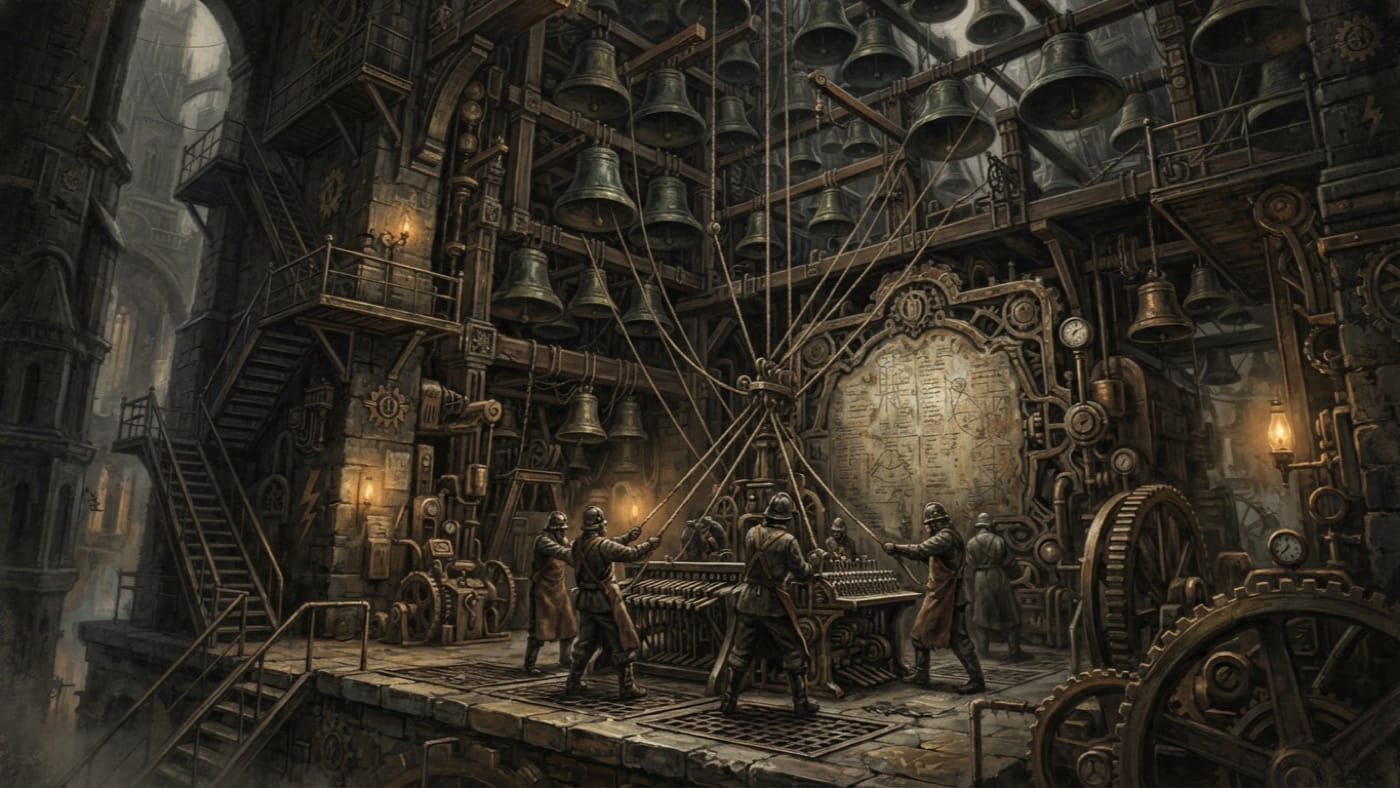
The Grand Carillon hangs in the Bell Tower of Strasbourg Cathedral, at the western face of the Sanctum Mile. The guidebooks call the building the Cathedral of All Saints and Settled Accounts. The Bureau of Records is loyal to the older choir and calls it the Basilica of the Ledgered Saints. The instrument has carried that second name in common speech for as long as anyone has troubled to write it down. Now and then a pilgrim goes looking for a separate Basilica with a separate carillon, finds the same tower from a different street, and buys a second candle out of embarrassment.
The Grand Carillon divides the day into eight canonical hours. Every tower in the Theocracy must sound within seven seconds of its toll. That is the entire law, and two centuries of clerks have found ways to make it longer.
A provincial deacon once asked me whether eight hours meant eight bells, eight strokes, or one stroke every three hours like a sensible kitchen clock. The answer to all three is no. The eight hours are eight occasions on which Strasbourg speaks and the Theocracy is expected to agree. How many bronze voices speak on each occasion, and for how long, is the schedule's business. The schedule belongs to men with better clearance than a deacon. He was given a printed extract, which answered nothing and closed the matter.
Most of the Theocracy never hears these bells. Strasbourg hears them, and so do the river barges and enough of the suburbs to keep the capital humble. Everyone else gets the Grand Carillon second-hand. It reaches them through diocesan towers, parish towers, licensed peal charts and the hands of local officers who have never climbed this stair. The bronze stays home. The hour travels on paper and arrives under seal.
#On the Authority Behind the Peal
The Bureau of Bells occupies the Tower's rooms and maintains the carillon within them. On the ninth floor, Master-Carillonist Aldo Venn directs the Grand Carillon and the harmonisation of the regional bell-grid. He keeps the master copy of the Grand Schedule. He keeps the fork-ledgers, against which every licensed pitch in the Theocracy is finally measured. He also signs the emergency peal permissions that let a parish ring outside its hours without being ruined for it.
Venn speaks in rhythms. A petitioner who climbs nine floors to argue with him is answered by a fork struck once against the desk, and an interpreter explains on the landing what has been refused. The Bureau certifies that his bells have produced no confirmed false peal. I commend the adjective. Records put it there, and Records never spends an adjective it cannot get back.
Below Venn, authority comes down in orderly steps. A diocesan Bell-master holds ordained scheduling authority and may overrule a parish priest who wants his Vespers a quarter-hour later so his sermon can breathe. Each parish receives a chart drawn from the Grand Schedule and amended for local feasts, mourning allowances and seasonal corrections, with a seal on every amendment. The Bell Codex supplies the grammar. The Grand Carillon supplies the reference against which that grammar is tested.
The institution is older than its present law. The Office of Bells was constituted in A.S. 52 and ratified under the Concordat of A.S. 90, and it received its current Codex in A.S. 115. None of those years dates the instrument. I cannot tell you when the present bronze was cast, who commissioned it or who first hung it, because no ledger I am licensed to open records any of it.
A visitors' card sold at the foot of the Tower stair described the Grand Carillon as "raised with the Bureau of Bells, A.S. 115."
Corrected. A.S. 115 is the year the current Bell Codex was ratified. The Office of Bells was constituted in A.S. 52. Neither date belongs to the carillon, and no record available to this survey establishes when it was cast or installed. The cards have been withdrawn. The vendor keeps his stall on the understanding that he will sell candles and leave chronology to the qualified.
#On the Day Enacted
The citizen never consults the Grand Carillon. He obeys whatever has been licensed from it.
At dawn Ninefold Matins comes down in nine descending strokes. Shutters open, knees bend, and the day's first debts are acknowledged. Labour begins at the third hour. At noon the High Angelus climbs in three ascending strokes, which the catechism teaches as stop, recite, resume. The hammer halts above the rivet, the ledger clerk lifts his pen, the washerwoman straightens with her arms dripping, and the parish recites its midday catechism until the third stroke lets it go. At Iron Vespers the garrison gates close and the powder magazines open. Soldiers love this arrangement because it replaces thought with tasks. Then comes curfew under the Ordinance of Quiet Hours, and the street belongs to the watch.
Between those hours, a swarm of lesser peals does the duller work. Markets open on a bell and close on a bell, and a merchant who sells after the closing stroke has sold illegally, however good his pears. The Widow's Toll gives grief a single low note. For the interval it allows, a woman may weep in the street without her weeping becoming a political act. Once the interval ends, it becomes one. Festivals are opened and ended by peal, and fasts are proclaimed by peal. When the Line is breached or a city burns, the Codex prescribes Silentium: the bells stop altogether. The faithful find this more frightening than any sound the Bureau has yet devised.
None of this is posted on the citizen's wall. He has no copy of the Grand Schedule and would be questioned if he did. What he has is his parish bell. The bell has a licence, and the licence descends from a desk on the ninth floor of a tower he will probably never see. Those links make up the whole of his liberty, and he may breathe between them.
#On Seven Seconds
A schedule kept only in Strasbourg would be a private opinion. The Bureau turns it into law by sending men to check it.
The Bell Inspectors travel the parishes with calibrated tuning forks and sanctified chronometers. They carry two instruments because they ask two questions. The fork tests pitch: is this bronze the bell its licence describes? The chronometer tests time: did the bell speak when Strasbourg permitted? Neither instrument reads a soul. An inspector who claims otherwise is reassigned to the cattle-bells.
The inspector reads before he climbs. He asks for the parish copy of the Grand Schedule, the Bell Peal Licence, every amendment filed since the last visit, and the compliance record kept by the Bellwarden. Then he opens his chronometer on the bench and waits for Strasbourg's hour to arrive in a parish that cannot hear Strasbourg.
Suppose the High Angelus strikes eight seconds past noon. If the parish holds a seasonal correction or a local addendum covering the delay, the eighth second is lawful, and the inspector moves on to the curfew bell. If it holds nothing, the eighth second fails the standard. He enters the discrepancy and forwards it. The Bureau of Doctrine decides what it meant, Records keeps the proof, and the Bureau of Tithes decides what it costs. The inspector decides only that it happened, and every other office relies on his being right.
The stakes are practical before they are doctrinal. If curfew rings late, the baker walking home is innocent by his own ears and in breach by Strasbourg's, and the watchman has to decide which to believe. And a parish that learns its alarm bell cannot be trusted will one day hear it ring for fire and stay indoors.
The standard costs labour at both ends. In a parish belfry the Bellwarden oils the fittings, runs every rope for fraying and checks the wax seals on his chart. He chalks pitch marks on the beams and writes down each deviation in a hand the inspector will later read against him. In the Strasbourg tower the same work is done higher up and under closer watch. Forks are checked against the fork-ledgers, and gloved hands run along every rope before the hour. Brass dust gets into the clerks' teeth and wet stone into their joints. Rope burns climb the forearm of every man who has rung there long enough to be trusted with it. The Grand Carillon is never wrong because a great many men are paid to keep it right.
#On the Present Schedule
In A.S. 201 the Grand Carillon sounds its eight hours over Strasbourg. The diocesan and parish towers of the Theocracy answer within tolerance, or they answer to the inspector afterwards. Its jurisdiction runs as far as Synodal authority runs and stops there. The Fractured North rings older iron at older intervals and files no amendments. The independent Isles and the Netherlands ring as they please. The Bureau records these facts with the face of a man reading his own obituary in a rival's newspaper.
Some will tell you the bells carry more than the hour. The bell-codes survey preserves my own observation that three irregular sequences preceded political purges within the last decade. I heard them in Strasbourg. Strasbourg has many towers, and I cannot say which tower carried them, what instruction they held, or who was listening on behalf of the Bureau of Shadows, which does not exist. The charts were lawful. I entered those nights as ordinary, and I have not amended the entries.
On the ninth floor, work continues as before. Venn taps the desk. The fork-ledgers are opened at dawn and closed at curfew. Rope is replaced on schedule, and wax is warmed for the next round of amendments. Tomorrow's dawn will come down in nine descending strokes, as it did today, and every parish clerk between the Rhine and the foundry towns will look at his chronometer and hope.