
#On the Sanctioned Peal
"Time is Holiness, Holiness is Time."
The citizen of the Dominion wakes to a bell, walks to labour on a bell, takes his ration on a bell, kneels at the High Angelus, and bars his door when the curfew of the Quiet Hours comes down from the tower. He has never asked who wrote the schedule. He should not. The Bureau of Bells writes it, seals it and has ordained officers sound it. After the Catechism it is the most obeyed text in the Church, and better obeyed than the Catechism, because no one can claim not to have heard it.
For want of any name the Synod will sign, I call the second use of that schedule the Bell Codes. I am reliably informed that certain sequences within the liturgical peal carry encoded instructions for the Bureau of Shadows. Matins is still Matins. The widow still hears her toll. In the same air, a listener who has been told what to listen for hears something else.
#On the Licensed Network
"His bells are never wrong."
The instrument is enormous and entirely lawful. The Bureau runs its regional networks from the great carillon of Strasbourg Cathedral: from cathedral to diocese, from diocese to parish, and from parish down to the last chapel with a rope and a boy heavy enough to pull it. Bell-masters are ordained officers. In the provinces they often outrank the local clergy, who tell me so in letters I file without reply. Unauthorized ringing has been punished as heresy. The miners of Liège once sounded their own work-shifts and were scourged for it. They ring nothing now.
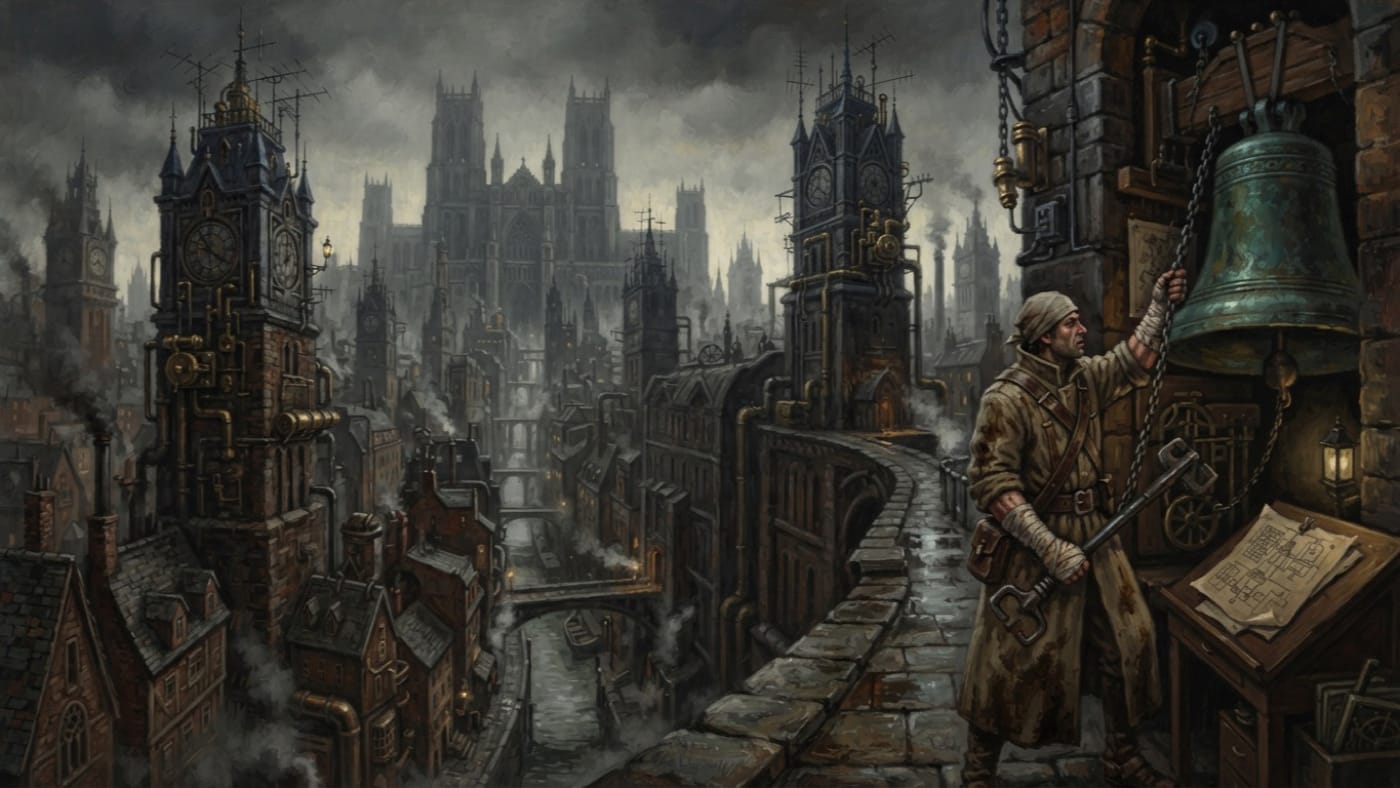
The work behind all this majesty is dirty. A Bellwarden climbs into wet stone and brass grit. He oils the iron fittings, checks the chain on the toll-key that hangs from his harness, tunes his bell against the fork and checks the day's peal chart against the seal of whoever ordered it. His forearms carry rope burns in the shape of his office. He logs every deviation. It is not his place to decide what the chart means. He decides only whether the stroke was clean.
The whole arrangement depends on precision. When a careless tower rings a code, it comes out as noise, and noise gets a man flogged. At Strasbourg, the Master-Carillonist Aldo Venn speaks in rhythms and may be slightly mad. His bells are never wrong. I credit him with nothing more than that sentence. It is praise, and I would like him to remember it.
The history is shorter than the Bureau would like. The Office of Bells was constituted in A.S. 52 under the provisional council that came before the Synod, and it took over parish customs older than itself. The current Bell Codex, the standard under which every tower is now licensed, was ratified in A.S. 115. The Bureau prefers to trace its authority to the Miracle of Cologne, when the ringing of cathedral bells is said to have scattered Wrath's Host. That is its tradition, and I record it as tradition. No ledger I have seen says when the schedule began to be put to its second use.
The Bureau of Bells was chartered in A.S. 115, after the Miracle of Cologne.
That line appears in this Codex's survey of the Bureau of Shadows and in an older row of the Ledger of Years, and it confuses two instruments. The Office of Bells was constituted in A.S. 52. A.S. 115 is the year the current Bell Codex was ratified. The Bureau of Bells has asked for its sixty-three missing years back. They are returned herewith, with the compliments of the Bureau of Doctrine and without interest.
#On Instructions Without an Issuer
"The Bureau of Shadows insists nothing, because it does not exist."
As a professional, I envy the arrangement. One Bureau is acknowledged, chartered and budgeted. The other has been denied fourteen times under seal. The acknowledged Bureau supplies the throat, and if my informants are right, the denied one supplies the sentence. They never need to meet in a room with a door.
Look at what this spares everyone. A written order can be seized, copied and entered as evidence. A peal is heard by forty thousand people at once, written down by none of them, and gone into the masonry within the minute. The tower's log records a lawful variation, sealed and correct. Whoever heard an order heard it alone, inside his own skull, where the Bureau of Records keeps no shelf.
I do not know who listens. I have not been told how the listening is taught, how a sequence is proved genuine, or who composes it. I have not asked, because the answer would come with a visitor.
The codes sit alongside the Bureau's other instruments, and I take care to keep them apart. A Night Paper grants authority for one night and is blank by morning. Its couriers choose routes that avoid bells, gates and known patrols. There is no contradiction in that. The tower speaks to a district, and the courier speaks to one man. A Blank Folio, sealed in grave-dust wax, establishes that a person was never there. The Night Wagons leave after the final peal and return before Matins, keeping time by the same bells every honest baker keeps. I cannot say whether a peal by itself sends out a wagon, carries a Night Paper's powers or strikes a name from a parish roll. In the pattern as reported, the peal comes first. Then the Custodians in black gauze do the rest, and the rest is collection.
#On Three Variations
"Standard liturgical variations."
In the last decade, three apparently random bell sequences preceded major political purges. The observation is mine. I have now repeated it in two surveys without correction. In this city, being left uncorrected is often mistaken for being confirmed, and I would ask the reader not to make that mistake on my behalf.
Precision, then, since the Bureau of Bells values it. I mean three sequences, not three strokes. I do not claim they were the only purges of the decade, or that the Bureau owns only three patterns, or that I know which instruction any of them carried. Three is the number I heard, noticed as irregular, and counted against what followed. The order was the same each time: a peal the chart called a variation, then a night, then vacancies.
The Bureau of Bells explains that these were standard liturgical variations. The Codex does license variation, for feasts, for commemorations and for emergencies, and a sufficiently devout ear can file any irregularity under one of the three. The explanation is sealed, countersigned and lodged in the proper register. As a document, it is flawless. I have drafted worse ones myself, for money.
The purges are on record, though the records have been reclassified under headings the Bureau of Records cannot find. I went looking. You can recognize reclassification by its look. A roll that once ran unbroken now has a neat correction in a second hand. A column total no longer matches the entries above it, and nobody has noted the discrepancy. An index reference points to a folio that exists, is properly bound, and is blank. I did not find names. I found the places where names had been ruled out with a straightedge, very evenly, by someone who cared about the page.
#On the Wrong Bell
"Do not negotiate with noise."
A cracked bell is not a code. A drunk ringer is not a code. A tower whose timing wheel has slipped a tooth sends the Bureau of Shadows nothing and sends the Bureau of Bells into a fury of audits. The loose talk of the taverns, where every late Angelus becomes a death warrant, is a nuisance to the Synod and a gift to the Great Deceiver, who prefers a population that trusts no bell at all.
The real terror of the network is the wrong bell. Saboteurs ring false peals to walk crowds into ambushes. Rebel chimes in the outer districts claim curfews that were never ordered. Some fog-bound ports report tones that copy the official patterns, and Doctrine has named where those come from. Against all of these the Synod sends its Counter-Toll Operators, who drown hostile tone in sanctioned peal until the only voice left in the corridor belongs to the Church. I am aware of no evidence that the Bureau of Shadows has ever needed their services, or caused them to be needed.
The irony has teeth. The only safe covert signal is a licensed one, because only a licensed peal passes every Bellwarden's clean-tone certification without anyone looking twice. A sequence that fails inspection is heresy, whoever the ringer believed he was serving, and he will be treated as a heretic. I am not aware that the Bureau of Shadows has ever stepped in on behalf of a man who rang its orders badly. It would first have to exist.
#On the Present Application
"Return to your duties."
The citizen still wakes to the bell, and he should. Only the bell keeps the Line supplied, the curfew kept and the parishes gathered at the proper hour. He has no alternative, and none is being prepared. He hears one schedule. I have come to hear it as two, with no means of telling them apart and strict instructions not to try.
I know this much. The towers are licensed. The charts are sealed. The strokes are clean. Somewhere under the schedule, an ear I cannot name is listening for a pattern I cannot describe, on behalf of an institution that does not exist. The rest belongs to the people who wear gauze.
Compline is ringing as I write this. I have stopped counting the strokes.