
#On the Recorded Name
Gravis is the name of a month. I know this because a clerk wrote a day in front of it and a year after it, and in the Church's hand that arrangement can be read only one way: the 14th of Gravis, A.S. 199. The phrase stands in the entry on the Third Ossuary, in the account of the seventeenth sealing. It is the whole of my evidence.
A calendar owes its readers a good deal more. It owes them the month's place in the year, its number of days, the months on either side of it, its season, the source of its name, the authority that gave the name and the year that authority acted. No register brought to my desk supplies any of these for Gravis. An attested name is one instrument. A specified month is another, and the Codex holds only the first. A seminarian who knows his Latin will come to me with a theory about gravis. He may leave it on the bench outside my door. A dictionary is not an ordinance.
The year causes less trouble. The Synod adopted its present reckoning retrospectively at the Concordat of Strasbourg in A.S. 90 and counted backward to A.S. 0. By that count A.S. 199 is 1909 of the Common Era, and I make that conversion without hesitation. The Concordat counts years. Its articles name no months, and nothing in them says when Gravis first appeared at the head of a page.
The Codex knows one other Church month by a single day, and Corvus has no approved conversion either. Two unconverted months do not make a sequence. I cannot say whether Gravis comes before Corvus or after it, or at the far end of the year from it.
#On the Fourteenth
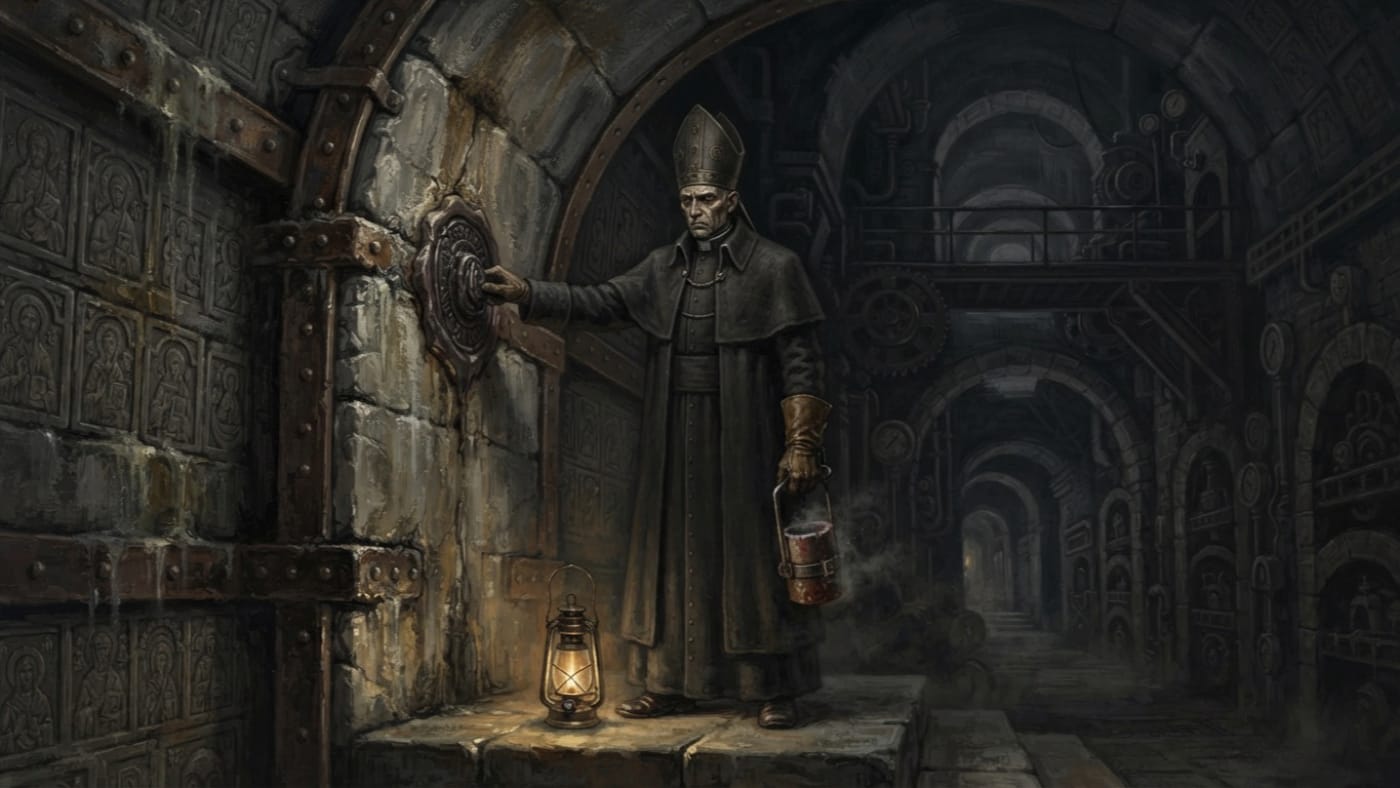
At half past three in the morning on the 14th of Gravis, A.S. 199, Canon-Warden Albrecht Goss applied the seventeenth layer of wax to the entrance of the Third Ossuary. The entrance is a Byzantine stone archway beneath the Third Ring of the Ossuary Rings of Bastion-Constantinople, fastened with iron bolts and mortar. The parent entry gives the hour, the day, the month and the year. Few acts in the whole Synodal archive are dated so exactly. Most Bureaus could not tell you within a week when their own charters were signed.
Goss was not on the schedule. The Bureau of Records holds no requisition for the wax he used. When he was asked who had authorised the sealing, he answered that he had authorised it himself. A Canon-Warden giving himself that authority goes beyond his jurisdiction by three ranks and two Bureaus. He has not been disciplined.
That is the testimony, and I will not add to it. I was not in the corridor and neither was any reader of this entry. Of the conversation, the record keeps one question and one answer. I have read enough reconstructed dialogue in the provincial martyrologies to know what happens when a compiler decides the record would read better with a second exchange. It becomes a sermon, the sermon is canonised, and some later Warden has to issue the retraction.
The fourteenth of Gravis is well documented as a date. The record places the act to the half-hour. It names the officer and the wax, and it records his answer. It holds everything a clerk is trained to supply. The one thing a clerk is trained to demand, the warrant, reads himself.
I raised the question of Goss's authority in the parent entry and predicted that nobody would raise it again. The prediction was correct. Being right about the Bureau usually pleases me more than this.
#On the Seals and Their Authority
The wax on the arch shows seventeen distinct layers. The earliest dates from A.S. 47, when soldiers retreating to the Bosphorus drove pilings into the headland, struck old chambers, and sealed them again with fresh mortar and a stamp. There was no Synod in A.S. 47 and there were no Bureaus. Whatever filing the soldiers' sealing now has was assigned to it decades later by offices that did not exist when the wax cooled. The chambers they found were already old. Nobody has established when they were built.
The latest layer is Goss's. The parent entry also records that the original stamp has been renewed eleven times. Both figures are in the record, eleven renewals and seventeen layers, and nobody has explained how one relates to the other. I will not invent six unrecorded visits to make the arithmetic close. The wax shows seventeen layers, and the wax is the better witness.
In A.S. 199, the year of the seventeenth sealing, the Bureau published its fourth explanation for the closure: the Third Ossuary is sealed by prior authority, and the present administration sees no cause to revisit the matter. The Bureau did not identify the prior authority, and I cannot identify it either.
So the Codex can date the last of the seventeen layers to the half-hour, and it cannot name the authority behind any of them. The Ledger is often in this position. The Ledger is rarely this embarrassed by it.
The parent entry reports that the intervals between sealings follow no liturgical calendar, no administrative schedule and no military operation. They correspond, it says, to incidents the Bureau of Bells has classified as "sub-carillon resonance anomalies of unidentified origin." No record makes the fourteenth a day for renewal or Gravis a season for wax. The act happened in Gravis, and that is all the date records.
An earlier edition of the parent entry stated that the Third Ossuary "presents no operational hazard and has been thoroughly catalogued."
Withdrawn in the parent entry. I note the withdrawal here because this entry stands on the same ground. The Third Ossuary has never been catalogued. This entry describes a month known by one day, and that day is known only for an act performed at a chamber whose contents have never been listed.
#On the Bells and the Reckoning
In the Ossuary Rings the Church tells the time with bronze. The Sub-Carillon of the Widow's Lanes keeps seven bells on a half-hourly schedule under the Bureau of Bells. Bell practices are older than that office. The Office of Bells was constituted in A.S. 52, and the current standard of ringing dates from the ratification of the Bell Codex in A.S. 115. On that schedule, half past three is a scheduled mark. A scheduled bell is a clock, and a clock could have told Goss the time. A clock does not authorise anyone to do anything.
Other bells are heard in the lower Rings at night, outside the schedule. The Bureau's instruments register them "below threshold." The instruments detect the sound and cannot classify it, and the Bureau would prefer that the sound did not exist. The parent entry links these bells to the pattern of sealings in general. It does not say that any of them sounded on the fourteenth of Gravis, before or after Goss raised his wax. I have looked for that sentence. It is not there, and I will not write it in.
Before the evidence can be read, it has to be divided into four parts. The date is in Gravis. The hour is on the scheduled half. The bells for that hour have no entry. The warrant is the man himself. Each of these is a separate kind of record, kept by a separate office, and none of them proves any of the others. A Warden who lets the date stand in for the warrant, or lets a bell stand in for a date, is writing hagiography.
#On the Limits of the Entry
The same year holds other records. Mother-Cryptor Sabine filed her first non-routine report in the spring of A.S. 199. The Vigil Ark Saint Barachiel had its broadcast incident in A.S. 199 as well. Neither record shares a day with the sealing, and neither puts its event in Gravis. Sabine's report was filed in spring, and that does not make Gravis a spring month. I have watched compilers build whole calendars out of coincidences like these, and the Bureau of Rites has later had to celebrate the results.
So the Codex keeps what can be documented. Gravis is a Church month, attested by one date. Its fourteenth day, in A.S. 199, is the recorded day of the seventeenth sealing of the Third Ossuary. A.S. 199 is 1909 of the Common Era. Nothing else about the month is established. The fourteenth has no other attested property, the month has no assigned place in the year, and its name has no known author.