
#On the Black Canvas
"A frame is a promise the Synod makes to the dead. The canvas is where the Synod reconsiders."
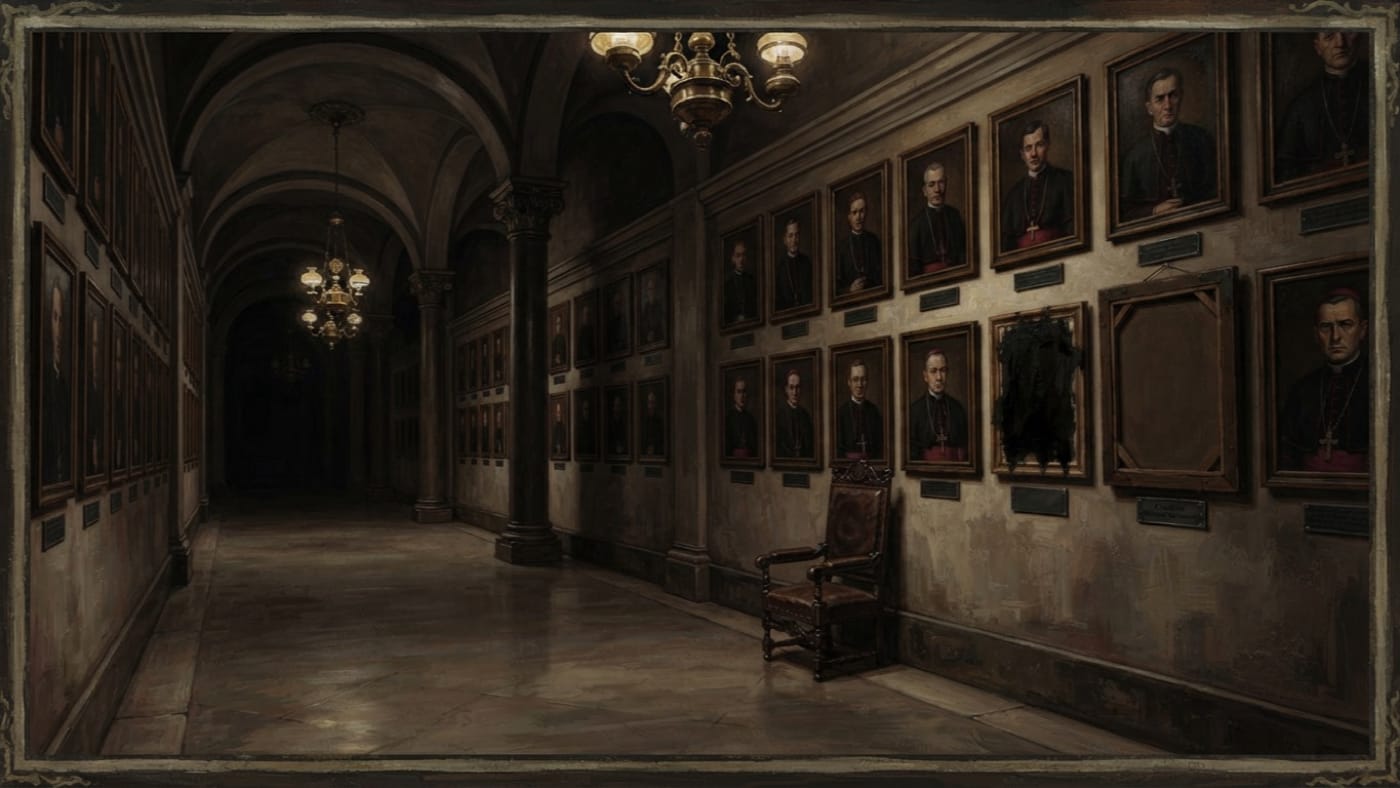
The most legible object in the Hall of Succession is a painting of nothing. Its frame has been kept. Its nameplate is blank. Its canvas has been painted over in ecclesiastical black from edge to edge. The black was applied to the canvas alone, which leaves the absence a frame to hang in and a plate it can decline to fill.
The Hall is the portrait corridor of the Synodal succession in Strasbourg, and it belongs to the institutional precinct of the Basilica of the Ledgered Saints, that house of red-ink scripture where the census of the living lies beside the absolutions of the dead. I give no directions. Anyone who needs directions has not been authorised to visit.
Strasbourg keeps more halls than it keeps honest clerks, and the provincial pilgrim confuses them at his peril. The Hierarchs sit and pronounce in the Inner Circle. Concordat Hall, the Hall of Seals and the Hall of Confessions each have their own keys, their own custodians and their own grievances. The Hall of Succession governs nothing. It remembers, on instruction.
It holds painted portraits in frames, nameplates beneath them and one empty chair with a plaque. Most of the portraits do the work portraits are paid to do, which is to look grave and say nothing further. Three exhibits have been altered: one was blacked out, one turned away and one left empty. The rest of this entry deals with those three.
#On the Numbered Succession
"Every chair has a number. Some numbers still have a chair."
The Hall makes one claim, and it makes it with paint. The claim is that each of the Seven Seals (Doctrine, Discipline, Martyrdom, Concord, Purity, Vigilance and War) has passed from holder to holder without a break. Holders are numbered within their own Seal. The Third Hierarch of Discipline was the third to hold Discipline. He was no more the third ruler of the Synod than a third verger is the third bishop.
The Seals as constituted offices date from the Concordat of Strasbourg in A.S. 90. The Bureaus received their charters in A.S. 92, and successors were confirmed at Mainz in A.S. 93. The registers nonetheless start the Doctrine succession with Augustinus, who held earlier ecclesiastical and interim authority and was dead before the Concordat was sealed. He never sat in the chair the registers give him, because it was finished after his burial. Kratz, who was also dead before A.S. 90, left the Seals their habit of mutual suspicion. The succession has inherited that suspicion and does not credit him for it.
The total is disputed. The Bureau of Records counts forty-one Hierarchs across the seven Seals. The Bureau of Doctrine counts forty-three. The Bureau of Purity says the count is correct and the correct count is classified. Counting frames will not settle it, because a frame can hold a black canvas and a plate can hold no name.
#On the Third Hierarch of Discipline
"Moths eat wool, vellum, and, on the authority of the Bureau of Records, personnel files."
No register I am permitted to consult records when the black was applied or by whose hand. What I can record is that three Bureaus have given three accounts of the record behind it, and that all three remain in force.
The Bureau of Records says his personnel file was destroyed by moths in the sub-vaults of the Basilica during the damp winter of A.S. 112. The Bureau of Purity says no such file ever existed. The Bureau of Doctrine says he served with distinction and that his record is theologically complete, which places it beyond any loss a filing clerk could suffer.
These positions cannot all be true. The Synod holds all three anyway, filed under separate seals in separate vaults, and each is defended with the full confidence of the office that issued it. A file that was eaten must first have existed, and Purity denies that it did. If the record is complete, as Doctrine says, then nothing was lost, and Records would have had no cause to report the moths. I have set the three side by side many times, and they have never yet agreed to be reconciled.
One correction belongs here because it comes from the taverns. The Records account concerns paper. Drinkers who say the moths took the Hierarch himself have confused an archival loss with a miracle, and the Bureau of Doctrine has certified no such miracle. His name is unrecovered. Nobody has established what happened to the man.
Three investigators were assigned to the matter. All three were later reassigned to duties the Bureau calls contemplative. Nothing released to me gives their names, their findings, the dates of their inquiries or where they now contemplate. The canvas remains black and the plate remains blank. The investigators asked questions in the order their commissions required, and those questions have not been taken up again.
#On the Reversed Portrait and the Empty Chair
"The Synod has three ways to keep a man out of its history while keeping his chair in it."
The Seventh Hierarch of the Seal of Martyrdom was previously listed as Hierarch Delmatius of Cologne (A.S. 98–117).
This entry, as carried in the Codex survey of the Hierarchy, has been retracted. In A.S. 147 the Fourteenth Doctrinal Congress declared Delmatius retrospectively heretical. It found that his canonisation proceedings for the Twelve Martyrs of Brest rested on testimony extracted from a dead man. The extraction method is not specified. His name has been removed from the Hall of Succession and replaced with the notation SEAT OCCUPIED — OCCUPANT CLASSIFIED. His portrait has been turned to face the wall.
The turned portrait and the black canvas are different instruments. The Third Hierarch's face cannot be seen by anyone at all. Delmatius's face is still on its canvas, facing the plaster. The new plate does not call the seat empty. It calls the seat occupied, which keeps the Seal of Martyrdom's count unbroken while taking the occupant's name away. The count stays intact and Cologne loses a son.
Correction after death has precedents. The Eleventh Hierarch of Concord was declared retrospectively heretical in A.S. 155 after Purity produced correspondence with agents of the Shadow Court. I have questioned the authenticity of that correspondence in the proper margin and stand by the question. Nothing I hold records what the Hall did with his portrait. I mention him so that no reader takes the corridor's corrections for a complete set.
The third altered exhibit is a chair. The registers attribute it to the Twenty-Second Hierarch of Vigilance, and its plaque reads IN ABSENTIA — DUTIES CONTINUING. In A.S. 172 he vanished from his chambers. He left behind a warm cassock, an untouched supper and a page of correspondence addressed to no one. The Bureau of Records classified the event as voluntary contemplative withdrawal. The Seven Seals account adds that his chamber stayed sealed for nine months, and that when it was opened the supper had been eaten. The plaque says nothing about the supper. Its claim concerns the office, and an office cannot be found eaten.
This chair must be kept separate from the Seat of War. That chair is draped in white in the Inner Circle. Its holder has not appeared in public since A.S. 107, and the lawful wording is that he occupies it in absentia. His vote is counted by faith at every session. The chair in the Hall votes on nothing. In the Inner Circle an absence is still given a vote, while in the Hall it is only commemorated.
That gives the Synod three formulas. The condemned man keeps his seat and loses his name. The man who is merely classified keeps his face, which is now turned to the wall. The man who is absent keeps his duties, and nobody sees him perform them.
#On the Present Condition
"The office outlives the officer. The officer's face is a licence, revocable."
This survey describes the Hall as it stands in A.S. 201 (1911 CE). No register available to me gives a year of foundation, a builder, a patron, a commissioning painter or the original programme of portraits. Nor does any register date the black paint, the turning of Delmatius's portrait or the fixing of the plaque on the Vigilance chair. The years attached above belong to the losses, condemnations and disappearances. They do not record when the Hall was altered to match them, and I have not invented those dates for the convenience of tidier readers.
The Hall is maintained. Its frames hang where they hung and its plates stay fixed in their places. Not one Seal has a gap on the wall. Seven successions run unbroken in paint, kept that way by black pigment, a reversed canvas, a classified plate and a chair whose duties continue. Strasbourg sees nothing to reconcile in this. Continuity is the Bureau's virtue, and the faces were only ever entrusted to the Hall on loan.
The Third Hierarch's frame still hangs in the Hall with its blank plate beneath it. The black has not been touched since it was laid down. The Bureau of Records lists the matter as closed. The Bureau of Doctrine lists the record as complete. The Bureau of Purity lists no file.