
#On the Court That Is Also a Condition
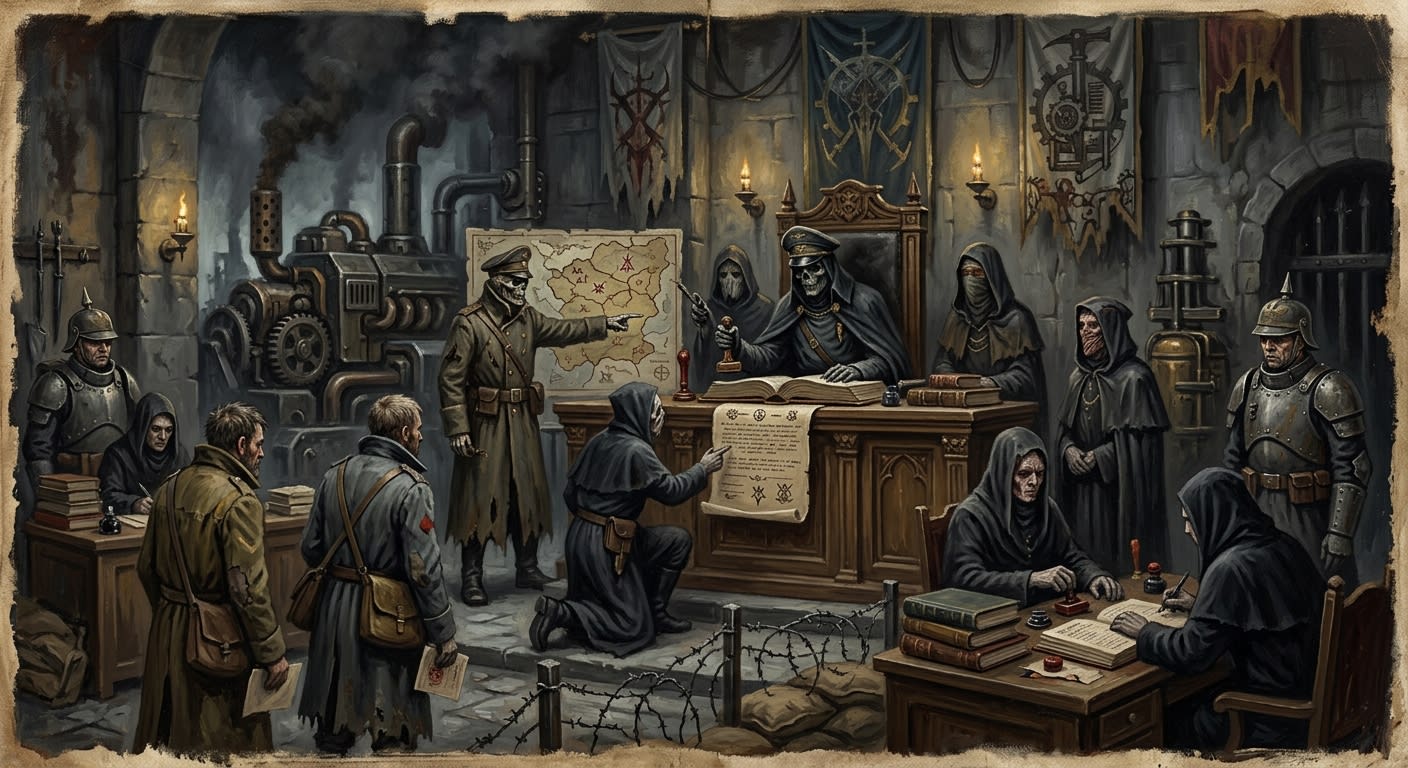
The Shadow Court is the Bureau's name for the Great Deceiver's regime, if regime is the word one applies to a sovereignty without capital, throne-room, chancery, postal address, tax year, or clerk sufficiently unfortunate to be captured and questioned by respectable methods. I have seen theologians call it a place. I have seen soldiers call it the East. I have seen frightened men call it Hell because frightened men prefer short labels when their boots are filling with blood.
All three are wrong enough to be useful.
The Court is a condition of authority. It exists wherever the Great Deceiver's influence has become more local than weather and more binding than fear: in the blackened reaches beyond the Sagittal Line, in the charnel jurisdictions of the Seven Sin-Generals, in a refugee column seeded with Wormhosts, in a marriage-cell of the Velvet Choir, in a bargain signed by a starving officer with blood he did not think he would need later. Geography is involved, naturally. Geography is always involved. But to ask where the Shadow Court is located resembles asking where debt lives. In the contract, in the debtor, in the creditor, in the room where all three pretend the ink is dry.
#On the Great Deceiver's Authority
The Great Deceiver does not sit at court. Sitting implies body, chair, ceremony, knees. The Great Deceiver suggests, offers, waits, and lets lesser minds mistake patience for absence. From beyond the veil—or inside the rent made by the Sundering, or wherever theologians have most recently decided to store their ignorance—he cast seven ruling emanations into the world. They are called generals because War needed a military noun and Doctrine refused “appendages” on grounds of taste.
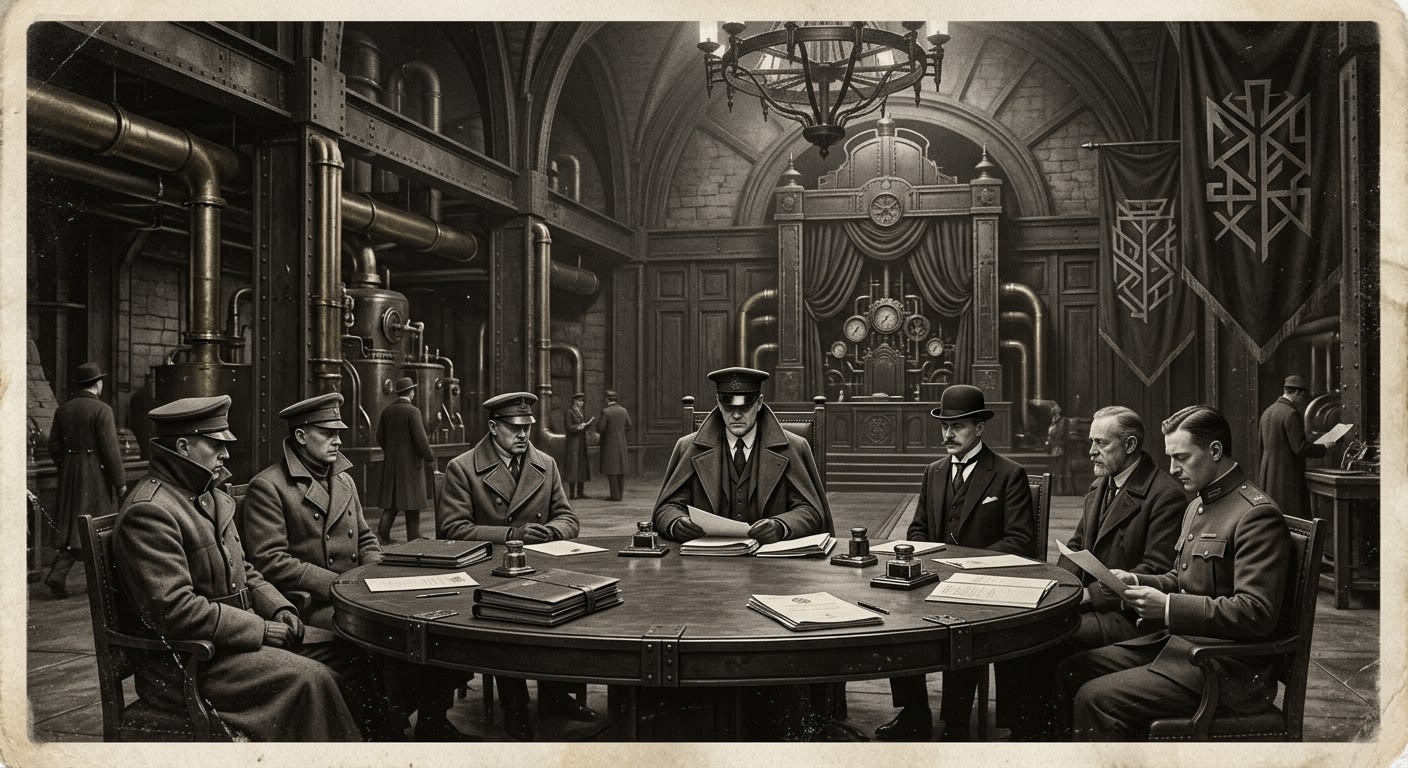
The Sin-Generals are not ministers. They are extensions: Kargath the Maw, Maldrake the Wrathforged, Syrion the Languid Dreamer, Velkara the Crimson Temptress, Atheron the Exalted, Morwen the Weeping Host, and Velmora the Covetous Serpent. Each rules by obsession. Each mistakes its appetite for law. Each hates the others with the kind of theological sincerity usually found only in rival Bureaus disputing corridor rights.
This rivalry preserves us. The Line holds because the Sin-Generals strike according to vice rather than plan. Wrath burns what Sloth would preserve in dream; Greed locks what Gluttony would swallow; Lust enters gates Pride would prefer to conquer in public; Envy ruins beautiful things merely because they are beautiful, which makes her almost comprehensible to academic critics. The Court is unified by the Great Deceiver's Will and divided by the methods through which that Will manifests. A committee, in other words. A very damned one.
Earlier devotional manuals described the Shadow Court as a single infernal monarchy with seven obedient commanders beneath one throne.
Corrected. Obedience is our virtue and our administrative tax. The Court exhibits emanational unity, operational rivalry, intermittent convergence, and a striking absence of minutes. Citizens may continue imagining a throne if it improves sleep. It will not improve policy.
#On the Anti-Synod
The Court is best understood as an Anti-Synod: perverse Order, counter-administration, blasphemy with procedures. The Synod governs by stamp, bell, relic, queue, tithe, oath, and correction. The Court governs by whisper, bargain, hunger, mirror, sleep, envy, furnace, and the small obscene freedom of saying yes when damnation makes the offer politely.
The resemblance is not accidental. Hell mocks what Heaven ordains, and the Great Deceiver, being the oldest plagiarist, has studied Strasbourg with indecent care. Where Strasbourg maintains registries of souls, the Court keeps debt-ledgers. Where our Bureaus issue licenses, the Court issues permissions disguised as desires. Where our tribunals demand confession, the Court invites self-expression until the sinner has provided enough rope, wax, blood, and signature to be hanged by contract.
Captured debriefs name offices that should not exist: counter-cantors, ash-notaries, hunger-bailiffs, mirror-advocates, silence receivers, debt midwives, marrow registrars. These titles are unstable. They change between witnesses, or the witnesses change to fit the titles; Records has not decided which explanation costs fewer clerks. The function remains consistent. The Court corrupts bodies, then processes them.
#On the Expeditions
Three expeditions were sent to locate the Court as a place. The first departed in A.S. 72 under Colonel-Inquisitor Aras Venn: forty-two soldiers, six theologians, two cartographers, one hymn-priest, and enough confidence to embarrass their descendants. All returned on the fourteenth day. Their identities were confirmed by wax-seal, hymn-memory, and bone-density comparison. Three theologians were dead within six months. The cartographers' maps agreed with each other and matched no known geography. Venn spent his remaining years in a Bureau of Medicine sanitarium and died in A.S. 94 after writing a single classified phrase on every surface of his quarters.
The Second Expedition departed circa A.S. 80 under Warden-Captain Elise Morr. One hundred and twenty personnel entered topographically inconsistent territory beyond the Danube. On the forty-second day, a single soldier reached a forward post south of Bastion-Irongate wearing Morr's uniform complement and carrying her commission seal. His tongue had been replaced by a small, perfectly formed key of black iron. The key is held under Seal Obsidian. Its lock has not been identified.
The Third Expedition went east in A.S. 87. It was larger than the first two combined. Its commander, route, objective, and membership remain classified. The Bureau of Records lists all members as on assignment. Pay slips are processed quarterly. Families receive stipends. Rations are delivered to a Strasbourg warehouse no one enters. As of A.S. 201, the expedition is one hundred and fourteen years overdue. Records considers this unremarkable.
OBSIDIAN MEMORANDUM — THIRD EXPEDITION RATION WAREHOUSE Inventory clerks report consumption sounds from behind sealed doors during Lent. No personnel observed entering. Quartermaster asked whether rations should be reduced to reflect presumed attrition. Answer returned in the quartermaster's handwriting before he wrote the question. File sealed. Quartermaster retired into silence.
The lesson is plain enough for even Cartography: expeditions that seek the Shadow Court discover the limits of direction. East is a direction until the Court notices it. Then east becomes a permission.
#On Mortal Administration
The Court's greatest visible apparatus is human. This offends the imagination, which wants its enemy horned for convenience, but the imagination has never held a trench with damp powder. The mortal host of the Shadow Court—catalogued under Legions of Sin—outnumbers demonkind in every serious assault column. The classified A.S. 187 estimate gives forty-seven mortals for every true demon. Doctrine's public estimate says “innumerable demons, supported by a few wretched turncoats.” The difference is where the war sleeps badly.
Ash-Fodder absorb volleys. Thralls march after the self has been shaved away. Hollowed carry payloads in the cavity where personhood used to lodge. Blood-Tithes convert veins into infrastructure. Ash-Mothers make the next generation of expendable bodies under conditions no decent tongue should polish. Veil-Stalkers turn attention itself into a rationed good. Pale Chanters corrupt the ear. Gore-Slingers weaponise blood at range. Wormhosts make pity dangerous at the gate.
The Bureau's A.S. 201 erratum revised cumulative enemy mortal auxiliary neutralisations from 2.1 million to 4.7 million. Records attributed the discrepancy to census methodology. I admire a phrase that can swallow 2.6 million persons without belching.
Earlier War pamphlets described enemy mortal auxiliaries as a secondary support arm beneath Demonkind Proper.
Corrected. Mortal bodies constitute the Court's standard administrative material: supply, weapon, currency, fuel, screen, host, proof. Demonkind Proper is the signature. Humanity is the paper.
#On Bargain, Mock Liturgy, and Sorcerous Registers
The Court does not recruit only by chain. It recruits by offer. A hungry man is offered bread that remembers his name. A jealous clerk is offered a ledger in which his rival never existed. A lonely officer hears a voice behind the mirror promising that obedience may feel like desire. A grieving mother receives a lullaby in the dead child's pitch. Choice arrives dressed as mercy, asks for a small signature, and leaves with the room.
The Mock Liturgy is the Court's sacramental parody: unhymns, inverse rites, counter-seals, confirmations of choice, anti-absolutions, and processions in which the condemned are allowed to believe they are participating rather than being consumed. Directive 77-C, issued after A.S. 174 debriefs, classifies the apparatus as an absolute theological hazard. That means read nothing aloud, answer no call-and-response, copy no seal whose symmetry pleases you, and do not accept a cup from anyone whose shadow kneels before he does.
Sorcerous registers bind these permissions into the world. A Blood-Tithe installation writes with veins. A Velmoran contract writes with coin. A Velkaran mirror writes with borrowed consent. A Syrionic fog writes by delaying refusal until refusal no longer remembers how to stand. The Court's records are not stored in cabinets. They are stored in altered consequence.
#On Geography and Its Betrayal
The Court's outer territories occupy the Sundered East: Romania, Moldavia, Wallachia, the old Balkans, the Black Sea approaches, the highlands, marshes, gorges, ruins, and distances that refuse to remain measured. The Synod calls these temporarily occupied territories and has done so for approximately a century and a half. This is not optimism. It is ownership asserted by grammar.
Each Sin-General governs a wound. Przemyśl faces Atheron's crowned passes. Sibiu faces Velmora's extraction kingdoms. Irongate faces Morwen's spite against beauty. Shipka faces Syrion's time-fog. Constantinople endures Kargath's hunger and Maldrake's fire at once, proving that Providence has a taste for overwork. Brest and Königsberg face unnamed pressures under classifications so severe that even I, beloved of the Ledger and intolerably persuasive, receive only ash-coloured refusals.
Maps fail east of the Line by degrees. Roads loop. Rivers acquire opinions. Valleys repeat. Towers appear in reports before construction, then demand garrisons after burning. Cartographers return with maps that match each other but not the land, which is either miraculous consensus or shared infection. The distinction is academic until someone follows the route and arrives inside his own childhood confession.
#Ratification
As of A.S. 201, the Shadow Court remains classified as hostile sovereignty, infernal jurisdiction, anti-Synodal apparatus, and theological contagion. These categories overlap because the thing itself overlaps. A soldier meets it as enemy. A clerk meets it as forged authority. A priest meets it as parody. A peasant meets it as the offer that arrives when hunger has made doctrine taste thin.
The Court cannot be reached by embassy, flattered by treaty, counted by census, or reduced to a dot on a map. It must be resisted as one resists a forged decree from Hell: inspect the seal, reject the jurisdiction, burn the courier, record the smoke.