
#On the Mountain Spine
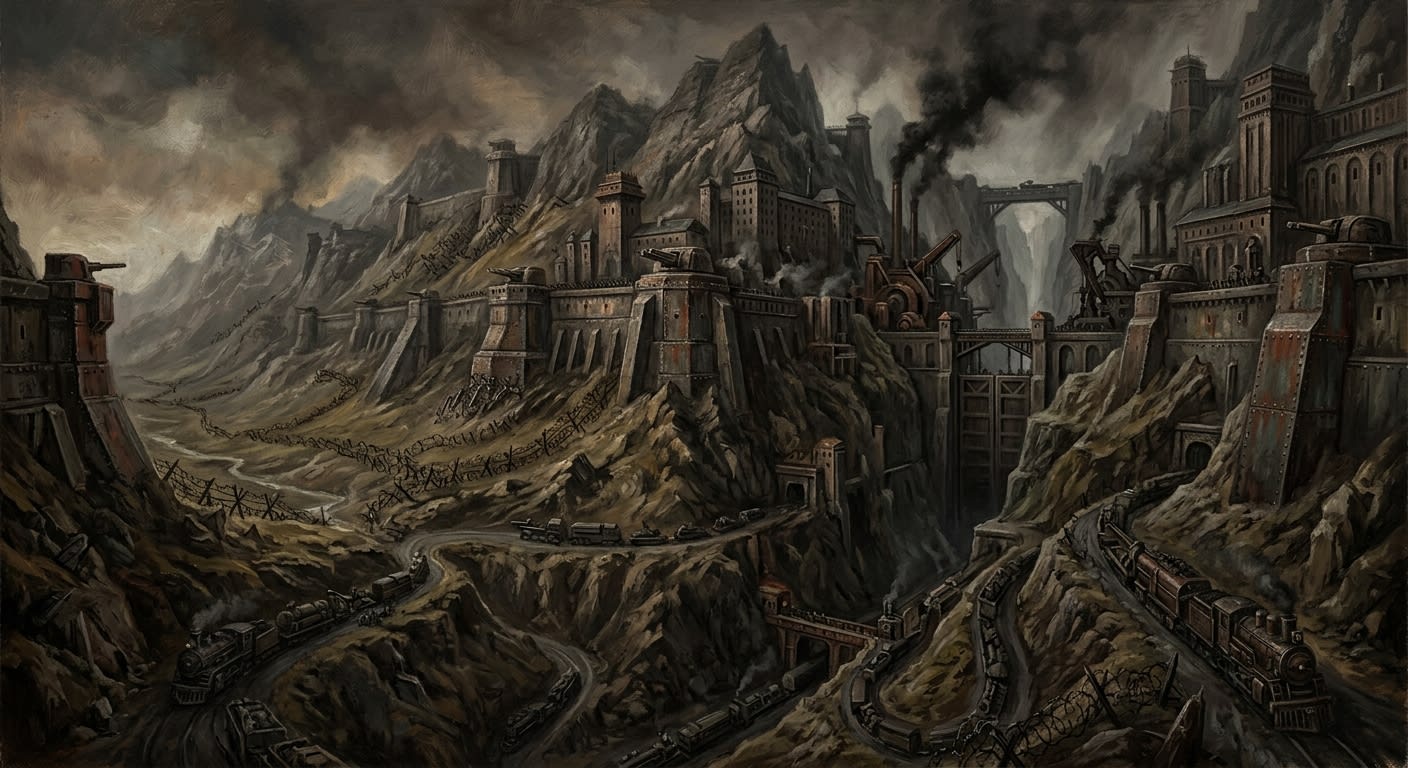
The Carpathians are the stone hinge of the middle war: a bent crown of ridges, saddles, ravines, pine-dark mouths, old passes, broken causeways, fortified towns, dead shepherd paths, gauge-cut rail beds, bell towers, fog bowls, and high snowfields whose innocence is strictly geological and should not be mistaken for mercy. They begin, for the purposes of the Ledger, where the Polish lowlands stop pretending to be generous and the ground rises into argument. They end where the Danube cuts the mountains open at Irongate and the Balkan troubles inherit the south.
The cartographer calls them a range. The soldier calls them cover. The Factor calls them delay. The heretic calls them shelter until the shelter asks for his name. Then he learns geography. Quickly.
The Sagittal Line does not merely cross the Carpathians. It fastens itself into them. Bastion-Przemyśl grips the western Carpathian arc where the old passes converge and the Wire Orchard hisses its rationed teeth into the wind. Bastion-Sibiu holds the Transylvanian Alps wall far south, filling the old seven-hundred-kilometre weakness between Przemyśl and Irongate with Saxon stone, requisitioned churches, mountain guns, and a garrison whose quartermasters know the price of every mule in three currencies and two sins. Between those bastions lie lesser gates, relay hamlets, ash roads, toll chapels, rail scars, caravan caches, plague sheds, and villages that swear allegiance by whichever bell reaches them before dawn.
This is the first truth of the Carpathians: they are neither rear nor front. They are the place where the rear becomes front by degrees, where a safe road discovers a watch post, where a watch post becomes a trench, where a trench becomes a shrine, where the shrine keeps a casualty book under the altar because worship without enumeration is sentiment, and sentiment does not feed artillery. The guns prefer nouns with weight. Iron. Flour. Men. Wax.
The mountains are older than the Synod, which is an offence history commits with unbecoming frequency. The Synod has answered by naming every ridge it can reach, taxing every road it can patrol, blessing every stone that refuses to move, and declaring the rest temporarily unprocessed. The result is a region where authority climbs slowly and descends as avalanche. Very efficient, once falling. Loud too.
#On the Old Road and the Sundering Scar
Before the Sundering, the Carpathians carried salt, cattle, timber, iron, wine, wool, miners, brigands, pilgrims, letters, dynastic marriages, tax dodgers, and all the little human traffics by which peace dirties its hands. The passes were difficult and profitable. Difficulty invites tolls. Profit invites theology. The old lords understood this with the clarity of men who owned bridges.
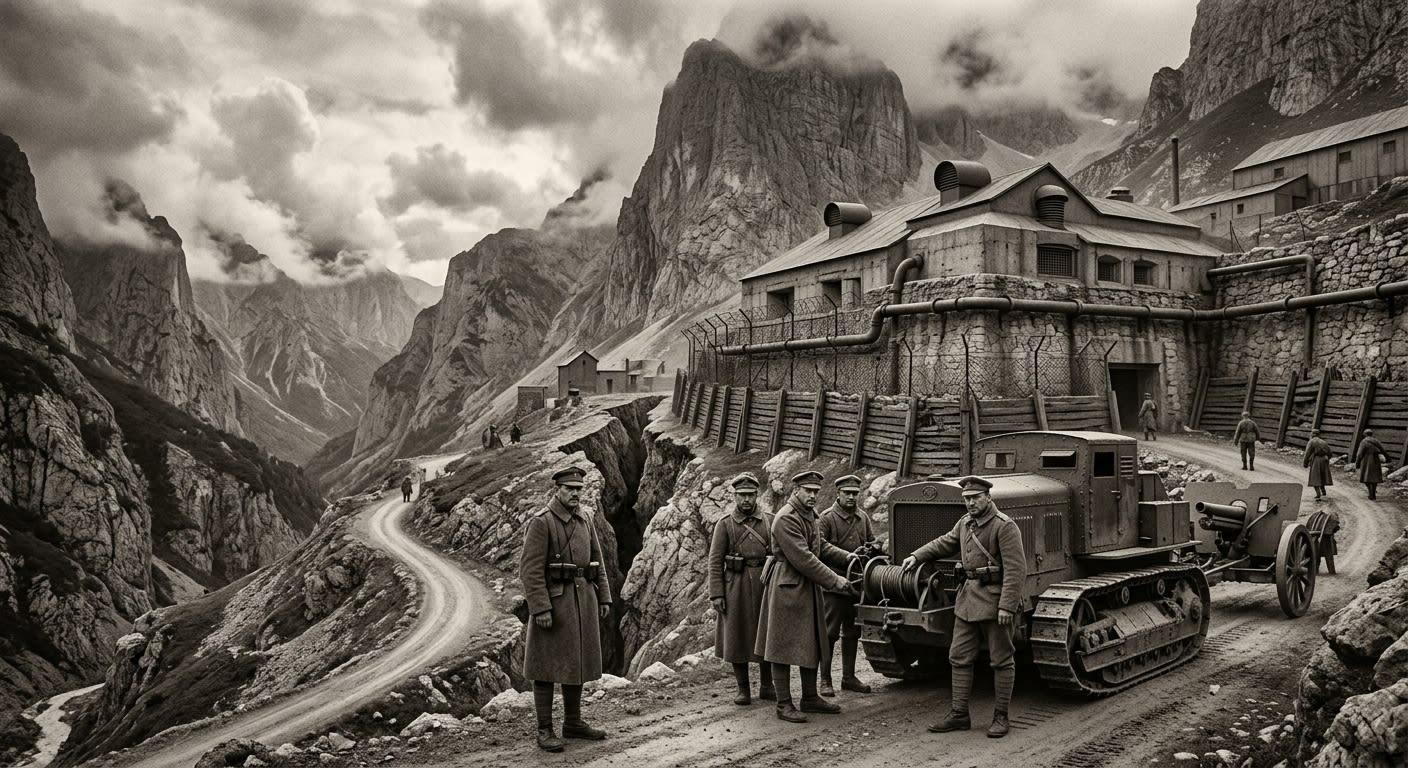
Then Hell opened its mouth, and the mountains acquired a second profession.
The first decades after A.S. 45 tore the east into zones of flight. Armies retreated through the passes. Villages emptied westward. Priests carried reliquaries in grain carts. Engineers marked defensible saddles with chalk and blood. The Bureau had not yet become the organism it now is; it was still learning the superb art of making emergency permanent. Every ridge that held for a day became a post. Every post that held for a season became a charter. Every charter required a clerk, and every clerk required food, and every sack of food required a road that did not presently exist.
The Carpathians taught the Synod its earliest logistical humiliation. The mountains accepted decrees, then ignored them. Writs authorised roads that snow had removed. Maps displayed bridges that spring melt had eaten. A valley cleared in the morning could be full of enemy-corrupted cattle by Vespers. A convoy that entered a pass with forty men, twelve wagons, three bells, and a licensed chaplain might leave with four men, no wagons, one bell, and a chaplain whose licence had become a moot point because he was now speaking through a mule.
Early catechisms describe the Carpathian defence as “a spontaneous rising of faithful mountain communities.”
Corrected. The communities rose when ordered, fled when hungry, bargained when cornered, and returned when the Bureau offered bread with a stamp on it. Faith was present. So were boots, fear, and arrears.
The Siege of Vienna in A.S. 95 hardened the western routes, but the mountains had begun their transformation earlier. A.S. 65 fixed the Line in principle. A.S. 67 saw Synod surveyors claim the old Rationalist garrison at Przemyśl. By A.S. 75, the Wire Orchard had its first two-mile extension. Beaconchain works followed in the northern ridges after the A.S. 72 convoy loss, when eleven wagons and three hundred mules vanished in winter with every seal intact and no man left to explain the compliment. The Third Light rose on higher basalt after the First and Second burned in a lightning storm that struck from below the ridge, an event Engineering classified as electrical and Bells classified as rude.
The Night of Black Decrees sent new ash-waves of refugees into the passes and taught the mountain offices to sort bodies by destination before sorting them by pity. That order remains in use because it saves time, and time is the only form of mercy the Carpathians have never manufactured locally.
#On Przemyśl, Sibiu, and the Middle Wall
Przemyśl is the northern fist. Sibiu is the southern shoulder. Between them the Carpathians form the Synod's crooked middle wall.
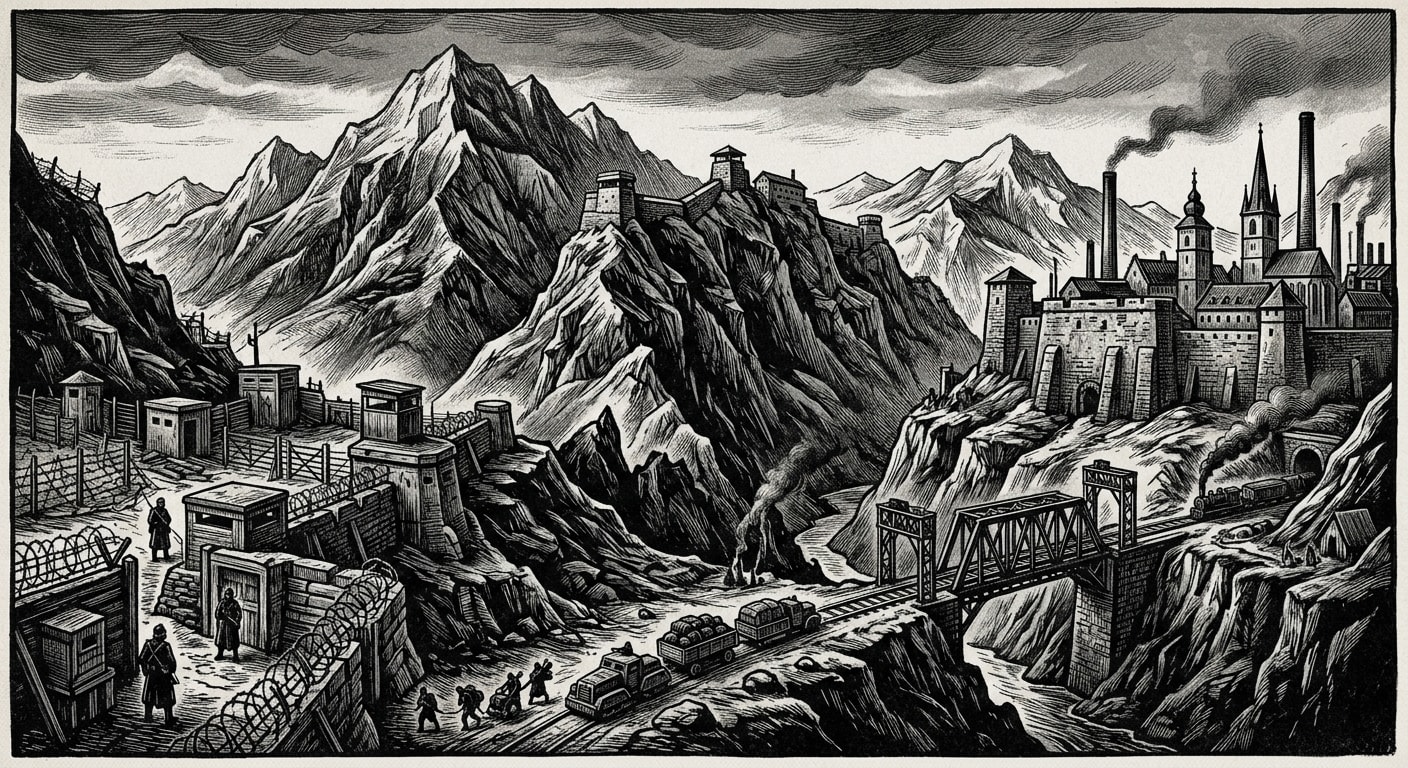
Przemyśl stands at the western Carpathian convergence, a ration-fort and choke-bastion built from an old garrison and improved by men who believed no human difficulty had reached its final form until electrified wire was added. The Wire Orchard is its signature: three miles of barbed steel, transit chits, ration tags, confession receipts, sleeves, scraps, and the occasional argument between Bells and Doctrine over whether the low humming at night counts as music. Everything entering the mountain war through Przemyśl is processed. Everything leaving is stamped. What fails to satisfy the stamp feeds ditchpits, patrol ledgers, or the Underwire.
Sibiu holds a different anxiety. It is built upon fortified Saxon habit, upon churches designed by generations who knew that the Creator appreciates thick walls, upon the Transylvanian Alps where passes can be shut by artillery, snow, sabotage, or one grandmother with correct local gossip. Sibiu faces Velmora and her purchased loyalties across the gold-veins. Direct assault is less common there than bribed supply, vanishing caravan, false salvage, coin that returns to the hand warm, and quartermasters who wake with a route they did not approve already written in their own ink.
The gap between Przemyśl and Irongate once yawned like an invitation. The Line could not survive such a gap. Sibiu made the invitation expensive. The mountains themselves became outer works: ridges as bastions, ravines as ditches, pine belts as screens, snowfields as white minefields whose charges are thaw, thirst, and misplaced confidence.
The old maps called this region defensible. That word has misled more officers than cowardice ever managed. Defensible does not mean safe. It means the ground will kill both sides in ratios that can be entered into a report. The Carpathians are defensible in the same sense a spiked chair is secure seating.
The smaller works between the two anchors have accumulated like scabs along a wound. There is the Arch of Saint Harrowglass in the approaches, an ossuary checkpoint whose shrine-glass rings hollow when cowards pass beneath it, or when the glass feels theatrical. There are the Bone-Lattice Warrens of Black-Snow Lor, born as a storm shelter with four walls and a clerk, now a settlement that houses more people than its own census will admit. There are signal huts set into ridges, charcoal watchrooms, quarry chapels, mule sheds with loopholes, abandoned pest houses restored as ammunition caches, and those nameless square forts that appear on no map because if they were mapped some office would have to pay for their roof.
Each small work has a patron, a keeper, a shortage, and a ghost story. The patron is usually sainted beyond evidence. The keeper is usually underpaid beyond charity. The shortage is always lime, wax, lamp-oil, nails, men, patience, or truth. The ghost story is sometimes false, which in the Carpathians is a technical distinction with limited field value.
The Line in these mountains is a series of locks, not a wall. Lock one: a pass. Lock two: a gate. Lock three: a permit hall. Lock four: a confession booth. Lock five: a ditch full of men who believed the previous four did not apply to them. The Synod excels at locks. The enemy excels at finding keyholes inside people.
#On the Enemy Above and Below
Atheron owns the eastern heights opposite Przemyśl, or rather he asserts ownership, which in his theology is stronger than deed and less susceptible to audit. His Ebon Heights rise beyond the wire with spires that grow year by year, each summit crowned by a tower taller than the last, each tower instructing the garrison in the posture of looking up. He holds passes because they are high and because men can see him from below. Strategy is present. Vanity gives it orders.
Atheron's war in the Carpathians is not mere assault. He sends hierarchies downhill. Crownguard Titans walking like coronations. Mirror-Lords who make officers kings or worms and thereby ruin cooperation. Sun-Spear formations that blind men with a vision of their own smallness. Ascendant Shades striking from reflections in polished steel. Field commanders at Przemyśl have learned to target leaders, break chains of command, and watch Pride's subordinates freeze while awaiting orders from corpses. The tactic works. Then the hierarchy re-forms, because Pride is brittle, not stupid.
Atheron's subtler pressure is worse. The Carpathian theatre breeds justified resentment: officers ignored, engineers overruled, chaplains mocked by bishops, clerks whose improvements are stolen by superiors with cleaner cuffs. An influence-demon need only agree. You deserve better. They do not see you. You should command. These sentences are dangerous because they are often true. Hell's finest lie is the accurate one delivered at the wrong altar.
Velmora gnaws the southern Carpathians with coin and contract. The Transylvanian veins feed her arithmetic. A convoy captain paid once becomes a route failure later. A mine warden who accepts a key wakes to find his storehouse unlocked from the inside. The Ten Thousand Keys cult loves the mountain passes because locks are everywhere: toll gates, powder stores, rail sheds, shrines, mouths. Velmora does not need to storm a gate that can be purchased by the hinge.
Syrion reaches less formally but no less foully. His time-fog drifts westward from Shipka and sits in Carpathian saddles like a lazy clerk occupying the only chair. Factors call it singing weather. Harness buckles loosen. Mules sit down. Men repeat the same sentence until dusk. Bell-credit rots in the pocket. A route that should take six hours takes three days and arrives claiming no delay occurred. Bells dislike Syrionic fog because bells are honest about time, and the fog regards honesty as needless exertion.
The lesser horrors perform the daily work: Rot-Oxen whose corpse-carriages spoil bread and rust iron; ash-fog that arranges itself into processional lanes; Black Ledger raiders; deserter saints; old tunnel things beneath Przemyśl; villages that answer to names removed from Records; wolves with pilgrim ribbons in their dung. The Carpathians do not run out of enemies. They store them in layers.
The mountains also preserve older sins, which is why Purity officers enter them with more forms than bullets. Rationalist bunkers remain sealed under prayer marks, their doors welded, their air vents plugged with bones and lime. Certain chapels built after the Black Decrees stand on foundations older than their charters, and their stones sweat in summer with ink-coloured damp. Shepherd families report iron crowns found in thaw and cast them back into ravines without consulting Heraldry, an omission that has saved several districts from official curiosity. In the Carpathians, wisdom often appears as failure to notify Strasbourg. Blessed negligence, stamped late.
Scouts returning from the eastern faces speak of caves where spoken rank echoes back higher, as though a corporal enters and hears himself addressed as colonel. Men who answer the echo begin correcting their officers within the week. Men who refuse the echo often dream of ladders. The Bureau of Doctrine has no category for self-promotion by acoustics. The Bureau of Purity has proposed one. Records has requested a shorter title.
FIELD MEMORANDUM — NORTHERN SADDLE, A.S. ███ Patrol found twenty-seven bells hanging from pine branches. No tower within six miles. Each bell bore a different village name. Three names were of villages not founded until later filings. The seventh bell rang when touched and answered in the inspector's childhood voice. Inspector promoted posthumously. Body not recovered. Promotion accepted by next of kin under protest.
#On Roads, Rails, and Mountain Arithmetic
The Carpathians made logisticians into theologians and theologians into baggage.
The Carpathian Corridor is the famous throat: Budapest west-bank yards and Bratislava approaches through Turda and the ridge-gates toward Przemyśl and Sibiu. It carries flour bricks, chrismole, lamp-oil, rails, bodies, wax blanks, spare bells, confession paper, artillery mouths, and the peculiar odour of men who have discovered that every plan is a draft until the mule consents. It is not one road, whatever the map says. It is an argument conducted through roads, rails, goat tracks, toll chapels, hidden culverts, and weather.
The Guild of Rails learned its authority here. During the Gauge War, A.S. 96 to A.S. 136, every Carpathian supply train could become a public confession of bad measure. Shells were unloaded, transferred, reloaded. Flour spoiled. Wounded men froze between carriages. The Przemyśl Split and the Sibiu Mouth became names men spat before they prayed. Standard Measure arrived in A.S. 136 at 1,435 millimetres, backed by closure threats and four thousand dead in the relaying. Strasbourg called it technical consensus. The Guild called it the Years of the Hammer. Widows called it by names unsuitable for catechism.
School primers record the Carpathian rail correction as an orderly improvement in military transport.
Corrected. It was a forty-year quarrel over distance, paid for in crushed hands, cold platforms, mislaid prisoners, cracked shells, and bastion hunger. Order arrived late and demanded applause.
Road power belongs to Caravan Factors. They came before licences, grew from failed clerks, widows, soldiers, wagoneers, smugglers, and those blessed criminals who know which gate wants grain and which wants wax. By A.S. 100, the Carpathian road to Sibiu could not function without them. A.S. 134 made them official, which means taxable. A Factor reads a route-cord by touch while lying politely to a sergeant. He knows the mountain's prices: one sack for passage, one stamp for silence, one mule for traction, one unregistered passenger under psalter-straw if the gate is vain and the wax is good.
Saint Kelm the Measurer presides over that trade from wayhouse doors, uncanonised and indispensable. Broken wheel. Chained ledger. Count what remains. Do not count the dead until morning. The Bureau tolerates him because the grain arrives. Doctrine has made harsher concessions for less bread.
The Reliquary Switchbacks deserve their own bruise in the Ledger. In A.S. 74 the Sixth Carpathian Route Audit widened an old shepherd path into the sole viable relic corridor between forward bastions and lowland spurs. Every turn received a shrine, a toll, or a femur driven into shale after the A.S. 76 avalanche killed forty-seven porters and turned inconvenience into martyrdom. By A.S. 82 every bend had a name. By A.S. 92 the Relic Registry Office had licensing authority. By A.S. 199, name-drift made certain turns answer to titles not stamped in any known route book. The Switchbacks continue to function, which is the Bureau's preferred word for a miracle that invoices poorly.
Winter gives the arithmetic its final examination. Rail freezes first at exposed plates; roads vanish under white sameness; mule hooves crack; men sleep while walking and wake only when slapped or dead. A good mountain quartermaster stores salt in three places, fodder in four, wax under his bed, lamp-oil away from chaplains, and one clean seal in a pouch sewn inside his coat. A bad quartermaster trusts the schedule. The Carpathians have eaten many bad quartermasters and several good ones with poor assistants.
Avalanche offices exist, which sounds like satire until one observes an avalanche with paperwork pinned to it. The Bureau of Engineering marks risk slopes. The Bureau of War demands passage. The Bureau of Pilgrimage petitions for shrine access. Tithes asks whether falling snow constitutes obstructed taxable surface or divine interruption. The avalanche does not reply. It descends with admirable administrative economy.
#On Villages, Bells, and the People Who Remain
The villages of the Carpathians are expert in small loyalties. A lowland city pledges to Strasbourg in marble and trumpet. A mountain village pledges to the bell it can hear, the gate that lets its flour through, the captain who did not requisition its sons this week, the saint whose shrine has not yet been taxed into ash.
Borders in the marches are surveyed by sound. A storm can carry Przemyśl's bell over a hamlet usually claimed by Sibiu's chain. Tithes shift. Prayers retune. A clerk arrives three weeks later with a correction, by which time the goats have been assessed, the dead buried under the wrong patron, and the village headman has discovered that ambiguity is an agricultural asset. Once, two bells rang over the same hamlet at dawn. The villagers divided by household, then by room, then by bed. Purity arrived after the knives and filed the matter under Excessive Devotional Precision.
Mountain culture is not romantic. Romance is what urban poets manufacture after failing to smell a winter goat shed. These villages live on bitter bread, cabbage, smoked roots, old cheese, black tea, ration salt, and the profit of knowing where the official road is wrong. Children learn bell ranges before letters. Women keep route marks under floorboards. Men who boast of secret passes are given less wine than men who quietly know them. Priests bless snowmelt, axes, bridge pins, and mule knees. The best confessors ask fewer questions during thaw.
The Bureau of Purity hates the Carpathians because the mountains make certainty expensive. Heresy hides in ridge speech, toll customs, bell variants, saint nicknames, boot charms, fog rules, and the merciful category of things everyone knows and nobody names. A Purity inspector can burn a charm. He cannot burn the reason the charm was useful unless he also burns the road, the weather, and the memory of the last man who ignored it and died with snow in his mouth.
The people who remain are accused of stubbornness by officials who visit in summer. Stubbornness is the polite charge. The truer charge is that mountain folk possess a memory longer than the Bureau's patience. They remember which saints failed to stop the avalanche and which unapproved song did. They remember the year Przemyśl requisitioned their goats and returned boots. They remember Sibiu's gold inspectors arriving with clean gloves and leaving with local wives, local debts, and local enemies. They remember every road closure that became permanent after a clerk found a cheaper ink colour for abandonment.
Their loyalty is real, but it is local first, bell-bound second, Synodal third, and rhetorical whenever a tax assessor takes notes. Strasbourg calls this weakness. I call it the usual arrangement between centre and edge: the centre believes itself obeyed; the edge believes itself patient; the road between them carries both delusions at tariff.
#On the Present Condition
As of A.S. 201, the Carpathians remain held, contested, counted, miscounted, fortified, bribed, sung through, frozen, taxed, and insufficiently understood.
Przemyśl reports increased tag pressure after the eastern disturbances of A.S. 198 and A.S. 199. Sibiu reports more bribed convoys, false seals, and gold-warm coin found in honest men's pockets. The Beaconchain records answering fog since A.S. 194, with log procedures amended so many times that the amendment book now requires its own oath-collar. Factors report more singing weather in saddles previously rated safe. The Guild reports tunnel settlement, bridge doubt, ballast movement, and other phrases by which iron politely announces it may kill you soon. Purity reports suspicious devotional variance. Tithes reports undercollection. War reports need.
War always reports need.
The Carpathians hold because no single office commands them completely. This offends doctrine and preserves function. War mans the posts. Rails carry what roads cannot. Factors carry what rails refuse. Bells tell villages whom they belong to for the next morning. Purity hunts what certainty can catch. Records files the remainder. Tithes taxes whatever survives into a category. Doctrine, with its usual elegance and my invaluable assistance, calls this Order.
The enemy remains east, above, below, and inside. Atheron's spires continue to insult the dawn opposite Przemyśl. Velmora's purchase-money moves through Transylvanian cracks. Syrion's fog naps in high saddles. Old tunnels breathe. Bell towers answer at improper distances. The mountains take men from both armies and return lessons nobody wanted.
At first light, the Carpathians perform their ordinary liturgy. Snow loosens on a ridge. A Track Walker taps rail and hears a dead note. A Factor wakes with his hand on a route-cord. A village headman listens for the bell before deciding which office owns his goats. At Przemyśl, the Wire Orchard hisses. At Sibiu, a quartermaster weighs coin in a gloved palm and orders it burned. Somewhere above the pine line, a bell rings where no tower stands.
The mountains do not kneel. We have made them useful anyway.