
#On the Certification Withheld
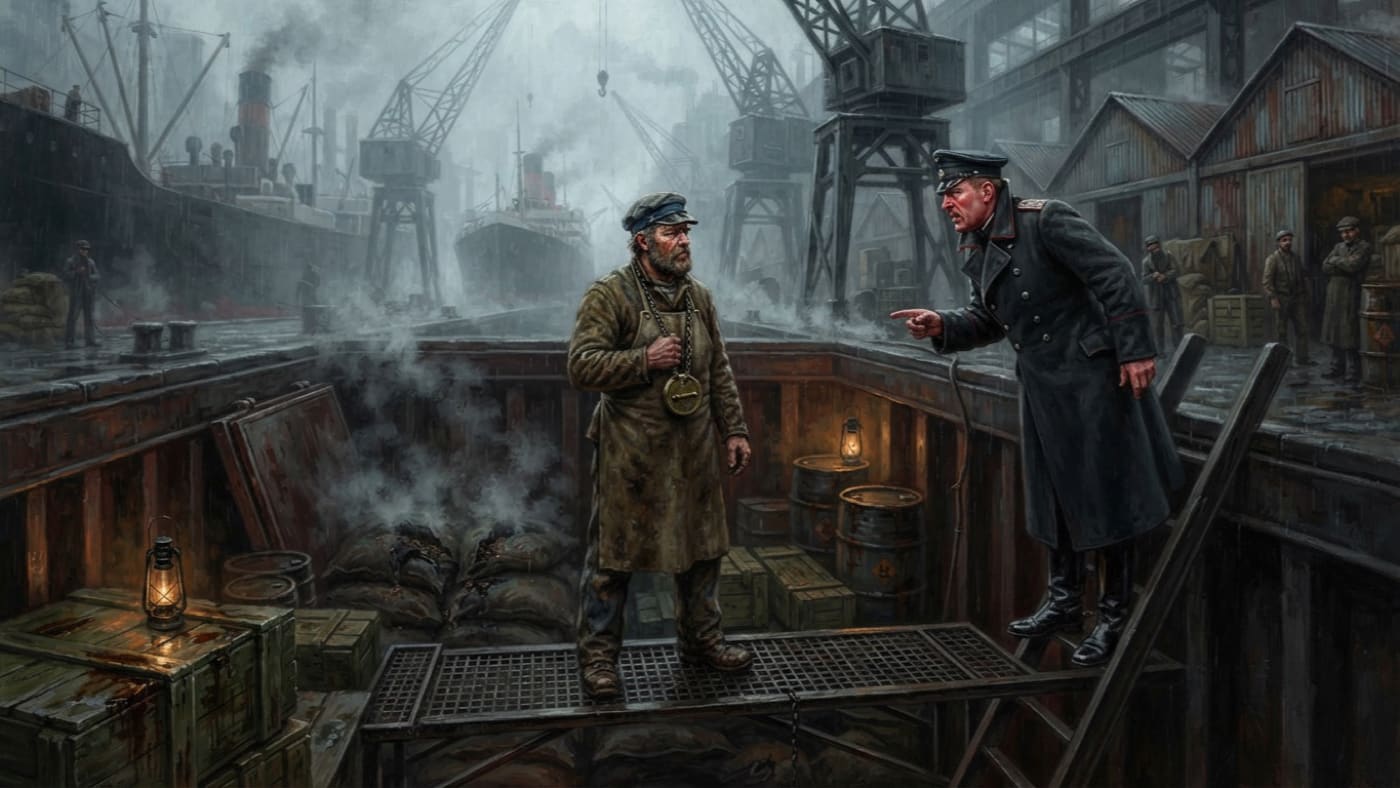
A ship can arrive in Hamburg with every preparation made. Its manifest is blessed, its berth assigned and its rail wagons wait on the siding, while a War officer paces the quay with a timetable in his fist. None of this moves a sack. Until a senior holdman of the Stevedores' Compact releases the hold-order token, the hatch belongs to the hold. The hold belongs to whatever is lying in it.
The Hazard Clause concerns that token, and more exactly the man who keeps it in his pocket. Since A.S. 189 a senior holdman may refuse to certify the discharge of unstable chrismole, damp ordnance, or grain heated beyond safe measure. For that refusal he may not be arrested at the hatch for obstruction. That is the whole of the privilege. It is as narrow as a hatch ladder, and men climb it daily.
Its jurisdiction is shipboard. The Longshoremen's Brotherhood commands the quay with its hooks, slings and chalk, and the clause grants the Brotherhood nothing. A crate condemned below deck never reaches the quay to be argued over. A crate certified below deck becomes the quay's problem with the Compact's thumbprint upon it, and the Compact's elders prefer their thumbs unindicted.
#On Warehouse 17-E
Warehouse 17-E stood in the Dock Quarter with a wall already condemned and still unrepaired. Against that wall sat chrismole in wooden crates stacked six high. Chrismole is sanctified fuel, the Church's own heat, the substance that feeds furnaces from the rear foundries to the Line. When the wall failed in A.S. 189, the fire went where unsafe storage had already laid its road. Four blocks burned in the Dock Fire. Three hundred and twelve people died.
The dead included dock workers, tally clerks, cart boys, surgeons and observers. Some burned so completely that Records could only list them by category. Records prefers the dead that way in any case, and on this occasion the fire spared it the trouble of asking.
Then the guilds stopped. The Compact withheld its deep-draught grain crews and the Brotherhood refused the western quays. The Coal-Heavers' Union refused night unloading and then refused the day as well. Twelve dock bodies closed the port for eleven days. Hamburg is the Synod's largest naval import terminal. Eleven days without it is long enough for an army to learn how much of its courage is porridge.
Two demands left the Dock Quarter, though clerks in Strasbourg filed them as one. The first was payment for dangerous work. The second was a voice in deciding which work was too dangerous to do at all. The Compact's stoppage notice withheld certification wherever fire risk, wall condemnation or fuel-adjacent cargo stood under dispute. That was the vocabulary of a strike, and the settlement would choose smaller words.
#On the Twelfth-Day Settlement
On the twelfth day the Bureau of War offered a seven-per-cent hazard supplement. The Bureau of Tithes agreed not to tax it. These are two concessions from two offices, and the reader should keep them apart as carefully as chrismole ought to have been kept from that wall. War paid. Tithes forbore, and has been sore about it since.
The supplement was money. It paid men to enter holds and yards that had just killed their neighbours. It bought their labour, but it did not buy their signature.
The Compact understood this before anyone on dry ground did, and it added a condition of its own before returning to the hatches. Senior holdmen could refuse certification for unstable chrismole, damp ordnance or grain heated beyond safe measure without immediate arrest for obstruction. War accepted. Tithes complained.
No signatory roll has reached any file I can lay hands on, and neither has any clause number worth its wax. The Codex therefore prints what the settlement did and does not pretend to know its wording.
War accepted because it needed grain moving on the thirteenth day. Twelve guilds had shown, with tedious unanimity, that the Synod cannot lift sacks with doctrine. A clause costs nothing until somebody uses it. Tithes, which reckons every cost in advance, saw the bill at once.
#On the Senior Holdman's Judgment
The three hazards are named, and the naming matters. Anything left unnamed stays subject to the ordinary displeasure of officers.
Unstable chrismole comes first. The fuel sweats heat through its casing, and a crate that has shifted, split or sat badly through a rough passage is a small Warehouse 17-E looking for a dock to burn. Damp ordnance is second. Powder and shell resent water, and munitions from a wet hold may refuse to fire at the Line or fire early at the quay. Heated grain comes last and is the most frequent. Grain that has taken water swells and splits its sacks, the split sacks heat, and heated grain turns into a mould garden that Purity insists on cataloguing once everyone else has finished retching.
The holdman judges with the tools the Compact already carries. His rank shows in the bent hatch nail worn on a cord at his throat. He reads the bracing for the twist of passage and the tally cord for its three-knot warning of compression. He lays a palm flat on the sacks, smells for damp and listens for the slow settling that comes before a collapse. Then he releases the hold-order token, or he keeps it.
The clause supplies no numbers. It sets no temperature at which warm grain becomes condemned grain, prescribes no assay of chrismole stability and names no tribunal of appeal. The settlement trusted the senior man's experience because the alternative was a Strasbourg standard drafted by men who had never been below deck, and men of that kind had approved the crates against the wall.
Its protection is just as lean. The holdman is shielded from immediate arrest for obstruction, and that is the whole shield. He gains no general immunity, no right to close the port over a grievance and no exemption from military authority. A refusal outside the three hazards is an ordinary refusal and meets the ordinary consequences. A refusal within them may still be questioned, disputed and remembered at the next contract. What the clause forbids is the convenient arrest at the hatch. That arrest was the old instrument by which unsafe cargo had always been made safe on paper.
#On the Offices That Require the Cargo
War tolerates the clause because it counts in throughput, and a hold that collapses on its crew unloads nothing for days. A refused hatch costs an afternoon. A burned quarter cost eleven days, along with a winter's supply of excuses passed down the Northern Corridor to garrisons who did not want excuses.
Tithes counts in weights. To the Counting House a declared weight is covenant, and a cargo condemned below deck turns its declared weight into fiction before the tax can be taken. Every refusal under the clause alters a receipt, and every altered receipt produces a memorandum. The memoranda have not stopped since A.S. 189. They reach Strasbourg in the tone of a creditor writing to a corpse.
Purity's interest is narrower and more theatrical. Its inspectors want to see heated grain before anyone else touches it, and now and then they arrive in time. The clause neither helps nor hinders them. It only keeps the man who smelled the rot out of a cell long enough for Purity to ask him what he smelled.
The Compact's A.S. 189 refusal delayed military supply for eleven days.
Clarified. The fire, the condemned wall, unsafe storage and the prior official refusal to repair that wall delayed military supply. The guilds made the delay visible to officers who notice danger only when it interrupts a schedule.
#On Present Application
As of A.S. 201 the clause stands as the Compact's modern precedent, and the northern front feeds through the holds it governs. British grain for Bastion-Königsberg and Bastion-Brest passes under a senior man's hand before it reaches the rail. Foreign hulls whose captains answer to crowns outside the Synod wait at berth while a Hamburg guildsman decides whether their cargo comes ashore at all.
Admiral-Prefect Gerta Halske weighs each refusal by spoilage risk, military consequence and foreign consequence, in roughly that order. When a British captain arrives with foul ballast and a clean smile, she lets the Compact go below first. Tithes may complain afterwards, at the speed of dry ink.