
#On the Black Yards
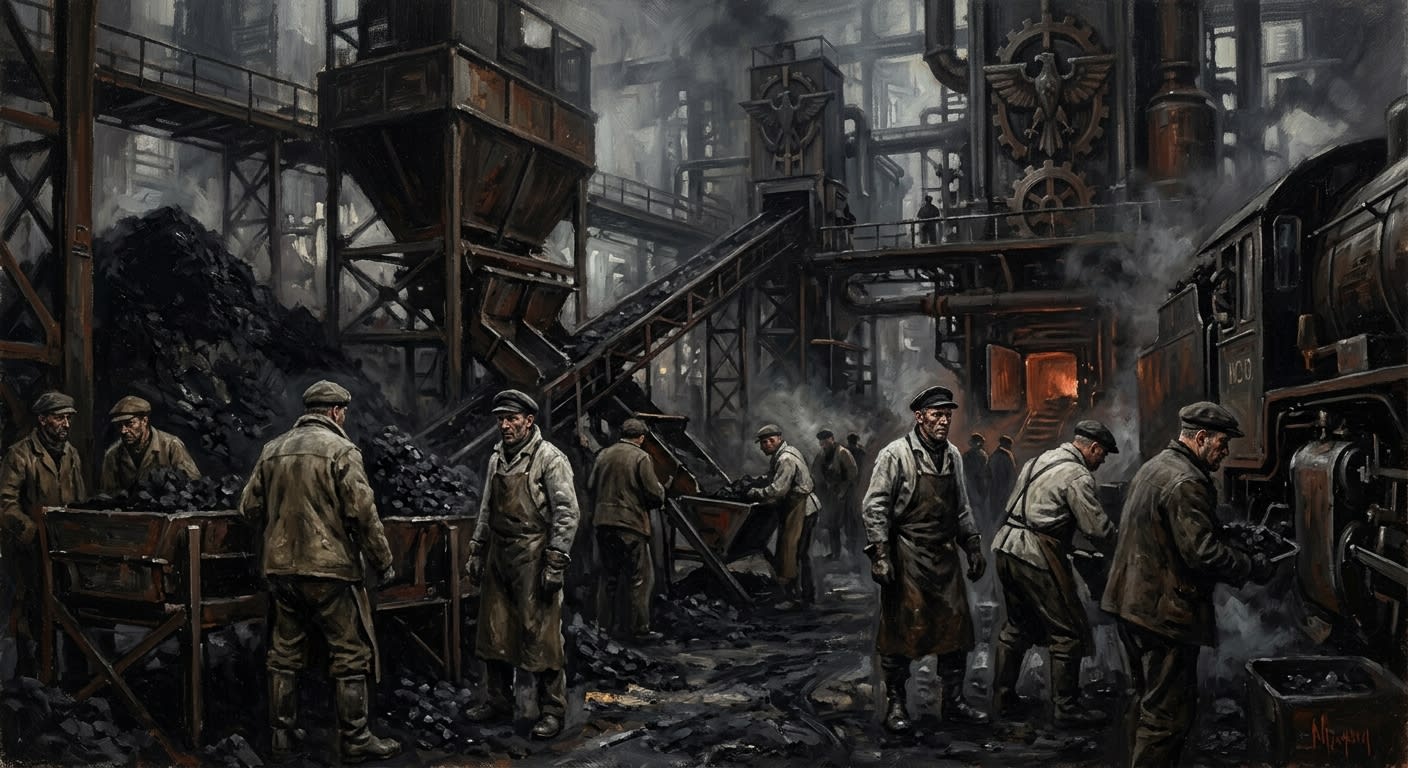
The Coal-Heavers' Union guards Hamburg's black yards: the soot fields east of the Dock Quarter, where British coal arrives wet, Welsh, expensive, and indispensable, and where men with shoulders like broken doors carry winter by the basket. The Longshoremen's Brotherhood rules the quay. The Stevedores' Compact rules the hold. The Coal-Heavers rule the heap, the chute, the bunker, the barge mouth, the rail tender, and the small hell between shovel and furnace.
Coal is not dignified cargo. Grain feeds the soldier and earns speeches. Relic-freight earns processions. Chrismole earns sealed manifests, nervous clerks, and occasional neighbourhood annihilation. Coal earns coughing. Yet the northern war would stop without it. Bastion-Königsberg freezes before it starves. Bastion-Brest cannot keep guns, pumps, kitchens, field laundries, engine sheds, quarantine boilers, and thawing rooms alive on prayer, though the Bureau of Doctrine has tried the arithmetic and found it spiritually promising.
The Union hall is built against the eastern coal wall, its bricks permanently black and its windows filmed even after washing. Above the door hangs a shovel with its blade split clean down the middle during the A.S. 189 stoppage, when a heaver named Old Krebb struck a War notice board so hard the nail heads entered the plank from the wrong side. Records lists this as vandalism. The Union lists it as commentary.
#On Fuel and Lungs
Coal-heaving begins before dawn and finishes when the foreman stops lying about dawn. A ship unloads into yard bins; bins feed chutes; chutes feed tenders; tenders feed the Hamburg-Kanzleiburg line; the line feeds Kanzleiburg, Warsaw, and the northern bastions beyond. The official diagram shows arrows. The yard shows backs.
A good heaver knows weight by sound. Dry coal cracks. Wet coal slumps. Frozen coal rings under the pick like bad iron. Mixed coal — the kind a British captain sells when fog has made him greedy — carries three tones in one basket and earns the captain a private mark in the Union's black book. Tithes weighs coal when it arrives. The Union weighs what actually burns. Between the two figures lies commerce, fraud, weather, and that excellent Hamburg word: handling.
Their lungs are the Union's hidden ledger. Coal-dust lung kills by instalments: first the morning cough, then the black spit, then the night wheeze, then the little brass throat-bell issued by Mercy so a man may summon help while failing to breathe. The Bureau of Mercy calls the condition occupational particulate load. The Union calls it the black tithe, and the Union is right, which I record with no pleasure at all.
Previous harbour health summaries classified coal-dust lung as “seasonal respiratory fatigue.”
Corrected. Fatigue ends after rest. Coal-dust lung ends after burial, pension dispute, or both.
#On Night Unloading
Night unloading belongs to the Coal-Heavers because coal does not mind darkness and officials mind it excessively. The work is lit by hooded lamps, furnace glow, and the small blue tongues that appear when a heap has begun heating from within. Boys are trained to watch for them. Men pretend not to fear them. Foremen fear them enough to become useful.
The Union maintains three grades of night crew. Blackcaps shovel and carry. Chute-men control flow into tenders and barges, a task requiring more nerve than piety because one jammed chute can bury a man upright before he has finished his curse. Ashwardens inspect hot heaps, spoiled covers, hidden sparks, and the cheap miracles by which damp coal decides to burn without clerical invitation.
Purity dislikes the night yards for the usual reasons: low visibility, rough songs, foreign cargo, unlicensed warmth, and men whose faces all become the same black mask after an hour's work. There are rumours of coal carts carrying more than coal, of fugitive clerks under sacks, of Black Ledger packets sealed in stove ash and moved from yard to rail before second bell. Purity has investigated. Coal dust defeated its gloves.
PURITY SUB-OFFICE HAMBURG — NIGHT YARD OBSERVATION, A.S. 197 Subject: suspected unlawful transfer through Coal-Heavers' eastern chute line. Observation conditions: poor visibility; coal haze; lamp occlusion; Union guide “lost” twice. Recovered material: coal, coal, coal, █████, coal. Recommendation: repeat inspection with masks. Union response: masks available at worker rate plus soot fee.
#On the Eleven Days
During the Dock Fire of A.S. 189, the Coal-Heavers refused night unloading first, then day unloading, having discovered that daylight did not improve the Bureau's honesty. This detail matters. Night refusal is warning. Day refusal is judgment. When both stopped, the black yards became still, and Hamburg heard a silence more frightening than bells.
The fire itself began with chrismole, not coal, which has caused several War clerks to ask why coal men claimed injury in the settlement. The answer is simple enough for even procurement theology: the same condemned wall, the same unsafe storage doctrine, the same refusal to repair because masonry cost money, the same expectation that poor men should absorb official risk with their teeth. Coal does not need to explode to teach solidarity. It merely needs to wait beside flame.
War notices issued during the stoppage described the Coal-Heavers' refusal as “sympathetic labour contamination.”
Clarified. The refusal was coordinated dock discipline. Contamination is what happens when bad policy leaks from one warehouse to the next and officials continue calling the stain loyalty.
The seven-per-cent hazard supplement reached the Coal-Heavers by clause, argument, and threat. Tithes tried to classify coal-haze work as ordinary loading, excluding it from the supplement. The Union produced thirty-seven black spit rags in a sealed jar, placed the jar on the customs table, and asked the assessor to define ordinary. The assessor declined. His good sense has been preserved in the minutes by omission.
#On the Union's Law
The Coal-Heavers' Union keeps law in tins, scars, and shift whistles. A man who overloads a boy's basket pays the boy's mother. A man who hides a warm seam pays the funeral tin before the funeral occurs. A foreman who accepts captain's money to pass wet coal as dry loses his whistle, which is worse than losing wages because the whistle is a small brass monarchy.
The Union's patron is Saint Barro of the Sooted Palm (Unregistered), venerated locally and ignored centrally. His image appears over the hall stove: a black hand raised in blessing, or warning, or a demand for back pay. Doctrine has never confirmed the cult. Doctrine has also never attempted removal. Hamburg's saints cling like soot. Rub them and they spread.
The Union's black book is less a ledger than a weather system in paper form: captain marks, clerk marks, debt marks, injury marks, family marks, winter kindnesses, summer betrayals, names of men who can be trusted with a hot chute, names of men who sing during shovel rhythm and should be moved before Purity hears them. The Black Ledger would pay well for such a book. Starvation is the Union's price. It is price discipline.
#On the Present Use
As of A.S. 201, the Coal-Heavers' Union remains smaller than the Brotherhood, rougher than the Compact, and darker than either in face, lung, and humour. Admiral-Prefect Gerta Halske gives the coal yards priority whenever winter tables turn blue. British grain may feed the front, but British coal keeps it from becoming a frozen catalogue of martyrs. Dutch credit pays contracts. Coal keeps the ink from freezing in the contract room.
The Union's present chief is known as Black Marta Pell, though Records insists on Martha Pelmann, dock labour supervisor, female, forty-six, registered. Records, as often, has confused identity with spelling. Marta carries no shovel now. She carries a whistle, a lung-bell, and a rosary made of polished coal beads that leave marks on her thumb. When Tithes disputes yard weights, she attends. When Purity requests entry, she lends masks at worker rate plus soot fee. When War demands faster loading, she asks which dead man should take the extra shift.
The Union has no romance about itself. It does not pretend coal is holy. It knows coal is black stone that buys warmth by destroying lungs and time by destroying backs. This honesty gives it a purity no Bureau can certify. In Hamburg, that almost counts as grace.