
#On the First Confession
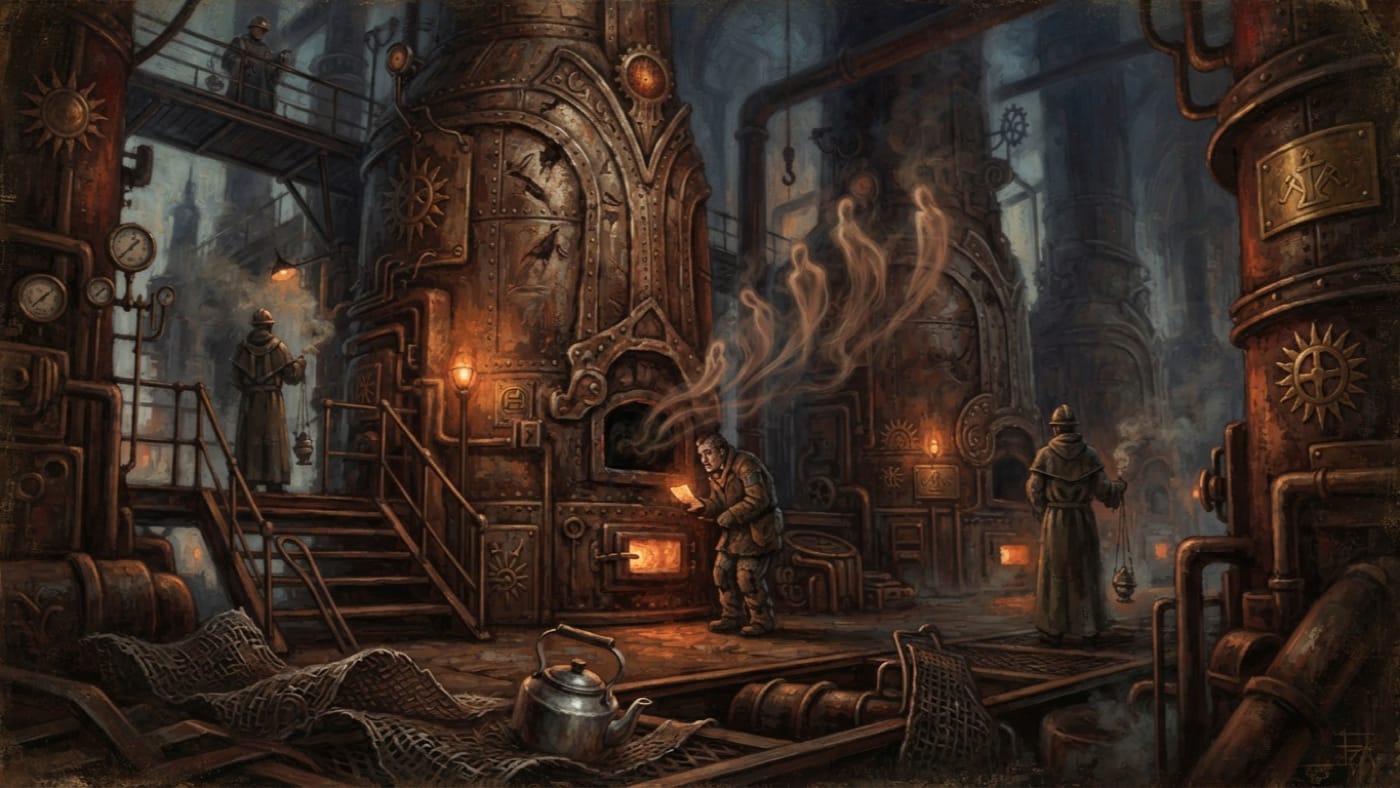
The Heretical Hymn entered the Ledger the way most catastrophes in Brast do: on cheap paper, in a worker's hand, at an hour when nobody of rank was awake. In late A.S. 201 a furnace-feeder assigned to night ash-scrape at the Chrismole Crown went to his confessor with something he could not keep down. He had heard singing from behind Kiln Three. The voice, he said, was like wet iron cooling.
Mark the preposition. Behind. The feeder did not see the warped mouth of the furnace open, and he never claimed to have seen it. He reported a sound, a place, and a warmth in his teeth that stayed with him for the rest of the scrape. The priest took the slip, as the Furnace Chapterhouse of Saint-Combust takes every slip, and afterwards reported that it grew hot in his hand.
So there were two witnesses, and one of them was a sheet of paper.
Provincial readers must keep hold of one fact: Saint-Combust is a furnace. Kiln Three blew inward on the nineteenth day of Ashmonth, A.S. 74, and nine men died at second-bell feed. In wording the Bureau of Doctrine has since sealed, the furnace was afterwards classified as "a vessel of instructive Providence", its disaster "consistent with martyrdom." Its shell still stands among the seventeen kilns of the Crown, railed and anointed and clad in iron that the Chapterhouse calls vestments. Behind the eastern chapel the Chapterhouse keeps an archive of every confession in the Crown. The feeder's slip went into that archive still warm.
#On the Forbidden Address
What the feeder heard was recognisably a work measure, and it was recognisably wrong. His confession gives three particulars. The Chapterhouse has published none since.
The singer put the stress of the distillation measure in the wrong place. The mercy syllable was reversed. And the singer addressed Saint-Combust as Brother Furnace.
Particulars of the measure as reported: distillation stress misplaced; mercy syllable reversed; address, Brother Furnace. Phrase as sung: ████████████ ██████. Withheld from public copy. The Ledger holds no authorised transcription.
The first two faults belong to the Calibration Choir. Its slates record where every stress must fall and which syllable begs which valve for mercy. In Brast a work song is a calibration specification, and omitted stanzas have been blamed for more than one burst boiler, so a misplaced stress is a technical offence and technical offences kill people. The Choir corrects such faults with one raised finger and a fine.
The third fault belongs to Doctrine, and Doctrine has no finger small enough.
Every approved rite in the Chrismole Crown sets the furnace either beneath the speaker or above him. The operator commands it. The priest petitions it. The Litany of Combustive Submission flatters it in a voice fit to stun pigeons. Saint-Combust may be vessel, martyr, warning, or Providence in plating, and each of these titles keeps a rail between the iron and the man. Brother takes the rail away. A brother stands at your own height, and you owe him things.
No office in Brast wishes to put in writing what a brother is owed. Brothers inherit. Brothers are mourned. Nobody feeds a brother coal by the shovel at second bell and scrapes the ash from him at third. Once a furnace has been called kin, it is hard to go on calling it property, and Brast's whole industrial theology depends on the furnace being holy, obedient and owned all at once.
#On the Phrase Outside the Shrine
Within three nights of the feeder's report, the phrase had left the Crown.
Two rag-boys in the Still-Canals were heard humming it while they cleaned residue from a filter housing. The mesh softened without heat. Filter mesh in Brast belongs to the Distillers' Compact. It is stamped and counted, and it reaches the Commons only after it has stopped being useful, so its softening was reported with unusual speed. The boys were not choristers. They held no licence, had never passed a hymn-check gate, and could not have read a Choir slate if one had been nailed to them.
Then a child in the Boiler Commons repeated the phrase in play. A kettle that had been lifted off the flame went on whistling for forty-seven minutes. Somebody counted. The Commons counts anything that costs warmth.
These are reports, and the Ledger receives them as reports. Nobody repeated the trial. Nobody set a second kettle on the trivet to see whether the phrase would do it again, since a second whistling kettle in the Commons would have produced a cult with a teapot. What the reports do establish is narrower and worse. The measure travelled by mouth, beyond the three hundred and twelve licensed throats of the Choir, into the mouths of boys and a child who had no business carrying anything sacred.
Nobody knows how it travelled. The file does not say whether the rag-boys learned it from the feeder, from a canal-side drunk, or from whatever stands behind Kiln Three. Brast informers already talk about "wrong hymn" cults as though every misplaced stress came with a membership roll. Nobody has shown that any of them owns this one.
#On the Seven Burned Slips
The Chapterhouse responded with the full apparatus of an institution that has heard something it cannot file. It declared a containment fast. It doubled the censer smoke over the Crown until the railings browned. It collected seven copies of the hymn, reconstructed from memory by those who had heard it, and burned them.
The Warden of the Sacred Ledger records this with professional grief. The only written versions of the measure were made by witnesses, while the memory was fresh. They were destroyed to protect a city from a phrase that its children were already humming. As theology it was impeccable. As archival practice it was arson.
One slip is said to have sung while it burned. The claim is disputed, and the Chapterhouse has classified it as pious exaggeration. As I have recorded elsewhere, that classification was issued by men who were not in the room.
Chapterhouse public notice: "a misremembered work-song of no doctrinal consequence."
Corrected against the containment record. A work-song of no doctrinal consequence has been met with armed priests, closed gates, confiscated kettles, a fast, doubled smoke, seven burned copies, and the removal of children from a canteen.
The notice was written for the Commons and the fast was written for the furnace. Brast reads both and believes the fast.
#On the Custodians of the Measure
Every office in Brast holds a piece of the hymn, and none of them will hold the whole of it.
Ilyra Kest holds the correct measure. Any honest inquiry into a misplaced stress has to begin by asking the Choir where the stress belongs, and Kest has never handed her slates to anyone who could not sing them back. Her fourth-bell authority depends on the right measure being hers alone. A wrong measure that works, if the reports are true, insults her more deeply than any priest has managed.
Pex Ruln holds the softened mesh, along with the recipes and the throughput that the mesh protects. Ruln fears accusations of fuel heresy more than he fears the furnace. A filter that yields to a tune makes the Compact's stock look like a congregation.
Sorn Vale holds the audit, and wants the eastern archive the way a tax-farmer wants a widow's attic. The Chapterhouse holds the feeder's slip, the ash of the seven copies, and the privilege of the confessional seal, which it guards with the grip of a priest protecting his only key.
These are interests, and an interest is not a confession. None of these four has been shown to have written, taught, sung or welcomed the hymn. Anyone who tells you otherwise is drafting an indictment and wants a sponsor.
The explanations are attributed and remain so. Engineering's standing account of the Sulking Engines invokes harmonic interference, pressure irregularity and responsive material fatigue. Those terms cover a softened mesh as easily as a sulking valve. The Chapterhouse maintains that sanctified fuel and long exposure to correct rite have given the machines a rudimentary spiritual awareness. On that view a furnace might learn its own name, and somebody might eventually call it by the wrong one. Both explanations lead in the end to the first-stage charge and the Substrate that is blessed without being named. This tract stops there, by order.
#On the Pending Examination
Lux Thane Mire is expected in the Crown. The shape of his inquiry can be forecast from the shape of the Chapterhouse. He will ask for the burned slips and be offered ash. He will ask for the confession ledger and be met with seal privilege. In time he may ask Kiln Three itself to answer. No priest in the Crown wants that question put, because any answer would tell them whether their vows were sworn to a saint, to a furnace, or to something that has learned to wait in vestments.
The file stands open. The singer is unknown. Where the hymn came from is unknown. The Ledger records that a slip warmed, a mesh softened and a kettle whistled for forty-seven minutes, and it has not been told why. Of the seven copies, only ash remains, and the feeder still has his teeth.