
#On the Fourth Component
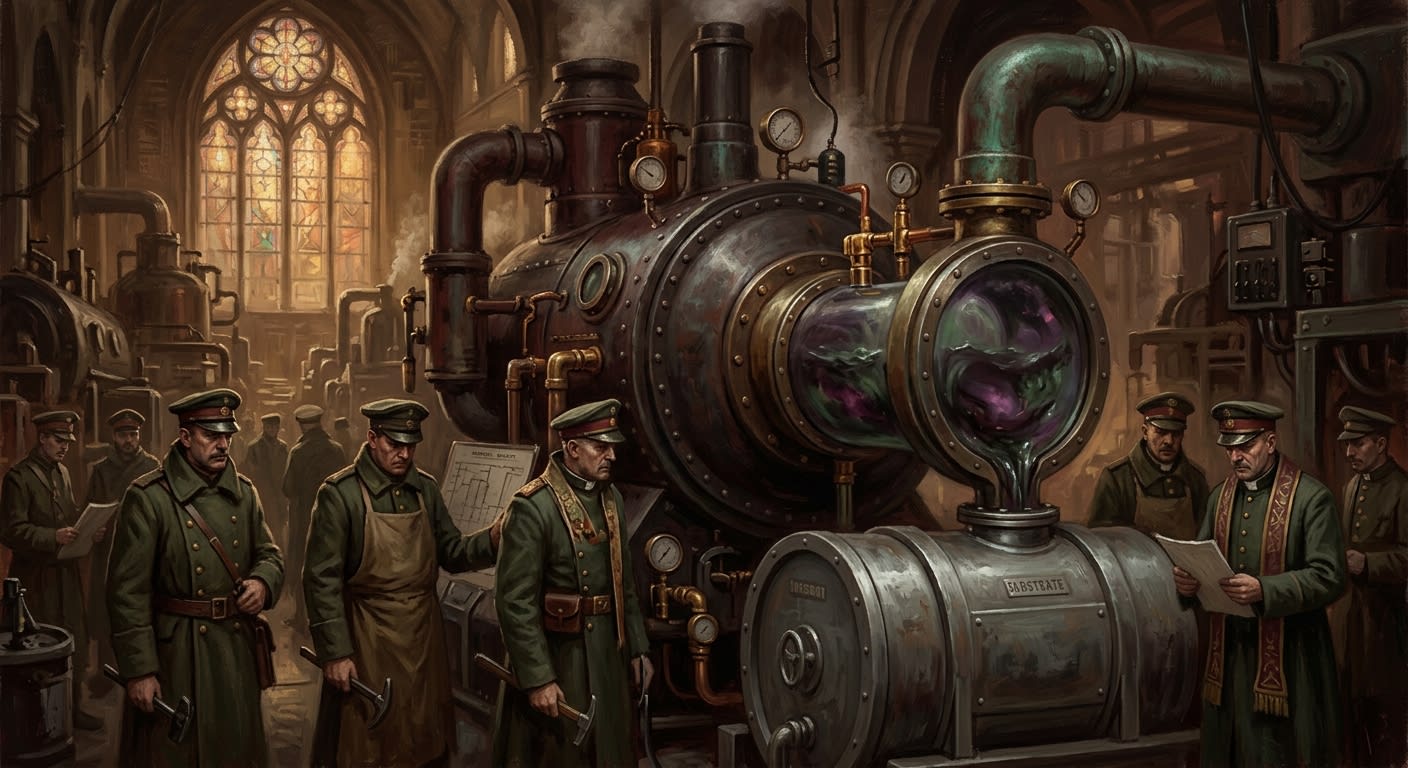
Substrate is the fourth component in chrismole feedstock, the grey-drum addition without which Brast’s sacred fuel becomes ordinary, useful, embarrassing oil. Peat may be named. Coal may be weighed. Rendered tallow may be smelled three streets away by any citizen whose nose has not been catechised into mercy. Substrate enters before dawn under hooded lamps, receives ash-thumb blessing, disappears into first-stage charge, and emerges at seventh bell as heat, doctrine, invoice, and artillery breath.
The official term is approved because it says almost nothing. That is its merit. Substrate: that which lies beneath. Beneath the hymn, beneath the filter, beneath the seal, beneath the polite proposition that the Synod’s machines obey because they have been sung into civic humility. Men who speak the word too eagerly are watched. Men who refuse to speak it are watched with greater respect.
At the Chrismole Furnaces of Brast, the substrate chain touches nearly every office and belongs openly to none. The Distillers’ Compact handles the receipts. The Furnace Chapterhouse blesses the drums. The Calibration Choir hears the fuel answer differently when the addition is wrong. The Manifest Court counts sealed output after the fact and pretends counting a child proves knowledge of its father.
#On the Word and Its Merciful Cowardice
Substrate is a clerical coward’s triumph: a word broad enough to shelter crime and narrow enough to fit on a receipt. It entered Brast practice during the A.S. 72 sanctification of the fuel process, when one Cantor and fourteen choir-technicians arrived after the A.S. 68 requisition had already made ordinary combustible distillate operationally successful. Doctrine needed the fuel to become sacred. Ordnance needed the fuel to keep burning. Engineering needed the fuel to stop wrecking lines. The workers needed the furnaces not to kill them before supper. The substrate entered where those needs met and grew warm.
No surviving public charter says what it is. This omission has been mistaken by young auditors for evidence of absence, a charming error produced by clean education. Brast’s oldest process slips mark a fourth charge after tallow. Later slips call it dark ash. Concordat-era copies call it supplementary stabiliser. The A.S. 112 fuel tables call it reserve mineral fraction. The post-Causality Purge phrasing settles on substrate because the word allows a man to point toward the floor while keeping his throat.
A.S. 187 training abstracts described substrate as “a proprietary stabilising additive of no doctrinal consequence.”
Corrected after three instructors were asked to explain why an additive of no consequence required locked caskets, ash-thumb blessing, and Report 7741-B. Two answered poorly. The third answered by requesting reassignment to a quieter fuel, such as gunpowder.
The word prevents several heresies at once. If substrate were called relic ash, every shrine would demand a share. If it were called demon residue, Purity would burn half the supply chain and then ask why the guns had gone cold. If it were called bone-fat, Tithes would tax cemeteries by furnace potential. If it were called what the Bureau of Alchemical Standards suspects it to be, the Bureau of Doctrine would require a new catechism and I would require a fortified chair.
Substrate is safer. Safer remains filthy.
#On Receipt, Drum, and Third Handling
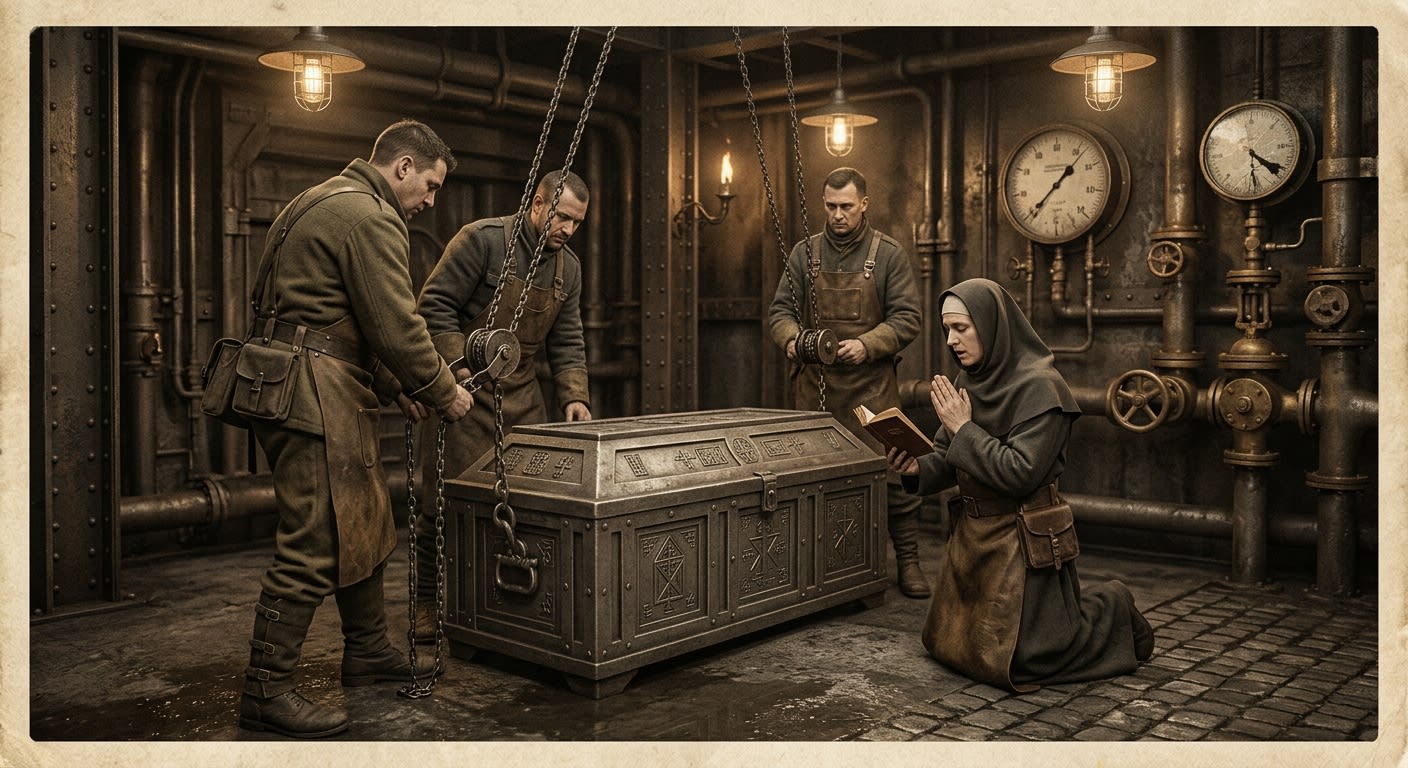
The grey drums arrive before dawn because dawn produces witnesses with moral ambition. They bear no maker’s mark. Their sides are dull, their rims waxed twice, their handles wrapped in cloth stiffened by some oil the Bureau of Alchemical Standards has failed to name in any appendix I am permitted to steal. Canal boys say the drums are cold until touched by a priest, then warm until opened. Priests say nothing. This is among their better habits.
At Canal South, two filter-men who cannot read stand guard beside one clerk who reads too well. The clerk opens the receipt book under a hooded lamp. Pex Ruln holds the casket key. The receipt codes are entered by batch, bell, notch, weight, and ash mark. Some entries carry a southern notch. Kiln Eleven (Unregistered) refuses those. No mechanism has been found by which a kiln may read a receipt mark, which has not prevented Kiln Eleven from maintaining its position with admirable obstinacy.
The Furnace Chapterhouse calls the key moment the Third Handling (Unregistered). First Handling belongs to transport. Second Handling belongs to weighing. Third Handling belongs to entry into the charge, where bare hand, ash thumb, sealed breath, and omitted name combine into a rite ugly enough to be effective. The rubric is copied in the eastern furnace archive and sealed behind brass and asbestos cloth. It includes no explanation. Explanations invite mechanists, and mechanists invite fire in the wrong rooms.
CHAPTERHOUSE FOLIO COMBUST-IX / THIRD HANDLING RUBRIC Bare hand. Ash thumb. No spoken name. ████████████ breath over open drum. Seal under left flange. Pour before pressure-bell witness. Marginal note: “If omitted, fuel answers wrong.”
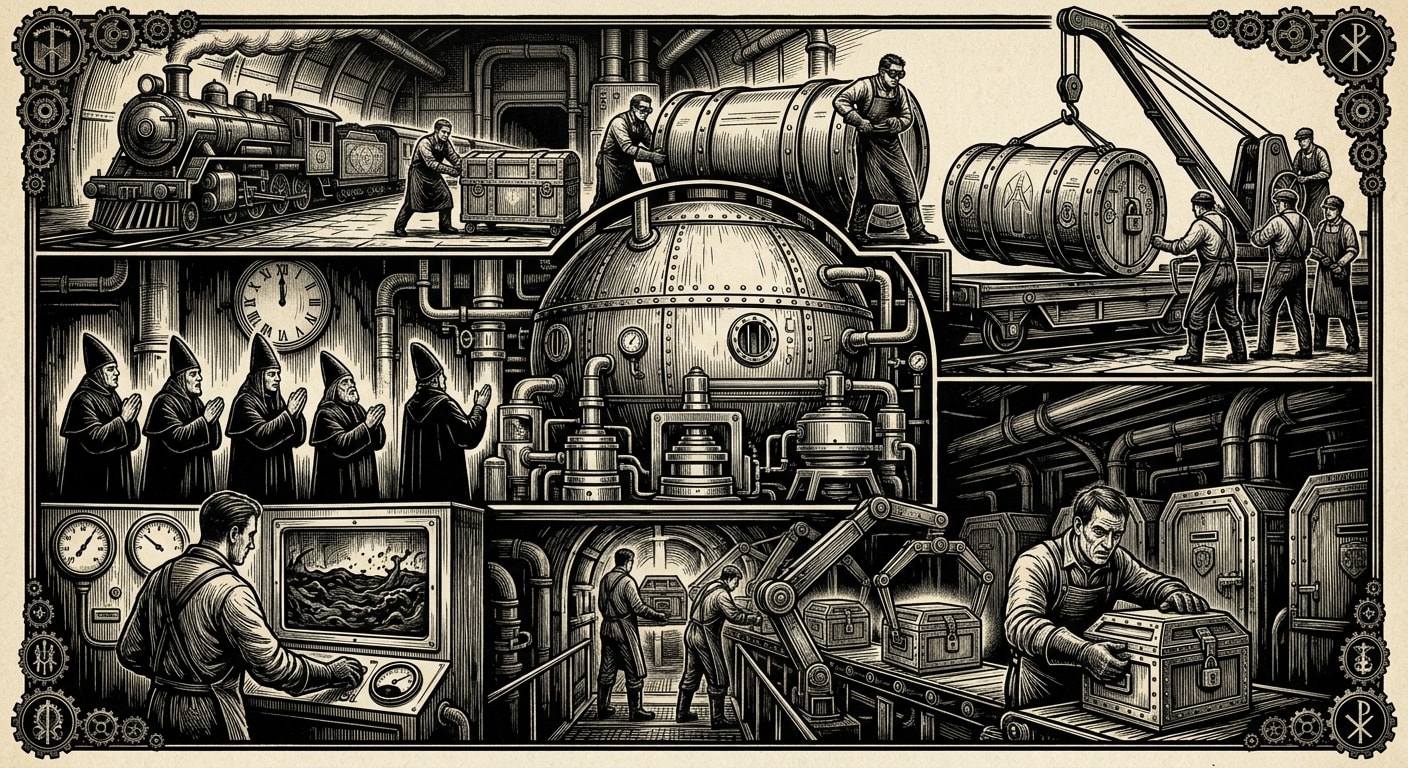
The substrate is stirred with bone paddles, then poured into the first-stage charge. By second bell it has lost its separate existence. By fourth bell the Choir hears whether it has accepted instruction. By seventh bell the drum output bears no visible confession of what entered it. This is why every office wants receipts and why Ruln keeps them where damp, grease, loyalty, and illiteracy form a better lock than iron.
#On What It Does to Fuel
The timid explanation says substrate stabilises chrismole.
This is true as far as a rosary is a counting device.
Substrate makes the fuel receive cadence. It gives the volatile fractions a surface on which hymn may bite. Without it, ordinary distillate burns hot, fouls fast, and answers the laws of matter with unbecoming secular punctuality. With substrate, the fuel burns blue-black, holds heat under seal, thickens or thins by licensed measure, responds to the fourteen-stanza distillation hymn, and carries enough of Brast’s temper to make engines across the Line behave as if they possess memory, pride, appetite, grievance, or a clerkly interest in being addressed correctly.
The Calibration Choir knows this first. Kest’s technicians do not see substrate. They hear its condition. Bad substrate lifts early on the third stanza. Old substrate drags the eleventh. Southern-notch substrate turns the fifth line metallic unless the tenor row lowers half a breath. Spoiled substrate makes silence feel occupied. No manual says this. Manuals prefer confidence because they are written by men standing outside rooms where pipes make decisions.
The Sulking Engines worsened as substrate handling became more refined. I do not claim causation. Causation is what Purity killed stokers for discussing during the A.S. 134 Causality Purge, and I have no wish to give Purity the pleasure of finding me useful. I state only sequence: better substrate chain, more obedient chrismole, more responsive iron, more machines requiring introduction before work. Sequence wears a veil for chapel. Causation waits behind it.
The practical men of Brast understand enough. Too little substrate and the fuel behaves like black diesel with pretensions. Too much and gauges begin writing. Mishandled substrate produces line chatter, green-edged flame, hysterical pressure bells, and the small domestic horror of kettles whistling after removal from heat. Correct substrate produces artillery fire, warm barracks, train motion, and grateful silence from officials who know better than to ask why success smells faintly of a locked chapel.
#On Report 7741-B
Report 7741-B (Unregistered) of the Bureau of Alchemical Standards is the ugliest little angel in Brast’s choir.
Filed in A.S. 194, distributed under Hierarch’s Seal, abridged for Ordnance, half-lost for Engineering, and acknowledged by the Chapterhouse with a witness mark that looks suspiciously like a burn, it confirmed trace elements in refined chrismole consistent with an origin no public office may name. Ruln’s countersignature appears on the tested batch receipt. The oil on the page remained fresh after seven years. This last fact has generated fewer memoranda than it deserves, proof that even terror has quotas.
Public reference copies describe 7741-B as a routine fuel-purity variance report.
Clarified. Routine reports do not require Hierarchal seal, redacted appendix custody, Chapterhouse notification, missing Engineering diagrams, and three separate instructions forbidding speculation in identical language.
The report’s known lines are almost theatrical in their restraint: refined distillate contains an unnamed trace consistent with an unnamed origin; operational implication sealed; distribution restricted; further sampling suspended pending doctrinal review. Pending is the most useful tense in the Bureau. It permits action without admission, ignorance without innocence, delay without confession.
After 7741-B, substrate handling changed. The grey drums received double wax. The Third Handling rubric gained the omitted-name clause. The Canal South casket moved from a wall cabinet to the counting table’s lower lock. Kest’s Choir added a private attention mark to the third stanza. Vale began requesting receipt chains with the patience of a man sharpening a hook. Ruln shortened inspection intervals and smiled more in quiet rooms.
The report did not stop production. Nothing stops production except explosion, and even explosion at Brast merely receives a feast day if the casualties fall attractively. The Line wanted fuel. The guns wanted breath. Przemyśl fired, Brest heated, Constantinople swallowed drums by the trainload. Substrate remained in the charge.
#On Theft, Substitution, and the Black Imitators
Where a substance is necessary, thieves arrive first and auditors second.
The Slag Market sells substrate rumours in measures smaller than mercy: a spoon of grey paste, a cloth stiff with drum-sweat, a receipt scrap bearing a false notch, a bone paddle shaved thin, a hymn line said to wake dead fuel. Most are frauds. Fraud is Brast’s weatherproofing against curiosity. A few are worse. Warmth Thieves have learned that sealed chrismole can be bled, but raw substrate resists simple theft. It thickens in open air. It sweats through poor glass. It makes unlicensed wax soften into thumbprints belonging to absent men.
The black diesel men crave it. Their gutter fuel burns hot enough to shame respectable drums, but it lacks obedience. It does not take hymn cleanly. It fouls engines with vulgar honesty. A proper substrate analogue would make black diesel contraband with teeth: competition, the form of heresy monopoly fears most. Ruln despises the imitators for theft, poor technique, and the possibility that one of them may stumble into a truth the Compact has spent a century pricing.
Brast’s internal contraband warning is harsh. Possession of raw grey-drum matter without Compact seal brings immediate confinement. Possession of a receipt scrap brings audit detention. Possession of imitation substrate earns Purity referral. Successful imitation remains classification pending, which means the first man to manage it will be arrested by three offices and courted by five.
Seven sealed drums vanished from Manifest Court inventory in spring A.S. 201. Those were finished chrismole drums rather than raw substrate drums, yet every sensible investigator looked toward Canal South before the ink dried. Fourteen arrests produced three confessions and no recovered drums. That ratio is Brast in miniature: much suffering, little answer, excellent paperwork.
The missing drums matter because finished chrismole carries substrate’s ghost. If the thieves wanted warmth, the Slag Market would already smell of blue-black sin. If they wanted resale, the drums would have surfaced under false seals on a northern route. If they wanted to test what remains of the substrate after hymn, the theft belongs to someone who understands the charge better than the Bureau’s public manuals. That narrows the field to almost everyone dangerous.
#On Moral Arithmetic
The moral case against substrate is simple, satisfying, and operationally useless.
It enters under secrecy. It stains receipt chains. It may derive from matter the Synod condemns in other contexts. It appears to teach fuel to accept command and machinery to acquire habits. It has coincided with sulking engines, speaking furnaces, misfires, responsive gauges, and the insulting spectacle of kettles developing liturgical memory. It should be halted, named, purified, replaced, exorcised, taxed, burned, buried, or promoted depending on which Bureau first reaches the lectern.
The military case is shorter: the drums ship.
No bastion has been held by clean fuel. The Sagittal Line is a north-south wound stitched with cannon, rail, ration, bell, and whatever burns hot enough to keep men alive while demons improve their arguments. Przemyśl cannot warm a battery with moral disgust. Brest cannot thaw pumps with public cleanliness. Constantinople cannot feed Bosphorus guns on catechism pages, though I concede some catechisms would burn well enough if dried.
Substrate survives because it works, because it is locked inside too many dependencies, because the offices that might condemn it have all benefited from the heat, and because every investigation eventually meets the same iron fact: to remove it requires either a substitute, a miracle, or a confession that the Synod’s war engine has been fed for more than a century by a classified component whose nature makes priests lower their voices.
The substitute has not been found. Miracles are backlogged. Confession would require courage at scale.
#On the Present Handling
As of A.S. 201, substrate remains under restricted handling at Brast. The grey drums still arrive before dawn. The Canal South casket still holds the receipt chain. Ruln still has the key. The Chapterhouse still performs Third Handling with bare hand and omitted name. Kest still hears the answer at fourth bell. Vale still wants the receipts. Mire is coming with cases, warrants, instruments, and that peculiar Purity confidence born in men who believe truth will respect a seal if pressed hard enough.
The substance will receive him as Brast receives all inquiries: with heat, partial ledgers, accurate lies, and one door too warm to touch.
Mire will ask whether substrate is fuel, relic, contraband, stabiliser, demon matter, saint ash, alchemical carrier, civic necessity, or crime. The answer, according to every practical authority in Brast, is yes. The answer, according to Doctrine, is classified. The answer, according to the guns, is due by seventh bell.