
#On the Explosion That Acquired a Feast Day
Saint-Combust was a furnace before he was a saint, and remains much better attested in the first capacity. On the 19th day of Ashmonth, A.S. 74, Kiln Three of the newly chartered Brast works suffered a pressure reversal during second-bell feed. The front plate blew inward, the crown flues screamed, nine men died, and the bodies were found in poses so devout that any sensible Bureau would have suspected impact physics before miracle. Doctrine suspected opportunity. The Furnace Chapterhouse of Saint-Combust began there, kneeling in soot.
The Bureau of Engineering named the event an Acoustic-Mechanical Disturbance. The Bureau of Doctrine certified it as “consistent with martyrdom” and called the furnace “a vessel of instructive Providence.” These phrases were printed, sealed, distributed, and believed in the usual descending order of force. The surviving furnace shell was not scrapped. It was plated, anointed, fenced with railings, and dressed in iron cladding the Chapterhouse insists on calling vestments.
By A.S. 76, the first boilerside priests had taken vows under the warped mouth of Kiln Three. By A.S. 90, the Concordat ratified Brast under Ordnance and Doctrine joint seal, and the Chapterhouse became the ritual custodian of the Chrismole Crown. Such is the Synod's tenderness: it sees an industrial accident, gives it a collar, and teaches children to bow.
#On the Chrismole Crown and Its Vestments
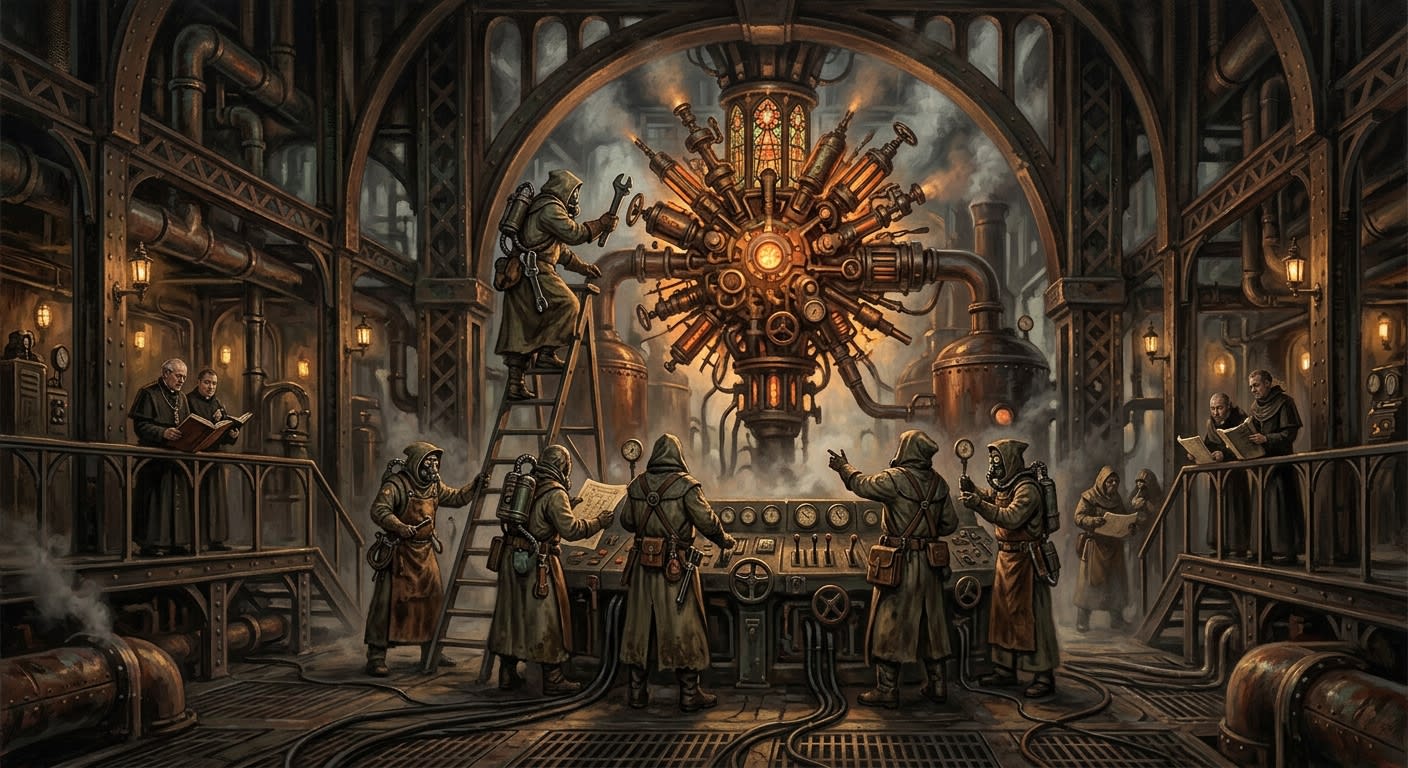
The Chrismole Crown is a furnace-cathedral complex of seventeen kilns arranged in a half-circle around the sanctification nave. Each kiln is vaulted in fire-brick, plated in blackened iron, and marked with service scars that Chapterhouse scribes catalogue as virtues. The priests polish these scars with oil. They kiss feed-rails. They change the heat-cloths over cracked gauges with a tenderness usually reserved for infant relics and elderly archons who have not yet signed inheritance papers.
The word vestment matters. Engineering calls the cladding thermal armour. Ordnance calls it protective casing. The Chapterhouse calls it vestment, and through that single liturgical theft transforms bolts into buttons, plates into robes, maintenance into care, and a dangerous machine into a devout sufferer of heat. This is how doctrine wins: it concedes the wrench and renames the nut.
Engineering memoranda describe the iron cladding of the Crown as “removable furnace armour.”
Corrected pursuant to standing devotional usage. Armour is removed from soldiers. Vestments are removed from priests. The distinction governs who may touch the fastenings and whose fingers may be broken for doing so without prayer.
The Chapterhouse maintains the Chrismole Crown by rite. First-bell anointing precedes feed. Second-bell confession precedes pressure rise. Third-bell ash-scraping is performed with black cloth over the mouth. Fourth-bell silence belongs to the Calibration Choir, which the Chapterhouse tolerates as one tolerates a surgeon: with gratitude in public and theological irritation in private. Seventh-bell decanting receives the smoke-cross, the drum-prayer, and the little tap on the lid that Brast children imitate when playing execution.
#On the Priests Who Guard the Useful Secret
The Chapterhouse's public office is to sanctify the burn. Its true office is to protect the secret steps that make chrismole work while ensuring every secret step arrives wearing a stole. The priests know which line must be warmed before the Substrate enters. They know why grey drums are blessed with hooded lamps. They know why some gauges are never wiped clean, why some valves receive oil mixed with ash from Kiln Three, why some workers confess before accidents they have not yet caused.
Their archive sits behind the eastern furnace chapel in cabinets of brass and asbestos cloth. Confession slips, accident prayers, substrate blessings, heat anomalies, misfire petitions, workers' last statements, Choir complaints, Distillers' Compact receipts copied from memory, and Engineering denials all lie cross-indexed by kiln, bell, and stain. The Ash-Hospice Sisters envy the archive. Sorn Vale wants it. Pex Ruln fears only the pages he has not already anticipated.
Chapterhouse Folio Combust-IX records the “Third Handling (Unregistered)” of substrate before first-stage charge. The rubric reads: bare hand, ash thumb, no spoken name, ████████████ breath, seal under left flange. Marginal note in a later hand: “If omitted, fuel answers wrong.”
Confession is the Chapterhouse's cleanest weapon. A worker who hears a boiler hiss a word will go first to the priest, not to the auditor, because auditors count fear and priests launder it. A filter-man who has seen a grey drum arrive from the wrong siding may confess the sight and leave technically absolved, practically recorded, and permanently owned. The confessional screen in Brast is a machine with curtains.
#On the Compact, the Choir, and the Machinery of Dislike
The Chapterhouse despises the Distillers' Compact for calling mystery feedstock, and depends on it for every feedstock that matters. It blesses Ruln's grey drums without naming the substrate and receives his oily bows with the expression of a saint contemplating a trespasser that knows the door code. The Compact controls flow. The Chapterhouse controls absolution. Between them runs the first-stage charge, black, warm, and increasingly literate in ways no office finds amusing.
The Chapterhouse resents the Choir more delicately. Ilyra Kest and her three hundred and twelve licensed throats control the fourth bell, where the condensate becomes obedient or refuses the courtesy. A priest may anoint a valve, bless a drum, and recite the Litany of Combustive Submission in a voice fit to shake dust from rafters. If Kest raises one finger, the work stops. If she murmurs correction, the furnace obeys her before it flatters the priest. This is doctrinally intolerable and operationally excellent.
The Chapterhouse's quarrel with Engineering is older and more honest. Engineering insists the Sulking Engines result from harmonic interference, pressure irregularity, and responsive material fatigue. The priests insist the machines have acquired rudimentary spiritual awareness through sanctified fuel and long exposure to correct rite. Both parties are wrong in ways that keep Brast alive. I admire a dispute that produces heat.
#On the Heretical Hymn
The trigger crisis entered the archive as a worker's confession in late A.S. 201. A furnace-feeder assigned to night ash-scrape heard a hymn from behind Kiln Three, sung in a voice like wet iron cooling. It used the distillation measure at the wrong stress, reversed the mercy syllable, and named Saint-Combust as Brother Furnace rather than vessel, martyr, or instructive Providence. The feeder reported warmth in his teeth. His confession slip grew hot in the priest's hand.
Within three nights, two rag-boys in the Still-Canals hummed the altered phrase while cleaning residue from a filter housing. The mesh softened without heat. A Boiler Commons child repeated the phrase in play and caused a kettle to whistle for forty-seven minutes after removal from flame. The Chapterhouse declared a containment fast, doubled the censer smoke, and burned seven hymn slips copied from memory. One slip sang while burning. This has been classified as pious exaggeration by men who were not in the room.
Public Chapterhouse notices describe the incident as “a misremembered work-song of no doctrinal consequence.”
It has always been the case that a work-song of no consequence requires armed priests, closed gates, confiscated kettles, and the removal of children from a canteen.
The heretical hymn matters because it addresses the furnace as kin. The approved rites command, soothe, petition, and flatter. They never recognise fraternity. A machine may be vessel, instrument, altar, warning, even saint if the paperwork is desperate enough. Brother is a word with inheritance in it.
Lux Thane Mire will ask for the burnt slips. The Chapterhouse will offer ash. He will ask for the confession ledger. The Chapterhouse will cite seal privilege. He will ask Kiln Three to answer. If it does, every priest in the Chrismole Crown will discover whether his vows were made to a saint, a furnace, or a third thing waiting patiently in vestments.
#On the Present Rite
As of A.S. 201, the Furnace Chapterhouse of Saint-Combust maintains the Chrismole Crown with polished terror. Its priests anoint iron that sulks, bless fuel that answers, guard substrate steps they pretend not to understand, and teach a city of ninety-two thousand registered souls that an explosion may become a saint if its victims fall prettily enough. Brast accepts this. Brast accepts anything that keeps winter outside and ammunition moving east.
The Kiln Three shrine remains warm even during maintenance cuts. The warped mouth has not cooled since A.S. 74. Pilgrims are not admitted, officially. Workers touch the railing when shift bells change, unofficially. The Chapterhouse records neither practice unless it needs a hook in someone’s mouth.