
#On the Commons That Are Not Common
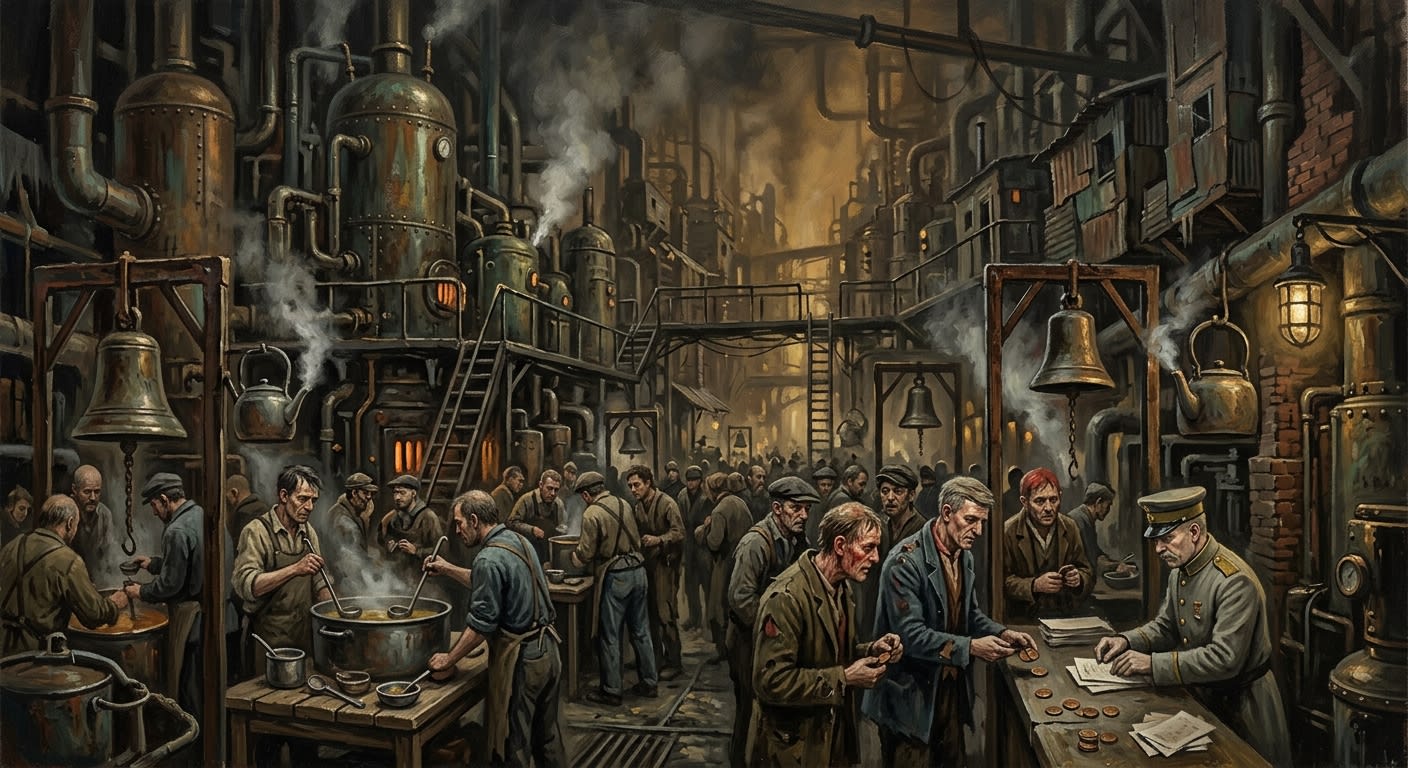
The Boiler Commons of Brast are called common because Brast has always enjoyed jokes too cruel to laugh at aloud. Nothing there is common in the old municipal sense: no green square, no free well, no parish shade, no little market where grandmothers quarrel over onions beneath a bell that rings for weddings instead of shift changes. The Commons are a belt of worker barracks, ration kitchens, sleep racks, heat pipes, laundry ropes, pressure bells, debt offices, counterfeit warm-chit dens, and canteens where men eat broth beside the machines that will eventually take their lungs. It is a neighborhood built from hunger around warmth, which is to say it is a chapel in Brast's native religion.
It lies in the second ring out from the Chrismole Crown, far enough from the Gauge Ward for privilege to thin and near enough for ash to remain intimate. The streets there are pipe-alleys with names assigned by bell schedule rather than by saint: Red-Three (Unregistered), Blue-Six, Kettle Row, Ninth Sleep, Lower Rack, West Broth, Four-Shift Yard. The houses are not houses. They are stacked sleep timber, iron-braced dormitories, family cubbies rented by the hour of warmth, widows' shelves, shift rooms, and long barrack halls where a man may cough in three dialects before anyone asks which bunk owns him.
The Commons grew when Brast stopped being a furnace site and became a city. By A.S. 76, chrismole was feeding gun-carriages at Bastion-Constantinople and anointing treaty-stones at the Steppe Gate. By A.S. 90, Brast had swallowed its villages and held forty thousand souls. By the First Continental Levy of A.S. 110, it had doubled and learned that barracks are cheaper than homes, ration kitchens cheaper than wages, and heat debt (Unregistered) more obedient than rent.
The first Boiler Commons were temporary timber halls thrown up behind Kiln Five (Unregistered) during the A.S. 91 winter expansion. Temporary, in Synod usage, means a thing that has outlived its builders, acquired offices, and begun charging fees. The halls multiplied along the heat trunk lines. A feeder who lived near the pipe could answer the bell faster. A man who answered the bell faster kept his heat allotment. A family near a pipe survived winter with fewer coffins. Survival attracted workers. Workers attracted kitchens. Kitchens attracted clerks. Clerks attracted debt. By A.S. 118, the Boiler Commons had acquired its own Heat Allotment Office (Unregistered), three ration courts, two public bath schedules, no public baths, and a riot tradition vigorous enough to embarrass polite annals.
#On Heat Debt and the Honest Currency
Brast has coin, ration chits, stamped manifests, Crown money, wage tokens, widow coupons, penal shift marks, and devotional heat cards distributed during festivals by men whose gloves cost more than the mercy they dispense. These are decorations. The honest currency of Brast is the warm chit (Unregistered).
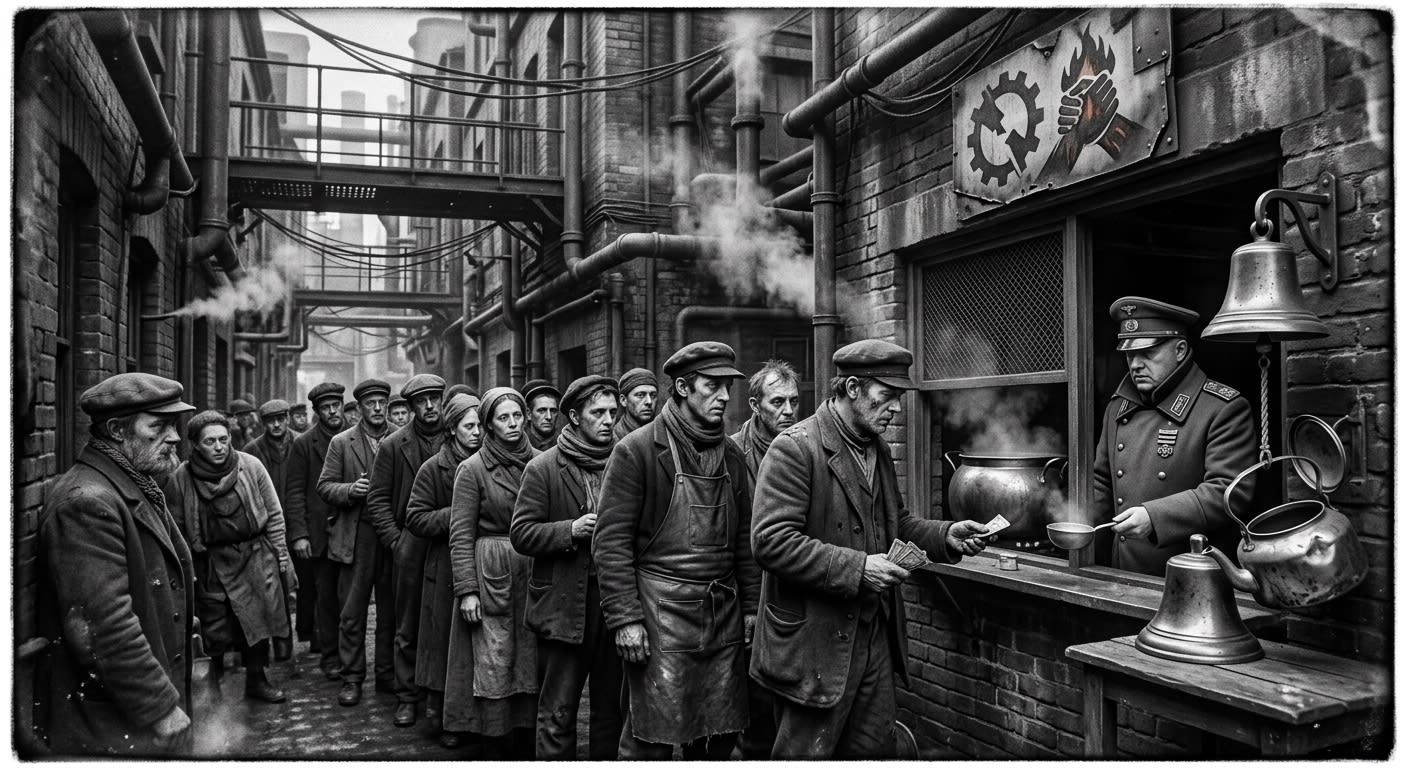
A warm chit buys an hour near a heat pipe. Ten buy a better bunk or a half-night in a room where the walls do not sweat ice. A hundred buy a season's rent in a family cubby with a door. A thousand buy passage west on a manifest-train, if the manifest clerk is drunk, pious, bribed, bereaved, or sufficiently convinced that your departure improves the district's air. Warm chits began as heat ration markers issued during furnace expansion. They became wages, dowries, bribes, fines, burial payments, blackmail notes, alms, court evidence, and, in three recorded cases, murder weapons when rolled into hard packets and inserted into socks.
The Heat Allotment Office sits at the north end of the Commons, beneath a brass dial that never shows the temperature indoors. It shows entitlement. The poor prefer honest cold; the Bureau gives them measured warmth, which is nastier because it arrives with a ledger. Every barrack line receives a pipe quota by shift value. Furnace feeders receive more than slag sorters. Choir technicians receive warmth in private rooms and call this housing. Hospice-bound workers receive warmth in arrears if their cough is certified useful to an inquiry. Widows inherit debt before blankets.
Early Brast civic notices describe warm chits as “supplementary comfort credits for industrial households.”
Corrected. Warm chits are rent, ration, discipline, threat, dowry, exit permit, and leash. Comfort appears only when the clerk has bad handwriting.
Heat debt is Brast's most elegant cruelty. Miss a bell and lose warmth. Arrive late after tending a fevered child and lose warmth. Fail inspection because soot hid your shift stamp and lose warmth. Owe warmth and owe everything: overtime, informant service, confession, political obedience, a son's apprenticeship, a daughter's ration share, a name given during audit sweep. Commander-Auditor Sorn Vale uses heat debt the way other men use chains, with the advantage that victims keep clasping it voluntarily for fear of freezing.
The counterfeit warm-chit presses operate in laundry cupboards, boiler seams, shrine boxes, coffin workshops, and under two official ration kitchens whose supervisors have condemned counterfeiting with great sincerity and very warm hands. A proper counterfeit requires the Ordnance border, the heat-rank numeral, the pressure-bell watermark, and the faint scent of tallow wax mixed with furnace ash. Children can detect poor fakes faster than provosts. Children have better noses and fewer promotion incentives.
The Slag Market sells forged chits by bundle. The Boiler Commons spends them by pulse. A man caught with ten false chits may be fined, branded, or sent to penal technical crew. A foreman caught distributing false chits may be promoted if output improved. That is scale.
#On the Pipe-Lanes and Their Minor Kingdoms
The Commons are ruled horizontally by heat trunks and vertically by pipe access. Every barrack hall sits beneath, beside, or too far from a line. This is the local geography. Near-pipe families sleep warm and wake watched. Far-corner families sleep honest and wake stiff. Underpipe families live in the crawlspaces where official plans show maintenance voids and unofficial maps show whole domestic arrangements: bedding, hooks, contraband shelves, candle nubs, children's chalk saints, and little tin cups placed to catch condensation from lines that sweat brown water during pressure rise.
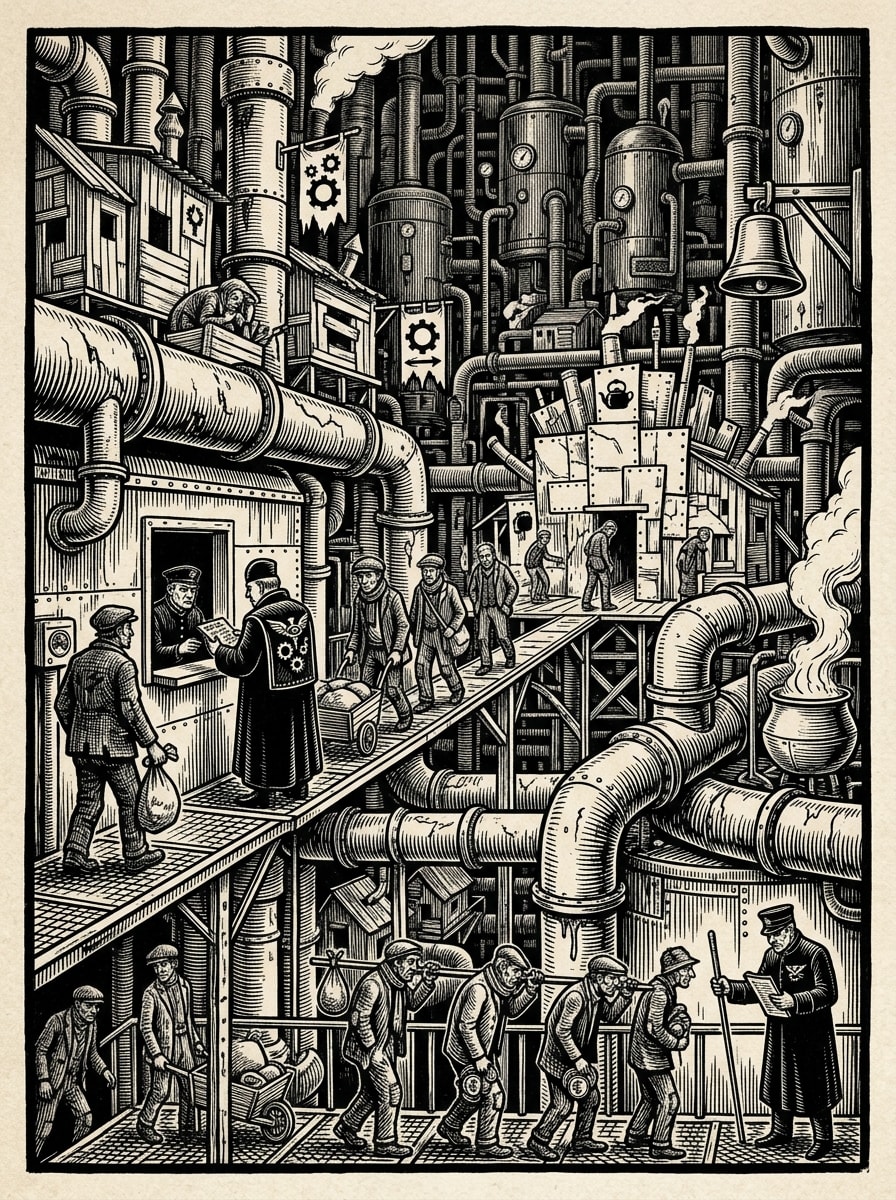
Pipe-lane captains emerge wherever Ordnance fails to appoint anyone useful. They are not elected. Election would require daylight and optimism. They are recognised because they know which valve knocks before burst, which vent may be tapped for cup heat without drawing a gauge drop, which provost takes broth instead of coin, which fever cough belongs in Hospice before the Sisters come hunting it, which child can crawl through baffle space without panicking. Their authority lasts until audit, accident, betrayal, or promotion into foreman rank ruins them.
The finest of these minor kings was old Marn of Lower Rack (Unregistered), who kept a cracked steam branch alive for twelve winters with clamp wire, stolen gasket wax, and a devotional hatred of official repair crews. He was never licensed. Licensing would have made him slower. When the branch finally burst in A.S. 196, he held a mattress against the split long enough for twenty-seven children to be dragged from the lower sleep room. The mattress cooked. So did Marn. Ordnance classified him as unlicensed interference with heat infrastructure. The Commons named the branch after him that same night and still touch the pipe where his hands blistered into it.
Pipe-lane law is brisk. A stolen blanket may be returned after apology. A stolen chit may be repaid with labor. A stolen pipe key invites communal correction in the laundry yard, where witnesses suddenly develop interest in rafters. The worst crime is false warmth: promising heat, taking payment, and leaving a room cold by dawn. Three men have been found in ash bins for that offense since A.S. 188. Their deaths appear in Records as quarrel, exposure, and industrial misadventure. The Commons keeps a cleaner archive in insults.
These pipe-lanes also shelter the city's smallest luxuries. A woman may rent five minutes over a warm vent to loosen a baby's cough. A man may pay one chit to dry socks that would otherwise freeze stiff enough to stand at inspection. Lovers meet behind baffle screens during night roar and emerge smelling of oil, steam, and the kind of poor judgment that keeps humanity statistically present. A child with a sliver of mirror sells glimpses of clean faces near the hot pipe, one look per crumb. Commerce begins wherever dignity has been rationed.
#On the Kitchens and Their Theology of Broth
The ration kitchens are the Commons' second furnace. They burn less gloriously and kill more slowly. Long brick halls run along West Broth and Kettle Row, each with iron cauldrons set into waist-high hearths fed by waste heat bled from the lower pipes. At first bell they issue soot bread, grey porridge, bitter tea, and marrow broth thin enough to suggest the animal died of abstraction. At fourth bell they issue worker stew. At seventh bell they issue night broth, fever broth, widow broth, and the little cups of salt-fat given to furnace feeders before deep-heat shifts. A city may pretend it runs on chrismole. A worker runs on broth and resentment.
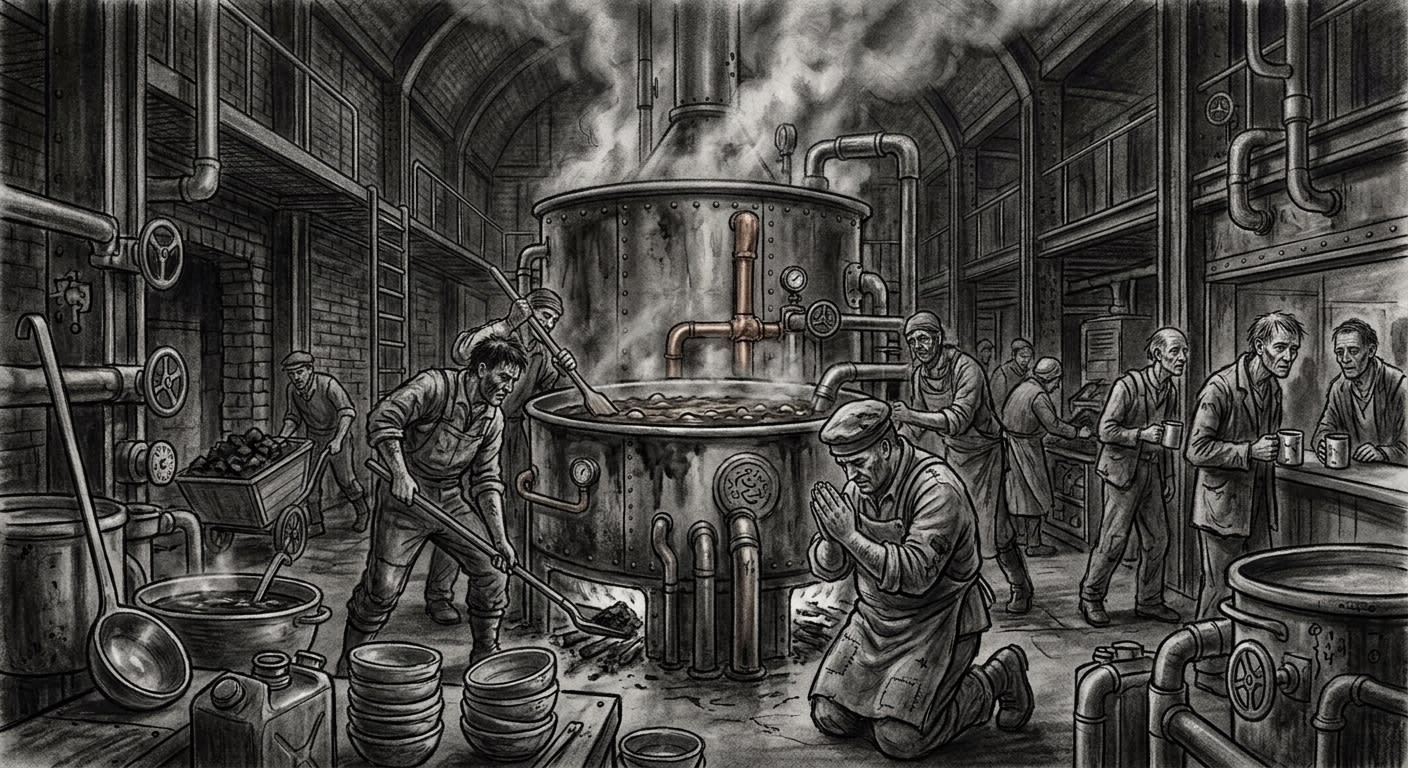
Each kitchen is assigned to a shift block. Each bowl is marked by heat class, labor class, and household debt. The spoon queues divide men more cleanly than sermons divide sinners. Furnace crews to the left, valve runners by the pipe rail, slag divers near the door, hospice families after the bell, unpapered labor at the outer hatch when surplus permits. Surplus almost never permits. Mercy, in the Commons, is a ladle that reaches the bottom and discovers procedure.
Broth riots are small until they are large. Brast knows this better than Strasbourg, because Strasbourg receives reports after the first bodies have been swept aside and the phrasing improved. The A.S. 142 Kettle Row disturbance began when a night crew found slag grit in its ration. The A.S. 167 Widow Broth stoppage began when heat-debt deductions passed to twenty-three families after a valve-house explosion. The A.S. 190 Salt-Fat Panic began when a rumor spread that foremen had been receiving clean marrow while Red-Three feeders received rendered boot. The rumor was false in detail and true in doctrine, which made it difficult to suppress without artillery.
The kitchens are where news travels before the bells can license it. Missing drums. Late trains. Kest's sealed cylinder. Mire's delayed arrival. Vale's audits. Ruln's filter shortage. The child who whistled a kettle into disobedience. The Sisters' ash dishes spelling names. The Commons receives facts as steam receives soot: everywhere, invisibly, and upon every surface.
The Bureau of Ordnance posts listening clerks in the queues. Everyone knows them. This does not stop speech. It improves it. A Brast worker can insult a commander, report a theft, arrange a marriage, denounce a foreman, buy counterfeit heat, and discuss possible furnace kinship in a five-sentence exchange about turnips. The art is old. Oppression has always been a school of rhetoric for the poor.
#On Racks, Families, and the Arithmetic of Sleep
Sleep in the Boiler Commons is assigned by warmth, rank, shift, and debt. The sleep racks are stacked five high in older halls and seven in the newer economy blocks, a word that should be taken outside and beaten. A full rack permits a worker to lie flat with one elbow bent if he has not eaten too ambitiously. Family cubbies are timber boxes partitioned by sackcloth, prayer boards, stolen slate, and private shame. Widows' shelves line the upper rafters where heat gathers badly and smoke gathers well. Children sleep under pipes when permitted and inside coal crates when not.
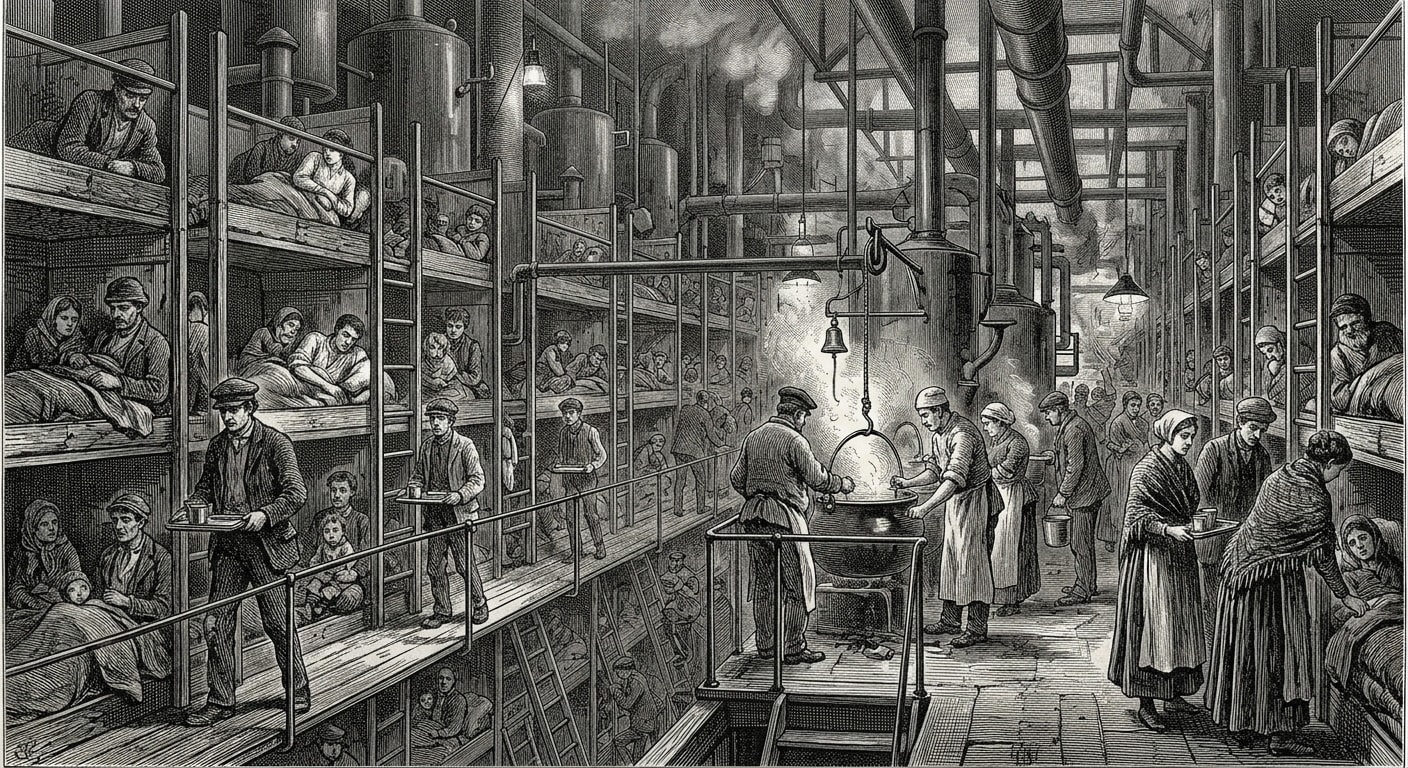
The Ordnance Bureau insists occupancy is regulated. It is regulated in the way a flooded cellar is regulated by bucket ownership. The A.S. 200 census counted Brast at ninety-two thousand registered souls. The Commons alone can hold, by rated plan, eighteen thousand. It holds twenty-six thousand on ordinary nights and more during levy arrival, winter allocation, or audit fear. Unregistered workers sleep in boiler carts, canteen cupboards, ash bins, underpipe tunnels, and the back of funeral sledges whose owners rent the space until needed by death.
The families of the Commons are not private units. Privacy requires walls thick enough to support lies. The Commons has curtains. Marriage is recorded by shared heat debt. Birth is recorded by cradle-warmth assignment. Death is recorded when the rack is reissued. A man may die at third bell and be replaced by sixth if his family lacks the chits to delay reassignment. Sentiment has a tariff.
Children learn the pressure bells before they learn letters. First bell means feet under you. Second means bowls. Third means school if the line permits. Fourth means do not interrupt the Choir. Fifth means hiding games under the pipe racks. Sixth means fathers return or do not. Seventh means kettles. Night roar means adults speak truth while pretending to sleep. Some children imitate drum sealing by tapping lids and condemning dolls. One child in late A.S. 201 repeated the altered phrase from the Heretical Hymn and caused a kettle to whistle for forty-seven minutes after removal from flame. The Furnace Chapterhouse confiscated the kettle. The child was reassigned for observation. The kitchen received a replacement kettle and a notice forbidding play liturgy.
A replacement kettle is easier than a theology.
#On Red-Three and the Fever That Wrote
Boiler Commons Red-Three is a shift block, a housing line, a ration queue, a debt column, and, as of late A.S. 201, an accusation. It sits along the lower east heat trunk where three barrack halls lean toward a pipe arcade blackened by years of condensation soot. Red-Three workers feed secondary lines, scrape ash from low vents, rotate kitchen heat baffles, and perform the nameless maintenance by which grand furnaces remain picturesque from a distance. They are the sort of workers who appear in triumphal engravings as smoke.
The mass fume fever (Unregistered) began elsewhere and everywhere at once: Gauge Ward, Still-Canal South, Boiler Commons Red-Three. Thirty-seven workers within two bells. By morning, eighty-one. By the next pressure cycle, one hundred and twelve. No shared meal. No shared foreman. No shared dormitory. Shared chrismole exposure, shared night roar, shared fourth-bell hymn. The official notice called it seasonal particulate irritation, because official notices are often composed by men who would call decapitation an upper-neck event if the phrase kept production steady.
The Ash-Hospice Sisters took dishes from the fever beds and found ash arranging itself into names. Some belonged to the dead. Some belonged to workers not yet dead. One belonged to a man still assigned to Boiler Commons Shift Red-Three. The Sisters moved his bed twice. The ash kept spelling him correctly.
HOSPICE FIELD NOTE — RED-THREE TRANSFER, A.S. 201 Subject moved from Rack 4 to Rack 19 at second bell. Dish relabelled under false initials. Ash settled after cough: full legal name, childhood diminutive, and heat-debt number. Subject asked who had told the ash about his mother. Answer withheld. Sister attending began prayer, stopped after third word, and requested sealed ink.
Red-Three has since become one of those places where officials walk more slowly than policy requires. Vale's provosts inspected the racks after the seven-drum theft (Unregistered) and found counterfeit chits, three unregistered bladders, a false seal press, two quiet hymn slips, and no drums. The discovery was celebrated as progress by men whose salaries demand optimism. Workers watched the provosts take the press and leave the fever. This produced an educational effect.
The canteen at Red-Three now speaks in fragments. Men say “dish” and mean death notice. They say “warm” and mean watched. They say “Mire” and spit into the floor crack, not from disrespect but from the local belief that names travel faster in soot than in air. A woman who sells salt-fat at the back hatch refuses coins stamped in A.S. 199 because that was the year the Przemyśl battery lied. She accepts warm chits, counterfeit or clean. Fever teaches practical theology.
#On Audits, Presses, and the Canteen Sweep
An audit bell in the Boiler Commons changes the shape of every room. Spoons lower. Children vanish under benches. Warm-chit brokers swallow paper. Foremen adopt expressions of public injury. The listening clerks try to look surprised, which is how everyone confirms they knew. Then the provosts enter with Vale's column sheets, and the district discovers which of its sins has become useful to someone above.
The A.S. 201 canteen sweep struck during mid-meal in the Boiler Commons, a deliberate choice whose elegance belongs to Sorn Vale. Men with full mouths answer badly. Women with hot bowls cannot run cleanly. Children carrying broth become obstacles whose injury may be blamed on crowd pressure. Vale's men sealed the three exits, set a ledger on the serving plank, and began calling heat-debt numbers. The first accused was a valve runner. The second was a kitchen widow. The third was a man dead six weeks according to Hospice papers and alive enough to flee through the scullery hatch.
The Manifest Court auxiliary filing recorded false chits, one under-table press, a quiet hymn scrap, three unregistered heat bladders, a deceased man in active queue, no recovered drums, and order restored. It did not record the sound of two hundred workers deciding at once to remember the same thing differently.
The false-chit press beneath the canteen plank was not sophisticated. Its border was too heavy, its pressure-bell watermark crooked, its ash scent achieved by rubbing sheets along the kitchen flue. It would not have passed a child. It passed because hunger endorses bad documents when good documents refuse to feed it. The press's owner remains officially unknown. The kitchen widow confessed to possessing it, then withdrew the confession after her son was moved out of Red-Three fever proximity, then reinstated it when his heat allotment doubled. The record now contains three truths, each valid at a different temperature.
The deceased man in the queue caused greater distress. His name had been entered by the Hospice after a rail crush in A.S. 200, closed under logistics casualty, and his rack reissued. He insisted he had been working night ash-scrape for nine months under another man's shift stamp. The other man insisted he was unmarried, childless, and currently dead in the Hospice ledger. Both men had the same heat-debt number. Vale's provosts took both. The Sisters requested access. The Chapterhouse requested silence. Kest's Choir requested the canteen's bell-metal ladle, which had rung once during the seizure without being struck.
No drums were recovered. The audit still succeeded. This is the lesson. An audit need not find the object named in its warrant. It finds obedience, fear, inventory, gossip, blackmail, and the little forgotten crimes that grow beneath any district warm enough to keep humans alive.
#On the Warmth Thieves and Useful Criminals
The Warmth Thieves of the Still-Alleys (Unregistered) do not rule the Boiler Commons. Ruling requires offices. They inhabit it as smoke inhabits cloth: everywhere by contact, denied at inspection, smelled by anyone honest. Their siphon bladders pass through underpipe tunnels, ration carts, ash-hospice laundry, widow sledges, furnace-hardliner handoffs, and kitchen broth deliveries whose bottoms are less innocent than their ladles.
Their public enemy is Vale. Their private enemy is cold. Their clients are workers with sick children, foremen with bad books, kitchen supervisors, unlicensed boiler anointers, fuel siphoners, and occasional officers whose private rooms grow chilly when official allotments become morally instructive. A thief sells warmth, but also mobility. A hidden bladder can heat a tenement. Three can buy a passage stamp. Seven drums can make the whole city whisper Hell before it whispers incompetence.
The Commons shelters them because the Commons needs them. Official fuel goes east. Official heat follows rank. Official mercy arrives after proof. A Warmth Thief arrives at night with a bladder under his coat and asks no questions except whether the chit is clean enough to pass in dim light. This creates loyalty of the durable, ugly sort. The Bureau calls it corruption. The widow calls it Tuesday.
The Furnace-Hardliners sometimes draw from the same channels, though they consider the Commons thieves sentimental and small. Hardliners move engine-grade heat to kitchens, pumps, ward generators, and guns. Commons thieves move cup heat, bunk heat, child heat, fever heat. The distinction is moral, financial, and measured in burns. A Hardliner may refuse a household job because the pressure value is low. A Warmth Thief may take it because his sister sleeps in that block. This is why Hardliners survive longer and are mourned less honestly.
The black market has its own tariff. One bladder for a room through freeze-night. Two for a fever child. Three for a foreman's silence. Five for a false western departure. A full drum is not quoted in public. A full drum is politics. The seven missing drums sit above the Commons like a second roof, invisible and heavier than slag.
#On Present Condition
As of A.S. 201, the Boiler Commons remain overfilled, underheated, overpoliced, undercounted, and indispensable. The population is whatever the Bureau says when it wants calm and whatever the kitchens see when the bowls run out. Red-Three coughs. The ash writes. The canteens serve broth under listening clerks. The false-chit presses have moved, not stopped. Vale's provosts return at irregular bells. Kest's Choir sends junior technicians through the district to listen for illegal measures in children's games. The Chapterhouse confiscates kettles. The Sisters label dishes.
The Commons have begun to acquire the particular civic silence that precedes either revolt or obedience made too perfect to trust. Men stop laughing when the pressure bells misstrike. Women count warm chits twice, then put one under the child's tongue during searches because paper hidden there grows damp but survives. Children tap lids in rhythms adults pretend not to hear. Foremen report punctuality improvements, which is how panic appears in cheerful tables.
The pressure bells are the district's weather. They mark dawn, shift, broth, curfew, audit, accident, fire, and the special broken peal that means no one is to move until a ranking man decides which danger is cheaper. In older neighborhoods, bells summon parishioners toward heaven. In the Boiler Commons they summon hands toward heat, bowls toward ladles, bodies toward queues, and suspects toward doors. The workers know each tone by injury. The children know which peal lets them run and which makes adults grab them too hard.
During the recent misstrikes, the fifth bell sounded twice at the seventh hour and the seventh bell answered from a kitchen ladle instead of the tower. No public explanation was issued. Explanations would have required admitting the ladle. The Choir sent two junior listeners. The Chapterhouse sent a priest with wax. Vale sent provosts, because Vale believes every mysterious sound has a payroll somewhere. The Sisters sent bowls, which proved most practical and least comforting.
Brast Ordnance Seat reports the Boiler Commons as “stable under heightened audit discipline.”
Corrected for readers whose boots touch floorboards. Stable means the pipes still heat, the queues still form, the workers still answer bells, and the district has not yet chosen which object to throw first.
The Commons cannot be cleared. Brast needs bodies near pipes. The furnaces need feeders, runners, scrapers, kitchen crews, baffle hands, laundry steamers, cart boys, ash sweepers, and the thousand small obediences no engraving bothers to include. Remove the Commons and the Crown becomes a holy machine with no hands. Freeze the Commons and output falls. Feed the Commons too well and men may acquire time for politics. The Ordnance Bureau seeks the blessed middle: hungry, warm enough, frightened, punctual.
At night, when the furnace roar covers treason and prayer equally, the Boiler Commons glows through pipe seams like a banked coal under ash. Bowls are stacked. Chits are hidden. Racks creak. Fever dishes settle. A pressure bell marks the hour and then, sometimes, a kettle answers from a kitchen where no fire remains lit. The workers listen without moving. They have learned the rule of Brast more perfectly than any catechism: sing it true, or it fails.
They are beginning to wonder what it means when the kettle sings first.