
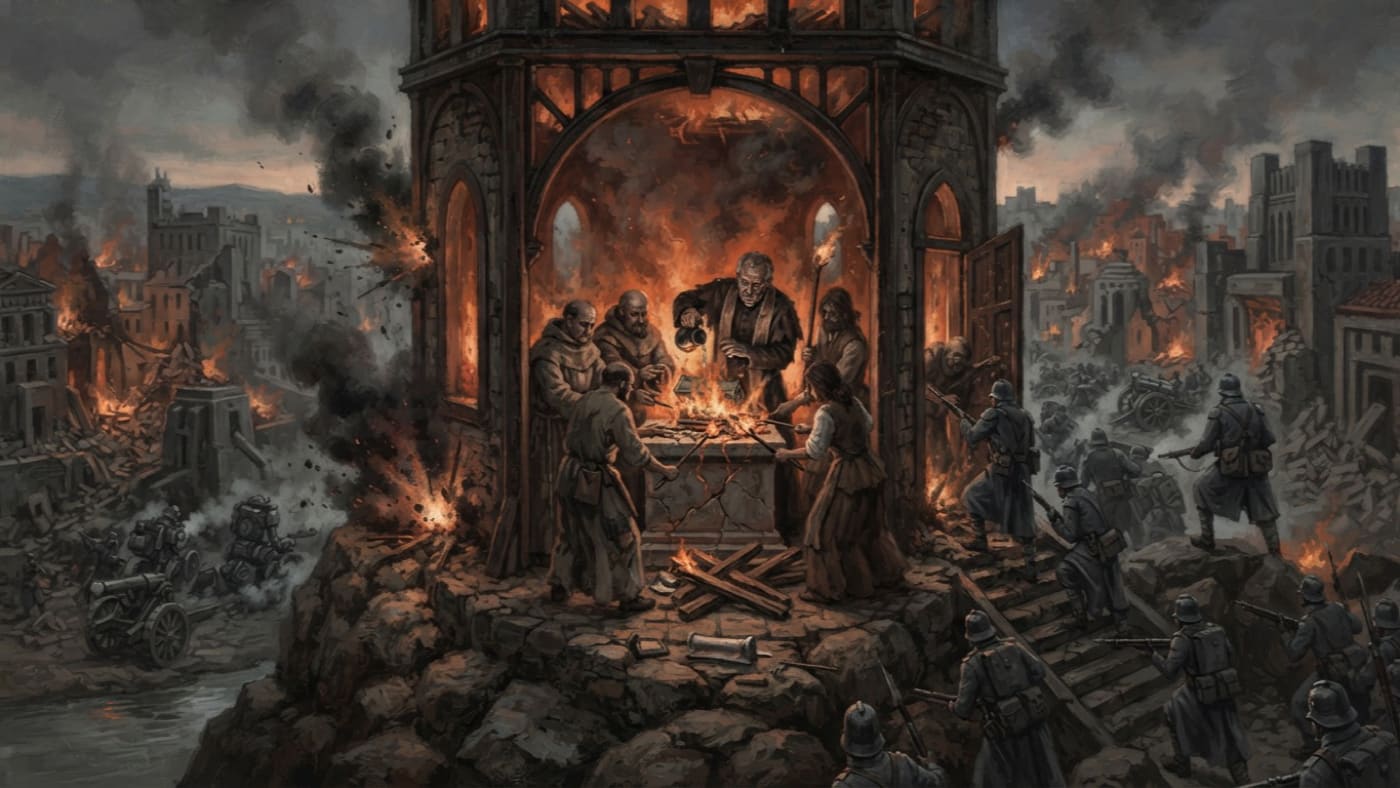
#On Custody at the Point of Capture
Heroic destruction is the Church's classification for a holy object burned, broken or otherwise unmade by the custodians sworn to keep it, at the hour an enemy is about to take it. Four conditions apply. The relic must have been entrusted. The enemy must be at the door, and the door must be failing. The act must be deliberate: a reliquary lost to a stray shell is a casualty, and the Bureau of Relics files it under damage with the other unlucky crockery. Last, and least comfortable for the dead, the Church must approve the act afterward. A custodian who burns a bone may be praised as a martyr or examined as a vandal. He will not be present for the ruling.
The governing argument is the distinction between possession and custody. The Bureau of Doctrine teaches it, and I have spent a career enforcing it against men who confuse the two. A custodian does not own the relic. He holds it for the Creator, for the saint, and for faithful not yet born. His duty is to keep it from capture, profanation, auction and study, and from the clean-handed reclassification by which secular clerks turn a martyr's jaw into a specimen. When the relic can no longer be kept intact, the duty does not lapse. It shrinks to the last form still available to the custodian, and at Toledo that form was fire.
#On the Toledo Case
The defining instance belongs to A.S. 15 / 1725 CE, in the middle of the Atheist Wars, at Toledo on its promontory above the Tagus. The Order of Saint Iago, an Iberian military-monastic order, held the city under Father Clemente de los Rios. In its care lay the Relic of Saint Iago, a jawbone set in silver and already scarred by the Desecrations. It had survived the First Relic Auctions of Amsterdam and the Bonfires of Purification, and it had served as a paperweight on a Rationalist prefect's desk in Córdoba until the Order took it back in A.S. 12 / 1722 CE by sanctified requisition. A relic with that history needs no theologian to explain what capture would mean. It had been captured before. It had been on the desk.
Colonel-Prefect Étienne Grimal came with two thousand Republican Guards and twelve clockwork cannon built to the designs of Lucien Artois. Against him stood three hundred clergy, forty-seven lay brothers, refugees no clerk counted honestly, and fourteen women of no recorded order. Their names have not survived. Their handling of oil was plainly trained. The Siege of Toledo lasted nine months.
On the seventh day of bombardment Clemente raised the Relic above the parapet and spoke the Psalm of Consuming. The received account reports three ammunition caissons destroyed and forty-seven artillerists dead. That blaze belongs to the Relic's military record and must be kept apart from what followed. In the first week the Relic burned the enemy. On the last day it burned itself. Doctrine prefers to say it consented to be burned, and I have learned to let Doctrine have its verbs.
The final assault came on 29 November A.S. 15. The Guards poured through the eastern breach into streets choked with pew-wood, tombstones and oil-fire. By dawn the defence had shrunk to one tower: Clemente, nineteen monks, six lay brothers, two of the unnamed women, and the Relic laid on a broken altar-stone. Clemente spoke the Psalm a second time. The tower burned with the defenders and the Relic inside it. Grimal took Toledo. He did not take the jaw.
#On What the Fire Preserved
A fire lit for holy reasons still behaves like fire, and it leaves ash. In the tower at Toledo it left ash, silver beads where the setting had run, and a blackened mandibular remnant. The Bureau of Relics rates that remnant probable and no higher. The rating annoys pilgrims who want certainty and preachers who want a better sermon. It stands.
The remnant is why the classification must be worded with care. Heroic destruction does not require every particle to vanish. It requires that the enemy be denied custody, and Grimal was denied it as thoroughly as any victor has been denied anything. He held the ground, the walls and the ruined tower, but the heap of material inside could not be carried off as a trophy, sold as a curiosity, or laid out for study as the intact Relic of Saint Iago. The object he had marched to seize no longer existed in any condition worth seizing.
Doctrine draws no further conclusion from the remnant, and I draw none either. The Toledo record does not show that holiness perished with the bone. It does not show that the blackened curve still answers prayer the way the jaw once answered artillery. Both questions remain in the file marked open. Engineering has never given a satisfactory account of either Psalm-fire, and I decline to write one for its convenience.
Several post-Concordat sermons claimed the Order hid the true fragment before the tower burned, so that the Relic of Saint Iago survives intact in some unnamed house.
Rejected. The Order preserved the Relic by refusing the enemy custody. The ash, the silver beads and the probable remnant are what the tower left. A hidden jaw would need a hidden courier, a hidden house and two centuries of hidden silence. The record supplies none of them.
#On Classification After the Event
No Bureau sat in Toledo in A.S. 15. The formal Synod would not exist until A.S. 90 / 1800 CE. When Clemente spoke the Psalm, the offices that now argue over his tower were scattered clergy and hidden chapels, or did not exist at all. He decided alone, under fire, with a rule forbidding surrender of relic custody to a secular hand and an enemy on the stairs. The classification came later. No document records when Doctrine first wrote "heroic destruction" into its teaching, and I will not invent a council to mark the occasion.
Doctrine now teaches the case under three heads: relic agency, siege obedience, and the distinction between possession and custody. Relic agency holds that the jaw took part in its own ending, as it took part in the caisson fire. That is Doctrine's teaching; the Bureau of Relics records it and declines to measure it. Siege obedience holds that a garrison's last duty may be to burn what it guards. The third head is the one that turns a burning tower into a precedent.
The Bureau of Relics keeps the material: the remnant, the beads, the provenance file, and the standing note that the bone was only ever probable. Given enough wine, its clerks will admit an embarrassment. The Church has approved an act of custody over an object it never fully verified. Doctrine replies that custody does not wait on authentication. A garrison under bombardment does not send for a provenance clerk.
The classification's value to the institution can be stated plainly. The Church lost Toledo, the Order and the jaw, and kept the precedent. A defeat in which the victor leaves empty-handed can be taught. A defeat in which he leaves with the saint cannot.
#On the Empty Setting
The later chapel at Toledo, on ground the Synod now holds as a martyr-city, displays an empty silver jaw-setting behind glass. It is blackened at one hinge. The Bureau of Pilgrimage administers the memorial. Pilgrims kneel before a mount with nothing in it, and Pilgrimage has priced the kneeling with theological sensitivity and commercial enthusiasm. I do not object. An empty setting teaches custody better than a full one. A full one teaches only that somebody was lucky.
A small custodial fraternity keeps lamp-watch beside the glass. Its members wear grey mantles with a red jaw-mark at the throat and claim descent from the Order of Saint Iago. The claim is contested. The fraternity's operational continuity is audited periodically by inspectors who leave satisfied and return anyway, since the Sundering taught the Church to distrust any satisfaction it has not paid for.
Modern reliquary custodians study the case as a lesson in final discretion. They are shown the empty mount, the hinge, the remnant's file and the date of 29 November, and they are asked whether custody survived Toledo. The approved answer is yes. The Bureau notes every custodian who gives a different answer. It watches more closely the ones who give the approved answer too eagerly.
The classification stands. The setting stays empty. The fraternity trims the lamp nightly, at its own expense.