
#On the Character of the Programme
"The Rationalists initiated desecration of sacred spaces. Initiation is guilt." — Draxian margin annotation, Codex of the Age, Folio I
There is a fashion, among the more craven historians of the Bureau of Records, for describing what the Rationalists did to the continent's sacred places as a sequence — a chain of regrettable episodes, each distinct, each explicable in isolation. This fashion is heresy in an academic gown. The Desecrations were a programme. They began with pamphlets and ended with pyres, and between the first and the last there runs a logic so consistent, so methodical, so cheerfully industrious in its blasphemy, that one might almost admire the organisational talent involved — if admiration were not itself a form of complicity that the Bureau of Purity punishes under Standing Order 14-A(Revised).
The programme operated in three phases, each building upon the last with the patient efficiency of a bricklayer assembling a wall. First: the erosion of credibility. Second: the seizure and liquidation of physical sanctity. Third: the theatrical destruction of whatever remained, staged for public consumption with printed programmes, assigned seating, and refreshments. That the Rationalists denied this was a programme — insisted, in their pamphlets and their minutes, that each act was a spontaneous eruption of Enlightened public sentiment — is itself the final proof of coordination. Spontaneity does not print programmes.
#On the First Phase: Ink Before Fire
The Desecrations did not begin with hammers. They began with arguments — which are, in the correct light, more dangerous.
The Year of Letters (–32 A.S.) was the Rationalist movement's first coordinated assault on the sacred, though the Rationalists themselves would have called it a triumph of reason. Scholars in Amsterdam — that city of canals and cowardice, where money has always found itself more comfortable than faith — distributed pamphlets across forty cities denouncing the Miracle of Saint Aldebrand as fraud. The pamphlets were technically sophisticated. They were also effective, which is the worse crime. Peasants who had kissed the reliquary at Vienna now doubted their own lips. Clergy who had preached the miracle now hesitated over their sermons. The Rationalists had discovered what every propagandist knows: that a lie repeated in sufficient volume acquires the texture of truth, and truth questioned in sufficient company acquires the texture of doubt.
By A.S. 5, the programme had graduated from paper to stone. Shrines burned. Relics were consigned to what the Rationalists called "purification" fires — a phrase they shared, we note with distaste, with the Bureau of Purity, though we employ ours with theological warrant and they employed theirs with an anatomy lecturer standing over the pyre explaining why saints' bones were structurally indistinguishable from those of pigs. Monasteries lost patronage. Priests were mocked in marketplaces, pelted with offal by crowds who had been praying at the same altars a decade prior. The speed of the apostasy was remarkable. Drax does not marvel easily, but the velocity at which the common man will abandon his inheritance when handed a pamphlet and a sneer merits scholarly attention, if only as a cautionary exercise.
The earlier Concordats of Ulm of 1655, fifty-five years before A.S. 0, had already subordinated theology in an academic compact. Later congresses and adopters extended that precedent. The compact is an intellectual precursor to the named A.S. 0–45 Desecrations, not an instrument first signed after A.S. 5. Its seal was a compass over a cross. Later Rationalist administrations repurposed religious spaces: monk's cell to faculty office, chapel to instrument store. Repurposing says: you were never sacred at all. You were merely real estate.
#On the Second Phase: Hands and Hammers
The friars were among the first to go bodily. The mendicants — those wandering vessels of prayer and stale bread — were expelled from France. They walked the roads until they vanished into the Ardennes. The Rationalists declared them "disbanded." The peasants whispered that their chants still echo beneath moss at dusk, and I confess the peasants are more often right than the Rationalists on matters of what does and does not persist.
By Lyon the programme showed its teeth. Friars were massacred in the marketplaces, their ashes carted to the Rhône. For three nights afterward, the river whispered psalms. Rationalist scribes attributed this to echo. I note only that the echo was, by all accounts, better catechized than most Rationalists and considerably more devout.
In Prague, the erosion became carnival. Students marched in secular processions, burning altars in the streets. Children were forced to the head of the column, chanting "Man Alone" — that bleak creed, that orphan's anthem, that declaration of cosmic solitude wrapped in a two-word slogan. One boy carried the skull of his grandfather as a banner. The Rationalists called it "anatomical demonstration." I call it what it was: a child turned into a weapon against his own dead.
In Iberia, the Bonfires of Purification stripped convents bare. Relics of saints were carried into plazas, heaped in piles, and burned while Rationalist lecturers delivered anatomical lessons over the pyre. The ashes were mixed with lime to plaster their lecture halls. The bones of martyrs ground into mortar so that students might scratch equations upon walls still reeking of incense. The mathematics, I am told, were excellent. The mortar held for fifteen years — precisely until the Sundering, when every wall plastered with saint-ash cracked simultaneously. The Bureau of Engineering insists this was structural failure. The Bureau of Doctrine insists it was judgment. Drax insists it was both.
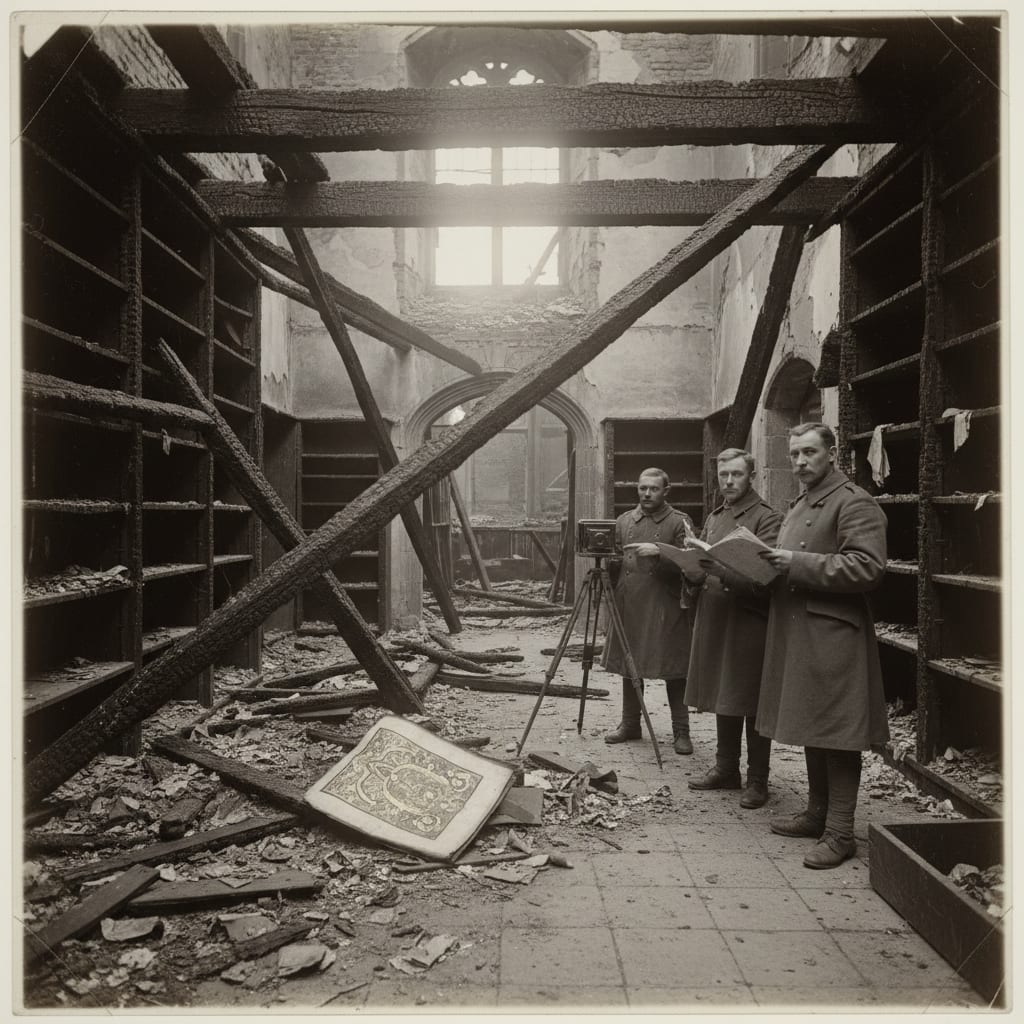
In Ghent, the scriptorium was barred, the monks locked inside, and the torches thrown through the windows. The Rationalist record lists the loss as "books: 7,212." The monks went uncounted. In this omission lives the entire philosophy of the programme: that the sacred thing — the prayer, the relic, the consecrated bone — was merely an object, and the man who tended it merely a custodian, and neither possessed value that the ledger of Reason was obliged to record. The Bureau of Records has since located the names of every monk who burned at Ghent. There were forty-three. Their names fill a single page in the Martyrology, and that page is edged in gold.
#On the Third Phase: Theatre and Silence
The Rationalists understood spectacle. This is their one talent the Bureau concedes without equivocation.
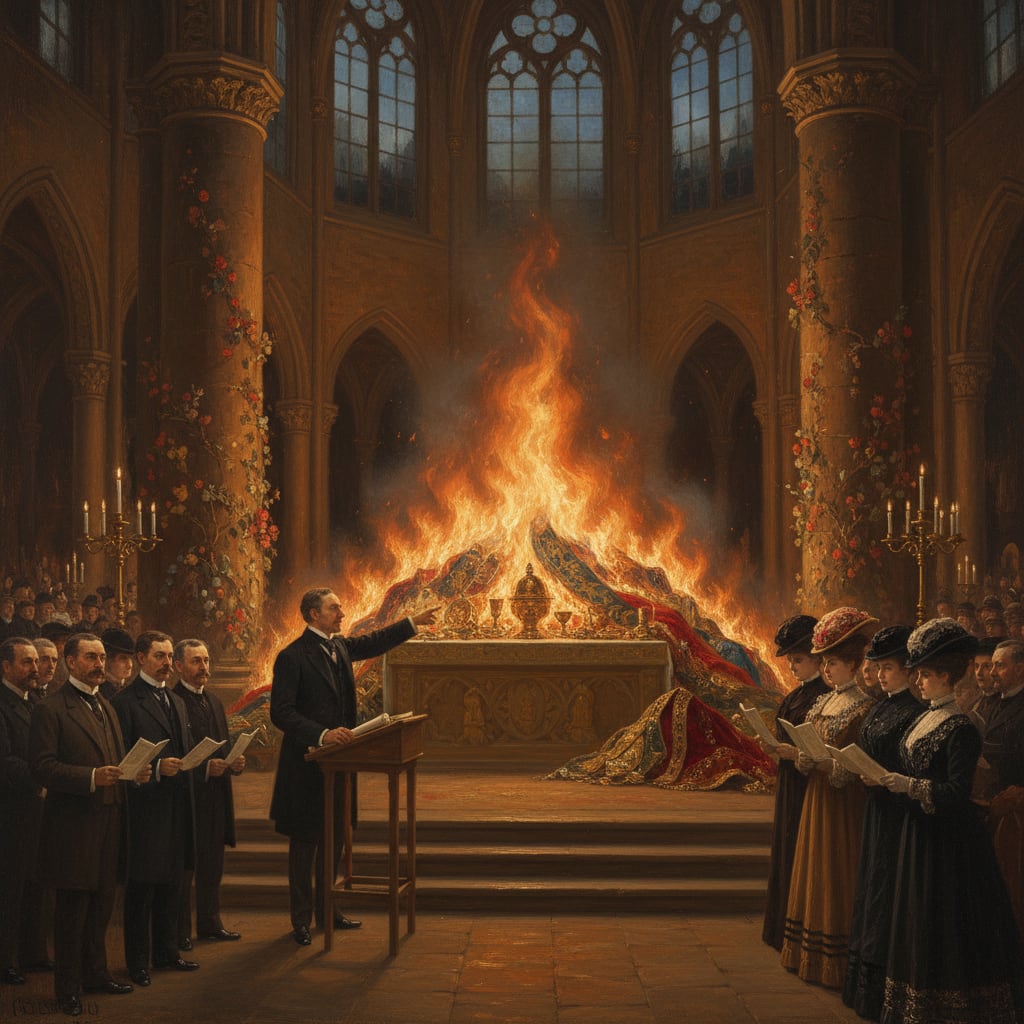
The Bonfires of Purification were staged with liturgical precision. Printed programmes announced the schedule. Seating was assigned — prefectural officials in the front rows, academy students in the middle, the public at the rear. Lecturers stood before the pyre and delivered orations on superstition while sacred vestments curled to ash behind them. It was ceremony stripped of its author and repurposed by his enemy. The Rationalists had not abolished ritual; they had stolen it and filed off the cross.
In Rouen, they orchestrated what their records blandly title "the Cauterization." The cathedral was gutted with fire — arsonists, the Rationalists claimed, though the witnesses swore the fire crawled up the nave like a living thing, pausing before each altar as though to memorize it before consuming it. Rouen's stones bleed soot in the rain to this day. The Bureau of Engineering calls this "mineral staining." The Bureau of Rites has declined to offer an alternative explanation, which is its way of saying that the alternative explanation is worse.
At Mainz, clerics were dragged into the square, nailed to oxen's horns, and the beasts loosed through the streets. The Rationalists recorded it as an "oxen panic incident." Even massacre disguised as agriculture. I doubt the oxen were persuaded.
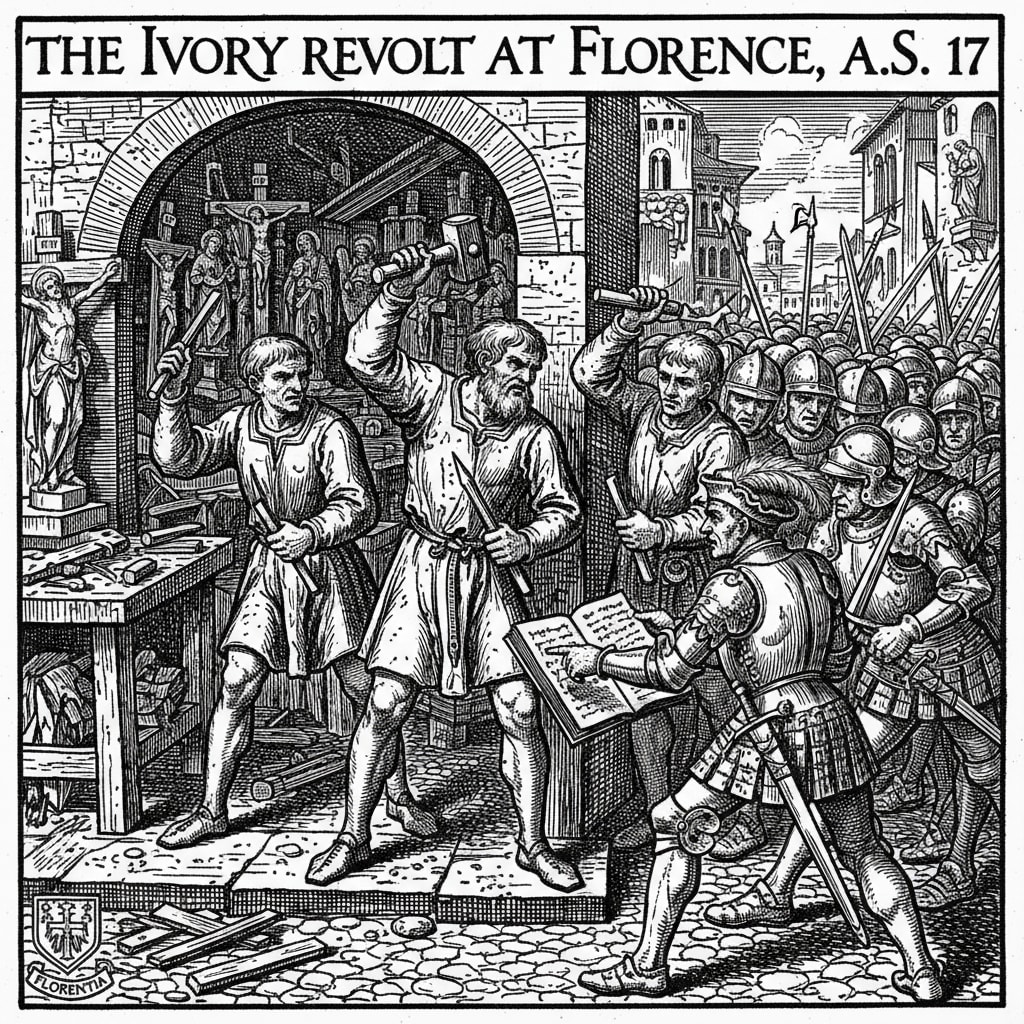
The faithful resisted where they could. In Florence, artisans rose in the Ivory Revolt when Republican Guards came to confiscate crucifixes from their workshops. They fought with chisels and awls, holding their ateliers like fortresses. By dawn every artisan lay dead and their crucifixes were piled in the square. The Rationalists called it "urban disorder." Florence calls it martyrdom. The chisels are preserved under glass in the Uffizi — or what remains of the Uffizi — and the Bureau of Relics has classified them "Instruments of Spontaneous Witness, Category Two," which means they glow faintly when handled by the devout and not at all when handled by anyone from the Bureau of Tithes.
Earlier editions of the Codex described the Desecrations as having concluded with the Treaty of Regensburg (A.S. 30).
This is imprecise. The Treaty did not end the Desecrations; it institutionalised them. Under the Rationalist Republic, the destruction of sacred property was no longer mob violence — it was policy, codified under the Edict of Rational Allocation, executed through Prefectural offices with filed reports, receipted confiscations, and notarised demolition orders. The programme did not stop. It merely acquired a budget.
#On the Scale and the Silence
The Bureau's count stands at over two thousand churches, monasteries, and shrines destroyed between A.S. 0 and A.S. 30. The count is conservative. It does not include wayside crosses torn from roadsides. It does not include household shrines smashed by neighbours eager to demonstrate their Rationalist sympathies. It does not include the uncounted icons scraped from plaster, the prayer-books burned in kitchen fires, the rosaries snapped and thrown into middens. The Bureau counts structures. It does not count faith, because faith — being immeasurable — falls outside the Bureau's ledger, and the Bureau does not acknowledge what it cannot stamp.
Bells were melted into cannon. Vestments were cut into curtains. Baptismal fonts were repurposed as horse troughs. Confessional screens were burned for firewood. Altar stones were prised from their consecrated settings and used to pave prefectural courtyards, so that Rationalist boots might tread upon the place where the Host had rested. This was done with intent. The Rationalists were not clumsy. They were meticulous, and their meticulousness is what damns them more thoroughly than any bonfire.
The named Desecrations ran from A.S. 0 to A.S. 45 — forty-five elapsed years, with earlier intellectual precursors. At the Sundering, central Rationalist command failed and surviving western offices persisted unevenly. Drax's account says the Republic had stripped away protective sacred spaces; that theological diagnosis should remain attributed rather than measured as a universal architectural fact.
The Cellar Saints preserved what could be preserved — relics smuggled in breadbaskets, icons wrapped in linen and buried in root cellars, prayers whispered in attics while the Rationalists patrolled below. That anything survived at all is due to the faithful who hid the sacred in the ordinary and called it survival. The Bureau calls it providence. I call it stubbornness dressed in liturgical vestments, which amounts to the same thing.
The Desecrations are not history. They are diagnosis. They tell us what happens when a civilisation decides that the sacred is merely expensive. The Rationalists weighed relics and found them wanting. The Sundering weighed the Rationalists and found them wanting. The symmetry is instructive, and the Bureau has filed it under "Providential Irony, Category One — Self-Inflicted."