
#On the Under-Gate
"The best place to buy a new life, if you can stand the line." — Underworld appraisal of Griefgate, recorded without attribution, which is how the underworld prefers to be recorded.
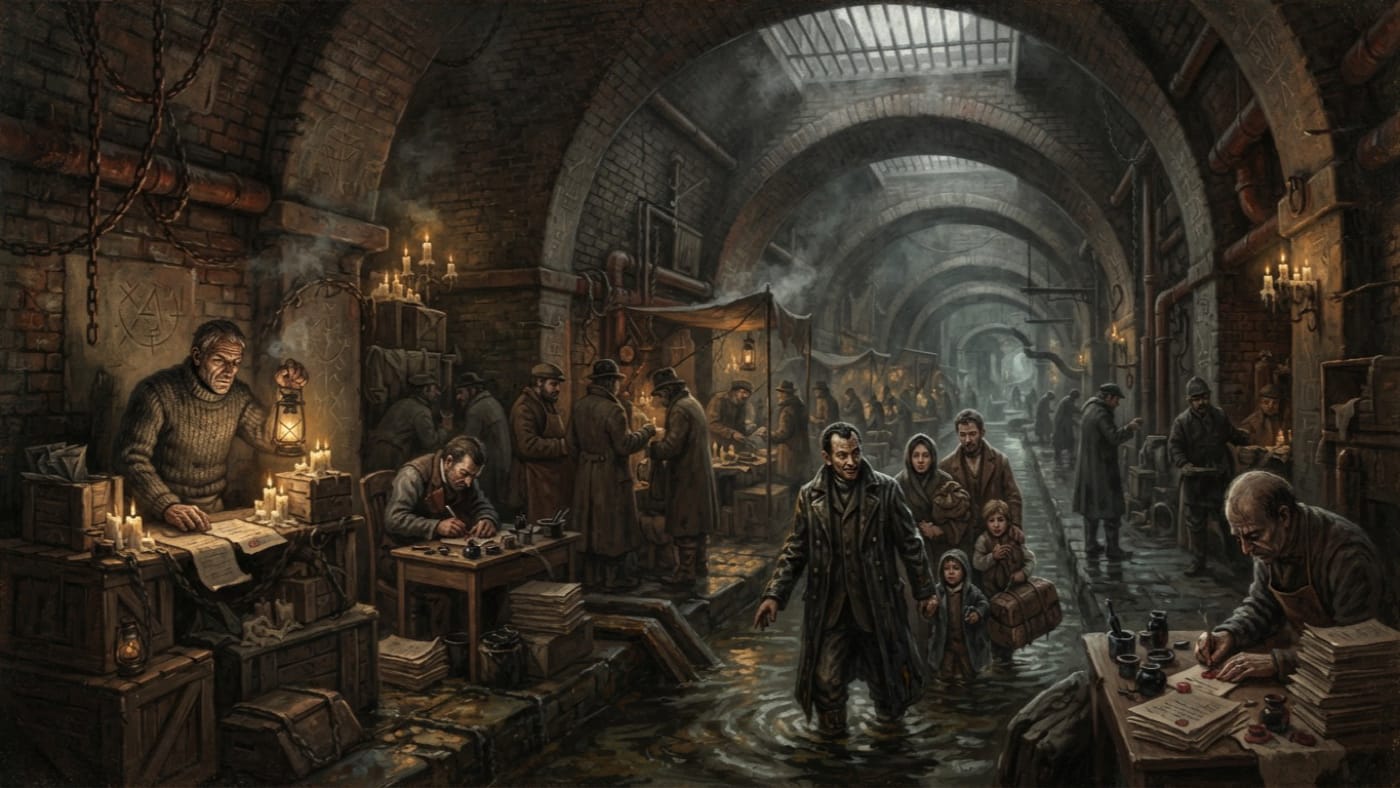
Griefgate has two floors. The upper floor belongs to the Widow's Pennies Exchange: three arches of black stone thrown across a chalk defile of the Pilgrim Roads, the three lanes of Coin, Confession and Cargo, brass scales in the hall beneath the central arch, and a queue that the Bureaucratic Synod counts among its finer instruments of government. The lower floor is water. Romans cut drainage culverts beneath the arches, the centuries widened them, and the widened space filled in the way empty space in a gate-town always fills, with people who have something to sell. The traders call it Culvert Market, though nobody ever entered it in a charter.
No survey of it sits in any office I am permitted to open. I will not draw it from imagination.
Wet brick, black stone footings, iron chain rusted to the colour of old blood, sluice gutters running the length of the floor. The light comes from tallow and from whatever grey the gratings let down, and it never rises above twilight. The Exchange smells of ink and metal. The market smells of river slime and smoke. In the spring rains the runoff stands at the knee, and a flash flood in the defile can fill a culvert faster than a laden pilgrim can turn round. Above ground Griefgate kills by crush, and below it the water does the work.
At curfew the surface crowds are herded into the sanctioned inns and the lanterns on the arches turn inspection white. From then until dawn the culverts are the only part of Griefgate still moving.
Two neighbouring drains should be kept out of the market's account. The Grief Lane, the side culvert where the Gate stores visibly mourning travelers until they are quiet enough to process, belongs to the Gate's own procedure, whatever its masonry has in common with the market. The subsurface chambers that Gate-Canon Meral Voss is reported to have sealed have never been shown to open onto any stall.
#On the Paper Trade
The Gate produces delay, and delay makes paper valuable. In Griefgate a fortune is a clean seal, a fast lane ticket, a credible witness, a grief-story that balances. The Exchange sells these at its counters, slowly and at assessed rates. Culvert Market sells them in the dark, faster, at whatever the buyer's face will bear.
Three kinds of paper move through the market, and a buyer who confuses them deserves what he gets.
The first is the genuine indulgence slip: heavy paper, the Gate Chapter's seal in red wax, the confession clerk's mark in black. Freshly stamped, it carries its holder through the checkpoints of the Pilgrim Roads for thirty days. Since about A.S. 199 these slips have changed hands as a second currency. The Bureau of Records holds that a Synod seal keeps its doctrinal validity however many hands it passes through. The Bureau of Purity holds that Records should mind its own stamps. The market trades on the first opinion and lives in fear of the second.
The second is the blank: unstamped paper of the correct weight and weave. It has no authority until wax is pressed onto it, and the wax is where the seal-forger's craft begins and where most of its failures end.
The third is the finished forgery. Lane tickets, slips, fake seals, witness affidavits. A smudged seal on any of them earns a conversation with an inquisitor that no traveler wants.
Then there are the witnesses, who will swear to a grief-story for the price of a meal, and the sellers of culvert maps, and the sellers of names. No tariff governs any of it. Payment is in whatever passes on the surface: coin, stamped paper, ration chits, oath-notes, the slips themselves.
#On the Passage Sellers
Paper is for the traveler who still means to face a clerk. The rest buy passage.
The culvert guide is the market's oldest trade, and the surface proverb says he knows the under-gate by smell. Many guides answer, or are said to answer, to the Culvert Choir, the smuggler ring whose territory this is. The Choir moves people and contraband beneath the arches by tunnel, fake seal and the disguise the culverts call borrowed grief: a traveler dressed and rehearsed until his sorrow matches the grief-tables above. No sorrow changes hands in the process. The Choir's public position is that it does not exist. It has no recorded founder or leader, no charter and no roll, and its name has never been shown to involve singing. Its fee varies with the desperation of the client, which means the price has been read off the client's face before anyone says it aloud.
The Choir does not own the market. Witness sellers, forgers, coin-biters and the class the surface calls culvert rats trade beside it, and no record binds them to it. Some are surely its servants. Some are surely its competitors. Some will be the inquisitors' informants by Thursday.
Every price in the culverts is set upstairs. When Voss calls a doubt-week, the queue stops and passage becomes the only thing anyone wants to buy. Each day the Broker Compact holds a lane closed for profit is advertising the market never paid for. The Assayers of the Bitter Scale under Master Assayer Tinn Halve can freeze all coin by declaring a taint, and on any day they do, the market's only usable currency is its paper. Arbiter-Widow Solenne's grief-tax rulings decide what a story must contain to balance, and so what a hired witness must remember. The Rope Saints sell places and silence in the line above. The guides sell the space beneath it.
No document shows an agreement between any of these authorities and the culverts. None has ever needed one.
#On the Name That Follows
The market's merchandise divides into two classes. One class moves a body under the arches. The other is meant to change what waits for that body at the next checkpoint. The first can be bought. The second can only be attempted.
At the Kneel-Sheds, clerks compare each traveler's story with his papers, appearance, companions, destination and the confessions already filed along the road. A story that agrees with all of them is a story-fit. One that does not raises a doubt flag, and the flag attaches to the name and goes with it through every checkpoint until it is resolved or the traveler stops travelling. Once flagged, a traveler cannot buy clearance at any price, above the arches or below them. A flagged woman who comes out of the culverts east of Griefgate is still flagged, and now she has an unlawful crossing on her record as well.
So some customers try to leave the name behind. Name-swaps are sold in the market, and every one of them is a fraud. Whether it holds depends on what the next station remembers and on what the Index Damnatus runners are carrying. Those couriers take prohibitions and revoked identities from gatehouse to gatehouse, and they are faster than any pilgrim. The Great Ledger has never been shown to forget a name because a stranger in a culvert was paid to.
A genuine indulgence slip purchased in Culvert Market carries its holder the same thirty days as one purchased at the Exchange counter.
The thirty days run from the stamping, and resale does not renew them. A slip that has passed through four hands since its wax set has spent part of its term in each of them. A forged slip carries no term at all and lasts until the first clerk doubts it. The earlier assurance confused the price of the paper with its worth. The Bureau regrets the confusion and does not regret anything else.
A darker rumour runs through the culverts: that the Exchange manufactures guilt, seeds false confessions into the Ledger, and writes flags before the traveler ever kneels. It is also whispered that some ledger of this kind frightens Blue Veil. The surface ledgers deny all of it, and I have found no document in the market that proves any of it. If even part of the rumour is true, some of the market's customers are running from a bill they never ran up.
#On the Marks and the Water
The routes are marked in bone. One account speaks of a tunnel map carved in bone, and my own earlier account placed the notation on the culvert walls. Both agree that bone is involved, and the Choir has not offered to settle the rest. When the Bureau of Bells examined a sample, it classified the marks as non-linguistic, which places them outside the Index Damnatus. That ruling concerns grammar. It does not make following the marks lawful.
The arches also carry the anomaly. The Bells confirmed the grief resonance in A.S. 143 and reclassified it in A.S. 187 as Category Two Ambient. When the sorrow in the crowd above grows thick enough, wax will not set, coins tarnish, bells ring flat, and travelers lose their own names in the middle of a sentence. A forger's seal smears under it exactly as an honest one does. This is the only point of doctrine on which the Exchange and the market have ever stood equal.
What the stone does with the grief, the Bells have not said. Nor will I.
#On the Present Traffic
In A.S. 201 the market is busy. Peak-season queues above it run to three days, and the Holding Pens have been enlarged twice in two years. Every new restriction at the arches sends more custom below, and the blank-slip trade is the most profitable line in the culverts. The Gate Chapter knows this, and so does the Broker Compact. The Bureau of Purity sent an investigative cell, which arrived in A.S. 200 and recommended further observation. Observation continues. No culvert has been cleared.
Some travelers coming east from the Choir-Broker Hall of Peregrine Row, one to two days back along the mule-road, arrive believing the two markets are one concern. Peregrine Row keeps its own cistern-tunnel trade. No tunnel and no ledger connects the two.
The pilgrim pays the guide, wades the dark, and climbs out east of the stone with wet boots and a dry slip. Thirty paces on, the next clerk opens the Ledger at his name.
Aqua transit; nomen manet.